
Throughout his career, J.J. O’Hanlon would send a selection of his game scores to the editors of Irish chess columns, frequently with his own annotations appended.
Here we present the result of one such offering, as described by T.P. Donnegan of the Evening Herald, and spread out over two successive issues of his column therein.
Mr. O’ Hanlon has been good enough to favour us with a couple of his games (together with his own annotations) played at the Cambridge Easter Tournament. One of them is of much importance; it breaks fresh ground in the [Nimzo-Indian Defence] and is likely to become a new headline in this variation.
John James O’Hanlon – William James Fry
Cambridge Major A Cambridge (Round 2), 28th March 1932
[Annotations by O’Hanlon; notes in italics are based on analysis by Stockfish 14]
1.d4 Nf6 2.c4 e6 3.Nc3 Bb4 4.g3
This move was suggested to me by Dr. Euwe, the Dutch champion, who thought it might prove to be the best way of meeting the Niemzowitsch defence. The object is to try and hold the centre, and White plays consistently for this purpose throughout the game. I am not aware if the move had been previously tried in tournament play.
4…d5 5.Bg2 0-0
If 5…dxc4 6.Qa4+ wins a piece; and if Black captures the pawn at the 6th or 7th move, then White plays Ne5 recovering the Pawn.
6.Nf3 c6 7.0-0 Nbd7 8.Qb3 Bxc3 9.bxc3 Re8 10.Nd2 dxc4 11.Qxc4
White could have prevented 11…e5 by 11.Nxc4; if 11…e5 12.Nd6 Re6 13.Ba3 threatening to win the exchange by 14.Bh3. But instead of 11…e5 Black could have played 11…c5 and it was to prevent this move that White played 11. Qxc4.
11…e5 12.e4 Nb6 13.Qd3 exd4 14.cxd4 Nfd7 15.Qc2 Nf8 16.Bb2 Ne6 17.Nf3 Nc7 18.a4 Be6 19.Nd2 Qd7
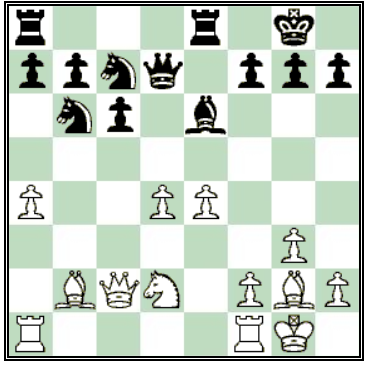
20.Rfe1
In order to be able to play 21.Bh1 if Black offered the exchange [of bishops], but it would have been better to have first played 20.a5 driving back the Knight and prevented the development of Black’s a8-Rook. The neglect to play 20.a5 allows Black to get up an attack.
20…Rad8 21.f4 f6 22.Rac1 Na6 23.a5 Nc8 24.Red1 Nb4 25.Qb1 Ba2 26.Qa1 Qf7 27.Nf1 Bb3 28.Rd2 Nd6 29.Qa3 Na2 30.Re1 Nb5 31.Qc5 Qc7 32.Re3
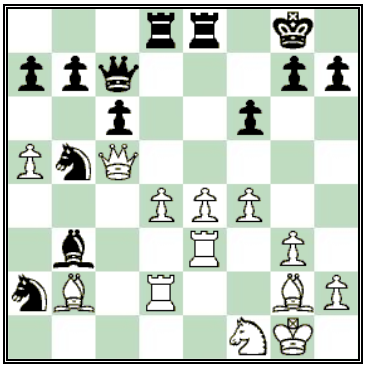
32…b6
Best! If 32…Bf7 33.d5! Qxa5 (if 33…cxd5 34.Qxc7 Nxc7 35.exd5 and the passed pawn would win) 34.Ra3 wins a piece.
[However Stockfish provides a way out here with 34…Qb4 when, to avoid a worse game White must play 35.Qxb4 and then the Knight escapes after the recapture 35…Nxb4.]
33.axb6 axb6 34.Qh5 Bf7 35.Qf3 Nd6 36.e5
The ending is very interesting, and it will be found that White wins in every variation.
36…Nc4 37.Qxc6 Qxc6 38.Bxc6 Re7 39.d5 Nxd2 40.d6
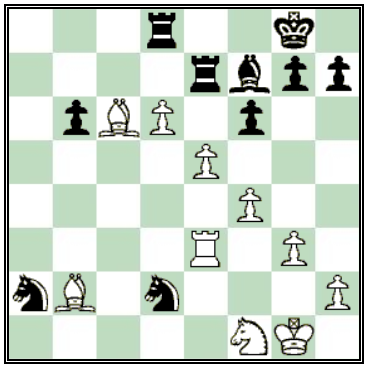
40…Rxd6
White expected 40…Nxf1 41.dxe7 Rd1 when the problem-like move 42.Ra3 wins.
[However Stockfish suggests instead 40…Re6! 41.Nxd2 Rdxd6 42.exd6 Rxe3 and a probable draw with best play.]
41.exd6 Rxe3 42.Nxe3 Nb4 43.Bb5 Be6 44.Bc3 1-0
[Source: Evening Herald, 30th April 1932, page 13]
The other game … is one with the blind player, Rupert Cross, who, Mr. O’Hanlon says, possesses great chess talent. He plays entirely by touch on a special board for the blind.
John James O’Hanlon – Rupert Cross
Cambridge Major A Cambridge (Round 4), 30th March 1932
[Annotations by O’Hanlon; notes in italics are based on analysis by Stockfish 14]
1.e4 e5 2.Nf3 Nc6 3.Bb5 a6 4.Ba4 Nf6 5.0-0 Be7 6.Re1 b5 7.Bb3 d6 8.c3 0-0 9.h3
Often played at this point, but 9.d4 at once is probably better.
9…Na5 10.Bc2 c5 11.d4 Qc7 12.Nbd2 Bd7 13.Nf1 Rfc8 14.Ne3
Black threatened to win a pawn, but as deployment if the Knight at g3 is desirable it might have been better to play 14.Bd3 or 14.d5
14…Bf8 15.Bd2 g6 16.Qe2 cxd4 17.cxd4 Nc6 18.dxe5 dxe5 19.Bb3 Rab8
If now or at the next move Black plays 19…Nxe4 then 20.Nd5 wins.
20.Rac1 Qd8 21.Nd5
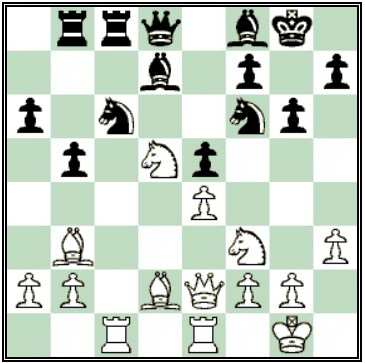
21…Nxd5 22.Bxd5
White, who was paying more attention to the blind player’s clock than his own, was getting short of time and completely overlooked that he could probably have won by 22.exd5 Nd4 23.Nxd4 exd4 24.Bf4 followed by 25.Be5. After this let-off Black plays accurately to a draw.
22…Bg7 23.Bg5 Qe8 24.Be3 Be6 25.Rcd1 Nb4 26.Qd2
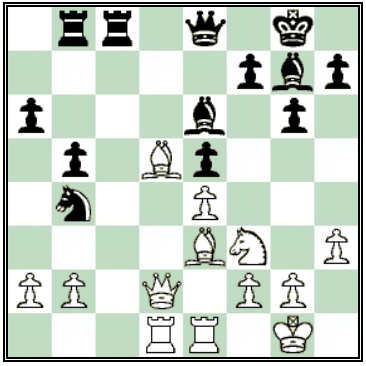
26…Bxd5 27.Qxb4
[A mistake; the correct capture would be 27.exd5.]
27…Be6
[Missing 27…Bf8 and the attack on the White Queen would allow Black to win the e4 pawn next move.]
28.a3 Rc4 29.Qa5 Qc6
[A serious mistake; with this move, Stockfish’s assessment goes from the game being equal, to White having a decisive advantage.]
30.Rd8+ Rxd8 31.Qxd8+ Bf8 32.Bh6 Qc8
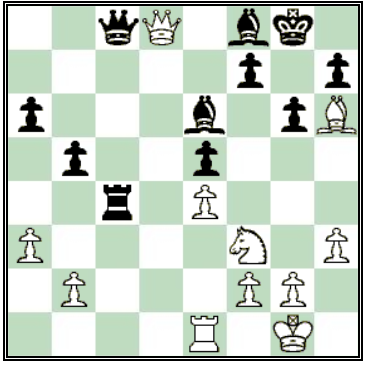
33.Qxc8
[Forcing off all the major pieces with 33.Rd1 Qxd8 (or 33…Rd4 34.Rxd4 exd4 35.Qxf8+ Qxf8 36.Bxf8 Kxf8 37.Nxd4) 34.Rxd8 Rc8 35.Rxc8 Bxc8 36.Bxf8 Kxf8 37.Nxe5 leads to a clearly winning ending, whereas in the game continuation Black’s active Rook provides compensation for the lost e5-pawn.]
33…Rxc8 34.Bxf8 Kxf8 35.Nxe5 Rc2 36.Nd3 Bc4 37.Nb4 Rxb2 38.Nxa6 Ra2 39.Re3 ½-½
[Source: Evening Herald, 7th May 1932, page 13]
Until now, both games do not appear to have found their way into the modern databases. Click the links for the playable games of O’Hanlon -v- Fry and O’Hanlon -v- Cross.
Cambridge Major Open A: Final Crosstable
                    G K C D O F M R Pts
1=2. H. Golombek    x 1 = = 1 1 = 1 5.5
1=2. G. Koltanowski 0 x 1 = 1 1 1 1 5.5
3.   A.R.N. Cross   = 0 x = = 1 1 1 4.5
4=5. L.C.G. Dewing  = = = x = 0 = 1 3.5
4=5. J.J. O'Hanlon  0 0 = = x 1 = 1 3.5
6.   W.J. Fry       0 0 0 1 0 x 1 = 2.5
7=8. A.J. Mackenzie = 0 0 = = 0 x 0 1.5
7=8. P. Reid        0 0 0 0 0 = 1 x 1.5