Last weekend, Lichess announced a new partial 8-piece tablebase “Op1”, containing all positions in which at least one pair of opposing pawns face each other on the same file.
The tablebase can be searched on line using the Lichess analysis board, among other ways, by replacing the FEN strong below the diagram with the string for the position to be searched. (The Nalimov endgame tablebase page at the Knowledge4IT web pages provides one easy way to generate FEN strings.)
Every advance in tablebases produces new, hard-to-fathom records for long and difficult wins. The position in the link above shows a win in 584 moves. Of course, this is of strictly theoretical interest, as it requires ignoring the 50-move rule.
These theoretical records usually involve exotic positions that have never arisen in actual games, even in plausible variations. Searching databases for actual games will probably yield much more prosaic results.
In any case, I can report the impact on Irish games. After some processing, I can say that the ICU games archive, as of February 5, contained 4,642 games containing at least one position covered by Op1, either in the game or in a variation. Many of these positions are trivial in various ways: some (actually 1,643) immediately transition to a simpler ending or appear after the last move of the game, some involve players playing on in utterly hopeless positions (example, after 38W), and some involve futile efforts to squeeze a win out of a drawn position (example, after 69W).
The top ten material balances encountered, in descending order of frequency, were:
R+2P-v-R+2P: 708
R+3P-v-R+P: 522
3P-v-3P: 498
4P-v-2P: 251
B+2P-v-3P: 142
B+2P-v-B+2P: 134
R+2P-v-B+2P: 124
B+2P-v-N+2P: 118
N+2P-v-3P: 114
R+2P-v-3P: 110
But Op1 did provide some revelations.
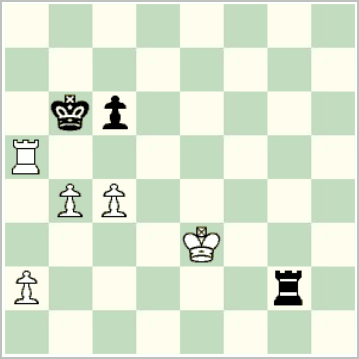
40… ?
Drawn with best play
The EEC Team Championships were very strong events, with a much smaller ‘tail’ than Olympiads. In the third and last of these, in West Berlin in 1980, Anthony McCarthy of Cork was defending the position above against Louis Roos of France.
Though White is two pawns up, Lichess Op1 shows that the game is drawn with best play. It is not that straightforward, though, and both players went astray in the sequel.
After 40… Rb2 41. Ra4 Rh2 42. Ra8 Kb7 43. Ra5, McCarthy’s 43… Rh4? was wrong; 43… Rh3+, 43… Kb6, and 43… Kc7 were the only moves to hold the balance. In turn, Roos’ reply 44. Kd3? was wrong; 44. Rc5! was the only winning move. The evaluation stayed the same until move 54, when McCarthy erred, allowing Roos to regroup on the queenside and win.
[Click to replay the full game.]
Here is another Irish game for which Lichess Op1 has something to reveal:
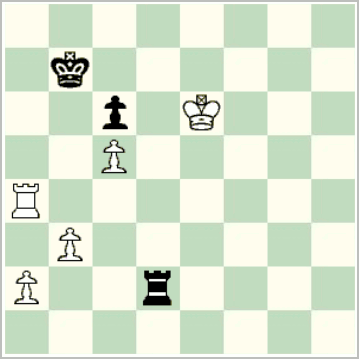
61… ?
Drawn with best play
Déjà vu; this is almost identical to the position above. Once again, Lichess Op1 shows that this is drawn with best play, and once again each player goes astray in the sequel. The reader is invited to work out why various moves are or are not correct; it doesn’t seem at all straightforward.
John Delaney’s 61… Rd5? was wrong; 63… Rc2, 63… Re2+, and 63… Kc7 were the only moves to preserve a draw with best play. After 62. Rb4+ Kc7 63. Rc4 Rd2, Colm Daly erred in turn with 64. Ra4?; 64. a4! (only move) wins. The evaluation changed twice more, and the game ended in a draw.