
On the 25th of August 1969 Albert Long, Honorary Secretary of the Ulster Chess Union, wrote to Brenda Kerlin about her brother Gerard.
In the letter, by way of introduction, he indicated that he had been given her address by Paul Cassidy, the Honorary Secretary of the Irish Secondary Schools’ Chess Council, and the letter proceeded as follows:
An Ulster boy (D.C. Wilson of Methodist College, Belfast) is the present holder of the “Gerard Kerlin Memorial Trophy” a silver Cup which was presented in 1948 and which has since been successively competed for and won by 10 Dublin, one Cork and 11 Belfast boys.
I am keeping a record of Chess Events and include, if possible a photo of the remembered one, a description of the various Trophies, with information about the circumstances of their donation.
I am writing now to ask you if you could let me have a photograph of Gerard Kerlin, taken about 1948 or thereabouts, so that I can have it copied.
I will return it carefully to you.
I would like also some biographical details if you could supply them, such as – Parents’ names, place of birth of Gerard Kerlin, date, school, and if dead, date and place of burial.
On the 13th of October 1969, Miss Kerlin replied providing a number of biographical details and enclosing four newspaper cuttings and a photograph. Albert Long was as good as his word, because on the 2nd of December Miss Kerlin wrote again thanking him for returning the cuttings and a photographic negative and providing some further information that Mr. Long must have requested. One important point she confirmed was that her brother’s first name was Gerard and not Gerald, the latter spelling having been given in at least one of the cuttings.
Here is the entry for Gerard Kerlin in Albert Long’s Archive:
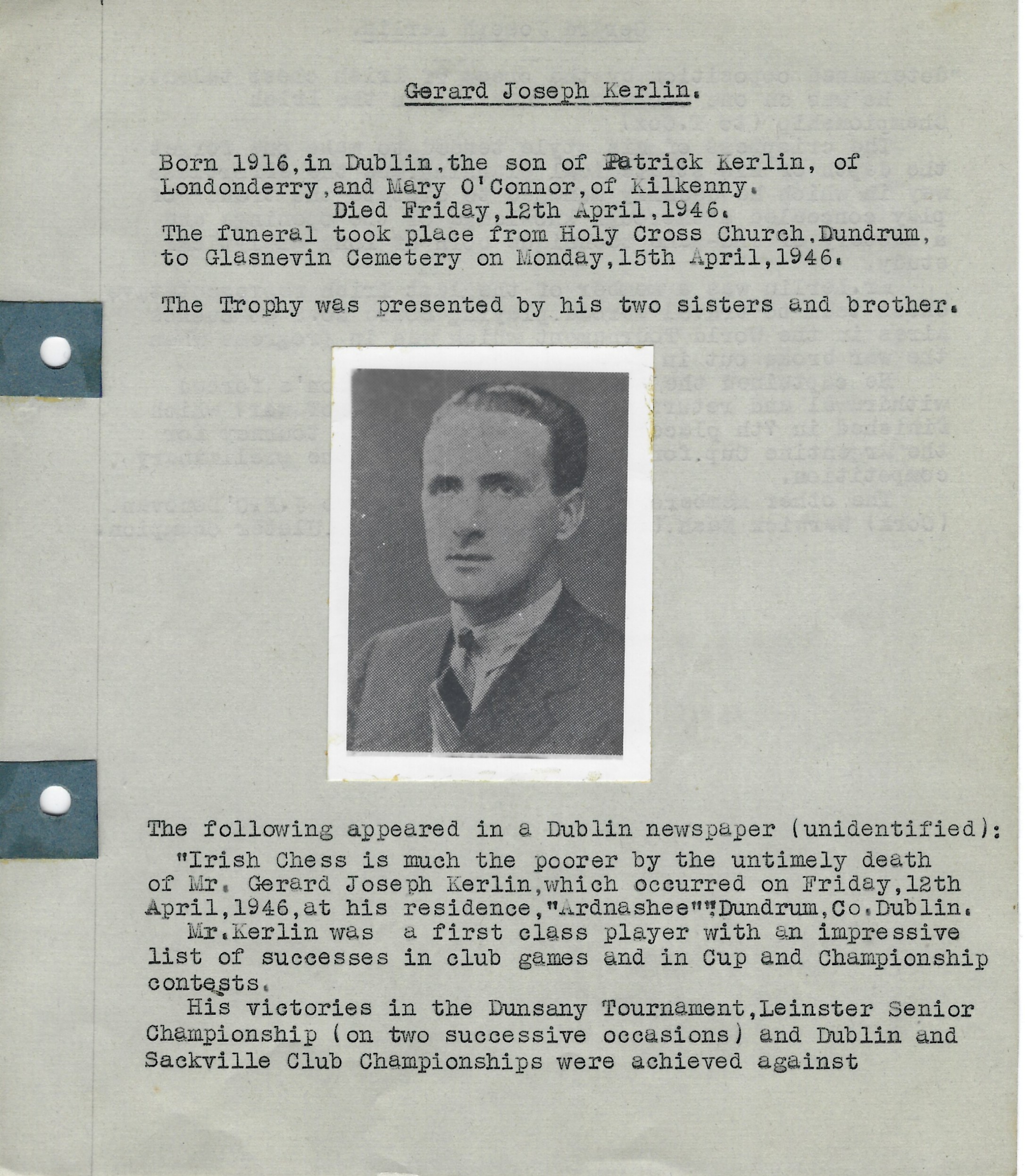
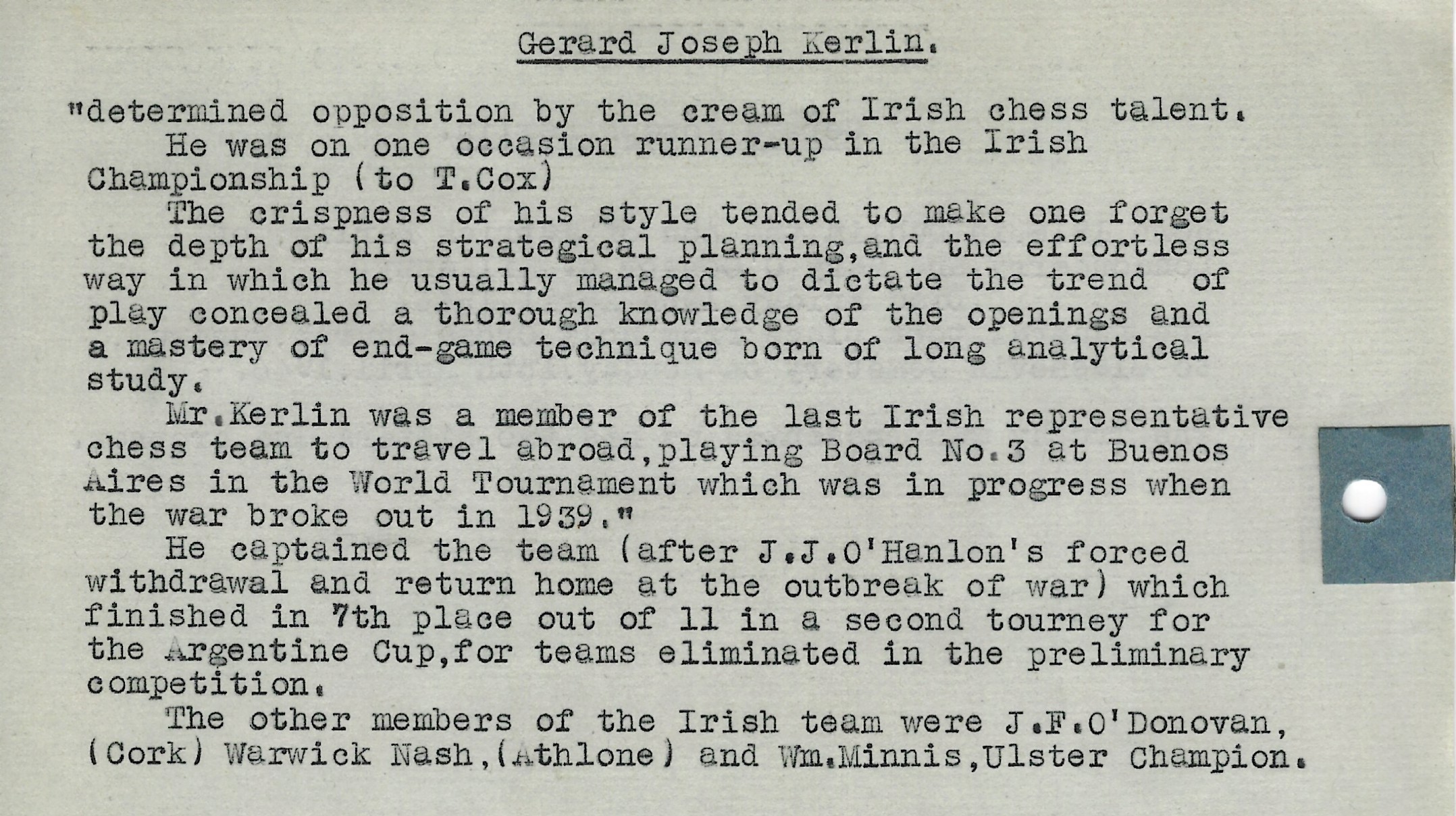
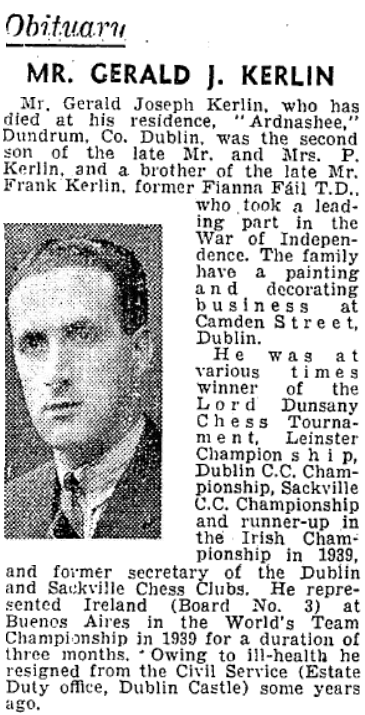
I have also not been able to identify the source of the newspaper cutting referred to in the Kerlin profile but there was also an obituary in the Irish Press, which contains some further biographical information, but it has an incorrect rendering of his first name. [Irish Press, 15 April 1946, page 11]
 The chess column in the Evening Herald (edited by T.P. Donnegan) periodically included photo-biographies of the players who competed in the newspaper’s correspondence tournaments. Kerlin was profiled in the column for the 11 of September 1937. Perhaps this was one of the cuttings that his sister Brenda sent to Albert Long. The text follows below:
Mr Gerard J. Kerlin learnt Chess from his brother, the late Frank Kerlin, T.D. and became a member of the “Evening Herald” circle. So rapid has been his progress latterly that this year saw him well in the running for the Irish Championship. Has a decided bias towards Gambit play, in the intricacies of which he seems to revel.
A couple of years ago he joined the “Sackville,” which, although loaded with years of Chess honours, and notwithstanding its comfortable quarters in the Civil Service Club, Harcourt Street, was then in rather low water, due to losses in the course of nature of some of its leading players. G.J.K. was at once made Hon. Secretary, with the happy result that, through his energy, a rejuvenation of this celebrated old club has been effected.
The short-lived magazine Irish Chess presented extensive coverage of the 1937 Irish Championship (mentioned above by Donnegan) and here is one of Kerlin’s wins from the event with his own annotations.
G.J. Kerlin (White) – J.D. Peebles (Black)
Irish Championship, Dublin (Round 1), 24 May 1937
[Source: Irish Chess, July 1937, page 12]
1.d4 d5 2.c4 e6 3.Nc3 Nf6 4.Bg5 Nbd7 5.cxd5
Simplifying. Releases the tension in the centre and declares for wing attacks.
5…exd5 6.e3 Be7 7.Bd3 0-0 8.Qc2 c6 9.Nf3 Re8 10.0-0-0 Ne4?
This is premature and loses a pawn. Probably best is 10…Nf8 followed by b5, etc.
11.Bxe4 Bxg5? 12.Bxh7+ Kh8? 13.Bd3 Bh6 14.g4 Qf6 15.Be2 Nf8 16.Rdg1 Ne6 17.h4!
It is practically impossible to find a defence for Black.
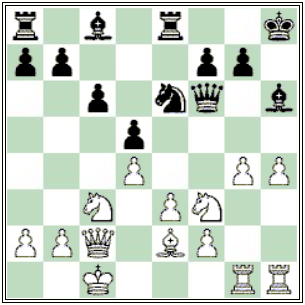
17…g5 18.hxg5 Nxg5 19.Nxg5 Qxg5 20.f4! Qf6?
But this loses a move. 20…Qg7 at once was better.
21.g5 Qg7 22.Rxh6+ Kg8 23.Rgh1 Rxe3 24.Qh7+ Kf8 25.Qh8+
With White a piece up this is probably the simplest.
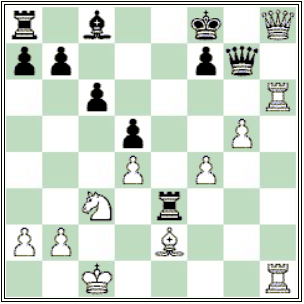
25…Qxh8 26.Rxh8+ Ke7 27.Kd2
27.Bg4 at once, winning the exchange, is stronger.
27…Rg3 28.Rg8 Rg2 29.Rhh8 Kd7 30.Rf8 c5 31.Rxf7+ Kc6
31…Ke6 would hold out a trifle longer. 32.Rc7 and if 32…cxd4 33.Rh6+ followed by mate. Therefore 32…Kd6 33.Rcxc8 and Black is two pieces down.
32.Rh6+ 1-0
[Click here to replay the game]
In the obituaries quoted above, mention is made of Kerlin’s victory in the Dunsany Tournament, which I wrote about 10 years ago (doesn’t time fly?) and there is a strong argument to be made that this was his best career tournament performance. But there is a rival candidate – a forgotten tournament, it seems, even at the time of Kerlin’s death four years later.
Champions’ Chess Tourney 1942
The name of this tournament had a number of variations. The alliterative Champion’s Chess Competition was also widely used. However both these versions were more descriptions of the event than titles, and in its “Sports Records of the Year” (on page 4 of its 30 December 1942 edition) the Irish Independent used the version O’Hanlon Premier Tourney.
On page 4 of the Irish Press for Saturday the 3rd of October 1942 was this announcement:
A CHAMPIONS’ TOURNEY
A novel tournament will commence next Monday at the Dublin [Chess] Club and will be continued Mondays and Thursdays throughout this month and next for prizes presented by Mr. O’Hanlon.
The entries are the following champions or former title holders – J.J. O’Hanlon (Irish), C. Barry (Leinster), T. Cranston and B. O’Sullivan (ex-Irish), G. Kerlin, J. Gerrard and R. Varian (ex-Leinster) and A. Bourke (Munster).
To this preview, we can that the format of the tournament would be a double-round all-play-all.
The Champion’s Tourney had a stronger cast that the 1940 Irish Championship, which was missing the 1939 Champion Barney O’Sullivan and two-time winner T.G. Cranston. It was also arguably slightly stronger than the previous year’s Dunsany Tourney (won by Kerlin) which did not have O’Sullivan in the field. The double-round format could also be said to be a better gauge of the absolute strength of the participants.
The press reported that Ralph Varian had “resigned from the tournament” prior to Round 4. His first round game against Bourke had been postponed and then he had sustained losses to Barry and O’Hanlon. Instead of his results being cancelled, players received a walkover point for the originally scheduled games against Varian. Of course, it made no practical difference.
The standings at the end of the first half of the tournament were:
Gerard Kerlin 5.0; Austin Bourke and Barney O’Sullivan 4.5; T.G. Cranston 3.5; J.J. O’Hanlon 3.0; J.T. Gerrard 2.5; C.J. Barry 2.0.
At this stage, there were three games that had been adjourned or postponed and not completed. Two of those three were Barry’s games against Cranston and O’Hanlon. I have been unable to identify the third game with a sufficient degree of certainty but am convinced that it did not involve Kerlin or Bourke.
Only one game-score appears to have survived from the tournament. It appeared in Donnegan’s chess column, but he did not name the loser, perhaps to save his blushes.
However, in a report on the Round 10 proceedings (in the Irish Press for November 13 at page 4) there is this description of a game that closely matches the game-score given by Donnegan:
The game between Kerlin and Gerrard was a French Defence. Kerlin, on the 12th move, made a brilliant sacrifice of three pieces to mate his opponent on the 16th move.
G. Kerlin (White) – J.T. Gerrard (Black)
Champion’s Tourney, Dublin (Round 10) 12 November 1942
[Notes by Donnegan in the Evening Herald: 9 January 1943, page 2]
In the O’Hanlon Tourney at the Dublin Chess Club one of G. Kerlin’s wins was against a French defence which followed “M.C.O. col 43 until 7…Be7?
1.e4 e6 2.d4 d5 3.Nd2 Nf6 4.e5 Nfd7 5.Bd3 c5 6.c3 Nc6 7.Ne2 Be7 8.Nf3 0-0 9.h4 f6 10.Nf4 Nb6
Here White made a treble sacrifice.
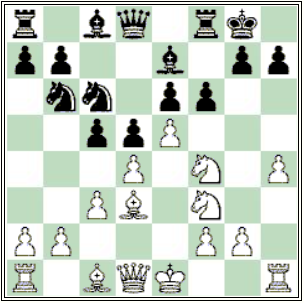
11.Bxh7+ Kxh7 12.Ng5+ fxg5 13.hxg5+ Kg8 14.Rh8+ Kxh8 15.Qh5+ Kg8 16.g6 1-0
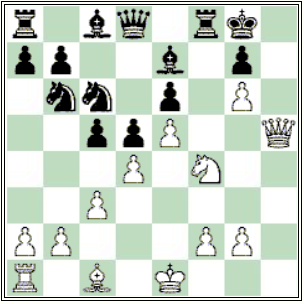
[Click here to replay the game]
The fourteenth and last round of the tournament was held on Monday the 30th of November, and the Irish Press reported the following day (at page 4 of the newspaper) on the final outcome, with another twist on the name of the event:
Kerlin Wins Chess Champions’ Trophy
Gerry Kerlin, holder of the Dunsany Trophy – a substitute Irish Championship held last year – and the ex-Leinster champion, became the first winner of the Champions’ Chess competition by defeating B. O’Sullivan in the final round at the Dublin Club, Lincoln Place, last night.
In a Queen’s Gambit Accepted opening, Kerlin by clever play won a pawn on the 30th move. O’Sullivan failed to recover and was forced to resign on the 38th move.
Final Crosstable
                    GK AB JO BO TC CB JG RV Total

1.   G. Kerlin      xx 1= 11 01 00 11 11 ++  10.5
2.   A. Bourke      0= xx 1= 11 =1 1= 01 ++  10.0
3=4. J.J. O’Hanlon  00 0= xx =1 1= 10 11 1+   8.5
3=4. B. O’Sullivan  10 00 =0 xx 11 01 11 ++   8.5
5.   T.G. Cranston  11 =0 0= 00 xx 1= 10 ++   7.5
6.   C.J. Barry     00 0= 01 10 0= xx == 1+   6.0
7.   J.T. Gerrard   00 10 00 00 01 == xx ++   5.0
8.   R. Varian      -- -- 0- -- -- 0- -- xx   0.0