
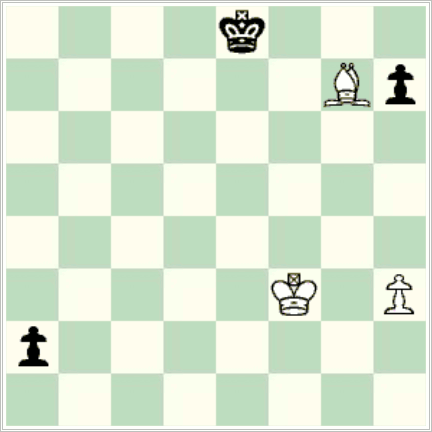
From Kriebel-Collins, Teplice Open 2011: how did Sam Collins (Black, to play) save the game?
From Kriebel-Collins, Teplice Open 2011: how did Sam Collins (Black, to play) save the game?
Here is an update on the items in August and September that weren’t the subject of separate posts. Pressure of work and travel kept me from posting an update last month.
Games collection:
Games with an Irish connection pop up all over the web. With an improved processing system it is now much easier to grab these and add them to the collection.
Games added to the archive in August include McKeown-Bracken, a casual blindfold game played in a Dublin pub in 1986; Siegrist-Kelly from a kids challenge match Berkeley-Straffan in 2001; Brisson-Burke and Janowski-Ruane from the Ennis Shield 2011-12; and Manojlovic-Carroll from the Bodley 2011-12.
For September, the games included five correspondence games by George Frith Barry from the 1870’s and 1880’s, versus Larminie, Long, Long, Meehan, and Pim; plus another correspondence game of the same era, Long-Buckley, 1871; de Jonge-Bradley 2007, Donoghue-Twomey 2008 and Horvath-Galligan 2008 from Cork C.C.’s games page; two games by outgoing Cork C.C. chairman Michael Bradley, versus D. O’Connell and McKeon, from the same source; and four games of Mark Orr’s from the Dundee Open 2009.
In addition, David McAlister’s post from February on Korchnoi’s simul in Armagh, 1981 gave a copy of the signed scoresheet in Korchnoi’s game against him, but the game wasn’t in the archive. A playable version has now been added.
TWIIC:
The Irish games from TWIC have now not been processed for over a month, since August 20 in fact. There’s a reason: I’m in the process of adding a small amount of extra functionality for this feature, and the programming is half-finished. In addition FIDE has altered the format of its rating lists, so I need to find time to adjust for that. Sometime soon!
Time for another game, and here’s one from the games page on Cork C.C.’s web site. It’s a dramatic one, involving everyone’s favourite theme, the king hunt. Strangely it wasn’t included in the ICJ report on the event and it doesn’t appear in the ICU games archive (or in any other database, as far as I know).
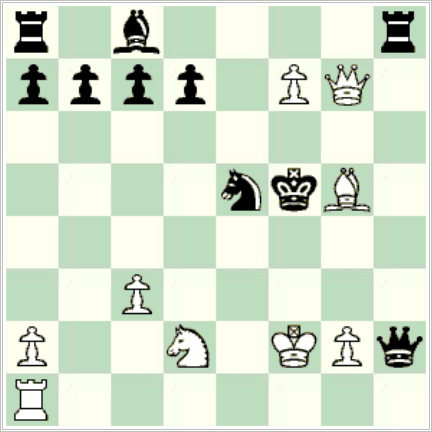 Orison Carlile – Stephen Short
Cork Congress (Masters) 2007
Round 1, 30 March 2007
The diagrammed position is after Black’s 24 … Ne5. Black’s king on f5 has already moved eight times and still has miles to go: he ends up on a3.
And the game also ends in an elegant mate.
Enough hints! This is a good game to test your analysis skills: there aren’t any obvious oversights or blunders (apart from one right at the very end), and though the engines point out many improvements for both sides, I wouldn’t call any of these obvious by any means.
Sean previously posted about the centenary of the birth of Thomas Cox, Irish chess champion in 1937 and 1938 but who died in 1939 aged only 27. This present post is the first of a series of articles on important matches played by Cox in 1936, which were the building blocks towards his Irish championships triumphs in the following two years.
The 1936 Leinster Championship was played over the first three months of the year in an all-play-all format and by winning his final game against Casey on the 25th March, Cox secured the Leinster title. At that point he was the youngest ever winner of the championship, which coincidentally had first been contested in the year of his birth. A few days later, there was a small article in the Irish Independent focusing on the young champion.
“Mr. Cox’s success should be an encouragement to all beginners and novices, as he took up the game less than three years ago. Joining the Dublin C.C. in October 1933, Mr. Cox was placed in fifth class and was entitled to receive the odds of Rook and Knight from the top players, at which odds, for a time, he lost more games than he won. With the aid of the excellent club library and the ready help of the club’s strongest players, who are always ready to help and encourage weaker players, he advanced to the 1st class inside twelve months.
For the past two seasons Mr. Cox has played for the Blackrock C.C. in the Armstrong Cup Competition, and this year the club won the trophy for the first time since 1902-3, when the club’s name was “Booterstown C.C.”.
Although he was rapidly improving, Cox still only played Board 3 for Blackrock in the 1935-6 League campaign, with the boards above him occupied by Ralph Varian, the 1928 Leinster champion (on board two) and J.J. O’Hanlon, who at that point of his career had already won seven of his nine Irish championship titles. Over the course of the next half-year Cox and O’Hanlon (who had not competed in the 1936 Leinsters) would face each other in three matches, all of which we will feature in this series of posts.
The first of those matches was a play-off for the Dublin C.C. Championship, which in those days was often as strong an event as the Leinster Championship. The match was played between the 15th and the 25th May and the Irish Independent for the 2nd June, under the heading “The Chess Match of The Season”, reported on the battle between youth and experience:
“The surprise of the chess year so far was the result of the match, which ended last week, for the championship of Dublin C.C. between J.J. O’Hanlon (holder), Irish champion, and T. Cox, the 23-years-old Leinster champion. They had tied for first place with 5 pts. each out of 6 in the championship tourney, and the committee ruled that a five-game match should decide the issue. Mr. O’Hanlon (white) seemed all set to retain the title when he won the first game after 57 moves pf a fine game that lasted 4½ hours, but with commendable pluck Mr. Cox came out to win the next three games in a row, and become the youngest player ever to win the club title since its foundation in 1867.
Game No.2 went 38 moves (3 hrs.); game No.3, 41 moves (4 hrs.); game No.4, 40 moves (3 hrs.) this making the whole match, 176 moves, in 14½ hrs., or an average of 44 moves per game in 3 hrs. 37½ mins. The winner showed resourcefulness and patience in critical positions, and counter-attacked strongly after prolonged sieges in one or two games.”
As far as I am aware, none of the games from this match have found their way into the databases; indeed the two games below have probably not been seen anywhere else since being published in the Independent newspapers at the time of the match.
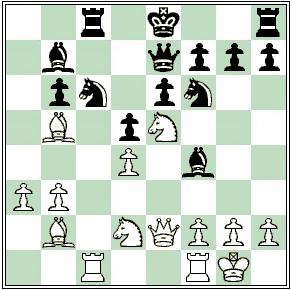 Thomas Cox – John J. O’Hanlon
Dublin Chess Club Championship
Play-off match (Game 2), 16 May 1936
1. d4 d5 2. Nf3 Nf6 3. e3 c5 4. Bd3 e6 5. b3 Nc6 6. a3 cxd4 7. exd4 Qa5+ 8. c3 Bd6 9. O-O Qc7 10. Qe2 b6 11. Bb2 Bb7 12. Nbd2 Rc8 13. c4 Na5 14. Rac1 Qe7 15. c5 Bf4 16. Bb5+ Nc6 17. cxb6 axb6 18. Ne5 (diagram) O’Hanlon is sleep-walking his way to defeat. Here 18…Bxe5 was absolutely necessary to avoid losing material. Now Cox exploits the pinned Knight on c6; 19…Rxc6 would only have lost the exchange, rather than the full piece. 18… Qd6 19. Nxc6 Bxc6 20. Rxc6 Rxc6 21. Rc1 O-O 22. Rxc6 Qb8 23. g3 Bd6 O’Hanlon’s situation is hopeless but he played on until eventually resigning on the 38th move. 1-0 [Click to replay the game.]
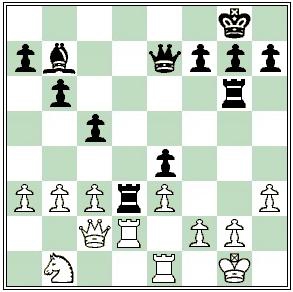 Thomas Cox – John J. O’Hanlon
Dublin Chess Club Championship
Play-off match (Game 4), 25 May 1936
1. d4 Nf6 2. Nf3 e6 3. e3 c5 4. Bd3 d5 5. b3 Nc6 6. a3 Bd6 7. Bb2 O-O 8. O-O Qe7 9. Nbd2 e5 10. dxe5 Nxe5 11. Nxe5 Bxe5 12. Bxe5 Qxe5 13. Nf3 Qe7 14. h3 b6 15. c3 Bb7 16. Re1 Rfd8 17. Qc2 Ne4 18. Bxe4 dxe4 19. Nd2 Rd3 20. Rad1 Rad8 21. Nb1 R8d6 22. Rd2 Rg6 (diagram) Cox was under pressure here, but he now showed the “resourcefulness and patience in critical positions, and counter-attacked strongly” which the Irish Independent had said was the hallmark of his play during the match. 23. Red1 Qg5 24. g3 Qd5 25. c4 Qc6 26. Nc3 Rh6 27. Nd5 Qe6 28. Rxd3 exd3 29. Qxd3 Rxh3 30. e4 Rh6 31. Nf4 Qe7 32. Qd8+ Qf8 33. f3 Bc6 34. Qc7 g5 35. Rd8 Be8 36. Qc8 Rc6 37. Qb8 Qh6 38. Rxe8+ Kg7 39. Rg8+ Kf6 40. Nd5+ 1-0 [Click to replay the game.]
Returning (after a long absence) to , the next that is missing from the ICU games archive (and indeed Big Database 2012 and all other databases I’m aware of) is a win by J.J. O’Hanlon against Eugene Znosko-Borovsky at Hastings in 1947.
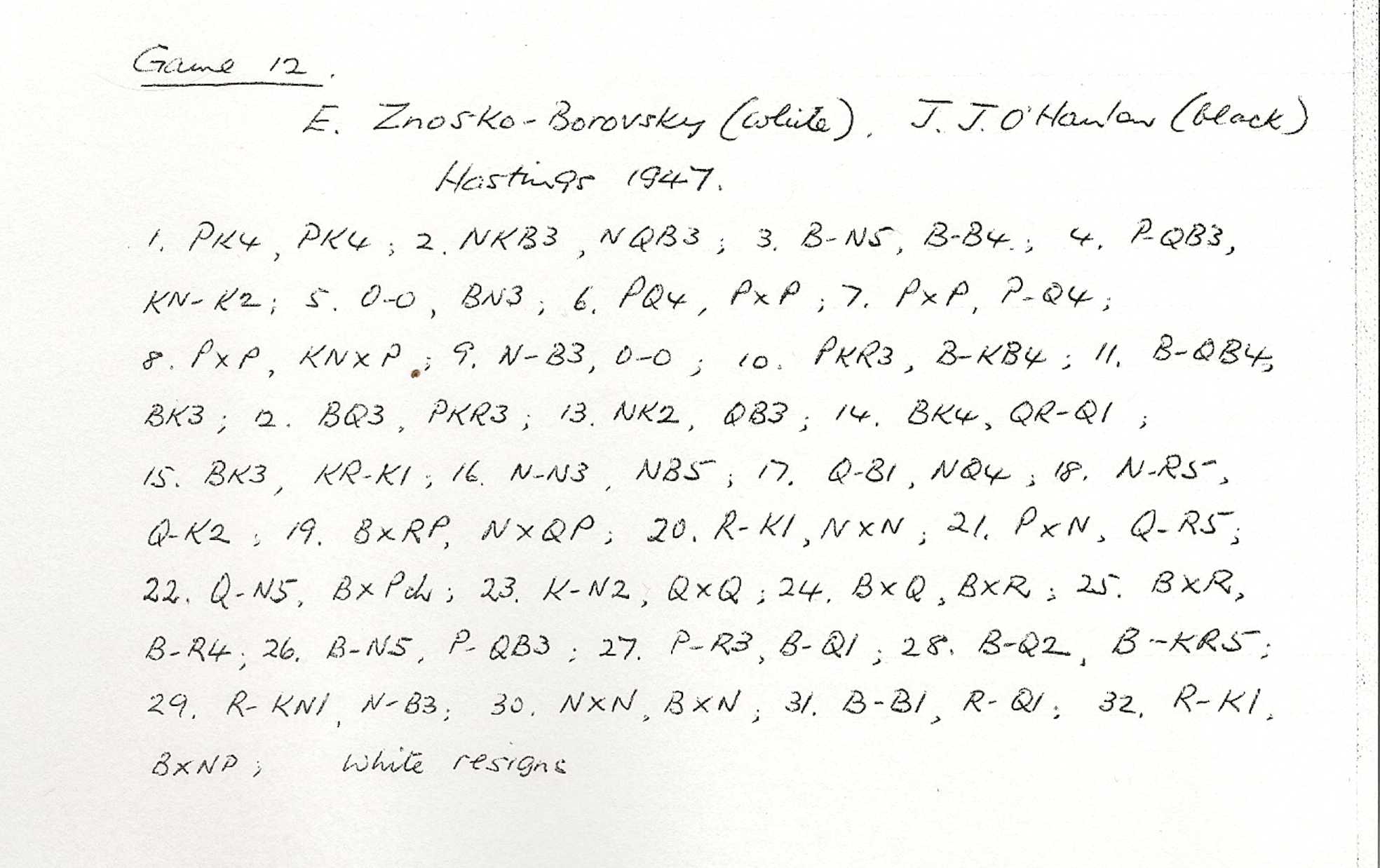
The players were both veterans when this game was played (Znosko-Borovsky 1884-1954; O’Hanlon 1874-1960) and had known each other for decades, back at least to Znosko-Borovsky’s visit to Ireland in 1926 previously reported here. This wasn’t the Hastings Premier, which O’Hanlon had played in in 1921-22, and which Znosko-Borovsky never played in. David McAlister provides further information to narrow it down to one of the Hastings Premier Reserves sections in 1946-47.
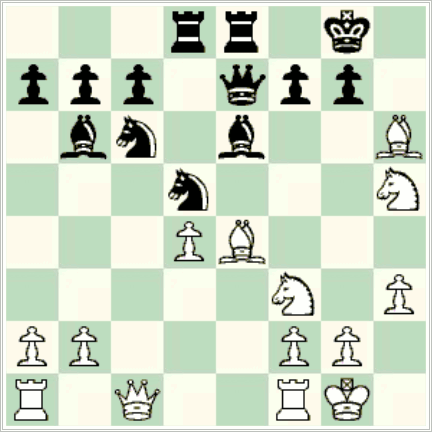 The diagram shows a critical point in the game, after Znosko-Borovsky’s 19. Bxh6!? is well countered by O’Hanlon with 19. … Nxd4! when everything appears to hang together, and O’Hanlon goes on to record a convincing win.
Oliver Dunne sends in a highly unusual and interesting game from this year’s Branagan Cup:
 Carl Jackson – Oliver Dunne
Branagan Cup 2012, round 1
Gonzaga-Elm Mount (5), 16 April 2012
1. e4 Nf6 2. Nc3 d5 3. exd5 Nxd5 4. Bc4 e6 5. Bxd5 exd5 6. Qe2+ Be7 7. Qe5 Nc6 8. Qxg7
A poisoned pawn …
8. … Bf6 9. Qh6 Bg5 10. Qh5 Nb4 11. Nf3 Bf6 12. O-O Nxc2 13. Nxd5 Be6 14. Nxf6+ Qxf6 15. Qb5+ Bd7 16. Qxb7
… and a second one. What is the record for number of poisoned pawns captured in a game? Tim Krabbé’s Chess Records page doesn’t have a category for this.
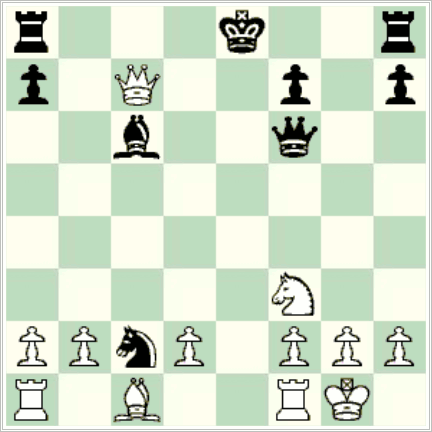
16. … Bc6 17. Qxc7 (diagram)
Now Oliver played the amazing 17. … Qxf3!!??. Of course White loses immediately if he captures, while if he checks first Black gets rook, bishop knight and pawn for the queen. Still, it’s a highly speculative trade, given the disjointed arrangement of the black pieces. Is it quite sound? No, say the engines, but it’s not necessarily easy to find an answer over the board, and White goes wrong. He resigns just as he is about to be mated in the middle of the board. And very picturesquely mated too: after 29. Kd5 Rd8 mate (or 29. f4 Rxf4+ 30. Kd5 Rd8 mate), all eight squares around the white king are empty, and five black pieces combine to cover all escapes.
18. Re1+ Nxe1 19. gxf3 Nxf3+ 20. Kf1 Bb5+ 21. Kg2 Ne1+ 22. Kg3 Rg8+ 23. Kf4 Nd3+ 24. Ke3 Kf8 25. b3 Re8+ 26. Kd4 Kg7 27. Qc3 Kh6 28. Bb2 Rg4+ 0-1.
[Click to replay the full game.]
Zygimantas Jakubauskas, also of Elm Mount, pointed out a similarity with a celebrated game of Morphy, as Black against Paulsen in the First American Congress in 1857:
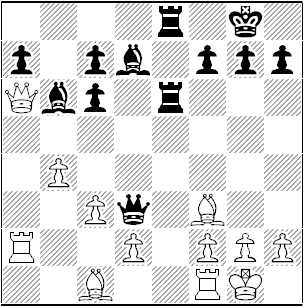 Here Morphy played 17. … Qxf3!!, winning in all variations. The conclusion was 18. gxf3 Rg6+ 19. Kh1 Bh3 20. Rd1 Bg2+ 21. Kg1 Bxf3+ 22. Kf1 Bg2+ 23. Kg1 Bh3+ 24. Kh1 Bxf2 25. Qf1 Bxf1 26. Rxf1 Re2 27. Ra1 Rh6 28. d4 Be3 0-1.
Though there were minor inaccuracies in the finish, the sacrifice is sound in this case. (Click to replay the full game (external database).)
This game has been a staple of anthologies ever since. It can be found, for example, in Reuben Fine’s The World’s Great Chess Games, 2nd ed. (New York: David McKay, 1976), pp. 23-24 (‘one of his most brilliant efforts’). (Fine’s book is available in Google Books.)
So in both games we have queen takes bishop minor piece on f3, in front of White’s unbroken castled K-side, on move 17 in each case.
Here’s a final question: in Jackson-Dunne the sacrifice, while artistically by far the best choice, isn’t objectively correct. So (without consulting engines) what should Black have played in the first diagrammed position above?
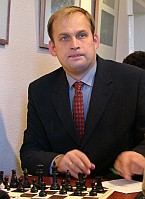 The recent discussion around Alex Lopez’s near-miss of a GM norm at the Istanbul Olympiad reminded me that the biography pages here were missing a page for Ireland’s first (and still only) GM, Alexander Baburin. He earned the title a few years after becoming an Irish resident, in fact, but it’s fair to say that he was GM strength long before that: in January of 1993, the year he moved to Ireland, he was the world’s ninth strongest IM.
In any case, a full profile has been added to the biography pages.
Anyone at all interested in Irish chess is surely following the progress of the Irish teams at the Olympiad in Istanbul. The live games coverage is outstanding, the captain of the open team, Colm Daly, is also reporting progress on his blog, and there’s discussion on the LCU Blog. (An outstanding result for the open team today, losing 2½-1½ to an Israeli team that outrated them by well over 200 points on every board, and at that Ireland was unlucky not to do better.)
In any case, I don’t plan to post here again until the Olympiad is over, barring some compelling reason, on the grounds that the chess reading-time budget of most readers will already have been used up by the Olympiad. So expect to see new posts here around September 10 or so.
Over at the ICU site there’s a fascinating report from Mark Orr, on a hitherto unknown trove of photographs, mostly of the Dublin zonal in 1957, belonging to Joe Keenan and discovered this year by his relative John Shearan (Malahide C.C.).
A summary wouldn’t do this collection justice: take a look for yourself at the link above. My favourite is the one of Pal Benko and Ken O’Riordan at Portmarnock beach on the rest day, with the photo of the participants at An Tóstal, Dublin 1956 a close second.
I also love the way player nationalities at the zonal are given as Gaeilge.
The Olympiad starts on Monday, with the first games on Tuesday. Best of luck to the Irish teams (Sam Collins, Alex Lopez, Ryan-Rhys Griffiths, Gavin Wall and Daire McMahon for the open event, and Monika Gedvilaite, Hannah Lowry-O’Reilly, Gearóidín Uí Laighléis, Karina Kruk, and Sarah-Jane Hearne for the Women’s event: see the Olympiad official page’s list of registered countries).
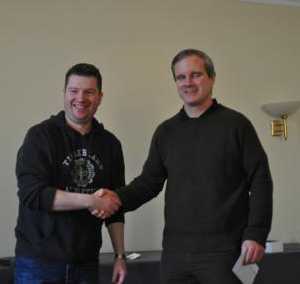 I would also like to wish best of luck to the chess director of my local club, IM John Donaldson (at right in the photo), who’s non-playing captain of the American (open) team. I didn’t realise this until I went down to the Tuesday evening lecture this week and found he wasn’t there, as he was already en route. He participated in both Bunratty and the Cork Congress this year (flying back to San Francisco in between to fulfil a club obligation–that’s dedication for you!). He very kindly sent all his games from these two events, as well as some others from 1995. Here is his final-round game from the Cork Congress, against Arnaud Aoustin (not available anywhere else, as far as I know).
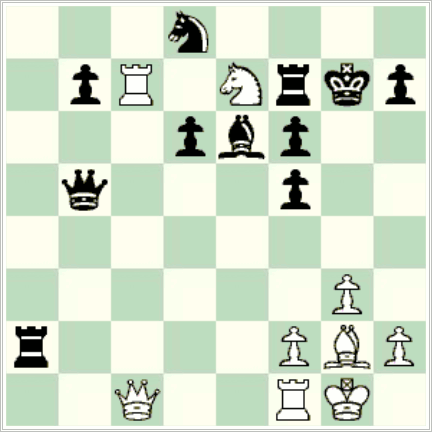 John Donaldson – Arnaud Aoustin
20th Cork Congress (6), 25th Mar 2012
White was comfortably in control a few moves earlier, and with 22. (or 23. or 24. or 25.) b6 Black would have been struggling to find any play. Instead Black’s 25. … Qb6! brought him fully back into the game and even gave him the advantage. The diagrammed position shows the choice faced by Donaldson, to move, on move 28. Objectively something like 28. Bf3 turns out to be best, but would probably give no more than a draw, which was of no use given the tournament situation. Black was very short of time, so Donaldson gambled with 28. Bd5!??!.
After 28. … Bxd5 29. Nxf5+, of course 29. … Kf8? is bad because of 30. Qh6+ Kg8 31. Rxf7, and 29. … Kg8 30. Nh6+ Kg7 31. Nf5+ just repeats. The right choice is 29. … Kh8! when Black’s winning. Instead Aoustin, in severe time pressure, went astray with 29. … Kg6? and was finished off in fine style: 30. Qh6+ Kxf5 31. Qh5+ Ke4 32. Qg4+ Kd3 33. Qf5+ Ke2 34. Rcc1 Bc4 35. Rfe1+ Kd2 36. Qf4+ 1-0.