A miniature: Allen-Clarke

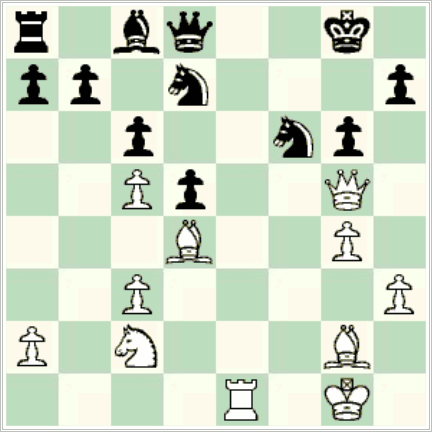
Time for a game. And why not a miniature? Here is an entertaining and instructive game between Keith Allen and Tom Clarke, event and date unknown (possibly a club game?) from a club game around 1988. Source: James O’Fee’s blog (plus extra details from David McAlister in the comments here).
Allen - Clarke, Belfast and District League, ca. 1988Keith Allen – Tom Clarke
Belfast and District League Div. 1 (Ulster Trophy), c. 1988
Fisherwick – Civil Service

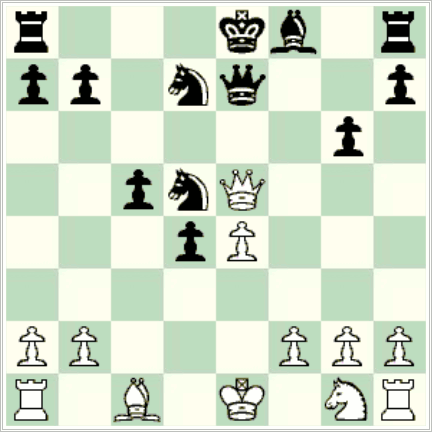
1. d4 d5 2. c4 Nc6 3. cxd5 Qxd5 4. Nf3 e5 5. Nc3 Bb4 6. dxe5 Qxd1+ 7. Kxd1 Bg4 8. Bf4 O-O-O+ 9. Kc1 Nge7 10. e3 Nd5 11. Bg5 f6 12. exf6 gxf6 13. Nxd5 Rxd5 14. Bxf6 Rc5+ 15. Bc3 Rd8 16. Be2 Bf5 (diagram) 17. Rd1? Rxc3+ 0-1.

[Click to replay the full game.]

I thought the diagrammed position was hopeless anyway (it would have been different if White had interposed 16. a3 Ba5 before playing Be2, when it’s very much all to play for). But the computer comes up with the strange-looking line 17. e4 Bxe4 18. Nd2 Bf5 19. Nb1 Nd4 20. Bd1, when it thinks Black’s better but White is hanging on.

Updated 24 August 2012.
Posted in Games | 1 Comment

Glorney Cup 1964

Glorney Cup 1964

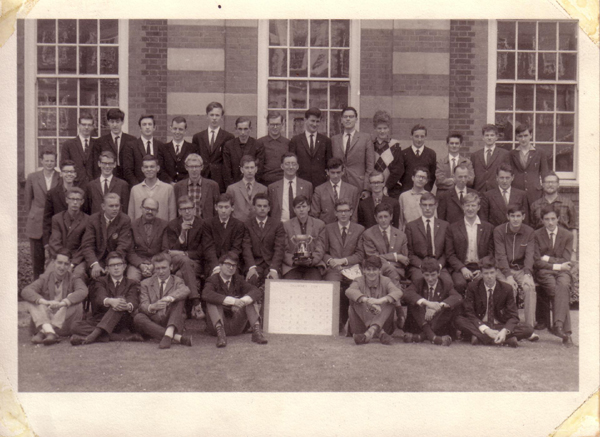
Here is a photograph of the players at the 1964 Glorney Cup, played in London.

A warmup question: can you identify the three very well known English players who are in the third row from front, seventh from right; second row from the front (seated), fifth from left; and second row from the front, seventh from left (holding the trophy)? See a larger image before giving up: they’re really quite recognizable.

This photo is from Alan McGowan’s excellent page on Scottish Teams in the Glorney Cup over on the Chess Scotland pages; he credits John Glendinning of the Scottish team, the leftmost player in the back row. (And it’s shown here with Alan’s permission, for which thanks.)

An account of the event, including final crosstable, can be found over on OlimpBase’s pages on the Glorney Cup (information largely assembled by David McAlister). It was the first Glorney Cup to include France and The Netherlands, and was a very competitive one, with one point separating the top three teams.

The Irish team that year was Kevin Ryan, John Moles, Ray Byrne, Ray (Raphael) Farina, J. Lacy, Gerard McAleavy, Solomon Negrine and Gerald McCurdy. (Again from David McAlister’s records.)

And now here’s the main question, not an easy one: how many of them can you identify?

Posted in Glorney Cups, Players, Tournaments | Leave a comment

Svetozar Gligorić 1923-2012

TWIC reports that Svetozar Gligorić died today in Belgrade. (Born 2nd February 1923, Belgrade.) He was one of the household names in world chess when I was learning the moves, so for me and I’m sure for many others this is the end of an era.

He visited Ireland on at least a couple of occasions. One was for the Dublin zonal, 1957, tying with Benko for 2nd-3rd behind Pachman. The other occasion I’m aware of was his series of four simuls in February 1971 (Cork, Wexford, and two in Dublin): see the Simuls page.

Posted in Players | 1 Comment

Conor Barrington

J.J. Walsh brought the news of the recent death of Conor Barrington. There was a notice in the Irish Times (3rd-4th October 2011): Conor Barrington (Mount Tallant Avenue, Dublin), formerly of the Department of Foreign Affairs and Trade, d. 1st October 2011, Rathfarnham.

He played quite a bit in Ireland in the 1970’s, finishing equal second in the 1975 Leinster championship. We both played in the 1979 Irish championship, finishing with similar scores, but I don’t recall if I ever played him. I have only sketchy details thereafter, but if I understand correctly his career in the Department of Foreign Affairs took him overseas after 1979 or so, to Chicago and later Saudi Arabia. He was in Ireland in 1989 and was on the Rathmines team that won the Armstrong Cup and the National Club Championship, and for good measure he was joint winner of the Rathmines club championship.

There are only two games of his in the ICU archive, both losses from that 1979 Irish championship, and only the same two are in Big Database 2012. He was also on the Irish team for the 1974 World Student (U26) Team Championship in Teesside, England, as 2nd reserve. As mentioned elsewhere, these Student Olympiads were tough events, and he struggled with an overall score of +1 =1 -5. OlimpBase has all these games, so here is his win, against Douglas Tudhope (Scotland):

Barrington - Tudhope, Teesside 1974Conor Barrington – Douglas Tudhope
World Student Team Ch, Teesside 1974 [final-B, round 8]
Ireland-Scotland, board 4

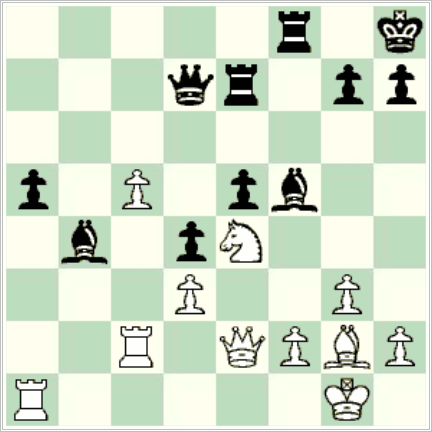
Here’s the position after Barrington’s 24. Qg5. The finish was 24. … Qf8 25. Rf1 Kg7 26. Qe3 h6 27. h4 Kh7 28. g5 Ng4 29. Qe2 Qg8 30. Qe7+ 1-0.

[Click to replay the full game.]

Any other games (especially any other wins) would be great. Can anyone supply any?

Posted in Games, Players | 2 Comments

European Union Youth Championship 2012

Ireland’s representatives at the recently-concluded European Union Youth Championships in Mureck, Austria,were Geoffrey Keating, Diana Mirza, Sasha-Ettore Faleschini and Mark Tonita (respectively U14, U12, U10, and U8). All games have now appeared on the tournament web site, and the 36 games involving the Irish contingent have been added to the archive here.

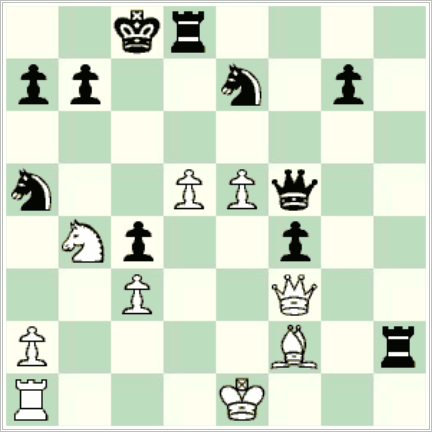
Radeva - Mirza, EUYCC 2012Diana Mirza deserves congratulations for finishing 12th overall in the U12 championships with 5/9, winning the silver medal for U12 girls. She finished ½ point behind the gold medal winner, Viktoria Radeva (Bulgaria). Their individual game was a hard-fought and interesting one: though Diana eventually lost, she had definite chances of a result. The diagram shows the position after Radeva’s 27. c5.

[Click to replay the full game.]

Posted in Games | 1 Comment

Bibliography

A new Bibliography page has been added to the menu above. The plan is to include information on all books, journals, columns, articles, and DVDs written in Ireland or by Irish authors.

Cover of Eminent Victorian Chess PlayersI hasten to add that the current page comes nowhere close to the promise above! That represents an enormous amount of material, and it will have to be built up gradually.

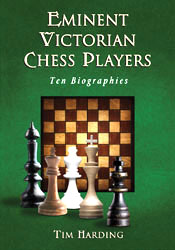
But the longest journey begins with a single step, as they say, so to get started, the initial cut includes the latest books in print that I’m aware of, the most recent of which is Tim Harding’s Eminent Victorian Chess Players (McFarland, 2012).

Posted in Books | Leave a comment

Scottish championship 2012

Several Irish players participated in the Scottish championship this year, with general success. The highlight was Conor O’Donnell’s win against Ketevan Arakhamia-Grant. At 13 he’s probably the youngest Irish player ever to defeat a grandmaster.

The games from the first 7 rounds showed up as usual in TWIC (issue 923), and were imported into the IRLchess games archive from there. But only the ‘live board’ games from rounds 8 and 9 appeared in TWIC, with Mark Orr’s round 9 game the only Irish one. TWIC seems to have a strict policy of being this week in chess, so games that miss their natural place don’t get a new place in later issues.

However the games did finally appear on the tournament website, and have now been included in the IRLchess database (just search for “119thScottish Championship 2012″ in the “Search Games” feature): ten new games plus one result (the moves for Diana Mirza’s last-round win are missing on the tournament website).

Here’s one interesting situation, from another Conor O’Donnell win, this time against a 2175-rated opponent:

O'Donnell - RysbayaevaConor O’Donnell – Aigerim Rysbayeva
119th Scottish Ch, round 8
14th July 2012

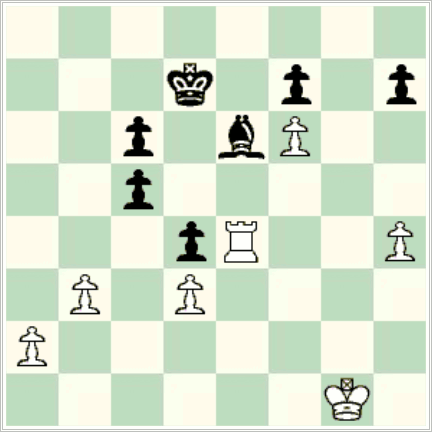
White is winning easily and after 36. Kf2 or any of a number of other ‘safe’ moves, would surely bring home the win quickly. Instead Conor played 36. Rxe6!??!.

Did he see the full finish? If so, well calculated. If not, he was a little lucky that it all worked out in the end. Either way it seems a bit chancy! I’d have played 36. Kf2 myself.

See if you can calculate the end from this diagram.

[Click to play through the full game.]

Posted in Games | Leave a comment

Janusaitis-Dunne, Branagan Cup 2012

Oliver Dunne sends in this snappy and instructive miniature from this year’s Branagan Cup semi-final, in which Elm Mount resoundingly defeated a considerably higher-rated Rathmines side that had just won the Armstrong Cup. Below I’ve set this up as a quiz, but the full game, as with most miniatures, is well worth playing through.

Janusaitis - Dunne, Branagan Cup 2012Mindaugas Janusaitis – Oliver Dunne
Branagan Cup ½-final, Rathmines-Elm Mount
29th May 2012

Whatever White had in mind, the last few moves have not gone according to plan, and now he’s forced to take the critical decision, to grab the rook or not. Which conclusion would you agree with?

A. Yes, go ahead and grab it, Black has nothing.
B. Avoid it like the plague, White will get massacred in short order if he captures on h8.

[Click to replay the full game.]

Posted in Branagan Cups, Games | Leave a comment

Yet ?!??!!!

Gawain Jones has won this year’s British championship, the 99th overall. Hearty congratulations, though not a huge surprise as he was after all the top seed.

He lived for two years in Ennis, and his name came up here recently as part of the list of players who finished equal first in an Irish championship but were never Irish champion, from his equal-first finish in the 2004 Irish championship in Limerick.

His website contains an interesting of that event, if you read carefully (emphasis added):

July 2004, Irish Championships, Limerick. This was the first tournament I’ve won for a while with 6.5/9. Not being Irish yet I couldn’t take the title and this was taken by Joe Ryan.

Yet ?!??!!! What is he trying to tell us?

Posted in Players | Leave a comment

Heidenfeld-Kerins, Dublin 1973

Over at the LCU Blog, there’s a discussion of illegal moves in games (scroll down in the comments for an example from Peter Cafolla). This calls to mind an Irish world record, at least according to Tim Krabbé’s Chess Records site: most castlings in a single game, held by the game Heidenfeld-Kerins, Dublin 1973.

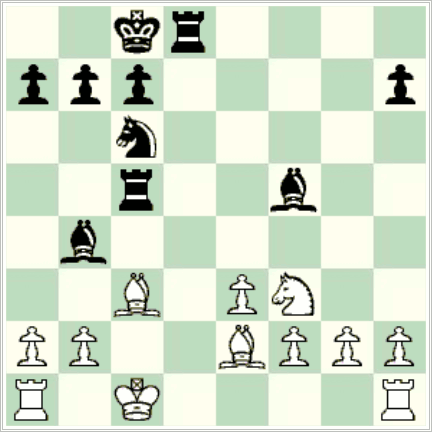
Heidenfeld - Kerins, Armstrong Cup 1973White, having earlier played 10. 0-0, now castled queen-side. Since he’s a full rook down and the game goes on for quite a while, we must assume that Black at least was in severe time trouble, and the moves must have been blitzed out at a rate that makes this oversight understandable.

[Click to replay the full game.]


Do you find this an impressive world record? Me neither. It’s hard to believe this doesn’t happen all the time. John Delaney reports another case in his game against Gerard O’Connell in the Armstrong Cup 2009-10:

O'Connell-Delaney castlings
(Bizarrely that post seems to have been airbrushed from the LCU Blog archives–I don’t know why.)

For a truly impressive record we’d have to have four or more castlings in the same game. (Any suggestions?) And for genuine surprise we’d have to have something more bizarre, such as the story I read of many years ago (reference long gone, sorry) of the fellow who was playing in some large congress in England where the boards were closely packed together. He sacrificed his queen’s rook, then later in a tense conclusion saw that he only needed to play … 0-0-0 to win. Entirely carried away, he castles, inadvertently grabbing the black king’s rook from the next board, and duly carried away the point.

Posted in Games | Leave a comment