GM Michael Stean on the BBC

On Monday 23rd April BBC Northern Ireland started a series of half-hour programmes entitled “Glory Days”. These are compilations of sporting events taken from the BBC NI archives and the first episode focused on the 1970s. Towards the end (about 25 minutes in) there was confirmation that at least the people at the BBC consider chess a sport, with coverage of a simultaneous exhibition by English GM Michael Stean in Newtownards, County Down.

Unfortunately, I cannot put anything of this on IRLchess, because the BBC understandably do not like people taking liberties with their copyright. However, if you live in the UK, for a few more days you should be able to view the programme, (unfortunately I believe it is geo-restricted elsewhere) courtesy of the BBC IPlayer at Glory Days 1970s.

However, from an old minute book of the Newtownards Chess Club, what I can tell you is that Stean’s simultaneous exhibition took place in the Londonderry Room of Newtownards Town Hall on Saturday 23rd June 1979 with the GM winning 32 games, drawing 2 and losing 6. The organiser was Mervyn Bennett, secretary of the Newtownards Chess Club, and if you are able to access the video, he’s the player, wearing glasses and in a dark striped shirt, featured in close-up. I wasn’t at the simul but I do recall attending a lecture Stean gave the previous night at CIYMS Chess Club in Belfast. He took the assembled players through a recent game from grandmaster praxis (possibly a Korchnoi game – Stean had seconded him at the 1978 World Championship). At one point, Stean stopped and asked us what we thought the next move was, and I’m afraid we completely failed to identify it!
Posted in Simuls | 1 Comment

Labourdonnais-McDonnell

The full scope of this blog, declares the About tab above, is “anything to with Irish chess, from Labourdonnais-McDonnell to today”. Fair enough, you say, but how on earth could anyone say anything new about Labourdonnais-McDonnell? This was one of the most famous series of matches ever and has been exhaustively analyzed ever since.

For those not familiar with the topic, the Frenchman Louis Charles Mahé de Labourdonnais (b. La Réunion, 1797; d. London, 13th December 1840) was considered the strongest player in the world in his era. He played a number of matches in London against the strongest players of the day, culminating with a series of six matches from June to September 1834, totalling 85 games, against Alexander McDonnell (b. Belfast, 22nd May 1798; d. London, 14th September 1835). Though de Labourdonnais had the better of it, winning four of the matches to McDonnell’s one, with the last unfinished, the contestants were well matched and the standard of play very high for the era.

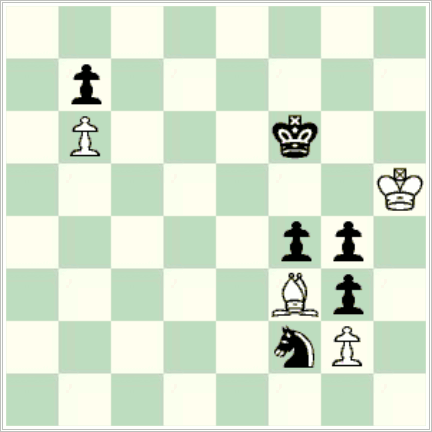
Here is a puzzling discrepancy, though. The second game of the first match, as given by the ICU on-line games archive, reached the position below after McDonnell’s 55. … g4:

Labourdonnais-McDonnell, Match (first) (2)The sequel, as given by the ICU collection, was 56. Bxg4 Ke7 57. Bc8 Kd6 58. Bxb7 Kc5 ½-½.

But what is wrong with 56. … Nxg4 instead? After 57. Kxg4 Ke5 58. Kf3 Kf5 Black has the easiest of wins.

ChessBase.com’s “Big Database 2012” (5,000,000+ games) also gives the same continuation.


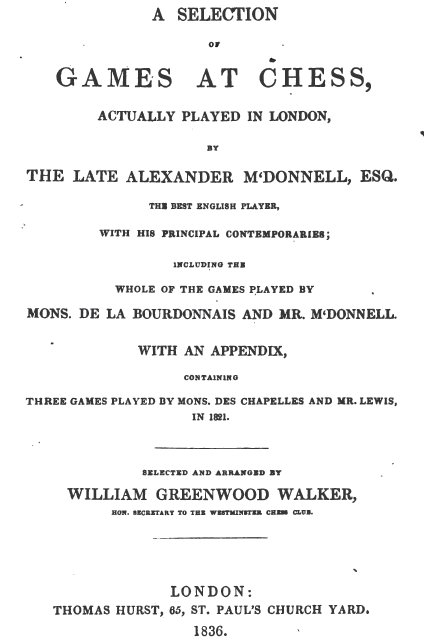
So did McDonnell fluff an easy chance? Actually, no: the databases are wrong, as they are so often for older games. The games from the match were widely published at the time, and since the books are long out of copyright we can access the originals on Google Books. The games were originally noted down by William Greenwood Walker, secretary of Westminster C.C., where the games were played, and he included them in an 1836 collection of McDonnell’s games:

Greenwood Walker title page

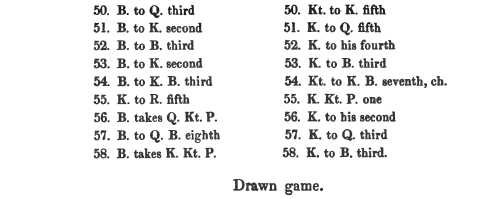
And here is the end of game 2 (p. 136):

Labourdonnais-McDonnell, end of game 2 of first match

That could hardly be clearer (apart from the ancient notation, that is): White captured the queen’s knight’s pawn first, and then after Bc8, the king’s knight’s pawn. This is also the version given by William Lewis, A Selection of Games at Chess (London: Simpkin and Marshall, 1835), p. 15 (adding some garbled moves at the end and calling it game 3), and by George Walker, Chess Studies (London: Longman, Brown, Green and Longmans, 1844), p. 1, both also available on Google Books.

So the actual finish was the much more reasonable 56. Bxb7 Ke7 57. Bc8 Kd6 58. Bxg4 Kc6 ½-½. (Click to replay the full game.)

This is also the version given in various modern books, e.g., Cary Utterberg’s De la Bourdonnais versus McDonnell, 1834: the eighty-five games of their six chess matches, with excerpts from additional games against other opponents (Jefferson, N.C.: McFarland, 2005), p. 51, citing Levy and O’Connell’s Oxford Encyclopedia of Chess Games (1981).

So an injustice to McDonnell is corrected. But where did the spurious version come from? It’s not just a matter of confusing the two knight’s pawns: in the spurious version Black can’t play 58. … Kc6 at the end, so someone “corrected” it to 58. … Kc5.

Posted in Games | Leave a comment

National Club Championship

The 2012 National Club Championship is being played on the last weekend of April. We have added a new page within our Team events section detailing the winners of the NCC since its inception in 1954. Records are far from complete, particularly for the late 1960s and 1970s, and this is very much a work in progress, so we will be pleased to receive any information out there that can add to our state of knowledge.

NCC Roll of Honour 1954-to date

Posted in Club chess | Leave a comment

MTK Budapest – Dundrum, European Club Cup 1985

MTK Budapest-Dundrum title

With the finale of the Armstrong Cup on this weekend (not to mention the thorny issue of the National Club Championship and European Club Cup the topic of renewed controversy), it’s time for a post with some reminiscences of club chess from yesteryear.

In 1985 Dundrum won the Armstrong for the first and only time (1984-85 season). I was playing board 1, would you believe, and this competition featured my last competitive games, as I left for California in early September that year and haven’t played a game since. I have only the haziest recollections of that season, and certainly no games. Nice to go out on a high note, though!

As a result of the Armstrong win, our captain David Drakeford entered the team for the European Club Cup. (What about the National Club Championship, you ask? Records are scarce and I’m fairly sure I skipped the event myself, but it seems Dundrum finished second. In those days this made no difference to anything, though, so the entry was accepted.)

The team was drawn away to MTK Budapest, a dream draw against one of the strongest teams in the competition. In the event they rested a couple of their players, e.g. Susan Polgar, but the team that played was strong enough: board 1 Lajos Portisch, then rated sixth in the world, GM Forintos board 2, and GM Lengyel board 3. The format was at that time a knockout series of matches (six boards, two rounds).

The match was scheduled for September, so I wasn’t able to play myself, being already in California by that time. But Eugene Curtin was home from Rhode Island on holiday, so played board 1 in my stead. Since Eugene was then Irish champion (joint with Mark Orr), having also won the Irish championship outright the previous year, this was an excellent trade for Dundrum. I hasten to add, since the ICU web site and LCU Blog are filled with talk of ‘ringers’, that Eugene had had a long association with Dundrum, extending back at least ten years.

Dundrum lost 9½-2½, with each player except one losing one game and drawing the other. I recall hearing that the team was quite happy with this result.

OlimpBase has a brief account of the match, showing the overall match result, and Eugene Curtin’s results, along with one of his games, his loss to Portisch. No other Irish players are listed and no other games are available, and ChessBase’s “Big Database 2012” (5,000,000+ games) also contains just this one game.

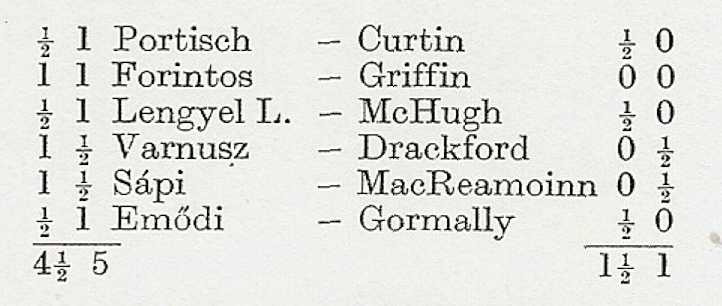
However there is some more information! I found an article on the match in Magyar Sakkélet, 1985 p. 396, giving full results, plus one more full game (Lengyel-McHugh) and an extended portion of another (Varnusz-Drakeford).

In a later post I’ll upload these as playable games, along with the full article. In the meantime here is the full table of results, at least as given by Magyar Sakkélet (I have an idea that it was Brian MacRéamoinn who lost both games, not John Griffin, and I think I recall seeing a report in Fiacla Fichille about the match; to be verified):

MTK Budapest-Dundrum scores

The Dundrum team was Eugene Curtin, John Griffin, Kevin McHugh, David Drakeford, Brian MacRéamoinn, and Ivan Gormally.

[Updated March 21, 2014: link to OlimpBase report corrected (see comment from Kevin Burke).]

Posted in Club chess | 5 Comments

Eugene O’Hare and Bobby Fischer

Colin Fenton has brought to my attention this tribute to Eugene O’Hare from the Derry Journal. It referred to Eugene as

“an internationally known chess player who once played against the late chess master, Bobby Fisher[sic].”

There is no game between them in the databases, so what was the origin of this quote?

The obvious place to look was O’Hare’s autobiography “Roast Beef on Sunday” which Sean has already referred to in his articles Eugene O’Hare and The Berlin Wall, Hans-Joachim Hecht & Eugene O’Hare.

The answer would seem to be found in the part of the book where Eugene is recounting his experiences at the 1960 Leipzig Olympiad:

“I made the acquaintance of a number of players including Count O’Kelly and two Americans, Raymond Weinsten and Bill Lombardy, a grandmaster and one of Bobbie [sic] Fischer’s trainers. Lombardy was a Jesuit student and we searched together for churches close to the hotel for Mass on Sundays and ended on first name terms. Raymond Weinstein, the American number six, a year later was charged with murder and found guilty. One night after dinner, I found myself beside the boy wonder himself, Robert J Fischer. According to statistics, Fischer was the best known chess player of all time. He was analysing on a travelling set and turned to me, asking if I would like to see his position in the analysis room. My moment of glory! We sat down, purchased two cups of coffee from the machine and for an hour went through his game for that day.”


Posted in Uncategorized | Leave a comment

Monthly roundup: February

Here is a summary of the changes this month that were not the subject of separate posts:

Simuls: Four more simuls were scheduled for February; the one by Michael Adams was eventually cancelled, details of Nigel Short’s two simuls (Dublin and Ennis) have been added, and there was one other, by GM Andrei Istratescu, scheduled for Limerick the Tuesday after Bunratty, but I haven’t seen any results from that one.

Details of J. H. Blackburne’s blindfold simul on 8 boards in Belfast in 1886 have been added, along with (on the Local Simuls page) one by Alexander Baburin in Ballina, 2002.

TWIC Irish games: TWICs 900-903 were processed, with 51 new Irish games, taking the total up to 1065. The latest TWIC, 903, has just one Irish game, in which Joe Ryan somehow grinds out a win in the Coral Colon IM tournament. Without feeding it through an engine, where does Black go wrong? My vote is for 38. … Rxe3: 38. … Kg4 seems much more promising.

DArtt: The post on Korchnoi’s simuls in 1981 brought a correction from Damian Artt, who won his game in Newtownards in the second simul, 4th February 1981, and knew of at least two others who did so also, whereas the newspaper reports had given Korchnoi’s score as +29 =3 -0.

I was a contemporary of DArtt, as he was known, and we played on the same Glorney Cup team in 1981, but I haven’t heard anything of him in 30 years. It turns out that he has been in the US since 1988, and is currently living in Arizona. He’s another example of the chess-poker connection, having finished in the money three times at the World Series of Poker, most recently finishing 362nd out of a field of 7,319 in the 2010 Main Event, winning $36,000.

Spam: I assume all web sites must be inundated with spam; certainly IRLchess is no exception, and the spam folder has over 1,400 comments in it. But in the past month there has been a wave of chess-related spam: a series of garbled messages in which a debate is raging back and forth on the merits or otherwise of Ivanchuk, Carlsen, Vasiukov, Geller, etc. It all almost (but not quite) makes sense. But what is the point of it? Bizarre.

Posted in Administrative | Leave a comment

Colm Daly

We’ve had no new player profiles here for a while, so an update is overdue. Since the Oscars were this weekend, the next profile up is Irish chess’s premier film-maker (among many other achievements, not least 4 Irish championships) Colm Daly.

Posted in Irish champions, Players | Leave a comment

Korchnoi and the car

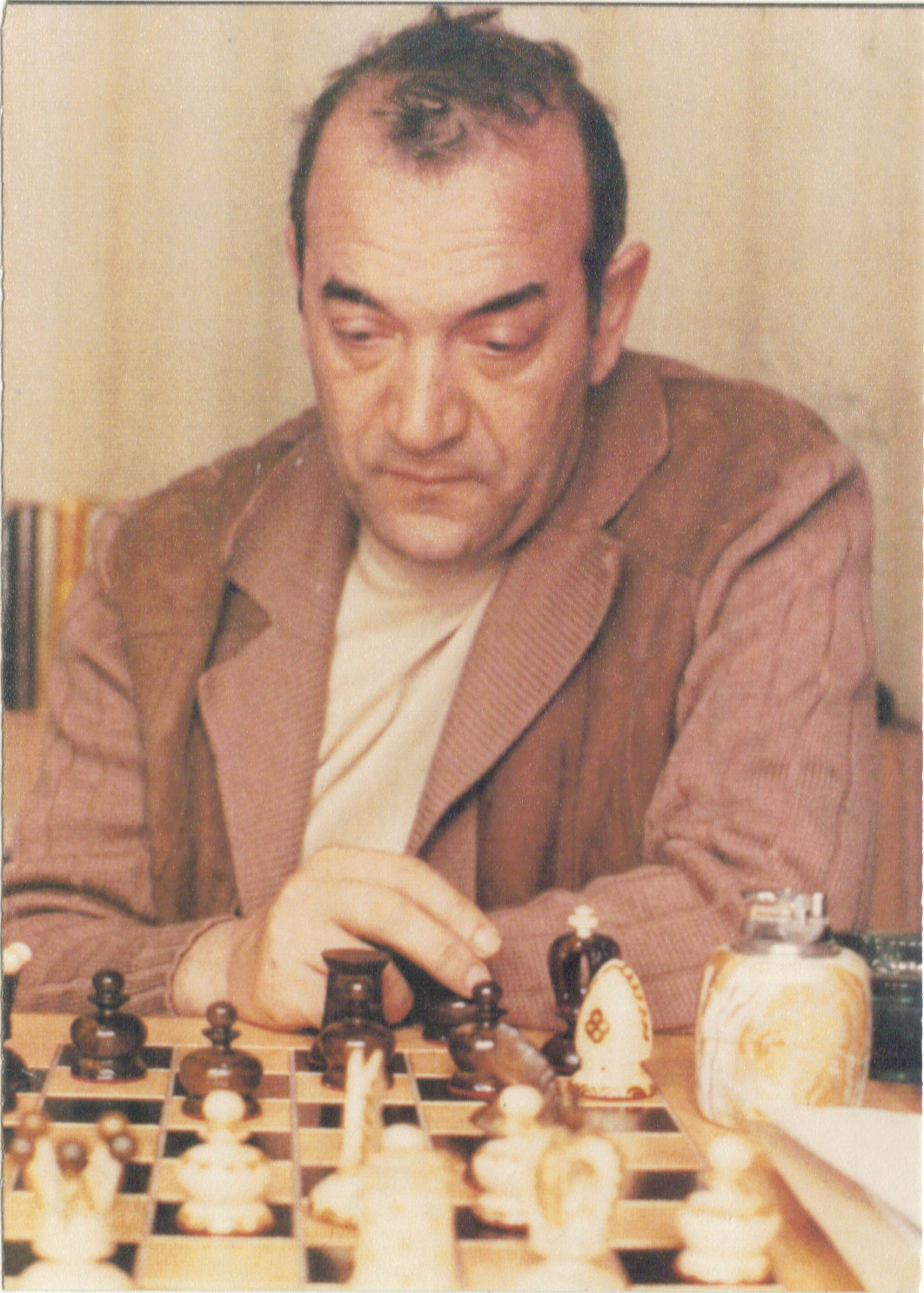
On a cold dark early-February night in 1981 sometime around midnight I was leaving the Drumsill House Hotel in Armagh after playing a game of chess. As I was walking through the hotel car park I saw in the distance a solitary figure at the back of a car, valiantly trying to push it. Like the good Samaritan, I went over to help and when I reached the rear of the vehicle I realised that the person I was assisting was my opponent from earlier in the evening – none other than World Championship challenger Viktor Korchnoi, though he had been playing 39 other people at the same time.

I had just time to say to him that this might be an unexpected end to his evening and for him in reply to give a little grin and a shrug of the shoulder before, with the assistance of a couple of other pushers, the car sparked into life, Korchnoi jumped into the front passenger’s seat and sped away into the night.

In the post-Fischer years Korchnoi was perhaps the most talked-about chess player on the planet. He had defected from the Soviet Union in 1976 and had fought an acrimonious and controversial World Championship match in 1978 with the golden boy of Soviet chess, Anatoly Karpov. Even five years after leaving the Soviet Union, Korchnoi was still facing the consequences of his defection and used his visit to Ireland to publicise the plight of his family still living in the Soviet Union. The Irish Independent reported that “Since June 1977 wife and son have been trying to get out of the Soviet Union, but without success. Their applications for visas had been consistently rejected” while the Irish Times referred to Korchnoi telling journalists “that he believed his 21-year-old son Igor, who was arrested in 1979 by Soviet police, was now in a Siberian labour camp. He believes that Igor’s only crime is being his father’s son.”

Korchnoi played three exhibitions in Ireland – in Armagh, Newtownards and Dublin, the original impetus having come from the Armagh Chess Club. Just how much of a draw he was at that time can be seen from the suggestion in the Irish Times that he was reputed to be receiving £1,000 for his Dublin appearance. No wonder all three exhibitions were sponsored. There were large audiences at all of them, with 300 reported to be at the Dublin exhibition with “Irish champion, Paul Delaney, entertaining  a large overflow audience by explaining the moves of some leading games on close circuit television in the analysis room.” (Irish Times). Korchnoi was scheduled to play precisely 100 games on his tour but 2 extra games were apparently fitted into the Newtownards simul. Overall Korchnoi won 87, drew 10 and lost 5. Further details are posted on the Simuls page.

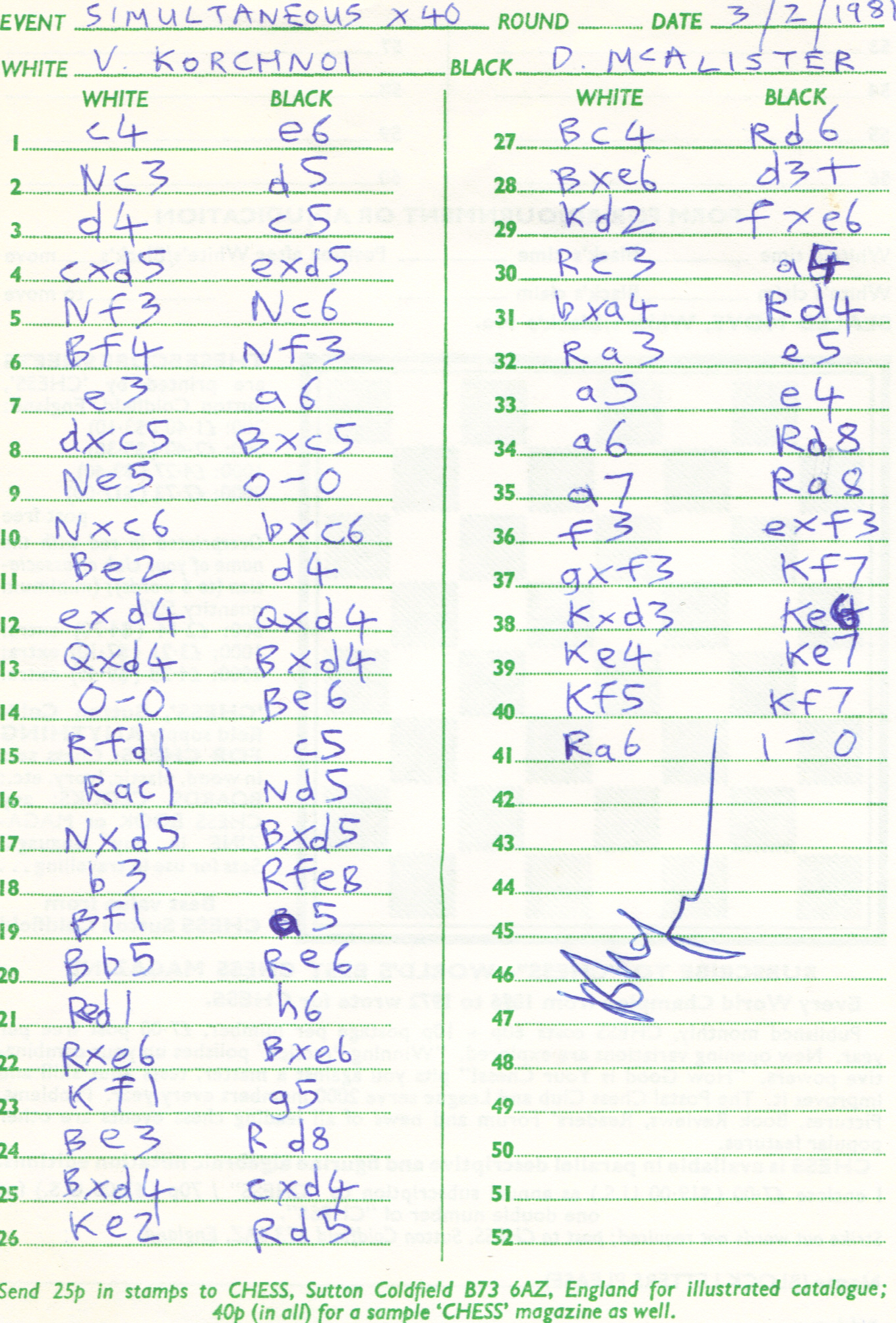
Update, 10 September 2012: click to replay the full game.

Posted in Simuls | 4 Comments

City of Dublin 2011

The City of Dublin championships took place last September, and a report (by Pat Fitzsimons) and a majority of the games in the Masters (complied by Ciarán Quinn) appeared at the time. Subsequently Peter Scott, chief arbiter, sent the crosstables, for which many thanks.

After some delay (due to software issues, including a devilishly obscure bug), the reports have finally been uploaded onto the Tournaments page. There were 115 players in all across four sections, up on recent years, with John Delaney (Blanchardstown Juniors) winning the Masters, Eamonn Walls (Fisherwick) the Majors, Airidas Tolkus (Naomh Barróg) the Challengers, and Gerard Wallace (Lucan) the Juniors.

Posted in Tournaments | Leave a comment

Monthly roundup: January

Here is a roundup of some of the changes this month that were not the subject of separate posts:

Branagan Cup: Two more winners were added to the roll of honour, based on Hugh Cummins’ tribute to Cormac Brady, in which he says that they were both on the Crumlin teams that won two Armstrongs and two Branagans between 1995 and 1999. Since 1997, 1998, and 1999 were already accounted for, that must mean Crumlin won in 1995 and 1996. (A bit indirect, admittedly, but with the Branagan we’ll take whatever we get.)

Simuls: We’re heading into a bumper month for simuls. In anticipation, details of the three simuls given by Steinitz in Dublin in 1881 have been added, based on Tim Harding’s research, along with several more simuls by local players.

TWIC update: Updates from five new TWICs (895-899) have been added, with 65 new Irish games.

Eugene O’Hare’s memoirs: In a couple of posts, I’ve recommended these memoirs, which are quite entertaining and deserve to be better known, but although I had found the full book on line I didn’t provide a link because I was unsure of the copyright status. However Jack O’Hare, Eugene’s son, has written to say that the book is available both in hardback and as a free pdf download from Lulu: http://www.lulu.com/browse/search.php?fSearchDataauthor=Eugene+O%27Hare.

Posted in Administrative | 1 Comment