
Philidor Cup, Hyères 1928
A total of 45 games were played in the tournament but unfortunately we have so far succeeded in finding only one brilliant game from the 2nd round, when M. Duchamp crushed the last player E.H. Smith. It is unlikely that any more games can be found in a French magazine or daily but perhaps a game is preserved in private archives of a local club or a local player. Since there were two British players, some of the games might also be found in a British chess column. [There is a footnote here: “J. Keeble in the 1920s was in charge of the problem section of the chess column in the Hastings and St. Leonards Observer, some games by J.J. O’Hanlon could be in a Irish chess column.”]. The discovery of another game from this tournament would be tantamount to a small miracle.
[Vlastimil Fiala: The Chess Biography of Marcel Duchamp (1887-1968) Volume 2: On the Road to the Chess Mastery (1926-1930), page 125.]
Turning first to the Hastings and St. Leonards Observer chess column, Keeble reported on the Hyères tournament in three successive editions on the 28th January, 4th and 11th February 1928. Two Scottish newspapers – the Falkirk Herald, and the Linlithgowshire Gazette – also carried his reports [in largely similar language] in their chess columns.
The column in the Hastings and St Leonards Observer for Saturday 28th January 1928 provided a preview of the event.
The Hyères tournament, the chief event of which is for the “Philidor” Cup, is rather a failure this year [the report in the Gazette adds: “as far as entries are concerned”], but it promises to be a pleasant affair. Only 15 entries were received, and of these only seven are of first-class strength. To make up the Cup tournament the committee have promoted three others, including Mr. John Keeble. The tournament is therefore being run with a premier section of ten players and a minor with five. The latter will play a double-round. The players in the chief event are Nicholas [de] Terestchenko, (Russia), Halberstadt (Russia), Duchamp, de Pampelonne and Jules Patey (France), O’Hanlon (Ireland), Col. Stuart-Prince, A. J. Maas, Dr Smith, and J. Keeble (England).
Competitors in the minor are Mr. Paull, J. Baines-Lewis (Harrogate), Lahallé, Garcia and Glogg (France).
The Observer’s column for Saturday 4th February carried a progress report on the event.
One of the players, Jules Patey, who entered for the Hyères tourney, has not turned up, so the cup contest is being played with nine competitors only. The scores at the end of the first week were:- Marcel Duchamp 4.5; V. Halberstadt 4.0; J.J. O’Hanlon 4.0, N. [de] Terestchenko 3.5; A.J. Maas 3.0: J. Keeble 2.0; Col. Stuart-Prince 1.5; R de Pampelonne 0.5; Dr. E.H. Smith 0.0. Duchamp has played one more game than the others.
On Saturday 11th February, the Observer completed its coverage.
The Hyères Chess Congress ended in a triple tie between M. Duchamp (Paris), V. Halberstadt (Russia), and J. J. O’Hanlon (Ireland), who scored 6 points out of a possible 8. They divided the prize money, taking 916 francs each, but as no opportunity occurred for playing off the ties for the cup, it will remain at Hyères till next year. Mr. A. J. Maas, now of Hyeres but formerly of London took 4th prize (300 francs) scoring 5.5, and Nicholas de Terestchenko [with 4.5 points] the fifth (160 francs). The remaining scores were J. Keeble, 3.5; Col. Stuart-Prince, R. de Pampelonne 2; and Dr E. H. Smith 0. The latter retired after the fifth round so that Maas, [de] Terestchenko and Pampelonne scored a game by default.
The minor tourney was played as a double round with five players only. This also resulted in a tie with, J. Baines-Lewis (Harrogate) and Lieut. de Vassien Lahallé 5.5. each. They divided the first and second prizes of 500 and 350 francs. A third prize, 150 francs, was won by M. Garcia.
The Observer also reported on a problem solving event at the Congress, but the two Scottish newspapers gave more detail. Here is the identical report from the Herald (Wednesday 8th February) and Gazette (Friday 10th February).
The fifth prize-winner in the Premier event, Nicholas de Terestchenko, is a problem composer of great merit. A charming and sympathetic man. It is quite a privilege to meet him. He has composed about 200 chess problems, and made a couple specially in honour of the Hyères Chess Congress (one in two moves and the other in three). These were set in a special solving competition Thursday morning [2nd February]. The first prize in this (75 francs) was won by John Keeble, who fully solved both quite accurately in 20 minutes.
The two mover appeared in both the Observer and the Gazette.
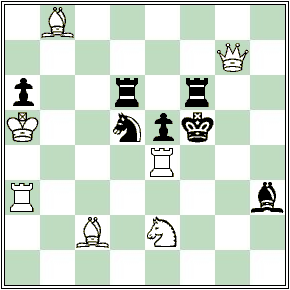
Nicholas de Terestchenko – Mate in two moves
Returning to the competition for the premier tournament, J.J. O’Hanlon’s local newspaper, the weekly Portadown Times, provided brief reports on his progress in three consecutive editions, with the final one revealing a controversial finale.
[Friday 27th January] At the International Chess Tourney at Hyères, Riviera, France, Mr. J.J. O’Hanlon, Portadown, beat E.H. Smith, Canada in the first round.
[Friday 3rd February] At the International Chess Tourney at Hyères, Riviera, France, Mr. J.J. O’Hanlon, Portadown, drew with V. Halberstadt, Russia, in the 4th round, and beat J. Keeble in the 5th round.
In the 6th round he beat A.J. Maas, Holland.
Leading scores are :-
O’Hanlon, Ireland 5.0
Halberstadt, Russia 5.0
[De] Terestchenko 4.5
Duchamp 4.5[Friday 10th February] The Hyères International Chess Tournament has resulted in a tie – J.J. O’Hanlon (Ireland), V. Halberstadt (Russia) and M. Duchamp (France) making an equal score.
These players will jointly hold the Philidor Challenge Cup and Championship of The Riviera for 1928.
At the start of the last round O’Hanlon was leading by one point, but after a few moves he accidentally touched a piece and was compelled to resign, and thus allowed two players to draw level with him.
A brief report on the tournament in the Belfast News-Letter chess column on 9th February provides an extra detail about the last round incident, revealing O’Hanlon’s opponent and thereby increasing the controversy level.
In the final round O’Hanlon lost to Duchamp through accidentally touching a pawn, which his opponent insisted upon his moving.
Hyères 23 January-3 February 1928
Final Crosstable
[Source: La Stratégie, 1928, page 39 via Jeremy Gaige: Chess Tournament Crosstables, Volume IV (1921-1930) page 802, amended to reflect the three games defaulted by Smith]
                         D  V  O  M  T  K  S  P  S  Pts
1=3. M. Duchamp          x  ½  1  0  ½  1  1  1  1   6
1=3. V. Halberstadt      ½  x  ½  1  ½  1  ½  1  1   6
1=3. J.J. O'Hanlon       0  ½  x  1  1  1  ½  1  1   6
4.   A.J. Maas           1  0  0  x  1  ½  1  1  +   5½
5.   N. de Terestchenko  ½  ½  0  0  x  ½  1  1  +   4½
6.   J. Keeble           0  0  0  ½  ½  x  1  ½  1   3½
7.   C. Stuart-Prince    0  ½  ½  0  0  0  x  ½  1   2½
8.   R. de Pampelonne    0  0  0  0  0  ½  ½  x  +   2
9.   E.H. Smith          0  0  0  -  -  0  0  -  x   0
We started with Vlastimil Fiala’s faint hopes for finding more games from the event. Now, to conclude, we can present our two small miracles, courtesy of O’Hanlon and the Belfast News-Letter.
Vitaly Halberstadt – John J. O’Hanlon
Philidor Cup, Hyères 1928 (Round 4)
[Source: Belfast News-Letter, 1 March 1928, page 13; annotations by O’Hanlon]
1.d4 d5 2.Nf3 Nf6 3.c4 e6 4.Bg5 Nbd7 5.e3 Be7 6.Nc3 0-0 7.Rc1 a6
Played by Janowski many years ago, and at that time it was thought that 8.c5 or cxd5 gave white the advantage. The Swiss player, W. Henneberger analysed the defence and proved that in reality 8.c5 was a bad move and he won a fine game from Alekhine in playing against the latter move. After this game, Alekhine was so impressed with the possibilities of this defence that he adopted it in a number of games in his match with Capablanca.
8.cxd5
In the earlier games of the Capablanca – Alekhine match Capablanca played 8.a3 without gaining any advantage, but he afterwards played the text move, which is, undoubtedly, the only move which gives any prospect of advantage.
8…exd5 9.Bd3 c6
This move is necessary, and at first sight it would seem that White has a very great advantage owing to Black’s weakness on the b6 and c5 squares, but in actual play it is very difficult, if not impossible, to exploit this weakness.
10.0-0
It would probably have been better for white to have played 10.Qc2 as now Black forces the exchange of Bishops and equalises the game at once.
10…Nh5 11.Bxe7 Qxe7 12.Ne5
Threatening to win a pawn by 13.Bxh7.
12…Nhf6 13.f4 Re8
A routine move whereas 13…Nxe5 14.fxe5 Ne8 followed by f6 would have given Black practically a winning advantage.
14.Qe1 Nf8
Black gains nothing by 14…Nxe5 15.fxe5 Nd7 16.Rf3 f6 17.Qh4
15.h3 N6d7 16.Rf3 f6 17.Nxd7 Bxd7 18.Kh2 Rad8 19.Qf2 Be6 20.a3 Bf7 21.Na4 Qc7 22.Nc5 Ne6 23.Qc2 h6
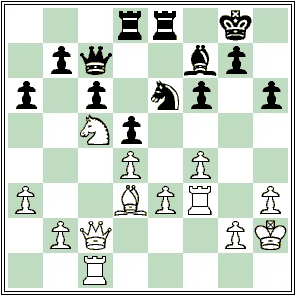 24.Nxe6
After this move, White offered a draw which, after some hesitation, Black accepted. If 24.b4 then 24…Ng5 25.Rg3 h5 26.fxg5 (If 26.h4 Rxe3 27.Rxe3 (if 27.hxg5 Qxf4 wins) 27…Qxf4+ 28.Rg3 Qxh4+ 29.Rh3 Nxh3 30.gxh3 Re8 winning) 26…h4 winning the Rook.
[Click here to replay the game]
Arthur J. Maas – John J. O’Hanlon
Philidor Cup, Hyères 1928 (Round 6)
[Source: Belfast News-Letter, 23 February 1928, page 5; annotations by O’Hanlon]
1.d4 d5 2.Nf3 Nf6 3.c4 e6 4.Nc3 Nbd7 5.Bg5 c6 6.e3 Qa5 7.Bxf6 Nxf6 8.Bd3 Bb4 9.Qb3 Nd7
White’s last three moves are recommended by Tartakower as giving an advantage to White but he now continues …9…0-0 10.Ne5 .The move in the game is distinctly better, and seems to give Black the advantage as he remains with the two Bishops.
10.0-0 0-0 11.Ne2 dxc4 12.Qxc4
No doubt better than 12.Bxc4 as it saves a move
12…Bd6 13.Ng3 e5
Black hesitated between this move and 13…c5 but finally selected the text move to remain with three pawns to two on the Queen’s side.
14.Qc2
If 14.Nf5 Bc7 [RR The way to equality is in fact 14…Nb6 15.Qc2 Bxf5 16.Bxf5 g6 17.dxe5 Bxe5 18.Nxe5 Qxe5] 15.Ne7+ Kh8 16.Nxc8 Raxc8 White has only exchanged his active Knight for an inactive Bishop, and is faced with the advance of Black’s Queen’s side pawns. [RR O’Hanlon misses the move 17.Ng5 threatening the pawns on f7 and h7, when best is 17…Qd5 but after 18.Qxd5 cxd5 19.Bf5 Rcd8 20.Nxh7 Rfe8 21.Ng5 Re7 22.Nf3 White has a considerable advantage.]
14…g6 15.Ne4 Be7 16.dxe5 Nxe5 17.Nxe5 Qxe5 18.f4
A weak move, but White was trying to get up an attack on the King’s side before Black could advance on the Queen’s side.
18…Qa5 19.a3 Bf5 20.Nf2 Bxd3 21.Nxd3 Qb6 22.Kh1 Rad8 23.e4 Rd4 24.Rae1 Rfd8 25.Rf3
If 25.Ne5 Black would have replied 25…Bf6 (and not 25…Rd2 because of the reply 26.Qc4).
25…Qb5 26.Ree3 c5 27.b3 c4
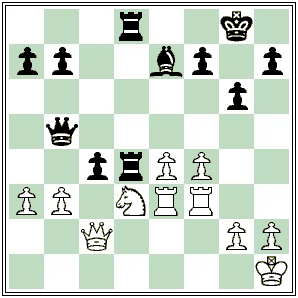
28.bxc4 Rxc4 29.Qe2
If 29.Qb2 Rxd3 winning a piece.
29…Bc5 30.Ne1
If White plays 30.Nb2 then 30…Qxb2 wins.
30…Bxe3 31.Rxe3 Qc5 32.h3 Rc3 33.Rxc3 Qxc3 34.Nf3 Qc1+ 0-1
[Click here to replay the game]
On the 2nd March 1928 the Portadown Times reported that O’Hanlon “had just received intimation that he had been awarded the special prize for the best game in the tourney” and it seems quite likely that it was for this game against Maas.