
“At the time I was 22 years old and easily the youngest member of the Irish team. Cranston, Creevey and O’Hanlon were already veterans of the chess-board; so that Ireland’s team had the doubtful distinction of being the oldest, in average age, which competed in Warsaw.”
(“International Team Tournament, Warsaw 1935” by Austin Bourke in “Chess in Ireland”, January 1960, pages 12-14)
Who played Board 4 against Poland?
In Who did Dake play? (to which today I have added a tailpiece) I addressed the uncertainty of whether T.G. Cranston or Austin Bourke (de Búrca) had played on Board 4 for Ireland in the Round 6 match against the U.S.A.
It turns out that this may not be the only misidentification involving those two players in some of the published material about the Warsaw Olympiad.
To start off our quest for the truth, here is Bourke’s take on how the Olympiad worked out for Ireland.
HOW IRELAND FARED
“It soon became obvious that the Irish team was rather outclassed – and there wasn’t even the consolation of young players gaining valuable experience. Indeed I watched the first third of the tournament from the sideline, for at least with the Irish team, the term “reserve player” was taken literally. Reilly and O’Hanlon played in all nineteen rounds. I was eventually brought on to the team on five occasions when the opposition was so strong that defeat was inevitable in any case; surely a baptism of fire for the young intruder. But when poor Cranston was laid low with digestive troubles, I got three further games against less stern opponents, and even won a game, rather luckily, against Salo of Finland. Reilly won in the same match, so Ireland drew with Finland as a single bright spot amongst eighteen defeats.”
24 years had elapsed for Bourke since playing at Warsaw until writing his article for Chess in Ireland. His recollections may have become a little hazy in that time. However, by doing a simple calculation, the article suggests that he played 8 games in total.
However, our own database lists all the games played by the Irish team at Warsaw (plus the Cork-born Hugh Alexander who played for the British team) and only gives (at least until now) seven games for de Búrca, as seen below. That total number and opponents (including Dake) concurs with the same in major databases such as Chessbase and Olimpbase.
Golombek, Harry	   de Búrca, Austin  1-0 (4.4)  1935.08.18
Dake, Arthur       de Búrca, Austin  1-0 (6.4)  1935.08.20
de Búrca, Austin   Réthy, Pál        0-1 (7.4)  1935.08.21
Danielsson, Gösta  de Búrca, Austin  1-0 (8.4)  1935.08.21
Raizman, Maurice   de Búrca, Austin  1-0 (11.4) 1935.08.24
de Búrca, Austin   Salo, Toivo       1-0 (18.4) 1935.08.30
Luckis, Markas     de Búrca, Austin  1-0 (19.4) 1935.08.31
The first thing I should point out is that not all the game scores from Warsaw 1935 have entered the public domain. This applies to the game below, from the Ireland -v- Poland match which is the focus of our attention for misidentification.
Friedmann, Henryk Cranston, T. G. 1-0 (15.4) 1935.08.27
The alternative spelling Friedman is used in many sources, and which from this point I shall use in preference.
The alleged Friedman-Cranston game is one of 17 games currently listed for Cranston in the IRLchess database and in others, e.g. Chessbase). It also appears in A.J. Gillam’s Warsaw Olympiad 1935 (Nottingham, 2020) as game 592 at page 271 (though, of course, it is only a stub).
There is, however, contrary evidence elsewhere that de Búrca in fact played 8 games and Cranston only 16 and that the correct listing for the Board 4 game in the Poland-Ireland match is Friedman-de Búrca.
In Chess Olympiads by Árpád Földeák (Corvina Press, Second enlarged edition, 1968) there are extensive statistical tables and at page 113 (see Table 1) the overall scores for the Irish team members at Warsaw 1935 are given: Cranston 16 games, de Búrca 8.
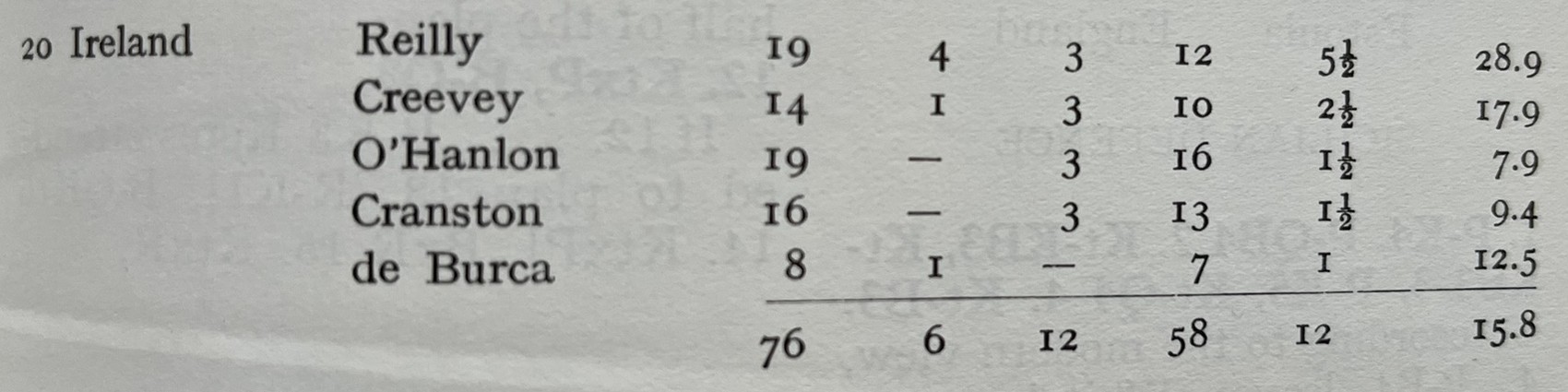
Table 1
Warsaw 1935 International Team Tournament by Fred Reinfeld and Harold M. Phillips (Black Knight Press, 1936) also provided the individual scores of every player. At page xii (see Table 2) the scores for the Fourth Board players and the Alternates (or Reserves) are again: Cranston 16 games, de Búrca 8.
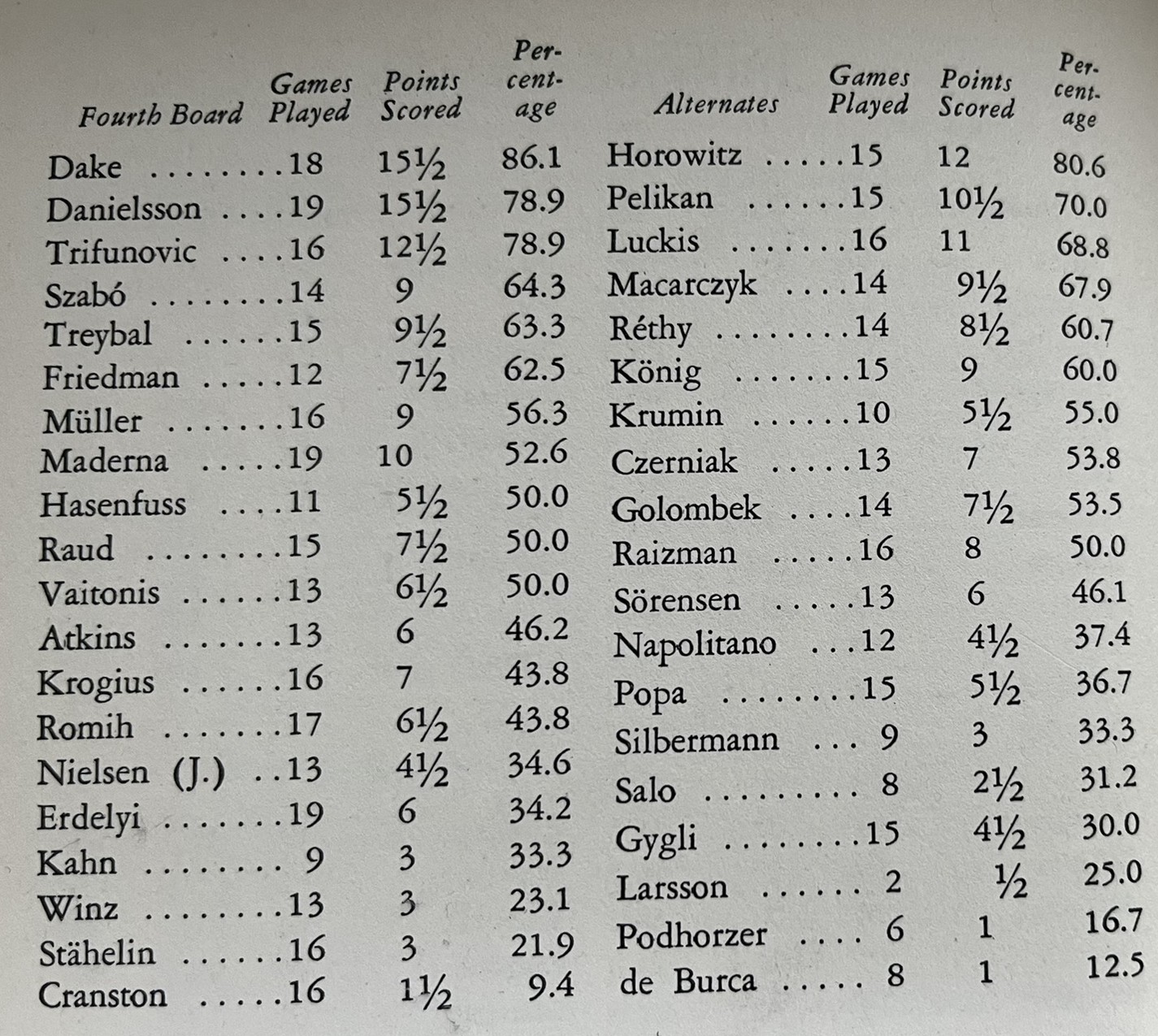
Table 2
VI Wszechświatowa Olimpiada Szachowa, Warszawa 1935 by Mirosława Litmanowicz (Warsaw, 1996) provides a contradictory picture of the game totals for Cranston and de Búrca.
In that book, each competing country was allocated a separate chapter outlining its performance. In the chapter for Ireland, at page 314 (see Table 3) the individual scores for each player are given: Cranston 17 games, de Búrca 7.
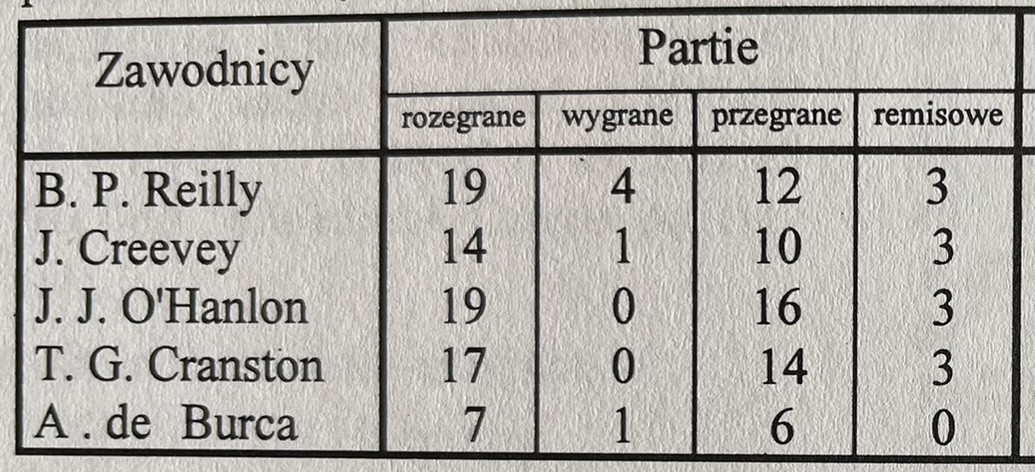
Table 3
For the avoidance of doubt, immediately below is the translation from Polish to English of the words given in Table 3.
zawodnicy partie rozegrane wygrane przegrane remisowe
players   games  played    won     lost      drawn
At pages 55-66 there are a number of statistical tables given by Litmanowicz.
In “Tabela 5. Indywidualne wyniki zawodników” (Individual results of players) all 99 players are listed in descending order of percentage score. At page 62 we find the lower reaches of that Tabela/Table (see our Table 4) where unfortunately we find all the Irish players: Cranston 17 games, de Búrca 7 again.
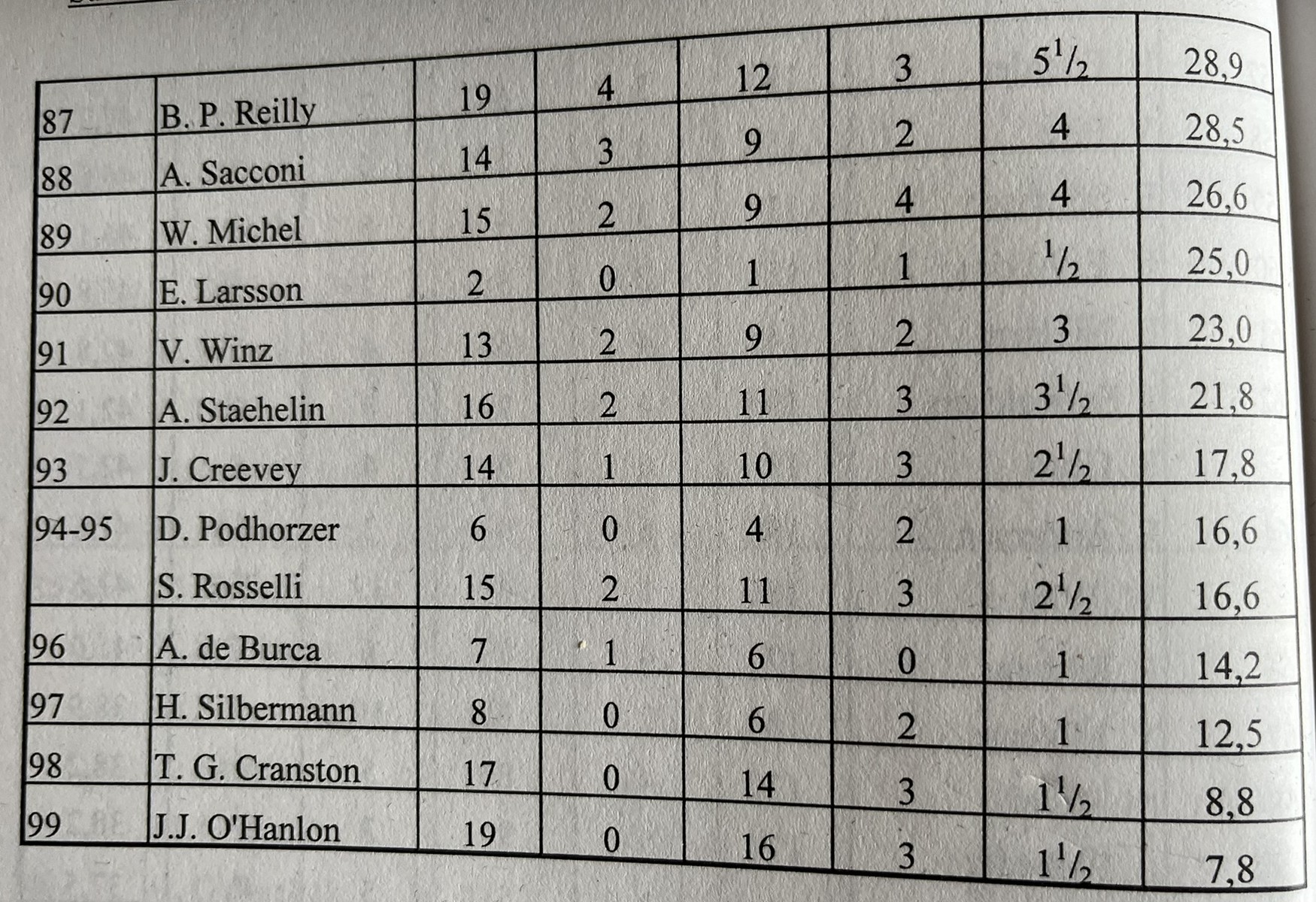
Table 4
However it is a different story when we come to Litmanowicz’s “Tabela 6. Indywidualne wyniki zawodników wedlug szachownic” (Individual player results by board). First an excerpt from page 65 (see our Table 5) from the Board 4 results: Cranston only 16 games.
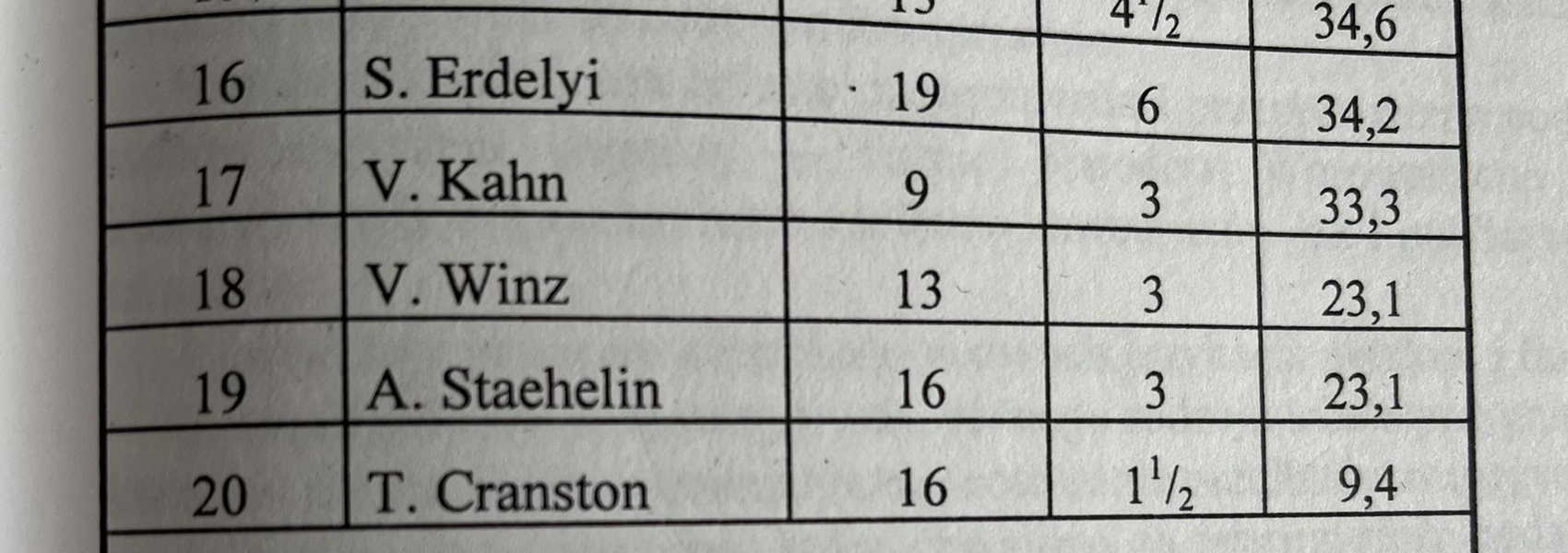
Table 5
Now, on page 66 (see our Table 6) we find the tail-end of the Reserves’ totals: De Búrca goes up to 8.
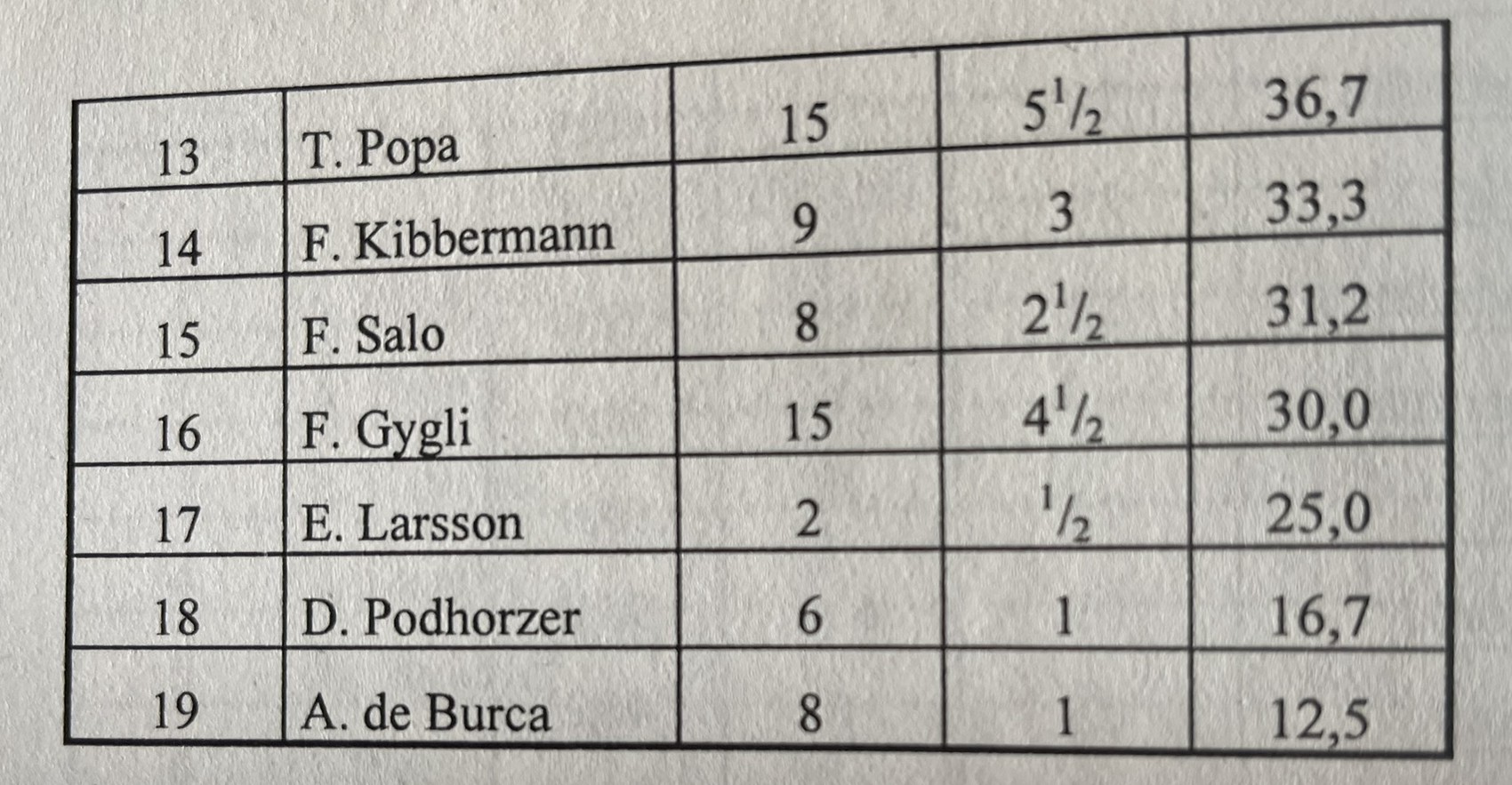
Table 6
However, there is another piece of relevant information in Litmanowicz and I would suggest that it provides a compelling argument in favour of the Cranston 16 games, de Búrca 8 games version of events. It helps particularly with proving there is a second game from the event (the first being the game against Dake) where there has been a misidentification between Cranston and de Búrca.
From pages 16-51 there is a chapter entitled Przebieg rozgrywek (Course of the games). A large part of the chapter is given over to a round-by-round report of the tournament and usually the individual results of the Polish team are given for each round. At pages 41-42 can be found the report on Round 15 including reference to the individual results in the Ireland-Poland match (see extract immediately below).
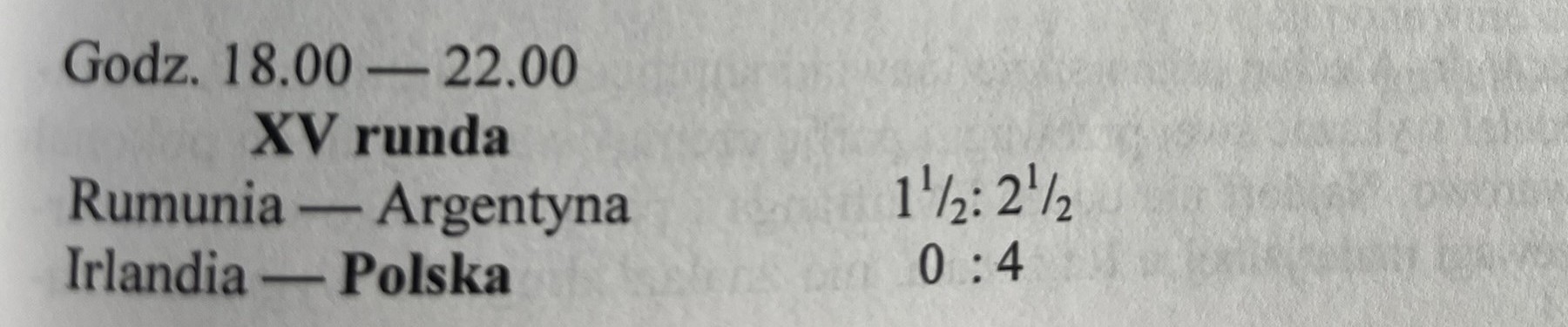
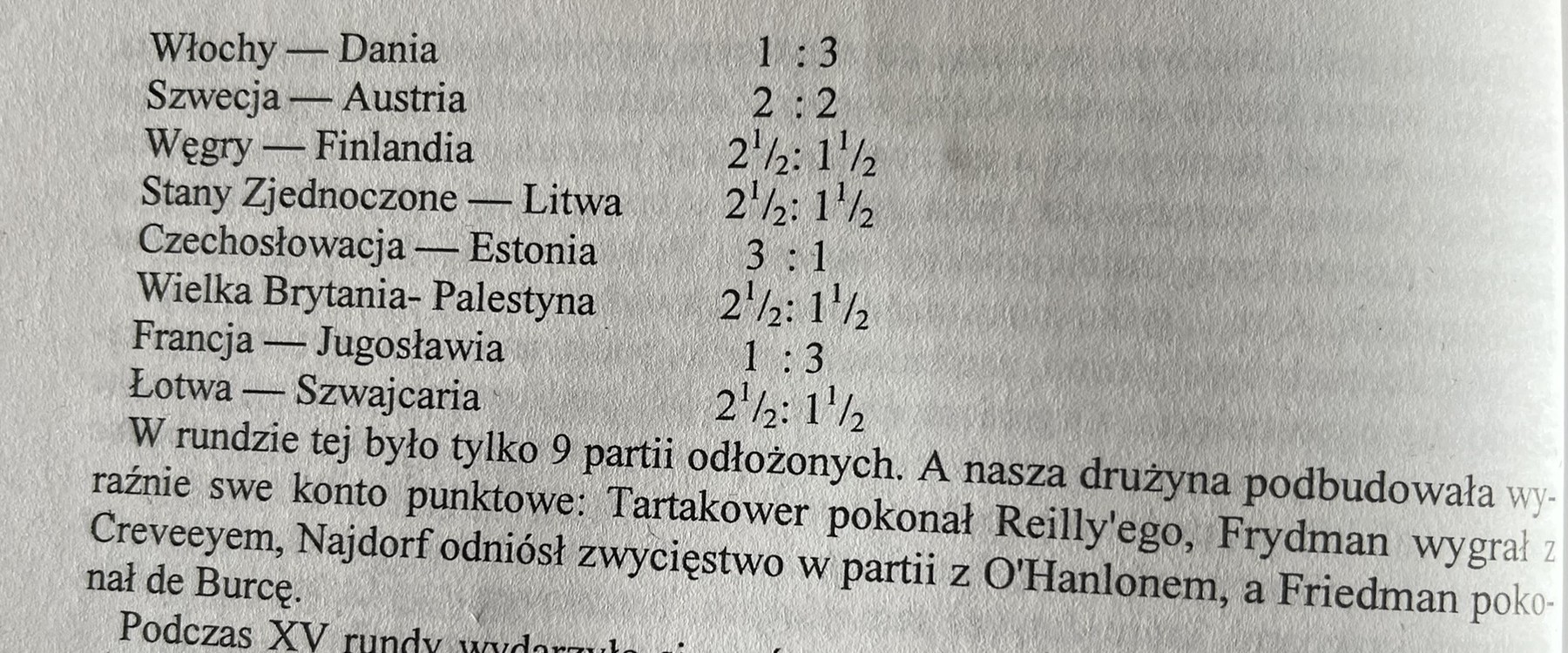
The final part of this excerpt translates into English as:
Tartakower defeated Reilly, Frydman defeated Creevey, Najdorf won the game against O’Hanlon, and Friedman defeated de Búrca.
So here, we have the evidence – from a Polish author, who had access to many Polish contemporary sources – that Friedman’s opponent was not Cranston, but instead de Búrca.
Of course, there might still be a nagging doubt over the discrepancies in the Litmanowicz statistical tables. However there is one final piece of evidence, that I consider wins the day for my hypothesis and it is moreover from a contemporary source.
The British Chess Magazine in its October 1935 edition contained a lengthy report on the Warsaw Team tournament, and which included the detailed results of every one of the matches played. Here, from page 445, is the result of the Poland-Ireland match.
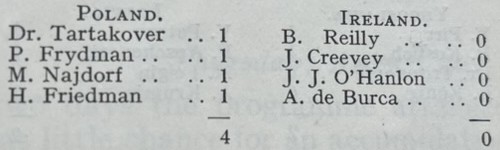
Quod erat demonstrandum.
Bourke-Salo
This game, played in the Ireland-Finland match and mentioned in Bourke’s Chess in Ireland article on Warsaw 1935, does not seem to have found its way into the databases nor any of the major books on the event.
The game-score is to be found in the chess column of Bourke’s local newspaper, the (Cork) Evening Echo. Unfortunately the legibility of the source’s digital column is not optimal though fortunately good enough to read the game score, but the appended notes on the game (probably by the editor W.R. O’Shea, and possibly based on comments by Bourke) are indecipherable. However, it is possible to see in the game-score the bracketed letters (from a to i) used to identify each note – and they are after moves black 2, black 3, white 14, black 15, white 18, white 21, white 24, black 24 and white 30. This does provide a rough guide to various significant points in the game
It is a complex game and worth studying in depth. I used Stockfish 14 to assist my understanding and the annotations are intended to provide no more than a few signposts on a journey through the game. Hopefully the computer engine has helped me avoid any egregious errors.
Aibhistín de Búrca – Tapio Salo
Olympiad Warsaw (Round 18, Board 4), 30 August 1935
[Source: Evening Echo, Saturday 15 February 1936, page 6]
1.d4 d5 2.c4 dxc4 3.Nf3 a6 4.a4 Nf6 5.e3 Bg4 6.Bxc4 e6 7.0-0 Nc6 8.Nc3 Bd6 9.Re1 0-0 10.h3 Bf5 11.g4 Bg6 12.e4 e5 13.Bg5 exd4 14.Nd5 Be5 15.Nh4
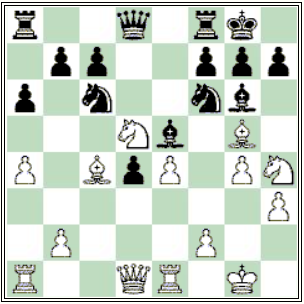
15…Na5
15…h6 was a plausible alternative and after 16.Nxg6 fxg6 17.Bxf6 Bxf6 if White goes material hunting with 18.Nxc7+ Kh7 19.Nxa8 then Black could counter-attack with 19…Bh4 20.Rf1 Ne5 21.Bd5 when both 21…Nf3+ and 21…Rf3 look promising.
16.Ba2 d3 17.f4 Bxb2 18.Rb1
Here White could have offered the exchange by playing 18.f5 or or 18.e5 when, in both cases, capturing the Rook would give White a strong attack. 18.Nxg6 is probably not as strong as the two pawn moves, if Black’s declined the exchange sacrifice, but accepting with 18…Bxa1 would have been catastrophic for Black after 19.Nde7+.
18…Bd4+ 19.Kg2 c6
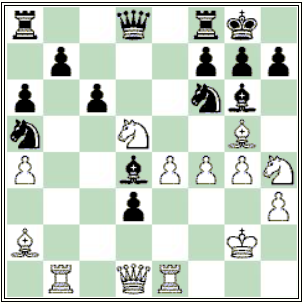 20.e5
20.e5
Here the alternative pawn push 20.f5 might have been better. White can win a piece with 20…cxd5 21.fxg6 hxg6 22.e5 but he would not necessarily be better, e.g. 22…Bxe5 23.Rxe5 when now Black can try 23…Nc4 24.Re1 d2!? 25.Bxd2 Ne4 26.Bxc4 Qxh4. White would now be forced to play 27.Rxe4 and after 27…dxe4 28.Rxb7 Stockfish 14 assesses this as 0.00.
20…cxd5 21.f5 h6
Better here would be 21…Bxe5 22.Rxe5 Nc4 23.Re1 h6! with advantage for Black.
22.Bxf6 gxf6 23.fxg6 fxe5 24.gxf7+
The alternative was 24.Nf5 fxg6 25.Nxd4 exd4 26.Qxd3. The pawns at d4, d5 and g6 are all targets and Re6 is a threat. Best for Black might be the counter-attacking 26…Qf6; e.g. 27.Bxd5+ Kh8 and if 28.Re6 Qf2+
24…Kh8
Black had to sacrifice the exchange, viz. 24…Rxf7 and if 25.Nf5 then 25…Rxf5 26.gxf5 Qg5+ with good counter-attacking chances.
25.Ng6+ Kg7 26.Nxf8 Qxf8 27.Bxd5 Qc5 28.Qf3 Rf8 29.Rf1 Qd6
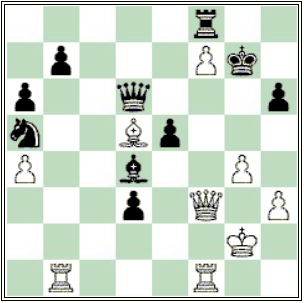
30.Be4?
Letting Black back into the game. Instead 30.g5 immediately and if 30…hxg5 31.h4 gxh4 32.Kh1 and the threat of Rfg1 is decisive.
If (instead of 30…hxg5) Black plays 30…h5 now 31.Be4 works; if still 31…Nc4 32.Qxh5 the only way to prevent mate in two is 32…Ne3+ 33.Kh1 Nf5 and after 34.Rxf5 White is a Rook up – plus Stockfish asserts it is at most mate in 9. In this line if (instead of 31…Nc4) 31…Rh8 is played then 32.Qf5 and …f8(Q) followed by mate is inevitable.
30…Nc4 31.g5 Ne3+ 32.Kh1 Nxf1 33.Rxf1 hxg5 34.Qf5 Qh6 35.Bxd3
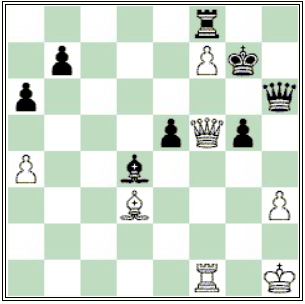
35…a5
Black must play 35…e4 to allow his Bishop to help out the defence. After 36.Bxe4 best is probably 36…b5 when 37.a5 may well be better than capturing the pawn. White could probably keep the pressure on, hoping Black cracks.
36.Rf3
36.Be4 stopping …e4 would be stronger. One idea available would be pushing h4 – for instance (although not forced) after 36…b6 37.Rf3 Bb2 38.Kg2 Bd4 39.h4! gxh4 (39…Qxh4 40.Qf6#) 40.Qg4+ Kh8 41.Kh3 and mate in ten according to Stockfish. However the move actually played turned out well. White’s relentless pressing finally paid off as Black now self-destructed.
36…Qh5?? 37.Qf6# 1-0
[Click here to replay the game]
A tongue-in cheek assertion
Austin Bourke provided an article for the Evening Echo chess column which appeared in the 16th April 1936 edition of the newspaper. He used the events of Warsaw 1935 and particularly his win against Salo to produce an over-elaborate claim to star status.
“AM I WORLD CHAMPION?”
by AUSTIN BOURKECapablanca set a stiff standard for succeeding world champions when, for a period of some three or four years, he played continuously in tournaments, and never lost even a single game. So that today, when in some obscure tournament, a Master, stale with too many simultaneous displays, slips up to some unknown amateur, the chess correspondents shake their heads and say:” Is X as good as he used to be?” However, even Homer nods (I have lost games myself!), and if every victor in every chess game is a better player than every vanquished, then I am World Champion! Why, on Warsaw form alone — I beat Salo (Finland), who beat Popa, of Rumania. Popa beat Golombek (England), who beat Horowitz (U.S.A.), who, in turn, beat Trifunovic, of Yugoslavia. Trifunovic beat our own O’Hanlon, who drew with Stolz, of Sweden. Stolz beat Marshall (U.S.A.), who beat Grunfeld (Austria). And Grunfeld drew with Alekhine, Flohr, Tartakover, Vidmar, Book, Winter, Stahlberg, etc. [all] of which goes to prove I could give Alekhine pawn and move. It may not be to far out, at that!
Epilogue
The final paragraph of Bourke’s Chess in Ireland article brought together his chess and work careers, and acknowledged the immense events that had occurred between two visits to Warsaw.
“The building in which the Team Tournament was held had immediately previously housed a meeting of the International Meteorological Organisation, a body then unknown to me. Last year, after a lapse of twenty-three years, I returned to Warsaw , and was elected President of Commission for Agricultural Meteorology of the World Meteorological Organisation! I looked for the old Military Club in which the chess tournament had been held, but it had vanished in the destruction and rebuilding of Warsaw. So much had changed; only the indomitable spirit of Poland, which has survived so much and continues to endure, remained unchanged.”