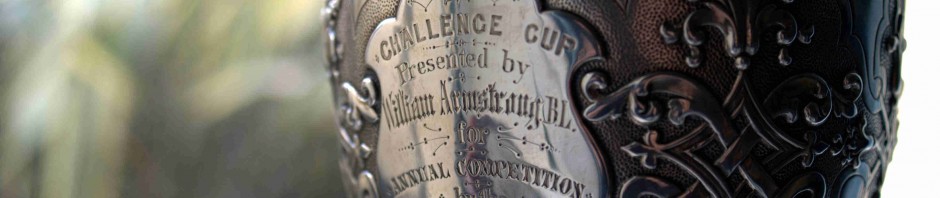
David McAlister’s post on O’Hanlon at the 1940 Irish Championship included an additional postscript comment by him, saying that the original version of the post had a couple of naming errors, now corrected.
This post concerns the second of these, concerning S. A. French. The error came from me and affected several other pages on this site.
S. A. French of Dublin C.C. was on the Dublin team that won the Armstrong Cup in 1932-33. As reported here previously, the January 1934 issue of B.C.M. had an excellent photograph of the team, with S. A. French at back left; he looked clearly the youngest of the team.
The Players and Players: References pages here provide biographical information about players, and naturally I sought more information on him, starting with his name: what did the “S. A.” stand for? This was not easy to answer, as sources stuck rigidly to the initials. Eventually I found an Evening Herald article from June 19, 1926 that listed 85 Irish players who were to play in a mammoth Anglo-Irish correspondence match against a team chosen by the British Chess Federation, and one of the players listed was Sean French. This seemed straightforward, and the Players and Players: References (“FRENCH, S.[eán] A.. Evening Herald, 19 June 1926 p. 8 (first name).”) were updated accordingly.
When David posted on the 1940 Irish championship and began his tournament report on it, I reopened the search to see if I could find his year of birth or other information. But further information on “Sean French” and Dublin chess did not emerge, and even mentions of “Sean French” and “chess” proved elusive. All I could find was a review of “Sport in the South”, from the Sunday Independent in December 1934, covering rugby, tennis, golf, boxing, and bowls, but devoting a good quarter of its discussion to chess, which mentioned that “Ald. Sean French, the Lord Mayor of Cork, is a “fan””. This seemed thin, as someone—especially a politician—can be a fan without being a player, and this seemed a little unlikely to be the same person as the Seán French from the 1926 Anglo-Irish correspondence match. But in any case, it couldn’t possibly be the same person as the S. A. French wo played in the Irish Championship in 1940, because the Lord Mayor died in 1937.
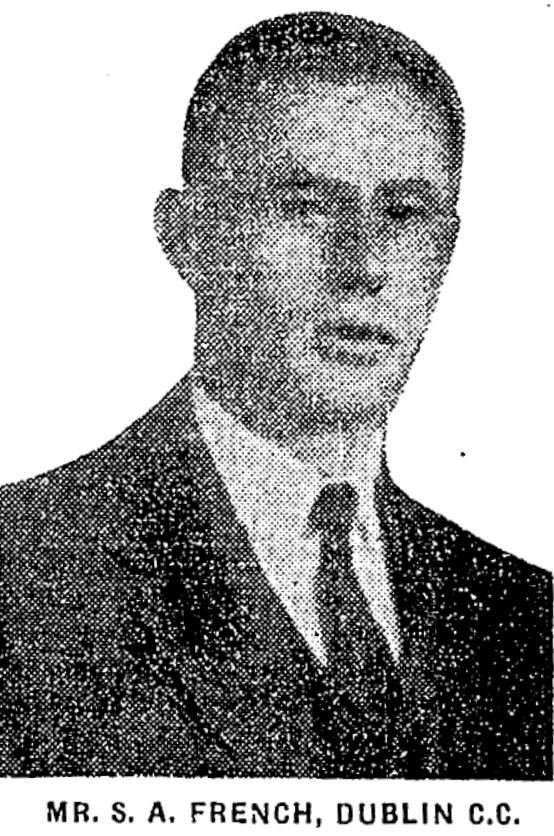
On the other hand, references to S. A. French, a solicitor in Greystones, without mentioning chess, were common. Some stories on Evening Herald fundraising events for the Warsaw Olympiad 1935 said that S. A. French of Greystones had suffered a recent bereavement with the death of his father. Finally (or so I thought), I found the birth cert. for Samuel Allen French, born in Dublin in 1899, son of a solicitor’s clerk, and thought that must be the same person. But his father, Samuel Henry French, didn’t die until 1955, so how did the bereavement fit in? (A clergyman who died in Greystones around the right time did not fit either, as two of his three sons were in Canada and the other was a rector in Cork.)
I found a little later that Samuel Allen French’s mother died on May 16, 1935. So perhaps the Evening Herald correctly reported a bereavement, but had the wrong parent.
This still left a sliver of doubt, but searching via “Greystones” “chess” found an Irish Independent story on the founding of Bray/Greystones C.C. that mentioned him, finally giving his first name (“Sam French was one of the most experienced players in the club, and indeed, his photograph taken in 1920 adorned the walls of Dublin Chess Club for many years, when he was an ‘international for Ireland’”). David McAlister then provided the final proof with an obituary from the Irish Times from 1978 for Samuel Allen French.
FRENCH, Samuel Allen, b. Rathmines, Co. Dublin, 7 March 1899, d. Dublin?, 29 April 1978.
He was a local historian in Greystones, and authored a booklet Greystones 1864-1964 to mark the centenary of St. Patrick’s Church in the town.
S. A. French’s paternal grandfather was the celebrated and historically significant photographer Robert French (1841-1917), whose “photographs provide an invaluable visual record of urban and rural Ireland over a period of almost forty years”, according to his entry in the Dictionary of Irish Biography. Around 30,000 of his negatives are held by the National Photographic Archive in Dublin.
But this still left the question of who was the Seán French who played in the Anglo-Irish correspondence match in 1926? After searching further, I found a report of a Cork v. Limerick inter-city match, held in Cork on St. Patrick’s Day 1927. On board 6 for Cork, out of 14, and winning his game, was “the Lord Mayor of Cork, Mr. S. French”. So the player and the politician were the same person after all.
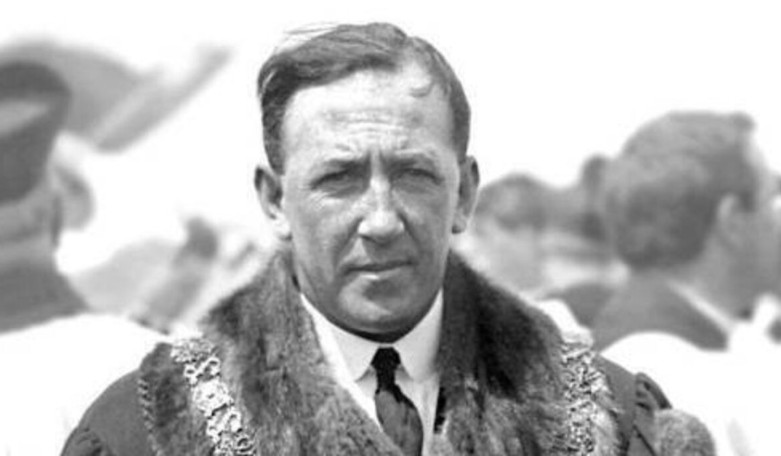
EchoLive.ie, November 22, 2023
Seán French’s colourful life is captured in an article in the Dictionary of Irish Biography. He was born in Cork in 1889, and after “a brilliant collegiate career studying chemistry, he became a partner in a well-known Cork firm of pharmaceutical chemists, Whelan & French. Although he never held any high rank in the Irish Volunteers or later the Irish Republican Army (IRA), he was very active in the independence movement and spent a considerable period of time interned or on the run. He was a close associate and friend of both Terence MacSwiney and Tomás MacCurtain” (Sinn Féin Lord Mayors of Cork who died during the War of Independence). He opposed the Treaty and was interned during the Civil War. He was subsequently elected as Lord Mayor of Cork in 1924, and repeatedly re-elected, serving from 1924-29 and 1932-37. He was a founding member of the Fianna Fáil party in 1926, and served as a T. D. for Cork Borough, in the 5th and 6th Dáils, from 1927-32.
He was known as a rugby player and oarsman as a youth, but was chronically infirm later in life. He died in 1937.
FRENCH, Seán, [John French], b. Cork City, 29 May 1889, d. Cork City, 12 September 1937.
His son, also Seán French, 1931-2011, served as a Fianna Fáil T. D. for various Cork constituencies from 1967 to November 1982, and was also Lord Mayor of Cork, from 1976 to 1977.