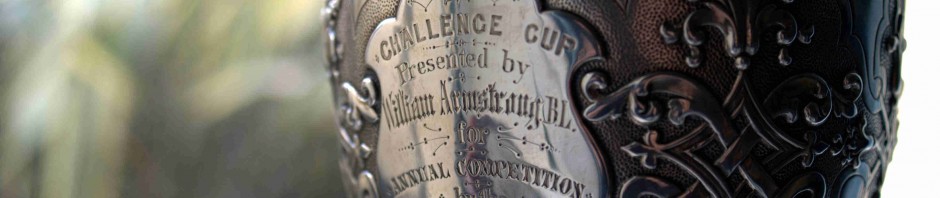
The Evening Echo for Saturday 9th February 1935 gave Sonja Graf the big build-up, with some impressive evidence to back it up.
TO VISIT CORK.
FRAULEIN SONJA GRAF.
Up to recently, Fraulein Wally Henschel (Hamburg) was the sole, and none too successful representative of German women’s chess to partake in important tournaments (Hamburg, 1930, Prague, 1931). Early in 1933 Fraulein Henschel was displaced from the women’s championship of Hamburg by Fraulein Ehlers (Hamburg), but Frau Ehlers, too, was destined to enjoy her title for only a short time, for suddenly a new star rose in the German women’s chess world. From Munich, by way of Holland, where she had swept all before her in simultaneous displays, came the small and very slender Fraulein Sonja Graf to beat Frau Ehlers by such a convincing margin (five wins and one draw to no wins) that, coupled with her previous successes against established Hamburg Masters, it removed any remaining doubt as to who was the greatest living German woman chessplayer. The German Masters, Paul Kruger and Alfred Brinkmann, among others, have acclaimed her us such.
Fraulein Sonja Graf’s style, which shows her as a pupil of the Tarrasch school, is, in contrast to the general play of women chessplayers, bright, aggressive and full of combinations, whilst she specialises in Queen sacrifices. She shows the imagination and temperament that are the legacy of her Russian descent. Her play is sometimes a little wild and unbalanced, but her ability is beyond question. In the International Women’s Tournament (June, 1932, at Vienna) she won first prize. In the winter of 1933-34 she took part in the Master Tourney of the Munich Chess Club, an unprecedented happening for a German woman, and emerged with a very creditable score just behind the prizewinners. Brian Harley thinks she is the second greatest woman chess player in the world, and recollects a match between herself and Miss Menchik in which she managed to snatch a win from the lady champion of the world. On next Wednesday evening, February 13th, at the Pavilion Café, Cork, from 7 p.m. to 10.30 p.m., Fraulein Sonja Graf, the German chess wizard, will face the leading chess lights of Cork, when she will play 16 boards simultaneously. An event of outstanding importance, this spectacular exhibition of brainwork by a lady chess player, eminently qualified to undertake the task, has aroused widespread interest, and speculation is already rife as to the results.
On the day of the Simultaneous Exhibition, the Evening Echo had a further preview of the event, including high praise for Sonja from the soon-to-become World Chess Champion.
Fraulein Sonja Graf, the 21-year-old woman champion of Germany, who is presently touring Ireland, arrives in Cork to-day to conduct a simultaneous display at the Pavilion Café this (Wednesday) evening, commencing at 7 p.m., when she will face 16 of the best chess-players in Cork. In view of her fine record and great success at Dublin recently, great interest is attached to her performance this evening. Chess-players interested in the display are invited to be present. Dr. Max Euwe, the Dutch champion and candidate for world championship honours against Dr. Alekhine, in a match to be played soon at The Hague, says she is better than Miss Menchik, woman champion of the world.
The day after the simultaneous exhibition, the Evening Echo was still rolling out the superlatives.
A REAL MASTER
Last evening, at the Cork Chess Club, Pavilion Café, Fraulein Sonja Graf, the woman champion of Germany, on the invitation of the club, gave a simultaneous display of chess against sixteen of the best players in the city. This young lady – she is only 21 years of age—came with a big reputation. Not alone is she lady champion of her native land, but she had the honour of winning a game against the lady champion of the world, Miss Menchik, recently in London.
Her reputation had preceded her to Cork. Last week in Dublin, where she is at present spending a holiday, she gave four simultaneous displays. She played sixteen boards on each occasion and only suffered eight defeats —two losses on each of the four nights.
Her opponents last night included Mr. R Archer, many times champion of Cork, and Austin Bourke, present champion of Munster. The results entirely favoured [the] Fraulein as out of the sixteen boards she only lost two games, winning six and drawing eight. This convincing display speaks for itself, and Fraulein Sonja Graf certainly deserves to be congratulated on the manner in which she played. A remarkable feature of the display was the speed at which she moved. She averaged fifteen moves at each board in the first hour, or fifteen seconds per move. She played bright, forceful chess, and proved herself a real master when defending with Black. She returns to Dublin this afternoon and leaves Ireland on Saturday next. It may be of interest to mention that [the] Fraulein played continuously for over four hours.
The Saturday edition of the Evening Echo provided an extensive review of the events of Wednesday night.
THE WEEK’S GREAT EVENT.
FRL. SONJA GRAF’S VISIT.
Fraulein Sonja Graf has come and gone, and her coming caused a great sensation in Cork, as evidenced by the great concourse of visitors that thronged the Pavilion Café on Wednesday evening, when she faced sixteen of the strongest chess players in Cork. After the Secretary of the Cork Chess Club had introduced the lady champion of Germany, play commenced at 7.20 p.m., when she had White on the first eight boards and Black on the remaining eight. Moving with extraordinary quickness she replied to her opponents’ moves with a rapidity that amazed everybody, and when the first hour had struck she had made a complete circuit of the tables fifteen times, and in two hours had made twenty-five moves against each player. As the evening progressed, the spectators increased in numbers and here and there knots of people congregated near a player with an interesting position. Fraulein Sonja Graf was now moving more slowly. Play had passed the initial stage, and intricate, situations had arisen that called for greater thought as the result of her having sprung various traps here and there. A bait of Pawn was offered at some boards, whilst at others she was planning difficult combinations in an effort to puzzle her opponents and involve them in making a hasty foolish move. At 8.45 p.m., there was a break of fifteen minutes for a rest. When play was resumed at 9 p.m. it was obvious that some results would soon be forthcoming and at 9.30 p.m. the Secretary announced the first win of the night in favour of the German which was greeted with applause. Numerous draws followed. Sonja suffered her first loss at the eighth board, where the best game of the evening was played. Here she met the hero of the evening — not with a smile but with the King’s Gambit, the most daring opening on record, which was declined by her prudent adversary. The game, from an early stage had attracted a gallery that were admirers of the able manner in which Black was handling his defence. Eventually a crisis was precipitated, and a series of most brilliant counter-checks followed, and on the 28th move Fraulein Sonja Graf resigned, and Mr. O’Donovan received a warm handshake from the most dangerous opponent he has over crossed swords with in chess, which was followed by numerous handshakes and applause all round. Mr. O’Donovan’s was the outstanding win of the night. He is a popular member of the C.Y.M.S. Chess Club, where his name has figured prominently this season.
In passing, there are two other players who are warmly deserving of recognition for their draws; these are Mr. J. Good and Mr. R. Jagoe, two most popular Cork chess players. The final results were — Six wins, eight draws and two losses for Fraulein Sonja Graf. She maintained her reputation, and proved herself to be a chess-player of the finest type, and all those with whom she came in contact while in Cork on Wednesday night were unanimous in acclaiming her as a worthy representative of the Fatherland, and that her play was of the highest order of merit, and of the standard of a master; whilst the display itself will always be remembered as an exhibition of coolness, skill and courage, and an endurance test that no one present would care to undertake. Mr, J. J. O’Hanlon, ex-champion of Ireland, was also present, and acted a co-adjudicator.
Result-

         PLAYING BLACK

1.  R. Archer               1
2.  B. St. J. Galvin        ½
3.  W.J. L. O'Connell M.E.  ½
4.  W.G. Whittaker          ½
5.  Austin Bourke           ½
6.  M. Madden               0
7.  C. O'Leary              ½
8.  Chris O'Donovan         1

         PLAYING WHITE

9.  D. Tuohy                0
10. Dr. G. T. Pyne          0
11. Dr. A. Whelton          ½
12. R. Jagoe                ½
13. Joe Gilroy              0
14. Miss V. Lynch           0
15. John Good               ½
16. B. Flahive              0
Normally the player giving a simultaneous display takes the White pieces on all boards, so it was a generous gesture by Sonja Graf to gift them to the bottom eight Boards – particularly as the top eight were as strong a group of Cork-based players as could be put out to face the German champion.
On Saturday 23rd February the Evening Echo published four game scores from the top eight group.
Sonja Graf – Chris O’Donovan
Simultaneous Exhibition, Cork, 13th February 1935
1.e4 e5 2.f4 d6 3.Nf3 Nc6 4.Bb5 Nf6 5.0-0 Bg4 6.d3 Be7 7.f5 0-0 8.Bxc6 bxc6 9.h3 Bxf3 10.Qxf3 d5 11.Nc3 dxe4 12.dxe4 Kh8 13.Be3 g6 14.Rad1 Qc8 15.Bh6 Rd8 16.fxg6 fxg6 17.Qg3 Qe6 18.Rf5
Precipitating the crisis.
18…Rxd1+ 19.Nxd1 Bc5+
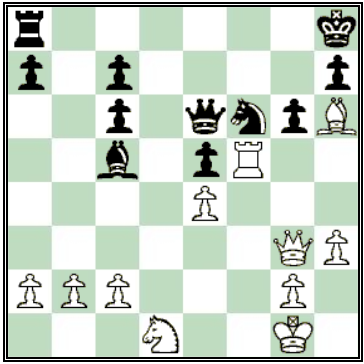
20.Kf1?
20.Kh2 was the correct move when 20…Nxe4 21.Rxe5 Nxg3 22.Rxe6 Nf1+ 23.Kh1 Ng3+ 24.Kh2 Nf1+ is perpetual check. If (instead of 20…Nxe4) if Black plays 20…Bd6 21.Rf1 Nxe4 22.Qh4 Nc5 the position is roughly even.
20…Rd8?
Missing 20…Qc4+ 21.Ke1 (or 21.Qd3 Qxd3+ 22.cxd3 gxf5) 21…Qxe4+ winning.
21.Rxe5?
Unfortunately for Graf, this forces O’Donovan to find the move he missed previously. Instead White has a difficult to see resource found by Stockfish 14: 21.Nf2 Bxf2 22.Rxf2 and after 22…Nxe4 White has 23.Qd3!! and if now 23…Rxd3 24.Rf8+ Qg8 25.cxd3 Nd6 26.g4 the most likely result is a draw.
21…Qc4+ 22.Ke1 Qd4
This is good enough to secure the win but Stockfish 14 prefers 22…Qxc2 23.Nc3 (23.Qf3 Rxd1+ 24.Qxd1 Qf2#) 23…Bd4 as an easier road to victory.]
23.Nc3 Bd6 24.Bf4 Kg8 25.Rg5 Nxe4
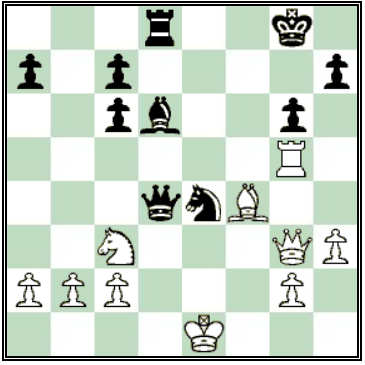
26.Rxg6+
A last desperate attempt, hoping for 26…hxg6 27.Qxg6 when White can still hope to keep the complications alive.
26…Kh8! 27.Rxd6
Losing immediately, but there does not seem to be any move here that would have prevented Black from taking the win.
27…Qg1+ 0-1
[Click here to replay the game]
The other three games given in the Echo were cagey affairs with the Cork players seemingly content to steer the games to a draw.
Sonja Graf – Cornelius O’Leary
Simultaneous Exhibition, Cork, 13th February 1935
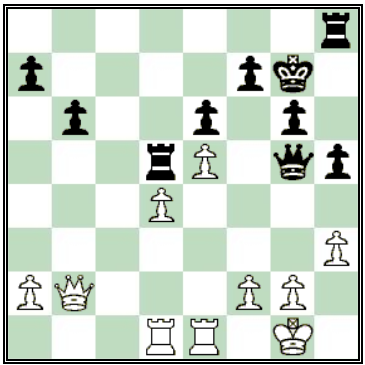
1.d4 e6 2.c4 d5 3.Nf3 Nf6 4.Bg5 Be7 5.e3 Nbd7 6.Nc3 c6 7.Bd3 dxc4 8.Bxc4 Nd5 9.Bxe7 Qxe7 10.e4 Nxc3 11.bxc3 Nf6 12.Qc2 c5 13.0-0 b6 14.Rab1 cxd4 15.cxd4 0-0 16.Rfe1 Qc7 17.Qb3 g6 18.Rbc1 Qf4 19.Bd3 Bb7 20.Qb1 Rad8 21.Bc2 h5 22.Rcd1 Kg7 23.h3 Rh8 24.Ne5 Nd7 25.Nxd7 Rxd7 26.Qb2 Qf6 27.e5 Qg5 28.Be4 Bd5 29.Bxd5 Rxd5 ½-½
[Click here to replay the game]
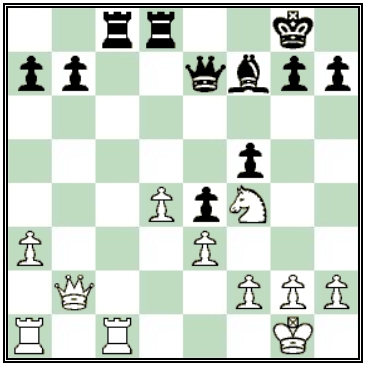
Sonja Graf – William J.L. O’Connell
Simultaneous Exhibition, Cork, 13th February 1935
1.d4 Nf6 2.c4 e6 3.Nf3 d5 4.Bg5 Nbd7 5.Nc3 Bb4 6.e3 c5 7.a3 Bxc3+ 8.bxc3 Qc7 9.Bxf6 Nxf6 10.cxd5 exd5 11.Bd3 0-0 12.Qd2 Ne4 13.Bxe4 dxe4 14.Ng1 cxd4 15.cxd4 Be6 16.Ne2 Rfd8 17.0-0 Rac8 18.Rfc1 Qe7 19.Qb2 f5 20.Nf4 Bf7 ½-½
[Click here to replay the game]
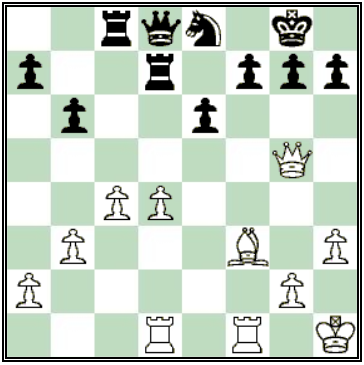
Sonja Graf – Barry St. John Galvin
Simultaneous Exhibition, Cork, 13th February 1935
1.d4 Nf6 2.c4 e6 3.Nf3 b6 4.Bg5 Be7 5.Nc3 Bb7 6.e3 Ne4 7.Bxe7 Qxe7 8.Nxe4 Bxe4 9.Qb3 d6 10.Be2 Nd7 11.Nd2 d5 12.Nxe4 dxe4 13.f3 Nf6 14.Rd1 0-0 15.fxe4 Nxe4 16.0-0 Rad8 17.Bf3 Nf6 18.Kh1 c5 19.Qa3 Qc7 20.Qc3 cxd4 21.exd4 Rc8 22.b3 Rfd8 23.Qe3 Rd7 24.Qg5 Qd8 25.h3 Ne8 ½-½
[Click here to replay the game]
The Evening Echo for Saturday 2 March had one final tale to tell.
ARCHER V. SONJA GRAF.
The following-game, played in the recent simultaneous display … shows the champion in characteristic fighting mood. A close study of the game reveals a well pressed attack by the German that is repelled by Mr. Archer in an able manner. Indeed, if he erred at all it was on the side of extreme caution, but then he probably did not care to underestimate his famous opponent; but she did, and this was the rock on which she perished. Now and again, Sonja made some tempting sacrifices in the hope of luring her opponent into an unsuspecting trap, but prudence, tempered with sound judgment, prevailed, and age and experience proved more than a compensating match for youth and genius.
Sonja Graf – Richard Archer
Simultaneous Exhibition, Cork, 13th February 1935
1.d4 Nf6 2.Nf3 d5 3.c4 c6 4.Nc3 e6 5.Bf4 Nbd7 6.e3 g6 7.Bg5 Be7 8.Bd3 Nb6 9.c5 Nbd7 10.0-0 b6 11.b4 a6 12.a4 Bb7 13.Re1 b5 14.a5 h6 15.Bxf6 Nxf6 16.Qc2 Rg8 17.e4 Qc7 18.Ne5 Nd7 19.exd5 cxd5
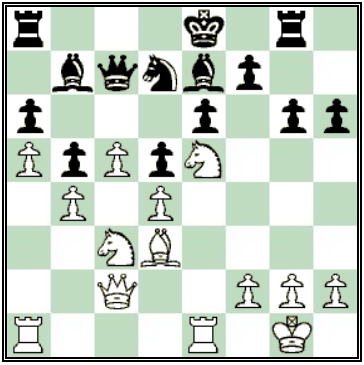
20.Nxg6
There are two much better sacrifices here. Stockfish 14 evaluates both 20.Nxb5 and 20. Bxb5 as leading to a decisive advantage. [There was also the sensible option 20.c6 Nxe5 (20…Bxc6? 21.Nxd5!) 21.cxb7 Nf3+ 22.gxf3 Qxb7 winning a piece.]
20…Bf6
[20…fxg6 21.Bxg6+ Kd8 22.Bf7 Rg5 23.Bxe6 with three pawns for the piece and Stockfish 14 assesses this as winning for White.]
21.Bxb5 Bxd4
[If 21…axb5 22.Nxb5 and the threat of Nd6 is very strong here. Stockfish suggests 21…Rxg6 as giving the best defensive chances, but it will require good survival instincts after 22.Rxe6+]
22.Bxd7+
Handing the advantage to Black. White should have played 22.c6 which Stockfish assesses as winning.
22…Kxd7 23.Nh4
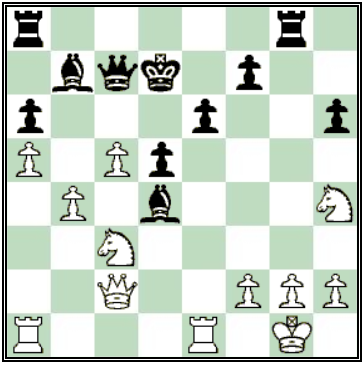
23…Qf4! 24.Rad1
24.g3 does not work as Black can still play 24…Qxh4 because the g-pawn is pinned.
24.Nf3 also fails to 24…Qxf3 because of the pin – and then due to the immediate checkmate threat, the c3-Knight will also be lost.]
24…Qxh4 25.Ne4 Qg4 26.g3 Qg7 27.Nd6 Bc6 28.Qe2 Bc3 29.Rf1 Bxb4 30.Nc4 Bb5 0-1
[Click here to replay the game]
I decided to leave aside the final paragraph from the Evening Echo’s 16th February report, because now as a valediction, it cannot be improved upon.
Fraulein Sonja Graf has gone from us, and we hope her visit will do much to foster chess in Cork. We will follow her future in international chess with interest, as it is the career she has mapped out for herself, and she carries with her the good wishes of the many friends she made in Cork during her short stay.