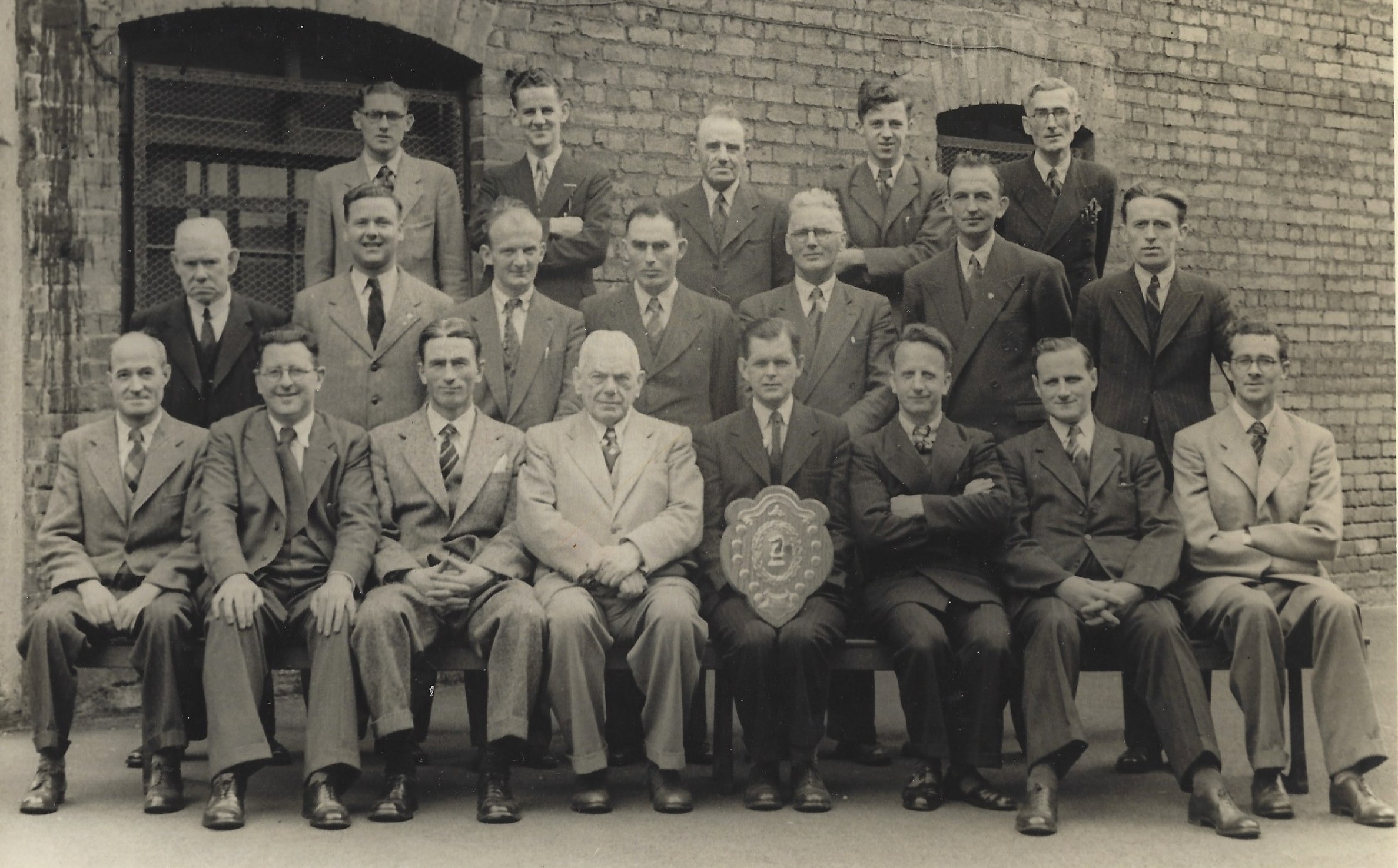
 We previously published reports on the 1949 and 1951 Irish Championships, and have now compiled a full report on the Championship in the middle. The group photograph above, unfortunately missing a few participants including the winner, is one of several taken at the Championship. The original prints reside in the Albert Long Archive, where also was to be found the Tournament Director’s pairing sheet, which has allowed us to present a fully accurate set of results.
Previously eight games from the Championship had been located in contemporary chess columns of the Belfast News-Letter and the Ireland’s Saturday Night. Those games have been for over 20 years in databases, including the one at the Irish Chess Union website. However, we have also been granted access to the eight games played by J.J. Walsh, only one of which (against R.A. Heaney) had appeared in the newspapers.
Walsh won his first two games and the Irish Press reported on a further success in Round 3:
Walsh continued to impress with a splendid win over T. Tormey of Leinster yesterday. The game was a queen’s pawn, which became complicated early on with Tormey seeming to hold the whip hand. Building up a strong queen side attack, he looked set for victory, but Walsh, with clever defensive play, wriggled out of a difficult situation. The game was adjourned, and on the resumption Tormey [had] erred in making a sealed move, and resigned.
T. Tormey – J.J. Walsh
Irish Championship, Belfast
Round 3, 19th June 1950
[Click here for the complete game]
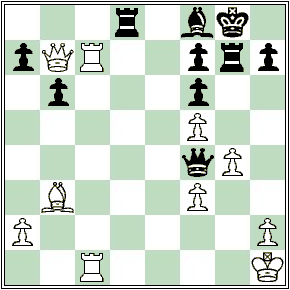
Position after Black’s 33rd move
It seems that at this point White sealed his 34th move, and losing blunder, 34.R1c3 and there was no further play over-the-board. 34…Rd2 leads inevitably to checkmate.
There are two curious circumstances here. First, the 4-hour playing session required 34 moves to be played in 2 hours, and therefore the earliest a sealed move could properly be made was on White’s 35th move. So how was this error allowed to happen? Perhaps there was a general misapprehension that 34 moves had already been played.
The second curiosity is that it seems that Tormey resigned immediately upon resumption, and did not wait to see Walsh’s 34th move, though perhaps it was now obvious to him that Walsh’s 33…Qd6-f4 had deliberately cleared the way for the Black Rook to move to the seventh rank.
After this game, Walsh and Vincent Maher were in the joint lead with 3 points, a full point ahead of their nearest challengers, and remarkably neither of them had been in the original list of qualifiers or nominees for the Championship. It seems a reasonable inference from the contemporary reports that Maher, the 1949 Intervarsity Champion, was the first reserve if a vacancy occurred. In any event, when the defending champion, Paddy Kennedy, withdrew about a week before the Championship began, Maher was his replacement. In Walsh’s case, he had entered for the supporting Premier tournament but when there were two further withdrawals from the Championship, he and the veteran Ulster player, R.A. Heaney were promoted to the main event.
When the two leaders met in Round 4, it was Maher who claimed victory. He then won his next three games to secure the Championship title with a round to spare. In the final round he lost his 100% record when sharing the point with the Ulster player, J.A. Flood, who only needed a draw to be certain of second place. Walsh and his fellow Leinster player, P.J. Murphy finished in equal third place.