
DEATH OF A WELL-KNOWN CHESS PLAYER
The announcement of the sudden death of Dr. Crawford Palmer from heart disease will come as a great shock to chess players throughout Ireland. The sad occurrence took place on Friday at Birkenhead Workhouse Hospital, while in the act of writing out a prescription for a patient. For over twenty years Dr. Palmer was well-known to chess players, be it at the D.B.C., the Dublin Chess Club, or even to the frequenters of the late Morphy’s Divan in Grafton street in the ‘eighties, and everywhere he was popular, and always a genial opponent. The deceased was the second son of the late Venerable Arthur Palmer, Archdeacon, of Toronto, and the funeral will take place to-morrow at Dean’s Grange.
(Dublin) Evening Herald, 1 October 1906, page 5
W.C. Palmer was a son of Irish parents, the afore-mentioned Arthur Palmer (who was appointed Rector of St. George’s Anglican Church, Guelph, Ontario in 1832) and Hester Madeline Palmer, née Crawford. He was very likely born in Guelph in late 1840. He died in Birkenhead, Liverpool, England on 28th September 1906, aged 65.
Regarding his chess career, he competed at both the 1st Irish Chess Association (ICA) Congress, Dublin in 1885 and its Congress the following year in Belfast. He played in the controversial correspondence match against the Sussex Chess Association during 1885-6 for an ICA team, alongside such luminaries as W.H.K. Pollock, Porterfield Rynd, George Soffe, W.H.S. Monck, George F. Barry, John Morphy and Thomas Long. He was a member of the Phoenix team which won the inaugural Armstrong Cup in 1889.
Our featured game was played in Belfast during the ICA Congress. Up to now, it does not seem to have been included in any of the modern game databases. A.S. Peake, the ICA Secretary and fellow contestant at the Congress had sent the game (and probably other material about the event) to the editor of the Liverpool Weekly Courier chess column. The game appeared in the newspaper’s 30 October 1886 issue.
Tim Harding at page 323 of his British Chess Literature to 1914 (McFarland, 2018) states that Robert Frederick Green was the editor of Liverpool Weekly Courier column from 7 November 1885 to 29 January 1889 and it seems likely that the unattributed notes given in the game are by Green.
Palmer set out from the beginning to go for a direct attack on his opponent’s King, with an early pawn sacrifice opening lines towards the Black King. With his Queen entering the fray, the Black King was chased across to the Queenside, but Palmer could not quite land a finishing blow. His 23.c4 would have brought about a quick conclusion, were it not for the en passant rule. There may have been an element of bluff about Palmer’s 25.Qh5 and after Black decided not to capture the offered Knight with 25…Rxd6 (26.Qc5+ Kc7!) the game remained complicated but roughly equal. However 29…Rd1 allowed White to snaffle Black’s advanced c-pawn and resume his attack. Palmer then seized an opportunity to trade off Queens and transition into a won endgame. A final flourish, sacrificing the exchange, forced Black’s resignation with his King too far away to prevent Palmer’s h-pawn from Queening.
William Crawford Palmer – John D. Chambers
2nd Irish Chess Association Congress, Belfast
Even Tournament (Round 7), 28 September 1886
[Annotations by R.F. Green in the Liverpool Weekly Courier]
1.e4 c5 2.Bc4
The old fashion in vogue in the days when the theory of the opening was imperfectly understood. It permits of the effectual advance of Black’s d-pawn, thus getting rid of the chief weak point in the defence. The Bishop manoeuvre losses time, and, as pointed out by Zukertort, would be much better posted at e2. The recognised move is 2. Nc3.
2…e6 3.Nc3 Nc6 4.f4
4.Nf3, followed by 5.d4, seems a more promising line of play.
4…Nf6 5.e5
Although he weakens his pawn position, still more by this move, it is possible that White had views of his own in yielding to his opponent’s temptation.
5…Ng8 6.Nf3 d6 7.0-0 dxe5
Black should not have gone in for winning the pawn, which obviously is deliberately sacrificed. 7…d5 not only gained time, but left him with a superior position.
8.fxe5 Nxe5 9.Bb5+ Nc6
The attack is embarrassing, and we would incline to the awkward looking defence 9…Ke7.
10.d4 cxd4 11.Ne5
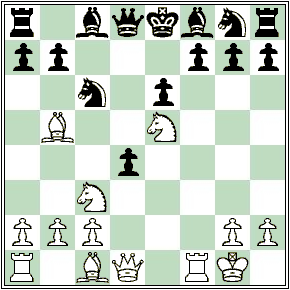
11…Qb6
This loses the “exchange”, but we question if there is anything better.
12.Bxc6+ bxc6 13.Na4 Qb5 14.Nxf7 Qxa4 15.Nxh8 Nf6 16.Bg5 Be7 17.Bxf6 Bxf6 18.Qh5+
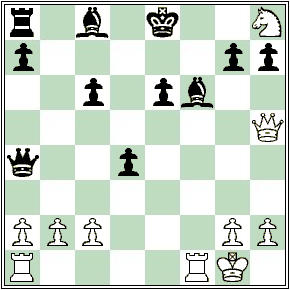
18…Kd7
Plainly 18…g6 is worse than useless because of 19.Qxh7 and if then 19…Bxh8 20.Rf7 and mate is unavoidable. If 19…B elsewhere, then 20.Nxg6 wins a piece or forces mate.
19.Qxh7 Kd6 20.Nf7+ Kc5 21.b4+ Kb6
He has evidently had enough of the Greek gifts, and this one is “declined with thanks.”
22.Nd6 Ba6 23.c4 dxc3 24.Rf4 Rd8 25.Qh5
Necessary before moving the Knight to prevent the awkward effects of 25…Rd1+. It also indirectly protects the Knight from capture by threatening 26.Qc5+.
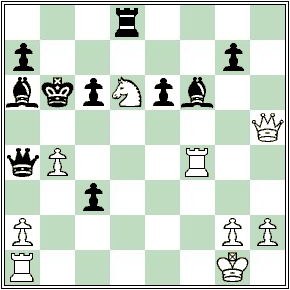
25…e5 26.Nc4+ Bxc4 27.Rxc4 c2 28.Rf1 Rd2 29.Qf3 Rd1 30.Qf2+ Kb7 31.Qxc2 Rxf1+
This last exchange destroys any chance of a draw Black might have had, and he might as well have resigned at once.
32.Kxf1 Qa6 33.a4 Qb6 34.Qb3 a6 35.b5 axb5
[The ambiguous 35…PxP is given in the text.]
36.axb5 cxb5 37.Rb4 Ka6 38.Qa2+ Kb7 39.Qd5+ Ka6 40.Qa8+ Qa7 41.Qxa7+ Kxa7 42.Rxb5
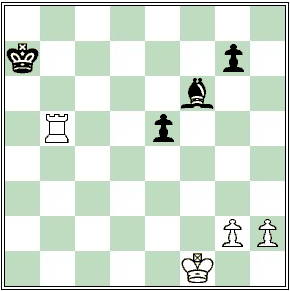
42…Ka6 43.Rb3 Ka5 44.Ke2 Ka4 45.Rb6 Ka5 46.Rxf6 gxf6 47.h4 1-0
Biographical Sources:
Birkenhead News: 29th September 1906, page 5 and 3rd October 1906, page 5
Belfast Weekly Telegraph: 6th October 1906, page 6
Wikipedia: Arthur Palmer (father) and Arthur Palmer (brother)
Wikitree: Hester Madeleine Palmer, nee Crawford (mother) plus other family pages
St. George’s Anglican Church Guelph, Ontario (Father’s ministry)