
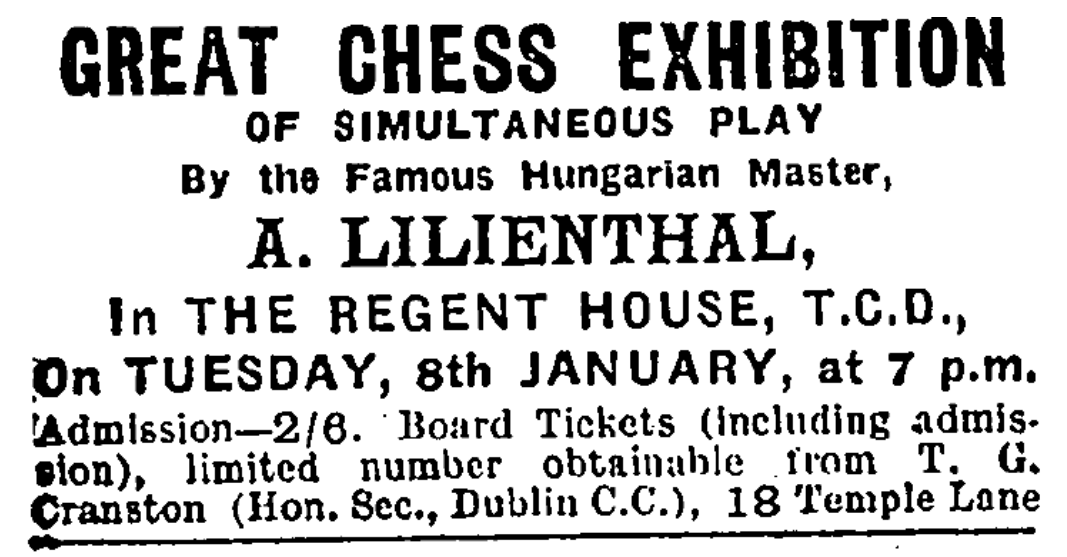
Advertisement, Evening Herald, 3 January 1935, page 6
In one of the earliest posts on IRLchess, in Lilienthal in Dublin, we recounted his visit to the city in 1935. That post featured a game from his simultaneous exhibition won by Barry St. John Galvin. More recently in Austin Bourke: First Steps we included that player’s victory over Lilienthal from the simul.
Now we present three further games from the event, all sourced from T.P. Donnegan’s chess column in the (Dublin) Evening Herald.
Update 14 April 2026: Since the post was first published, we have discovered a longer version of one of those games – the one against Peter Wahlrab – in W.J. Allen’s chess column in the Belfast News-Letter.
The first game features the 1939 and 1946 Irish Champion, but that was still in his future when this game was played, and Donnegan gives a short history of Bartholomew (Barney) O’Sullivan’s early chess career in his introduction.
A delightful game, in which a County Limerick man outplayed the Hungarian champion (1) from start to finish, was that in Board 32 (2). Mr. O’Sullivan came to Dublin (via Clonmel and Liverpool) from Adare a few years ago, and joined the Rathmines C.C., being then merely a novice at chess. Later, for greater experience, he became a member of the Sackville as well; and he has been figuring in the “Herald” circle since 1931. This year he is playing in [preliminary] section “D” of the I.C.C.C.
The Chess Editor feels he cannot do better than give Mr. O’Sullivan’s own comments on his meritorious win, and they are accordingly interpolated.
(1) Lilienthal never won the Hungarian championship but perhaps Donnegan used “champion” in a generic sense of someone who shows marked superiority.
(2) The boards numbers assigned do not seem to have indicated level of ability.
Andor Lilienthal – Barney O’Sullivan
Simultaneous Exhibition, Dublin, 8th January 1935
[Annotations by O’Sullivan in the (Dublin) Evening Herald, 19th January 1935]
1.d4 d5 2.c4 Nf6 3.cxd5 Nxd5 4.e4 Nb6 5.Nc3 e6 6.Nf3 Be7 7.Bd3 Bd7
Better than 7…Nc6 as I was afraid of inviting 8.e5. As things worked out it was the saving of me.
8.e5 c5! 9.dxc5 Bxc5 10.0-0 Bc6
Making use of the long diagonal and to develop the b8-Knight to d7; and by preventing White from playing 11.Qc2 by reason of the threat 11…Bxf3 12.gxf3.
11.Qe2 N8d7
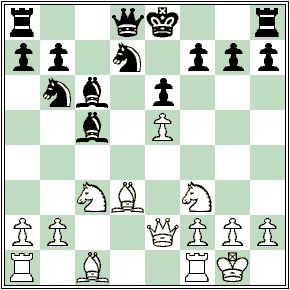
12.Bg5
A blunder which gives me a piece. I was expecting 12.Re1 or 12. Bf4 to save his e-pawn from 12…Bxf3 13. Qxf3 Nxe5.
12…Bxf3! 13.Qxf3
If 13.Bxd8 Bxe2 still winning a piece.
13…Qxg5 14.Ne4 Qxe5 15.Rfe1 0-0 16.Rac1 Be7 17.a4 Nf6 18.a5 Nbd5 19.Nc5 Qf4! 20.Nxb7 Qxf3 21.gxf3 a6
All Black pieces now receive marching orders to fight on the Queenside.
22.Nc5 Nb4
I would not play 22…Bxc5 to bring the White Rook into it; also the White a-pawn is on a Black square.
23.Bf1 Bd8 24.Rc4 Nfd5! 25.Ra1 Bf6! 26.Ra4 Rfc8
White’s play is trappy from this until his 35th move.
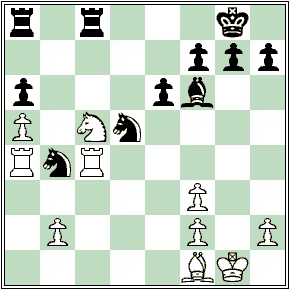 27.b3 Be7 28.Ne4 Rc6 29.Rxc6 Nxc6 30.Nd2 Bb4! 31.Nc4! Nd4 32.Nb6! Rb8! 33.Nxd5 exd5 34.Bxa6 Nxb3! 35.Bb7! Nxa5!
I have timed it to the P.
36.Bxd5 g6 37.Ra2 Rd8 38.Be4
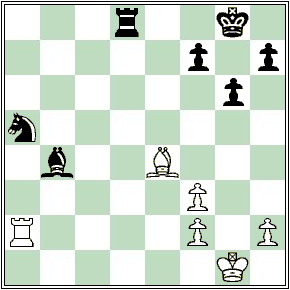 Left off at this position for adjudication. I play 38…f5 39.Bc2 (forced) Rd2. 0-1
Andor Lilienthal – Peter Wahlrab
Simultaneous Exhibition, Dublin, 8th January 1935
[Annotations by Donnegan in the (Dublin) Evening Herald, 19th and 26th January 1935 and Allen in the Belfast News-Letter, 24th January 1935]
1.d4 Nf6 2.c4 e6 3.Nc3 d5 4.Bg5 Nbd7 5.cxd5 exd5 6.e3 Be7 7.Nf3 c6 8.Bd3 0-0 9.Qc2 h6 10.h4
An interesting sacrifice of the Bishop to be followed naturally by castling on the Queen’s side. But Black is not forced to take the Bishop. [Allen]
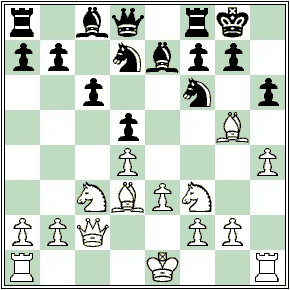
10…Re8
10…hxg5? Lilienthal knows all the traps, but Wahlrab met this one before. [Donnegan]
11.0-0-0 Bd6 12.g4 Nf8 13.Rdg1 Kh8 14.Bf5 a5
Black makes a Queenside diversion and Lilienthal falls for it! See White’s 22nd move. [Donnegan]
Black initiates his attack on the Queen’s side. [Allen]
15.Rh3! b5 16.Bxf6 Qxf6 17.Bxc8 Raxc8 18.g5 Qe6 19.Rgh1! h5! 20.g6 fxg6 21.Ng5! Qd7
Black is now in a comfortable position, with a fair prospect of continuing his attack on the Queen’s side.[Allen]
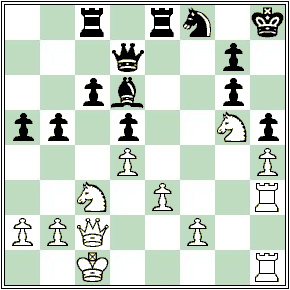
22.Kb1?
A weak move, overlooking that 22.Rf3! was available with the threat of Rxf8+ and Qxg6 to follow. [Donnegan]
Wahlrab thinks 22.Kd2 would have been better but 22.Rf3, threatening Rxf8, followed by Qxg6 looks like winning. [Allen]
21…b4 23.Na4 Qa7 24.Nc5 Bxc5 25.dxc5 a4 26.Rg3 b3 27.axb3 axb3 28.Qxb3 Ra8 29.Qa3 Qxa3 30.bxa3 Rxa3 31.Kb2 Rea8 32.Rb1 R3a5 33.Rc1 Rb5+
and wins. Lilienthal resigned at move 52. [Donnegan]
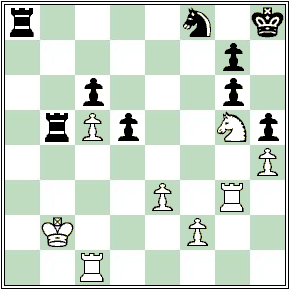
The game-score in the Evening Herald ended here but it continued in the Belfast News-Letter, to the point where the game was adjudicated as a win for Wahlrab.
34.Kc2 Ra2+ 35.Kd3 Rxf2 36.Rc3 Rbb2 37.Kd4
Mate, of course, was threatened. [Allen]
37…Rb4+ 38.Ke5
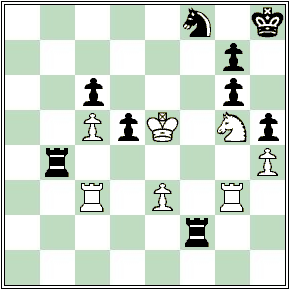
38…Rf5+
38…Rf6 was best, threatening Nd7 mate, which White could only avoid by giving up his Knight. [Allen]
39.Kd6 Rf6+ 40.Ke7 Rb7+ 41.Ke8 Kg8 42.e4 dxe4 43.Rb3 Rd7 44.Rge3 Rd4 45.Rb7 Ne6 46.Nxe4 Rxe4 0-1
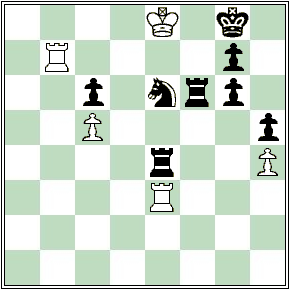 The game ended here, but the adjudicators awarded Black the game on the following variation:- 47.Rxe4 Nxc5 48.Reb4 Nxb7 49.Rxb7 Rf8+ 50.Kd7 Rf7+ etc. There is, of course, a better variation for White, but Black had a won game since the 30th move. [Allen]
[Click to replay the game. Updated version]
Andor Lilienthal – W. Murray
Simultaneous Exhibition, Dublin, 8th January 1935
[Annotations by Donnegan in the (Dublin) Evening Herald, 26th January 1935]
1.d4 d5 2.c4 e6 3.Nc3 c6 4.e4 dxc4 5.Bxc4 Nf6 6.Nf3 Bb4 7.0-0 0-0
With his next move, White prepares for e4-e5 with occupation of d3 (Bishop) and e4 (Queen) after Black’s …b7-b5, His 9, Rd1 is trappy, but timely.
8.Qe2 h6 9.Rd1 b5 10.Bd3 Bb7 11.e5
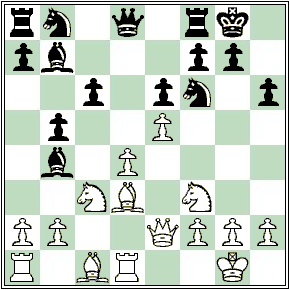 Now Black is in grave danger. He made some delay in replying, quite excusable under such circumstances – laudable in fact, If 11…Nd5 or d7 12,Qe4 threatening mate; if now 12…f5 13.exf6 etc. winning easily.
11…Ne8 12.Ne4 f5 13.Nc5 Bxc5 14.dxc5 Qe7
The utility of White’s 9th move is now apparent. With the text Black takes over the initiative and compels White to defend. A struggle for command of the open file begins.
15.b4 Nc7 16.Bc2 Nd5 17.Bd2 Na6 18.a3 Nac7 19.Bb3
Forming a combination based on Bxd5 later. Black perceives it! See his 23rd move.
19…a6 20.Nd4 Rf7 21.f4 g6 22.Rac1 Rd8 23.Qf3 Rg7 24.Be1 g5
[Preparing] a counter combination which succeeds; it wins a piece.
25.fxg5 Qxg5
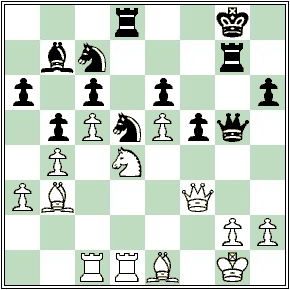
26.Bxd5 Rxd5 27.Bg3 Rxd4 28.Rxd4 Qxc1+ 29.Rd1 Qg5 30.Rd6 h5 31.Bf4 Qg6 32.h4
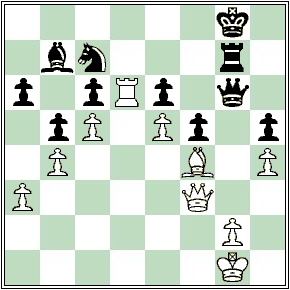 Adjudication came here, Lilienthal conceded the win to Black, but in the excitement he was misinterpreted to mean the reverse. The question was raised later and Murray offered to call it a draw, and to this Lilienthal cordially agreed. ½-½