Irish Women’s Championship 2022

Last month, Trisha Kanyamarala qualified for the WGM title, making her third norm at the XTX Markets London Chess Classic Open, November 27-December 3, having met all other requirements. Congratulations! This terrific achievement came shortly after her twentieth birthday.

She won the Irish Women’s Championship in 2022, for the first and so far only time. A full report has been uploaded to the Tournament pages here, containing all games.

The field of 16 contained three former champions: Ioana Gelip, Diana Mirza, and Alice O’Gorman (defending). Trisha’s 5/5 score included successive wins against these three.

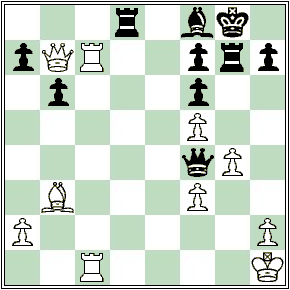
As Tim Harding pointed out in his report on the Chess Mail web site, this win was “not without several hard-fought games with her rivals”. Indeed, Diana Mirza had a clearly won game against her in the second round.

T. Kanyamarala - Mirza, Irish Women's Championship 2022

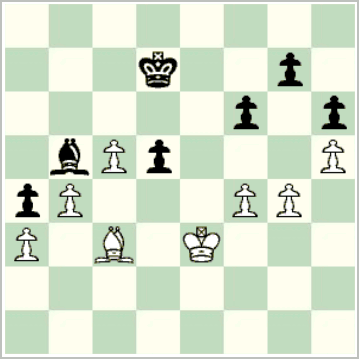
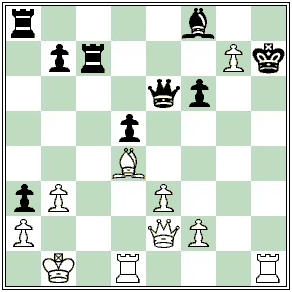
T. Kanyamarala – Mirza, Irish Women’s Championship 2022 (2)
34… ?

After the natural 34… e4, the black bishop joins the attack to devastating effect. One point is that 35. Rxf5 is met by 35… a3, and if 36. b3, then 36… Rxb3+! 37. axb3 Rxb3+, winning.

Mirza, with a little over five minutes on the clock, chose 34… f4 instead, presumably to avoid the white rook generating an attack, and after 35. Qd3 erred again with 35… Qxb7?. After 36. Qxh7 she was lost. Here the awkward-looking 35… Kg8 would still have left her with a much better or winning position.

[Click to replay the full game.]

Posted in Irish women's championships, Tournaments | Leave a comment

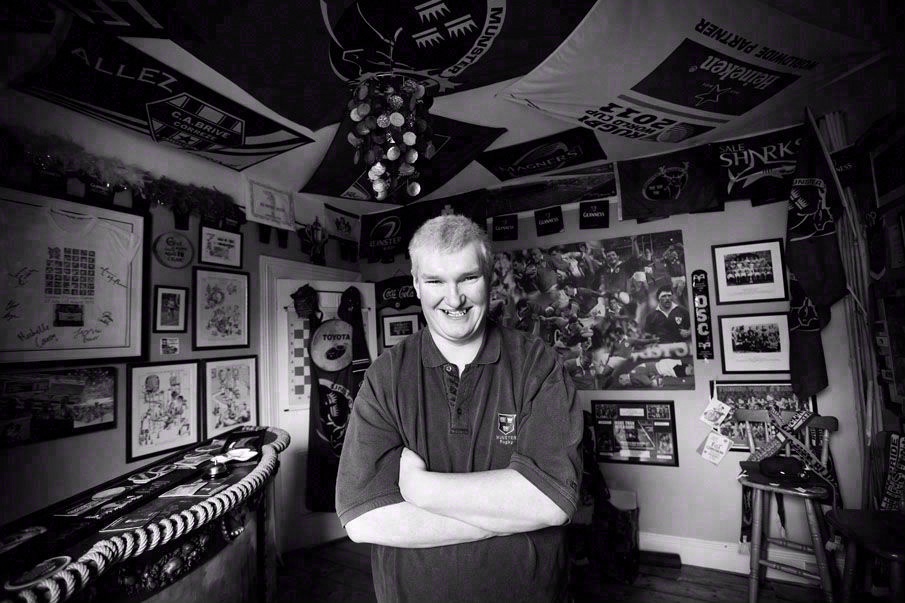
Paul Carey 1964-2025

I was very sorry to hear the news of Paul Carey’s passing, last Tuesday. Sincere condolences to his family.

Paul Carey

He was one of the organisers of the spectacularly successful and long-running Bunratty tournament from its founding throughout its existence.

His name is so associated with Bunratty that it is difficult to find his other chess achievements, but he was a founder and organiser, also along with Gerry Graham, of the Limerick Schools Chess League in the mid-1980’s. He played for Sarsfield in the Munster League.

Paul Carey, b. April 22, 1964, d. Limerick City, December 2, 2025.

Posted in Players | Leave a comment

Irish Women’s Championship 2025

The Irish Women’s Championship was held last month in the Talbot Hotel, Stillorgan, over the Bank Holiday weekend October 24-27, 2025.

A full report has been added to the Tournament pages here.

This year the event and two supporting events were held as part of “The Inaugural Irish Women’s Fsetival”. The Irish Women’s Championship itself had a rating floor, of 1600, for I think the first time. It was contested over seven rounds, which I think was also a first. The event was open to Irish citizens, IRL-registered players, and non-IRL players who had been resident for at least two years in Ireland, though non-IRL-registered players were not eligible for the title. Last year’s champion Diana Mats did not play, and indeed she does not seem to have played any games in Ireland in the past year, and WGM Shrook Wafa was a late withdrawal. However, the field of 12 included three former champions.

First place was taken by the Ukrainian teenager Maryna Petrenko, who scored an unbeaten 6/7, including wins against each of the three former champions Antonina Góra, Diana Mirza, and Alice O’Gorman, to finish 1½ points clear of the field. However, she was not eligible for the title.

Heading into the last round, Nemhain Doolin was in second place on 4½, followed by Góra on 4, and Mirza and O’Gorman tied on 3½. All changed in the last round as O’Gorman beat Doolin and Mirza beat Góra. This produced a three-way tie for second place, and for the title, between Doolin, Mirza, and O’Gorman.

The tie-break system was the same as for the Irish championship: head-to-head results between the (eligible) tied players, and if no clear winner, a rapid playoff match between the two players with the highest scores between these, counting all missing results as draws. In this case, it all worked out much more smoothly than with the Irish championship a few months ago. Doolin had beaten Mirza earlier, O’Gorman had beaten Doolin in the last round, and O’Gorman and Mirza hadn’t met. This meant a rapid playoff between Doolin and O’Gorman, which was won 2-0 by the latter. So Alice O’Gorman became Irish Women’s champion for the second time.

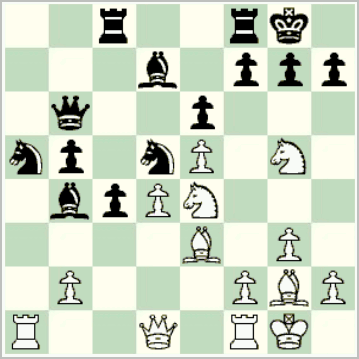
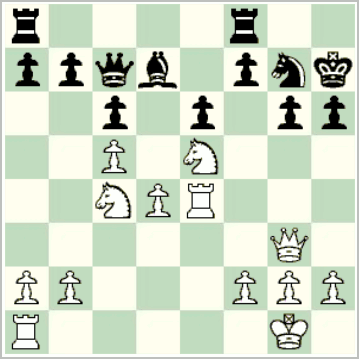
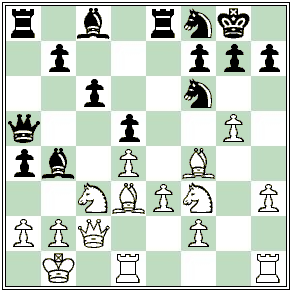
Petrenko - Fougerat, Irish Women's Championship 2025

Petrenko – Fougerat, Irish Women’s Championship 2025 (6)
21… ?

The diagram shows a crucial moment in the sixth round game between Petrenko and the Portuguese-registered Emma Fougerat.

Black now played the natural 21… h6, but this turns out to be an error. White has the very strong 22. Nf6+!!, winning. If 22… gxf6 23. Ne4 f5 24. Qh5 Be7 25. Bxh6, White threatens Ng5 and in some lines Nf6+. Black is forced into 25… Qxd4 to avoid being mated, and will still end up in a losing position, as the knight on a5 will eventually drop.

Instead 21… Be7! would have avoided this possibility and left Black with a slight advantage.

In the game, Petrenko missed this exceedingly difficult chance, and instead played 22. Qh5.

After 22… Be7 23. Nh3, Black went wrong with 23… f5? (23… Be8=) and after 24. exf6 Bxf6? 25. Nc5 Be8 26. Qg4 was lost.

[Click to replay the full game.]

Posted in Irish women's championships, Tournaments | Leave a comment

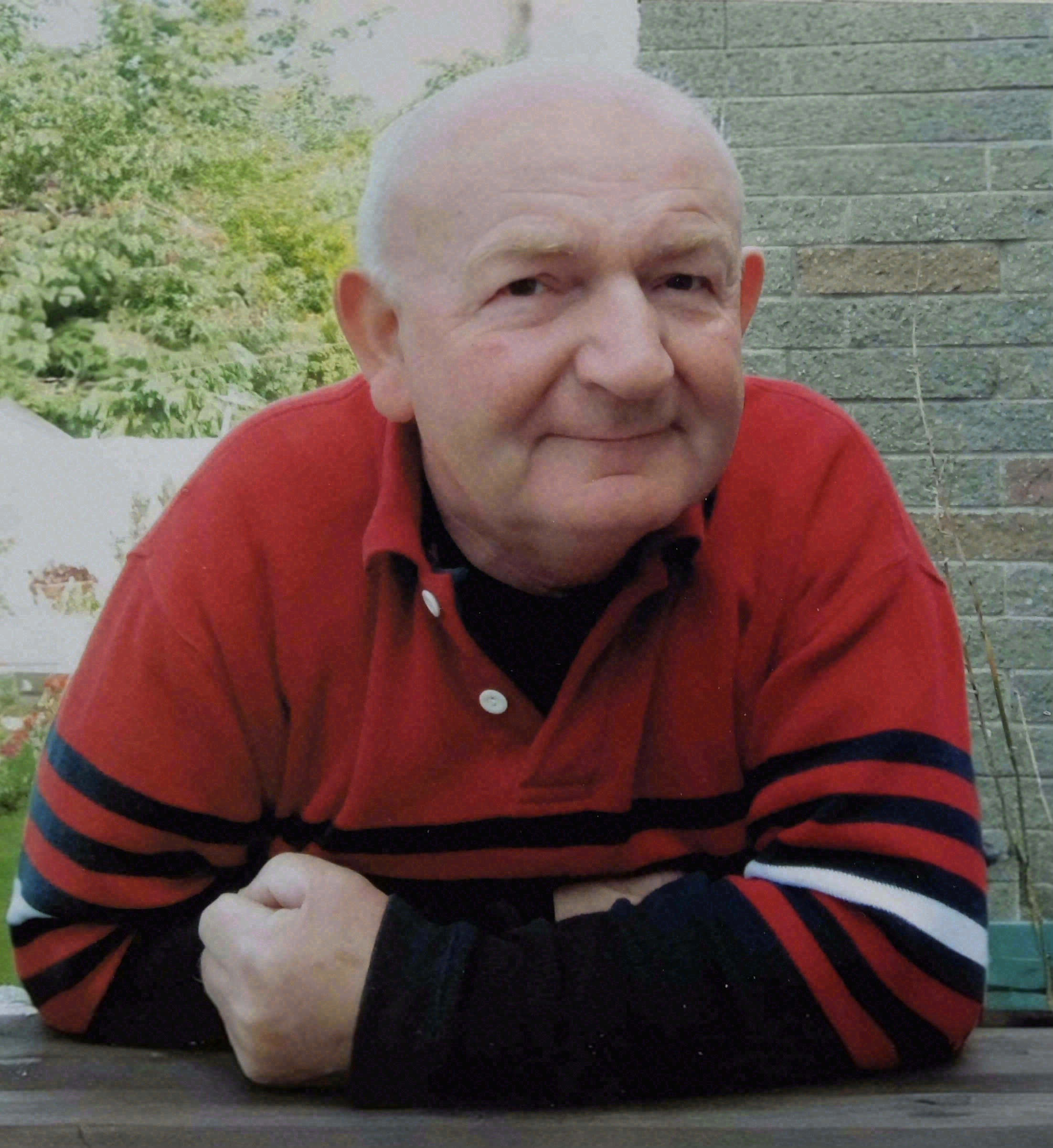
Henry Higgins 1941-2025

I was very sorry to hear of the recent passing of Henry (Harry) Higgins, via an obituary by Kevin Burke on the ICU web site yesterday.

Henry Higgins

He organised the Dundrum International Opens in 1975 and 1976, which were at the time the largest chess competitions ever held in Ireland. I was brought as a ten-year-old to the 1975 event at Wesley College and still vividly recall my awe at the entire spectacle. “A Triumph of Organisation” was the headline of J. J. Walsh’s review of that event in the Irish Times.

He was a founding member of Dundrum C.C., my own club, and was part of the team that was promoted rapidly from Ennis Shield in 1973-74 to the Heidenfeld Trophy, and then immediately to the Armstrong Cup for the 1975-76 season. I can’t definitely recall if I ever played him myself, but we were teammates in some Armstrong matches at the end of that decade. He was still playing for St. Benildus, which had merged with Dundrum in 1991, up to the 2013-14 season.

Deepest sympathies to his family.

Henry Higgins, b. 19 February 1941, d. Dublin, 12 August 2025.

Posted in Players | 1 Comment

1950 Irish Championship, Belfast

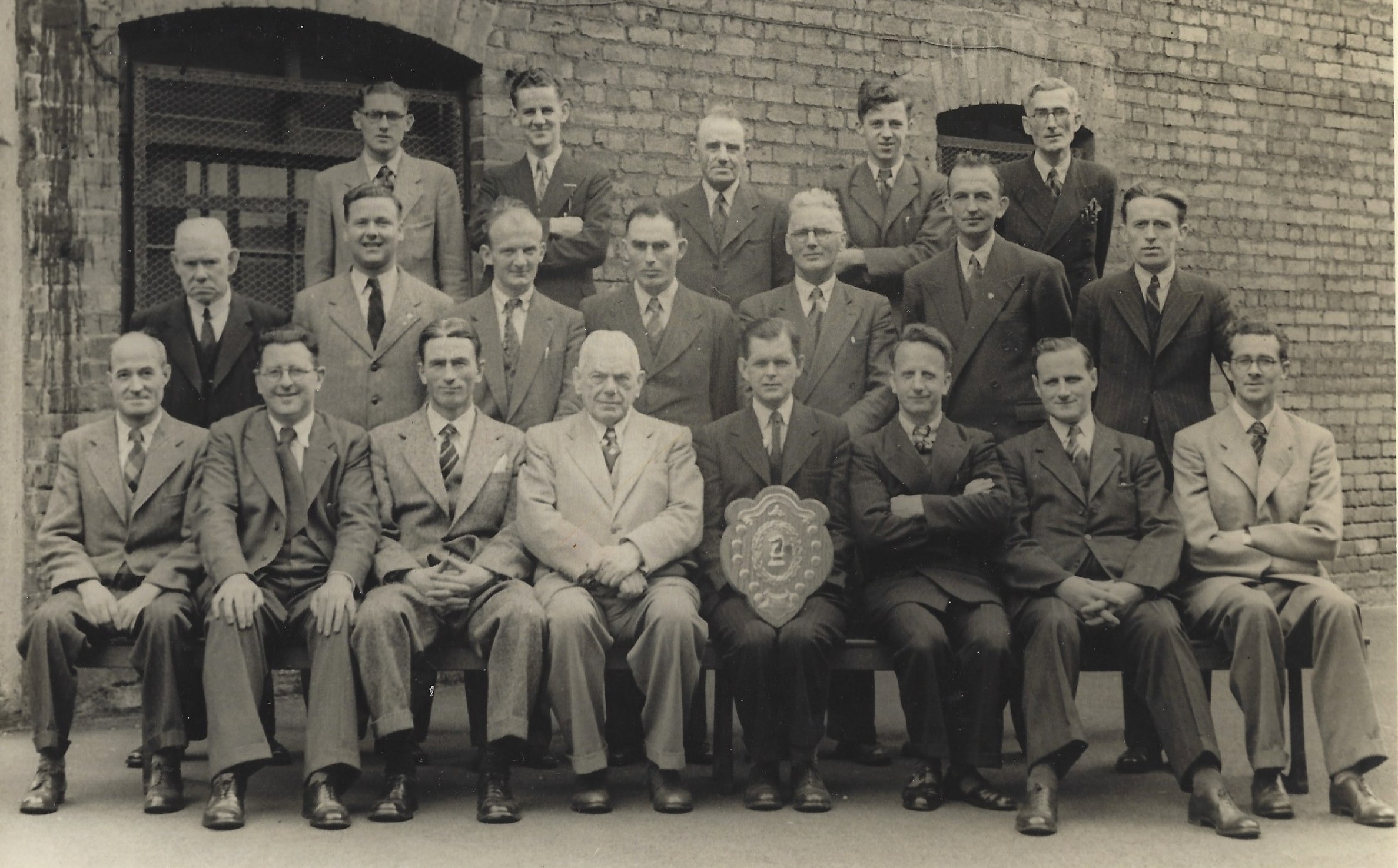
We previously published reports on the 1949 and 1951 Irish Championships, and have now compiled a full report on the Championship in the middle. The group photograph above, unfortunately missing a few participants including the winner, is one of several taken at the Championship. The original prints reside in the Albert Long Archive, where also was to be found the Tournament Director’s pairing sheet, which has allowed us to present a fully accurate set of results.

Previously eight games from the Championship had been located in contemporary chess columns of the Belfast News-Letter and the Ireland’s Saturday Night. Those games have been for over 20 years in databases, including the one at the Irish Chess Union website. However, we have also been granted access to the eight games played by J.J. Walsh, only one of which (against R.A. Heaney) had appeared in the newspapers.

Walsh won his first two games and the Irish Press reported on a further success in Round 3:

Walsh continued to impress with a splendid win over T. Tormey of Leinster yesterday. The game was a queen’s pawn, which became complicated early on with Tormey seeming to hold the whip hand. Building up a strong queen side attack, he looked set for victory, but Walsh, with clever defensive play, wriggled out of a difficult situation. The game was adjourned, and on the resumption Tormey [had] erred in making a sealed move, and resigned.

T. Tormey – J.J. Walsh
Irish Championship, Belfast
Round 3, 19th June 1950
[Click here for the complete game]

Position after Black’s 33rd move

It seems that at this point White sealed his 34th move, and losing blunder, 34.R1c3 and there was no further play over-the-board. 34…Rd2 leads inevitably to checkmate.

There are two curious circumstances here. First, the 4-hour playing session required 34 moves to be played in 2 hours, and therefore the earliest a sealed move could properly be made was on White’s 35th move. So how was this error allowed to happen? Perhaps there was a general misapprehension that 34 moves had already been played.

The second curiosity is that it seems that Tormey resigned immediately upon resumption, and did not wait to see Walsh’s 34th move, though perhaps it was now obvious to him that Walsh’s 33…Qd6-f4 had deliberately cleared the way for the Black Rook to move to the seventh rank.

After this game, Walsh and Vincent Maher were in the joint lead with 3 points, a full point ahead of their nearest challengers, and remarkably neither of them had been in the original list of qualifiers or nominees for the Championship. It seems a reasonable inference from the contemporary reports that Maher, the 1949 Intervarsity Champion, was the first reserve if a vacancy occurred. In any event, when the defending champion, Paddy Kennedy, withdrew about a week before the Championship began, Maher was his replacement. In Walsh’s case, he had entered for the supporting Premier tournament but when there were two further withdrawals from the Championship, he and the veteran Ulster player, R.A. Heaney were promoted to the main event.

When the two leaders met in Round 4, it was Maher who claimed victory.  He then won his next three games to secure the Championship title with a round to spare. In the final round he lost his 100% record when sharing the point with the Ulster player, J.A. Flood, who only needed a draw to be certain of second place. Walsh and his fellow Leinster player, P.J. Murphy finished in equal third place.

Posted in Games, Irish championships, Photos | Leave a comment

Three new FMs

The European Club Cup in Rhodes, Greece, finished yesterday. Six Irish teams competed, with Blanchardstown achieving the highest placing, finishing 74th, with 6 match points. Ennis and Master C.C. finished 79th and 83rd, respectively, with 5 match points. Malahide, U.C.D., and St. Benildus also played. (See the full pairings & results.)

Blanchardstown also recorded a remarkable achievement, with three players qualifying for direct FM titles, having also met the rating requirement. A score of 65% from 7 games is enough for the title (FIDE Table for Direct Titles effective from 1 May 2025), provided the player has also reached a published or interim rating of 2100 at some time or other (FIDE Title Regulations effective from 1 January 2024, section 0.6.2).

Here WFM Hong Nhung Nguyen, Vietnam-registered but Irish-resident, scored 5/7 on board 1, CM Jason Liu scored 6/7 on board 3, and CM Shane Melaugh scored 5/7 on board 4. All three have crossed 2100, so all qualify to become FMs immediately.

Nguyen was the highest-rated female player resident in Ireland in the most recent FIDE list, at 2230, and she gains 34 points from this event. Liu gains 70 points from this event. Each reach 2264, so they would not have been far away from the FM title via reaching 2300, even if they did not record the direct title result.

Two other players in Irish teams reached the required score, though they still need to reach rating 2100. Seán J. Murphy scored 6/7 on board 5 for Master C.C., and Shriman K, India-registered, scored 6/7 on board 5 for U.C.D. Murphy was rated 2060 on the last FIDE list, and he gains 42.8 from this event, so he will qualify for the title immediately if he has not lost points this month in some other event.

Congratulations to all!

The individual results for all players on Irish teams can be seen at Chess-results.

[Update, October 27, 2025: Oliver Barnes also recorded a direct title result, scoring 5½/7 on board 5 for Malahide, but he has not yet reached 2100. Many thanks to Pat Reynolds for pointing this out.]

[Update, November 1, 2025: Seán J. Murphy is rated 2103 in the November 2025 list, and thus has met the rating requirement for a direct FM title. Congratulations!.]

[Update, December 17, 2025: FM titles have been recorded, as of December 16, by FIDE for Hong Nhung Nguyen, Jason Liu, and Shane Melaugh. Oliver Barnes, requiring only a rating of 2100, reached a live rating of 2099.4 in games rated for the December 2025 list.]

Posted in Players | 1 Comment

Cork Masters 2025

The Cork Congress took place last weekend, in the Clayton Hotel Cork City, a new venue. A total of 177 players competed over three sections, and there was a Blitz on Saturday, with 57 players.

Games from Cork Congresses have been rare in the past; I cannot recollect any previous time in which live boards were used. This year was a welcome first, with 30 games from the Masters and another 15 from the Majors.

A full report for the Masters has been added to the Tournament pages here.

Brendan O’Gorman, who played in the Majors, published a set of 51 photos of the event.

David Fitzsimons and Kavin Venkatesan finished 1st-2nd on 4½/5, having drawn their round 3 game. The published rules said there would be a blitz playoff in the event of a tie, but no report was published and the result is unknown, if the playoff took place at all.

The last round game between David Geaney-O’Brien and Paul Carey featured an enterprising finish.

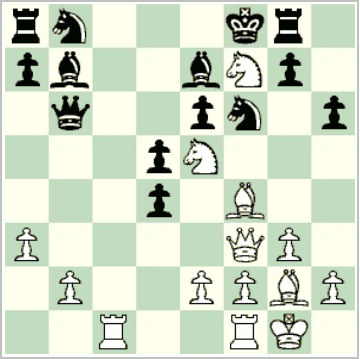
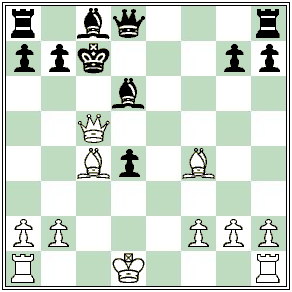
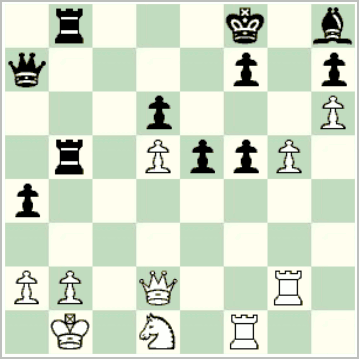
Geaney-O'Brien - Carey, Cork Masters 2025

Geaney-O’Brien – Carey, Cork Masters 2025 (5)
22. ?

White has an overwhelming position, and there must be many ways to win. The game continuation was the most efficient: 22. Nxg6! Rfc8 23. Nf8+! Kh8 24. Ne5. Black has no viable defence. After 24… Be8 25. Rg4 f5 26. Nxe6 Nxe6 27. Rg8+ Kh7 28. Rxe8 Rxe8 29. Qg6+ Kh8 30. Nf7+ Nxf7 31. Qxf7 Black resigned.

[Click to replay the full game.]

The pairing was puzzling: why was Geaney-O’Brien, on 2½/4, paired with Carey, who was on 0/4?

The second round saw an interesting ending in the game between Korneliusz Bartczak and Dariy Kelbas.

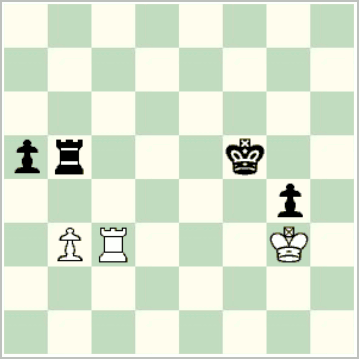
Bartczak - Kelbas, Cork Masters 2025

Bartczak – Kelbas, Cork Masters 2025 (2)
48. ?

The diagrammed position is within the range of the Syzygy tablebases, which show that White has just one move to preserve a draw with best play: 48. Kf2!. White’s problem seems to be that the rook has a shortage of available squares on the third rank, and if Black can play … Ke4 with tempo, the king will invade with a winning position. After 48. Kf2, 48… Ke4 leads nowhere after 49. Ke2.

Bartczak instead played the natural but wrong 48. Re3?, and after 48… Rc5 49. Rd3 Ke4 50. Rd1 Rc3+ 51. Kxg4 Rxb3 was lost.

As it turned out, though, there were several tricky and non-obvious points in what followed (perhaps there was a straightforward way to win without permitting these difficulties?), and there were seven further changes in fortune, before the game ended in a draw.

[Click to replay the full game.]

Posted in Cork Congresses, Games, Tournaments | Leave a comment

Gonzaga Masters 2025

The 20th Gonzaga Charity Classic took place over the weekend of January 17-19, 2025. A total of 187 players took part, spread over four sections.

A report on the Masters section has been added to the Tournament pages here.

The two grandmasters Matthew Turner and Ante Šarić were by far the highest rated players in the field, by a margin of around 150 points, and duly finished equal 1st-2nd on 4½/5, having had a quick draw in round 4. They had also finished equal first last year, with Daniel Howard Fernandez. But this year, tie-break applied for first place, including for prize money, and this made quite a difference. Turner took the first prize of €650, while Šarić received €350.

Irish women’s chess has been strengthened by the addition over the past few years of several strong resident but not IRL-registered players, and in this event three were competing: WGM Shrook Wafa (Egypt), WFM Hong Nhung Nguyen (Vietnam), and WFM Maryna Petrenko (Ukraine).

Nguyen suffered a reverse in the second round against Robert Arellano.

arellano-nguyen-2025.gif

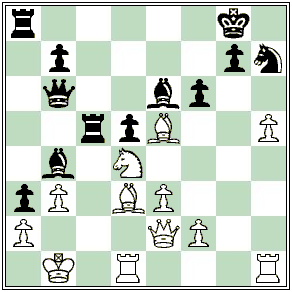
Arellano – Nguyen, Gonzaga Masters 2025 (2)
18. ?

A slip in the opening had left Black in deep trouble, and in the diagrammed position White is winning easily after 18. Qd3 g5 19. Nxh6. Instead he played 18. Bxh6?, with no clear point. After 18… gxh6 19. Nxh6 Rg7 20. Nhg4, Black would have been right back in the game after 20… Rxg4! 21. Nxg4 Nd7. Instead she missed the opportunity via 20… Qd8? 21. Qf4 a5? 22. Rc7! and a massacre occurred.

[Click to replay the full game.]

Three boards away, Colm Daly and Fiachra Scallan reached the position below.

Daly - Scallan, Gonzaga Masters 2025

Daly – Scallan, Gonzaga Masters 2025 (2)
39. ?

White can break through via 39. Bxf6. Let’s leave this one as an exercise: what do you think of this move, and how should the game end with best play from the diagrammed posiiton?

[Click to replay the full game.]

Posted in Games, Gonzaga Classics, Tournaments | Leave a comment

Austin Bourke: Margate 1935

From 1935 to 1939 the Kent County Chess Association staged five Congresses at or near Easter, until the Second World War put an end to the series. Many of the elite players of the period played in the Premier section, such as Capablanca (three times), Alekhine, Keres and Flohr (all twice) and the Americans Reshevsky and Fine (each once).

There were many subsidiary tournaments and other attractions during the 1935 Congress, encapsulated in this report in the 4th May chess column of the Cork newspaper, the Evening Echo.

The Margate Easter Congress was a very successful meeting, Every section of the chess public was fully catered for. Play was not confined alone among the Masters. On the contrary it was split up into eight sections, so that for ten days and nights everybody – from Masters to schoolboys and girls – were able to indulge in their favourite pastime in some form or other. Play was not limited solely to serious chess. There were special attractions in the nature of Lightning Tournaments, Simultaneous Displays, Blindfold Exhibitions and Living Chess, which were much appreciated by the large audiences. In the Living Chess Section, the “pieces” were specially coached pupils from the local schools, who were dressed in gorgeous white and crimson costumes, their contrasting colours, particularly of the Kings and Queens, intermingling upon a gigantic chess board, gave the proceedings a peculiar touch of medieval court splendour.

For anyone wanting to read about the event as a whole, John Saunders  has compiled a comprehensive report on Margate 1935 at Britbase.

The Congress took place from Wednesday 24th April to Saturday 3rd May. However there were four “First Class” tournaments, played over five rounds, in the first four days of the Congress for players who could not stay for the duration. Among the competitors in these was Aibhistín de Búrca. This is the earliest occasion I have found when he used the Irish form of his name. One mysterious feature of the British Chess Magazine report (Volume LV, at page 270) on the tournament is he listed as being from Belfast, not Cork.

However, all the reporting in his local newspaper referred to him as Austin Bourke and we will use that form for the rest of this post. First, we have two games to present, which until now have not found their way into the usual databases.

In a fairly minor section, it is not surprising that Bourke won all five of his games in the all-play-all tournament. Here is his last round victory.

Austin Bourke – Francis Albert Joyce
Margate Short First Class C (Round 5) 27 April 1935
[Source: (Cork) Evening Echo, 18 May 1935, page 6]

1.e4 e5 2.Nf3 Nc6 3.Bc4 Nf6 4.Ng5 d5 5.exd5 Nxd5 6.Nxf7 Kxf7 7.Qf3+ Ke6 8.Nc3 Ncb4
The alternative is 8…Nce7 as in the consultation game, O’Shea, Whittaker and Bourke (White) v Creevey, Galvin and O’Dea, which continued 9.d4 c6 10.dxe5 Nf5 11.Be3 g6 12.0-0-0 Bg7 13.Nxd5 Resigns.
9.Qe4 c6 10.d4 Nxc2+
A wild effort to free his position by returning the piece, In conjunction with his next move, however, it only helps to bring the end nearer.
11.Qxc2 exd4 12.Qe4+ Kd7 13.Nxd5 Bb4+
Neat, but to no avail.
14.Kd1
Quickest. It leaves Black with no resource. 14.Nxb4 Re8 15.Qxe8+ Qxe8+ with three pieces for the Queen.
14…cxd5 15.Qxd5+ Kc7 16.Bf4+ Bd6 17.Qc5+ 1-0

[Click here to replay the game]

The other game is from one of the many “side events”.

Samuel Reshevsky – Austin Bourke
Simultaneous Display, 26 April 1935
[Source: (Cork) Evening Echo, 11 May 1935, page 7]

Played at Margate Chess Congress, 26th April, 1935, in a Simultaneous Display, Reshevsky v. 23 others. Result – 22 wins and 1 draw.
1.d4 Nf6 2.c4 e6 3.Nc3 d5 4.Nf3 Nbd7 5.Bg5 Be7 6.e3 c6 7.cxd5 exd5 8.Bd3 0-0 9.Qc2 Re8 10.0-0-0 Nf8 11.Bf4 a5 12.h3 a4 13.g4 Qa5 14.Kb1 Bb4 15.g5

15…a3 16.b3 N6d7
Causing a critical loss of tempo in developing the Queen’s Bishop. 16…Nh5 giving Black the advantage of two Bishops, is obvious, and good.
17.Ne2 Nb8 18.Ne5 Be6 19.h4 c5 20.dxc5 Rc8 21.Nd4 Rxc5 22.Qe2 Qb6
22…Rc3 looks better.
23.h5 Nbd7 24.g6 Nxe5 25.gxh7+ Nxh7 26.Bxe5 f6

27.Nxe6 Qxe6 28.Bd4 Rc7 29.h6 Bf8 30.Bxh7+ Kxh7 31.hxg7+ 1-0

[Click here to replay the game]

Bourke provided this article for the Evening Echo, which appeared in the chess column on Saturday 4th May.

IMPRESSIONS OF THE MASTERS AT MARGATE EASTER CHESS CONGRESS.

By AUSTIN BOURKE, B.Sc.

J. R. Capablanca — Gives the impression or being no longer the great Master he was before Alekhine wrested the World’s Championship from him. All the old technique and craftsmanship is still at his command, making him always a formidable opponent, but the touch of genius which marked so many of his former games is lacking.

W. A. Fairhurst — Ex-Scottish Champion, cool, level-headed and, next to Thomas probably the strongest British player.

Jacques Mieses — The German veteran, once famed for his many direct-attack victories, is rather outclassed in this company. Plays well up to the end-game stage, wherein he is completely outmanoeuvred by the younger Masters.

Miss V. Menchik — Is also passing through a lean period. Did not win a game in Moscow, and does not look like doing any better here.

S. Reshevsky — On whom interest focuses in this tournament, plays out of America for the first time, and looks like winning. Goes all out for victory in all his games, and prolonged an obviously drawn position with Klein through several adjournments in an effort to save half a point.

B. Reilly — The Irishman from Nice appears to be more solid than brilliant, with a certain ingenuity for extricating himself from difficult positions. Drew his first three games.

E. G. Sergeant — Is hardly as strong as the others in this class.

Milner-Barry — of Cambridge, another Irishman, deputises for Sultan Khan, and appears to be in excellent form. Capablanca was hard pushed to avoid defeat in the first round game with him, and in the second round Milner-Barry forced Mieses’ resignation in twenty moves in a fine attacking game in Mieses’ own style.

Klein — Deputises for Lilienthal, who was sick, and could not travel. Like all the Austrian Masters, his knowledge of the theory of the game is immense.

Sir George Thomas — Hero of the Hastings Christmas Tourney, appeared to be somewhat subdued, and his play, sound as always, lacked sparkle.

Two things spring out from this piece. First, the temerity with which Bourke comments on the players in the top section.

The second is the reference to [Sir] Stuart Milner-Barry being an “Irishman.” I had not come across this assertion before. Initially I wondered if there might be some confusion with Milner-Barry’s great friend Hugh Alexander, who was born in Cork. Despite a strong dose of scepticism, I decided to do some digging in genealogical sources – one that I found particularly helpful was Geni.

In this search I found John Milner Barry (1768-1822), a distinguished physician and a native of Cork. He was one of eleven children of James Barry and Elizabeth Barry (née Milner). The online records I consulted suggested that his mother Elizabeth, after her marriage used the hyphenated surname Milner-Barry but his father James did not. In any event all their eleven children had Milner Barry in their name (and it seems that this naming convention established the family name hyphenation).

John Milner Barry (perhaps this should be given as a hyphenated surname) was the great grandfather of Sir Stuart Milner-Barry in a direct paternal line. Sir Stuart’s grandfather was Edward Roche Milner-Barry (1819 – 1902), the last in the direct line born in Ireland, and his father Rev. Edward Leopold Milner-Barry (1867 – 1917) born in Scothern, Lincolnshire.

Posted in Games, Players, Simuls, Tournaments | Leave a comment

Austin Bourke: First Steps

Bourke, Patrick Martin Austin (1913–95), meteorologist and historian, was born 10 May 1913 in Dungarvan, Co. Waterford, second son of Patrick M. Bourke, stationmaster, and Clare Bourke (née O’Sullivan). He was educated at Mount Sion CBS, Waterford, and UCC, where he was (among other activities) president of the Student’s Union and editor of the student newspaper; he graduated B.Sc. (1933) in mathematical science, winning the Peel memorial prize for outstanding student of the year, and M.Sc. (1937) from NUI. [From the opening paragraph of Bourke’s entry in the Dictionary of Irish Biography]

The “other activities” included a significant contribution to chess, as detailed in the Cork Examiner on the 5th December 1933. He had

infused a wonderful enthusiasm for the Chess Club, which has now got quite a large membership. Each afternoon one may see the chess enthusiasts crouching over the boards, engrossed in the game.

Representing Cork

The first reference I could find for Austin Bourke being engaged with the wider Cork chess community is when he was selected to play in a match against Limerick. W.R. O’Shea in his Evening Echo chess column for Saturday 2nd December 1933 reported on the occasion.

The Cork team motored to Limerick on Wednesday [29th November], where they were right royally entertained by their hosts. The Cork combination was the strongest ever visiting North Munster, whilst Limerick opposed with a new team, comparatively speaking. A most enjoyable evening was spent, every player being evenly matched, as evidenced by the protracted games. Following the dinner, the matches were played, and resulted as follows:-

Bourke was again selected for a return match between the two main chess centres in Munster a few months later, and was again victorious in his individual game. The Evening Echo chess column carried a report on the match (and another significant happening) on Saturday 10th March 1934.

The biggest chess tournament which ever took place in Cork occurred on Thursday evening, when Cork met Limerick at the Pavilion Café with a team of seventeen players a side and resulted in Cork being victorious. The following is the scoring:-

Cork fielded a most powerful team, which accounts for the better scoring on their side, but none the less commendable was the gallant manner in which Limerick accepted defeat.

Between the first and second matches, the Limerick board 1 in both, James Creevey, had won the Irish Championship by defeating the holder of the title,  John J. O’Hanlon in a match. The occasion also doubled as a supper and presentation to the new Champion.

The presentation took the form of a solid oak Chess Table, the contrasting colours of the playing section being light oak and walnut and was a beautiful example of Irish workmanship. In making the presentation. Mr. W.J.L. O’Connell. M.E., Captain of the Cork Chess Club, said it gave him great pleasure, on behalf of all the chess players in Munster who were there that night, and the many who were absent, and on behalf of all the chess clubs in the South to show the esteem and affection in which Mr. Creevey was held amongst them, by making him this presentation. Mr. O’Connell congratulated Mr. Creevey on the great distinction he had achieved in winning the chess championship of Ireland, and all were very proud of him, and hoped he may long enjoy the honour he so deservedly won and fought so hard for.

Mr. Creevey then replied, thanking all his chess friends in Munster for their magnificent present, which came as a complete surprise to him, as he knew nothing about it. He was deeply grateful. The presentation would be a lasting souvenir of the many happy days he had spent in the company of the Cork and Limerick Chess Clubs.

Munster Championship

On Saturday 17th February 1934, the Evening Echo chess column had brought news of a potentially highly significant development for Munster chess.

MUNSTER CHAMPIONSHIP – AND A CHALLENGE!

So far there has never been a Chess Champion of Munster, although Leinster and Ulster always have had one. The National Championship, of course, comes first, then the provinces follow, succeeded by the cities, and lastly come the champions of the local clubs, each being the stepping-stone to the other. Limerick have put forward a suggestion and very appropriate, too — that the Chess Championship of Munster should be decided. They have accordingly issued a challenge, and are putting forward Mr. Robert O’Dea as their representative, and are asking Cork to respond. There should not be much difficulty in answering the challenge. The procedure is simple. The winner of the first three games (draws to count) is usually declared the victor. Using a clock, play is at the rate of 20 moves per hour, and this eliminates unnecessary slowness, and ensures that a game does not so beyond the first sitting. Considering the short distance between both cities, the arranging of suitable days would be a comparatively easy matter.

Meanwhile Austin Bourke had been competing in the Cork Chess Club Championship and his victory in that tournament brought him into contention for the mooted Munster title.  W.R. O’Shea takes up the story in his Saturday 19th May 1934 chess column.

NEW CHESS CHAMPION.

The tournament for the championship of the Cork Chess Club has once again been brought to a successful conclusion. Being a contest open to every member of the Club, each competitor had a wide variety of play to try his strength and tax his chess knowledge. As in all tournaments where an important title is at stake, the games were played in a hard fought manner, and there were some surprising wins and defeats, out of which emerged victorious Mr. Austin Bourke, B.Sc., of the University College, Cork. At the Pavilion Café, Cork, on Friday evening last Mr. Bourke received the trophy commemorating his win. In presenting it, Mr. J. Creevey, Chairman of the Cork Chess Club, and Chess Champion of Ireland, said that it gave him great pleasure to hand over to Mr. Bourke a souvenir of recognition of his achievements during the past session, and hoped that he may long remain Chess Champion of the Cork Chess Club, a title he so meritoriously deserved. Mr. Bourke had also a second honour conferred upon him, being nominated by the Governing Body of Chess in Cork as the city’s representative to play the Limerick challenger. Mr. Robert O’Dea, for the Chess Championship of Munster. As soon as the details are arranged, the date of the match will be announced in these columns.

It did not take long to sort out the details, and on Saturday 9th June, O’Shea’s column carried a report on the start of the match,

CHESS CHAMPIONSHIP OF MUNSTER.

A schedule of Rules and Regulations having found mutual agreement by the parties of both sides, Cork’s representative, Mr. Austin Bourke, of the University College, Cork and chess champion of the Cork Chess Club, met Mr. Robert O’Dea, chess champion of Limerick, at the Literary Catholic Institute, Sarsfield Street, Limerick, on Thursday last, when play opened for this important title.

Mr. O’Dea won the toss and opened with P-K4, to which Black replied P-QB4 – SICILIAN DEFENCE – and along these lines the game proceeded until the 11th move, when Mr. Bourke effected a pawn capture which immediately decided the game. The game, however, was played to a finish, Mr. Bourke winning in 46 moves.

In the second game Mr. Bourke had White and opened with P-Q4, and play took the normal course of the Queen’s Gambit Declined.

By far the better of the two games, this game was splendidly contested by both players, and it was just as exciting to be an onlooker as one of the players. White Castled on the Queen’s and Black on the King’s side and each has an opposite attack with the centre intact. Upon the 20th move the game was adjourned until Thursday evening, 14th inst., when played will be resumed at the Pavilion Café, Patrick Street, Cork, between 5 pm and 11 pm. Anyone interested is welcome and onlookers are assured of something interesting in Chess. The winner of the first two games is declared the champion.

At this exciting moment, with the prospect of a report on the further progress of the match in the Evening Echo chess column for Saturday 16th June, there was instead an announcement in the newspaper that the chess column was discontinued “during the summer months.”

There was, however, a brief paragraph in the Evening Echo for Friday 15th June on the Munster Championship. Unfortunately, that paragraph (or, at least the copy I studied) is partially faded and illegible – however, the final sentence can be read and states that “Mr. Bourke has therefore won the Championship“. The brevity of the paragraph suggests that the adjourned second game had been lost by O’Dea and Bourke had thereby won the two games necessary for the title.

Lilienthal simultaneous game

In Lilienthal in Dublin we have previously reported on Lilienthal’s simultaneous display, including a game won by Barry Galvin against the simul-giver. Austin Bourke was also successful against Lilienthal in a complicated game with opposite-side castling.

Andor Lilienthal – Austin Bourke
Simultaneous Exhibition, Dublin, 8 January 1935

1.d4 Nf6 2.c4 e6 3.Nc3 d5 4.Bg5 Nbd7 5.cxd5 exd5 6.e3
Not, of course, 6.Nxd5 Nxd5! 7.Bxd8 Bb4+! etc.
6…c6 7.Bd3 Be7 8.Nge2 h6 9.Bh4
Weak! 9.Bf4 seizes the open diagonal and gives White the advantage.
9…0-0 10.Qc2 Re8 11.0-0-0 b5
Brinkmann’s suggestion. Black counters White’s strong King-side attack by a demonstration on the Queen’s wing.
12.g4

12…Qb6
Better was 12…Nxg4 which can be played with perfect safety. If, however, White had played his Bishop as suggested to f4 on the 9th move, as pointed out in the earlier note, …Nxg4 would be answered by 13.Nxd5! exd5 14.Bc7! winning the Black Queen.
13.g5 hxg5 14.Bxg5 a5 15.Rhg1 a4 16.Nf4 Qa5 17.Bh6 Bf8 18.Rg2
18.Rg3 was better.
18…Kh8 19.Bg5 b4 20.Rg3

20…Nc5
Probably making unnecessary complications After 20…bxc3 White has nothing better than a perpetual check by 21.Rh3+ and Bh7+. After the text which prevents Rh3+ White could have obtained a good position by 21.dxc5 bxc3 22.Bxf6!
21.Bf5 Bxf5 22.Qxf5 Ncd7 23.Bxf6 Nxf6 24.Rh3+ Kg8 25.Nh5 Nxh5 26.Qxh5 f6
And White’s attack has been beaten off.
27.Ne2 Qa6 28.Nf4
The entry of the Black Queen at c4 cannot be prevented, but White’s move is not the best. 28.Kd2 was better.
28…Qc4+ 29.Kd2
Forced. If 29.Kb1 b3! If then 30.axb3 axb3 31.Rc1 Ra1+ and mate next move.
29…b3 30.a3
Again forced. If 30.axb3 Bb4# mate.
30…Qc2+
Besides winning the Queens-side Pawns it renders the Queen’s Rook inactive.
31.Ke1 Qxb2

32.Qh7+
Lilienthal misses his chance. The correct move was 32.Nxd5! (If then 32…cxd5 33.Qxd5+ Re6 34.Qxe6 mate!) After 32. Nxd5 he threatens, that is, of course, if Black does not take the Knight 33.Nxf6+! gxf6 (forced) 34.Qh7 mate.
Black cannot play 32…Be7 on account of 33.Nxe7+ Rxe7 34.Qh8+ winning the Black Rook.
Black’s best reply is 32…Re6 and White still has a fighting chance.
[RR 32…Qc2 covers the h7 square. After 33.Nxf6+ gxf6 34.Qh8+ Kf7 35.Rh7+ Ke6 36.Qg8+ and it seems that the game probably should end in perpetual check after 36…Kd6 (Definitely not 36…Kf5 37.Rh5+ Ke4 38.Qg4 mate) 37.Qg3+ Kd5 38.Qg8+ Kd6 39.Qg3+]
32…Kf7 33.Qg6+ Ke7 34.Qf5 Kd6 35.Rh8
A pointless excursion.
35…Qxa3 36.Nd3 Kc7
Threatening to win White’s Rook by Bb4+! White has no attack and Black has two strong Pawns extra. After some more play Black won. 0-1

[Click here to replay the game]

Intervarsity Match

This section was edited on 26 September 2025 to clear up a confusion about the date of this match.

A University College Cork team travelled to Dublin to play a five-board match against Trinity College Dublin (Dublin University). A report on the match in the Cork Examiner for Monday 18th February 1935 stated it had been played on the Saturday night, which would have been the 16th.  However when the game below was published it was stated that the game had been played on the 17th February.

The Cork players scored three wins, one draw and one loss, with Bourke securing a quick win against the Dublin top board. Hopefully the latter’s attention was not drawn to the rather acerbic annotations, probably by O’Shea, in the Evening Echo.

Austin Bourke- J. Mortimer (Board 1)
Trinity -v- U.C.C., Dublin, either 16 or 17 February 1935
[Source: (Cork) Evening Echo, 16 March 1935, page 6]

1.e4 Nf6 2.Nc3 d6
A very slow treatment of Alekhine’s Defence.  2…d5 is more in the spirit of the Opening, which now is converted into a Philidor.
3.d4 Nbd7 4.Nf3 e5
We now have the Hanham variation of the Philidor Defence, much favoured by the Hypermoderns. All very good Nimzowitsch!
5.Bc4 g6
But this is just bad Mortimer! There is no time to develop the Bishop on this wing. 5…Be7 is correct. Now Black’s game is lost.
6.Ng5

6…Qe7
6…d5 is the only move to save the Queen, but even that, of course, would not save Black’s game. The text move has the merit of losing quickly.
7.Bxf7+ Kd8 8.Ne6+ Qxe6 9.Bxe6 1-0

[Click here to replay game]

Plunkett Trophy

Austin Bourke further burnished his growing reputation with his performance against a very strong field in Cork’s most prestigious competition. The chess column of the Evening Echo for Saturday 20th April 1935 contained a report on the concluding stages of the season-long Individual Championship of Cork.

This season’s tournament for the Plunkett Trophy has just been brought to a successful conclusion. Eleven competitors entered, and the tournament was spread over a period of five months, in which some exciting games were played. This tournament is by far the most important chess event of the season, as it is the yearly contest for the Chess Championship of Cork, which was inaugurated in the year 1907 and perpetuated by the trophy presented by the late Sir Horace Plunkett. K.C.V.O. During the progress of the tournament there were some surprising wins and losses. Perhaps the greatest individual achievement was by Archer, who lost only one game – to O’Leary. O’Leary, himself an ex-champion, put up a capital performance by defeating in turn Archer, O’Connell, Bourke and Madden, and drawing with Whittaker, which was a splendid succession of victories, but they were marred by a dreadful loss to Good, which is the only reason why his name does not appear among the first. The last stages saw a very close struggle for top place between Archer, O’Leary, Bourke and Madden, so much so that several of their games had to go for adjudication, upon the results of which the final figures depended. In this respect, Mr. Creevey acted as an impartial judge, and gave the following decisions:— Archer v. Bourke, draw; O’Leary v. Whittaker, draw; Madden v. Bourke, win for Bourke; Madden v. Whittaker, draw. The following are the final results:—

R. Archer and A. Bourke tie for first place with 6½ points each (joint winners of the Plunkett Trophy);- C. O’Leary and M. Madden, tie for third and fourth places with 5½ points each; B.St.J. Galvin, W.J.L. O’Connell and W.R. O’Shea tie for fifth, sixth and seventh places with 4½ points each; W. G. Whittaker, eighth place with 3½ points; John Good, ninth place with 3 points; J. MacEvoy, tenth place with 1 point; S. Spillane resigned.

Mr. Archer is an old and leading member of the C.Y.M.S. Chess Club, and his varied successes in Chess have placed him in the front rank of tournament players in Cork. He is one of the greatest chess players that Cork has produced, and one cannot help admiring how, year after year, he manages to come out on top. During the long course of years that he has been associated with the C.Y.M.S., whose interests he always has at heart, he has held the lists against allcomers. It is only on very rare occasions that he has lost, and these wins have usually been the result of supreme effort on the part of his opponent ….

Mr. Bourke, on the other hand, is a prominent member of the University Chess Club, who in a short space of time, has achieved quite a reputation for himself as a chess player of a high standard. He has done much to promote the theoretical study of chess in Cork, and is himself a noted theorist.

The Evening Echo chess column had previously reported (Saturday 23rd March 1935) upon one of those rare Richard Archer’s defeats, on board one of a Club Match.

COPEMAN CUP

The University Chess Club met the C.Y.M.S. Club at the Pavilion Café on Wednesday night … and on the adjournment at 11 o’clock both sides had recorded a win each. Friday night being set apart to play off the unfinished games. Perhaps the greatest sensation of the evening was the defeat of the champion, R. Archer, by the 21-years-old Austin Bourke.
Posted in Games, Players, Simuls, Tournaments | 2 Comments