Paul Cassidy on the Irish Championship 1968

A little while back we had a post and report on the Irish Championship 1968. Wolfgang Heidenfeld won the fifth of his six titles, holding off a strong challenge from Paul Cassidy, who was making his début, as was over half the field.

There was a large amount of information about the event, and the only major lack was in games: only three of the games were available, plus a position from a fourth game.

I’m delighted to report that Paul has provided eight of his nine games from this event, with comments and impressions, for which many thanks. The report has now been updated with all the new material.

Paul’s overall summary is as follows:

“This was a weak Irish Championship which quickly developed into a two horse race between Wolfgang Heidenfeld and me. We were tied together for most of the week, occasionally swapping places as each of us were held to a draw in different rounds. We entered the final round tied on 7/8, a full two points ahead of the nearest competitor. Had I accepted a draw in my last round game, I would have finished runner up on 7½ points, possibly the highest runner up total in the history of the championship.

I did not, however, play to my best chess in this championship. I won a lot of games through sheer dogged determination and good middle game play after coming out of the opening with not great positions. I was very lucky that David Wilson resigned a drawn position and it could have been worse. Wolfgang Heidenfeld was the deserving winner of the championship.”

The tie-break system had been changed earlier in the year from sum of opponent’s scores to a playoff match. In the last round, Heidenfeld faced Peter O’Kane, while Paul had White against David Cox.

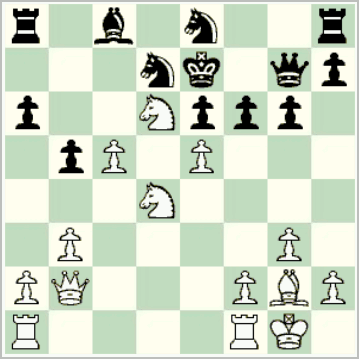
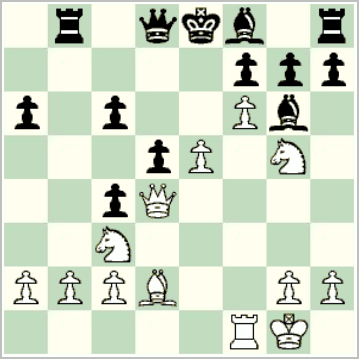
Heidenfeld beat O’Kane, but Paul ran into severe difficulties against Cox. In a King’s Indian, he had a slight advantage in the opening, when he disastrously castled on the queen’s side. Perhaps this was understandable in a must-win situation, but his position went steeply downhill almost immediately. With nothing to lose, he sacrificed heavily, and Cox slipped before the time control to allow him back into the game.

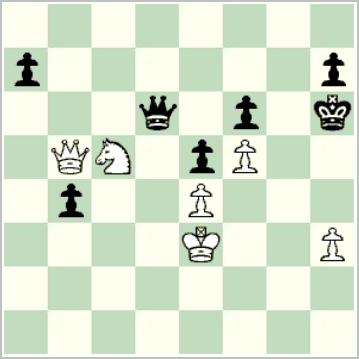
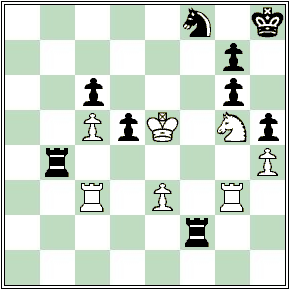
Cassidy - Cox, Irish Championship 1968 (9)

Cassidy – Cox, Irish Championship (9)
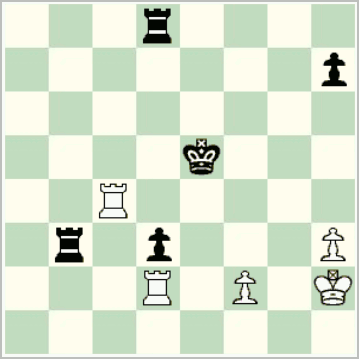
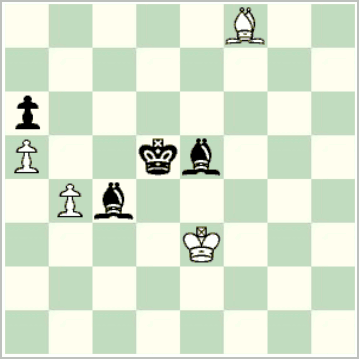
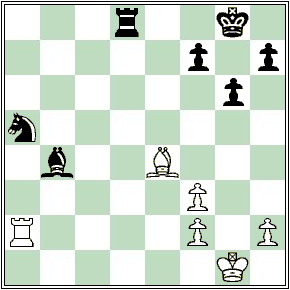
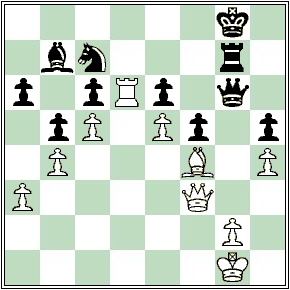
Position after 43. Qxb5

In the diagrammed position, White has just captured a black knight on b5. But, though it is not entirely clear-cut, there is no win. After 43… Qd4+, Cox offered a draw. Needing a win, Paul declined, and eventually lost.

“Despite its many flaws, this was a most exciting game, a real titanic struggle. I still remember the crowd of spectators around the board during the final 10 moves of the first session with both of us in severe time pressure and in a hugely tension filled position.”

[Click to replay the full game.]

Among Paul’s other games was a convincing win against former champion Brian Reilly, one of half a dozen wins.

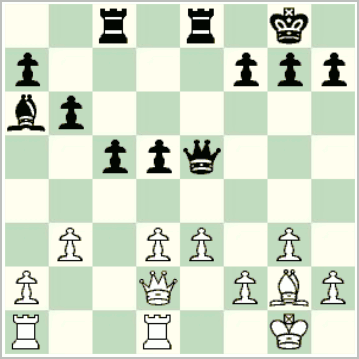
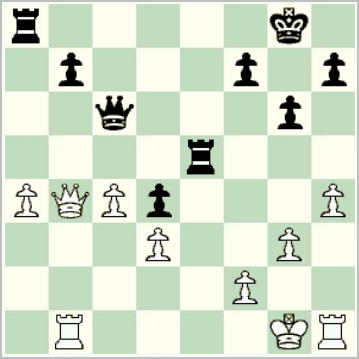
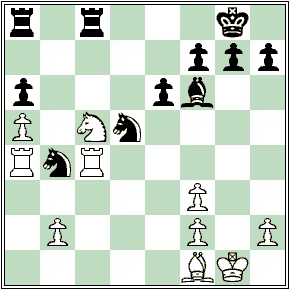
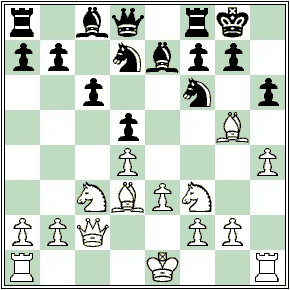
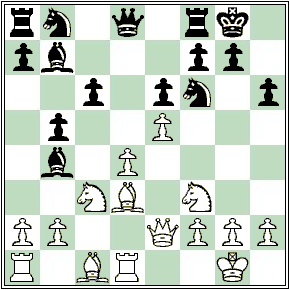
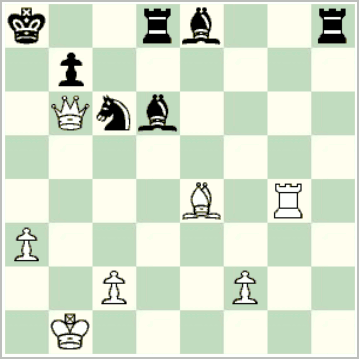
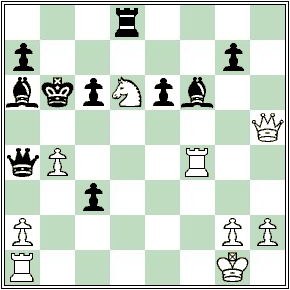
Perhaps the most difficult moment in all his games occurred in his fifth round win against David Wilson. In the diagrammed position below, Paul discovered only recently that engines find that White has a very strong continuation; in fact, it seems White is winning. What should White play now, and what is the winning plan? (I found this very non-obvious, even with the help of the engine.)

Cassidy - Wilson, Irish Championship 1968

Cassidy – Wilson, Irish Championship 1968 (5)
37. ?

[Click to replay the full game.]

Posted in Games, Irish championships, Tournaments | Leave a comment

Choudhury – Sallan, DCU Majors 2026

The last post mentioned that Cahit Furkan Sallan recorded a perfect 5/5 in last month’s DCU Majors. In the last round, he faced Darshan Choudhury, who had also reached that point with a perfect score.

The game had an interesting, but quite puzzling, finish.

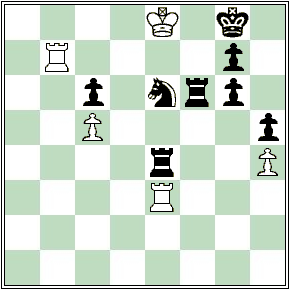
Choudhury - Sallan, DCU Majors 2026

Choudhury – Sallan, DCU Majors 2026 (5.1)
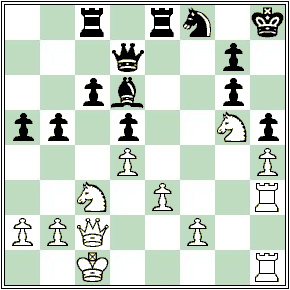
41… ?

The diagrammed position is crushing for Black, and now 41… Rb2 is the simplest way to proceed. Instead the game continued 41… Qg1+ 42. Kf3 Qf1+ 43. Kg4, and now Black erred irrevocably with 43… f5+??.

After 44. exf5, he erred once again with 44… gxf5+?, instead of 44… Qxf5+ with equality.

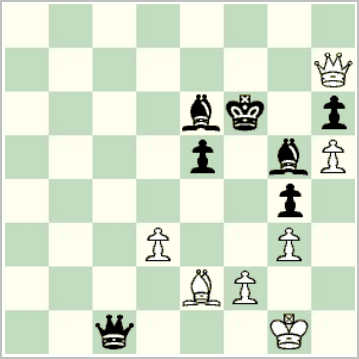
Choudhury - sallan, DCU Majors 2026 (II)

Same game
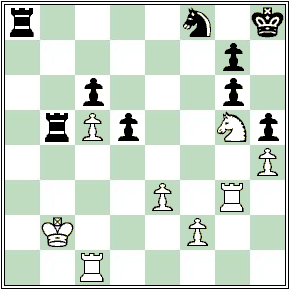
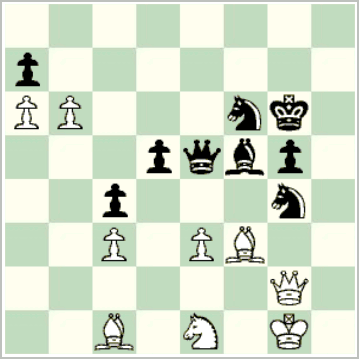
45. ?

Amazingly, after 45. Kh5!! White would now be winning. The threat is 46. Kg6 and 47. Rxe7, and Black has no effective defence. After 45… Qh3 46. Qf3 Kf7 47. Bf4 Ra3 48. Bg5, White has a winning attack.

Instead White missed the opportunity with 45. Kg5?. The difference is that after 45… Qh3!, 46. Qf3? (46. Qxf5=) would now lose to 46… Rxd2! 47. Rxd2 Be3+! 48. Qxe3 Qg4+ 49. Kh6 Qg7+ 50. Kh5 Kh7 and mates.

The game continuation as shown on live boards was 45… Bf6+?, which loses, and then 46. Kg6 Qh3 47. Bg5 Rxe2 48. Qxe2 Bxg5 49. Qe6+, followed by the two illegal moves 49… Bf6 50. Qe2, followed by 0-1.

This is the puzzling part. The last two moves are clearly spurious ‘live board’ moves, but Black is irredeemably lost after 45… Bf6+, and it is not evident what the actual game was. Did White lose on time?

[Click to replay the full game.]

Posted in DCU Congress, Games | Leave a comment

DCU Congress 2026

The DCU Congress 2026 took place at DCU St. Patrick’s campus in Drumcondra, from February 20-22. The event comprised three sections, Open, Majors, and Challengers, and also, on the Saturday, the Leinster Open Go tournament.

Full tournament reports for each (chess!) section have been uploaded to the Tournament pages here.

The Open attracted 47 players, and resulted in another first place for FM Oleg Artemenko on 4½/5, half a point ahead of David Fitzsimons and Oisín O’Cuilleanáin.

The Majors (rating 1650-1900) attracted 40 players. Cahit Furkan Sallan of Blanchardstown C.C. took first place with a perfect 5/5.

The Challengers (rating < 1650) attracted 91 players, and ended in a three-way tie between Jayden Amrolan, Eoin Dunne, and Alexandros Sykaras.

In the Open, David Fitzsimons had a complex task in his fourth round game against organiser (and highly ranked Go player, if I am interpreting it correctly) Emmet O’Rourke.

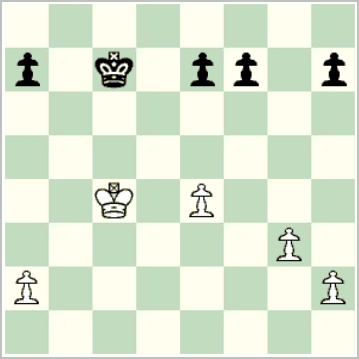
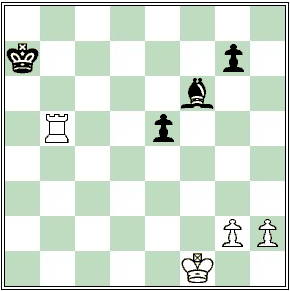
O'Rourke - Fitzsimons, DCU Open 2026

O’Rourke – Fitzsimons, DCU Open 2026 (4.5)
Position after 69… Bxe5

Winning the pawn on b4 will lead to a king, bishop, and wrong-coloured rook pawn versus king, so Black’s task is to manoeuvre to force White’s king far enough away from a1 before making the capture. This turns out to be tricky, but possible: the new Lichess Op1 tablebase shows that this is won for Black with best play.

As it happened, both players erred in the sequel: David missed an early chance to capture on b4, and Emmet missed three chances to draw with a timely b5 break. Emmet made the last mistake, and eventually resigned on the 112th move.

[Click to replay the full game.]

Posted in DCU Congress, Games, Tournaments | Leave a comment

More games from Lilienthal’s 1935 Dublin simul

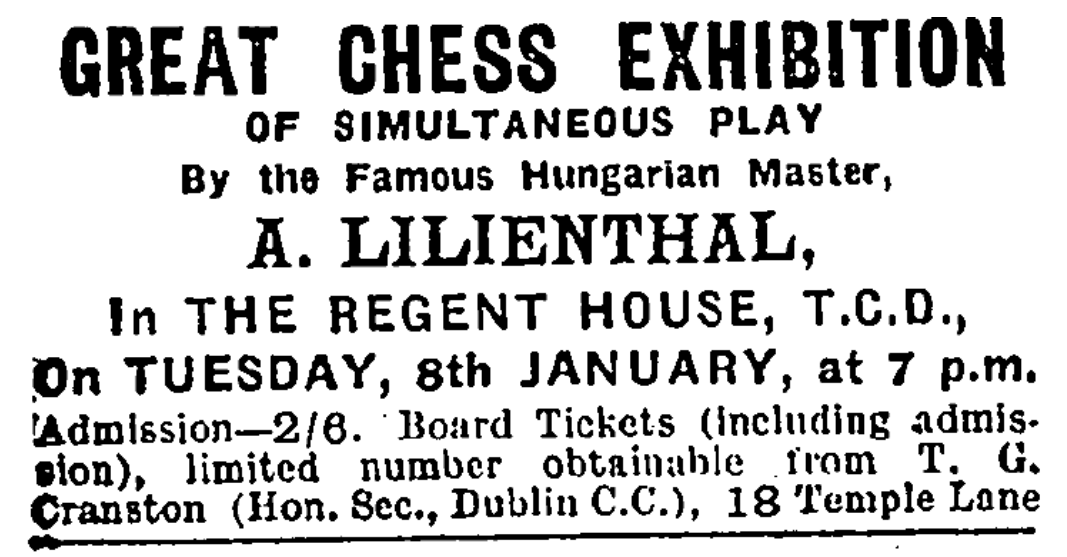
Advertisement, Evening Herald, 3 January 1935, page 6

In one of the earliest posts on IRLchess, in Lilienthal in Dublin, we recounted his visit to the city in 1935. That post featured a game from his simultaneous exhibition won by Barry St. John Galvin. More recently in Austin Bourke: First Steps we included that player’s victory over Lilienthal from the simul.

Now we present three further games from the event, all sourced from T.P. Donnegan’s chess column in the (Dublin) Evening Herald.

Update 14 April 2026: Since the post was first published, we have discovered a longer version of one of those games – the one against Peter Wahlrab – in W.J. Allen’s chess column in the Belfast News-Letter.

The first game features the 1939 and 1946 Irish Champion, but that was still in his future when this game was played,  and Donnegan gives a short history of Bartholomew (Barney) O’Sullivan’s early chess career in his introduction.

A delightful game, in which a County Limerick man outplayed the Hungarian champion (1) from start to finish, was that in Board 32 (2). Mr. O’Sullivan came to Dublin (via Clonmel and Liverpool) from Adare a few years ago, and joined the Rathmines C.C., being then merely a novice at chess. Later, for greater experience, he became a member of the Sackville as well; and he has been figuring in the “Herald” circle since 1931. This year he is playing in [preliminary] section “D” of the I.C.C.C.

The Chess Editor feels he cannot do better than give Mr. O’Sullivan’s own comments on his meritorious win, and they are accordingly interpolated.

(1) Lilienthal never won the Hungarian championship but perhaps Donnegan used “champion” in a generic sense of someone who shows marked superiority. 
(2)
The boards numbers assigned do not seem to have indicated level of ability.

Andor Lilienthal – Barney O’Sullivan
Simultaneous Exhibition, Dublin, 8th January 1935
[Annotations by O’Sullivan in the (Dublin) Evening Herald, 19th January 1935]

1.d4 d5 2.c4 Nf6 3.cxd5 Nxd5 4.e4 Nb6 5.Nc3 e6 6.Nf3 Be7 7.Bd3 Bd7
Better than 7…Nc6 as I was afraid of inviting 8.e5. As things worked out it was the saving of me.
8.e5 c5! 9.dxc5 Bxc5 10.0-0 Bc6
Making use of the long diagonal and to develop the b8-Knight to d7; and by preventing White from playing 11.Qc2 by reason of the threat 11…Bxf3 12.gxf3.
11.Qe2 N8d7

12.Bg5
A blunder which gives me a piece. I was expecting 12.Re1 or 12. Bf4 to save his e-pawn from 12…Bxf3 13. Qxf3 Nxe5.
12…Bxf3! 13.Qxf3
If 13.Bxd8 Bxe2 still winning a piece.
13…Qxg5 14.Ne4 Qxe5 15.Rfe1 0-0 16.Rac1 Be7 17.a4 Nf6 18.a5 Nbd5 19.Nc5 Qf4! 20.Nxb7 Qxf3 21.gxf3 a6
All Black pieces now receive marching orders to fight on the Queenside.
22.Nc5 Nb4
I would not play 22…Bxc5 to bring the White Rook into it; also the White a-pawn is on a Black square.
23.Bf1 Bd8 24.Rc4 Nfd5! 25.Ra1 Bf6! 26.Ra4 Rfc8

White’s play is trappy from this until his 35th move.

27.b3 Be7 28.Ne4 Rc6 29.Rxc6 Nxc6 30.Nd2 Bb4! 31.Nc4! Nd4 32.Nb6! Rb8! 33.Nxd5 exd5 34.Bxa6 Nxb3! 35.Bb7! Nxa5!
I have timed it to the P.
36.Bxd5 g6 37.Ra2 Rd8 38.Be4

Left off at this position for adjudication. I play 38…f5 39.Bc2 (forced) Rd2. 0-1

[Click to replay the game.]

Andor Lilienthal – Peter Wahlrab
Simultaneous Exhibition, Dublin, 8th January 1935
[Annotations by Donnegan in the (Dublin) Evening Herald, 19th and 26th January 1935 and Allen in the Belfast News-Letter, 24th January 1935]

1.d4 Nf6 2.c4 e6 3.Nc3 d5 4.Bg5 Nbd7 5.cxd5 exd5 6.e3 Be7 7.Nf3 c6 8.Bd3 0-0 9.Qc2 h6 10.h4
An interesting sacrifice of the Bishop to be followed naturally by castling on the Queen’s side. But Black is not forced to take the Bishop. [Allen]

10…Re8
10…hxg5? Lilienthal knows all the traps, but Wahlrab met this one before. [Donnegan]
11.0-0-0 Bd6 12.g4 Nf8 13.Rdg1 Kh8 14.Bf5 a5
Black makes a Queenside diversion and Lilienthal falls for it! See White’s 22nd move. [Donnegan]
Black initiates his attack on the Queen’s side. [Allen]
15.Rh3! b5 16.Bxf6 Qxf6 17.Bxc8 Raxc8 18.g5 Qe6 19.Rgh1! h5! 20.g6 fxg6 21.Ng5! Qd7
Black is now in a comfortable position, with a fair prospect of continuing his attack on the Queen’s side.[Allen]

22.Kb1?
A weak move, overlooking that 22.Rf3! was available with the threat of Rxf8+ and Qxg6 to follow. [Donnegan]
Wahlrab thinks 22.Kd2 would have been better but 22.Rf3, threatening Rxf8, followed by Qxg6 looks like winning. [Allen]
21…b4 23.Na4 Qa7 24.Nc5 Bxc5 25.dxc5 a4 26.Rg3 b3 27.axb3 axb3 28.Qxb3 Ra8 29.Qa3 Qxa3 30.bxa3 Rxa3 31.Kb2 Rea8 32.Rb1 R3a5 33.Rc1 Rb5+
and wins. Lilienthal resigned at move 52. [Donnegan]

The game-score in the Evening Herald ended here but it continued in the Belfast News-Letter, to the point where the game was adjudicated as a win for Wahlrab.

34.Kc2 Ra2+ 35.Kd3 Rxf2 36.Rc3 Rbb2 37.Kd4
Mate, of course, was threatened. [Allen]
37…Rb4+ 38.Ke5

38…Rf5+
38…Rf6 was best, threatening Nd7 mate, which White could only avoid by giving up his Knight. [Allen]
39.Kd6 Rf6+ 40.Ke7 Rb7+ 41.Ke8 Kg8 42.e4 dxe4 43.Rb3 Rd7 44.Rge3 Rd4 45.Rb7 Ne6 46.Nxe4 Rxe4 0-1

The game ended here, but the adjudicators awarded Black the game on the following variation:- 47.Rxe4 Nxc5 48.Reb4 Nxb7 49.Rxb7 Rf8+ 50.Kd7 Rf7+ etc. There is, of course, a better variation for White, but Black had a won game since the 30th move. [Allen]

[Click to replay the game. Updated version]

Andor Lilienthal – W. Murray
Simultaneous Exhibition, Dublin, 8th January 1935
[Annotations by Donnegan in the (Dublin) Evening Herald, 26th January 1935]

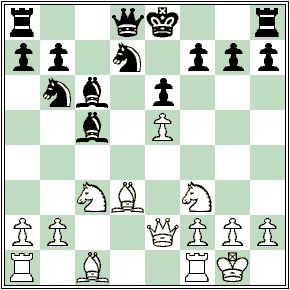
1.d4 d5 2.c4 e6 3.Nc3 c6 4.e4 dxc4 5.Bxc4 Nf6 6.Nf3 Bb4 7.0-0 0-0
With his next move, White prepares for e4-e5 with occupation of d3 (Bishop) and e4 (Queen) after Black’s …b7-b5, His 9, Rd1 is trappy, but timely.
8.Qe2 h6 9.Rd1 b5 10.Bd3 Bb7 11.e5

Now Black is in grave danger. He made some delay in replying, quite excusable under such circumstances – laudable in fact, If 11…Nd5 or d7 12,Qe4 threatening mate; if now 12…f5 13.exf6 etc. winning easily.
11…Ne8 12.Ne4 f5 13.Nc5 Bxc5 14.dxc5 Qe7
The utility of White’s 9th move is now apparent. With the text Black takes over the initiative and compels White to defend. A struggle for command of the open file begins.
15.b4 Nc7 16.Bc2 Nd5 17.Bd2 Na6 18.a3 Nac7 19.Bb3
Forming a combination based on Bxd5 later. Black perceives it! See his 23rd move.
19…a6 20.Nd4 Rf7 21.f4 g6 22.Rac1 Rd8 23.Qf3 Rg7 24.Be1 g5
[Preparing] a counter combination which succeeds; it wins a piece.
25.fxg5 Qxg5

26.Bxd5 Rxd5 27.Bg3 Rxd4 28.Rxd4 Qxc1+ 29.Rd1 Qg5 30.Rd6 h5 31.Bf4 Qg6 32.h4

Adjudication came here, Lilienthal conceded the win to Black, but in the excitement he was misinterpreted to mean the reverse. The question was raised later and Murray offered to call it a draw, and to this Lilienthal cordially agreed. ½-½ 

[Click to replay the game.]

Posted in Games, Simuls | Leave a comment

Sligo Open 2026

The recently concluded Sligo Chess and Culture Festival featured four subsidiary events in the Weekender on the opening weekend, plus a 9-round international Open, a rapid, and a blitz, in addition several other non-tournament events in an ambitious programme.

Full reports have been added to the Tournament pages here for the four subsidiary events in the Weekender on the opening weekend: respectively the Expert, Championship, Major, and Challenger events.

A full report has also been added for the 9-round International Open. In theory, title norms were possible, though in the event none were achieved.

The event resulted in a clear win for the top seed and only grandmaster Felix Blohberger of Austria, on an unbeatean 7½/9. As noted in the Europe Échecs report on the event, though, his win wasn’t clear until his victory in the final round. Adam Collins had an excellent result in finishing clear second on 7/9, followed by the visiting IMs Alexander Krastev and Emil Risteski, both of whom lost to Blohberger, in joint 3rd-4th on 6½/9, with the former taking third prize on tie-break.

The selection of interesting games in the report includes some entertaining one-sided massacres, which are often a feature of large open events. There was also a marathon 133-move game between Augustín Fernández Manrique and Collins, where the latter finally squeezed out a win in the queen ending; these are very difficult to play.

Here is one combinatorial moment from the second round game between Alfonso Alvarez Jiminez (Spin) and Jon Konig (England).

Alvarez Jiminez - Konig, Sligo Open 2026

Alvarez Jiminez – Konig, Sligo Open 2026
44… ?

Black had built up a clearly winning position, but had started to lose the thread shortly before the diagrammed position arose. Now 44… axb6 was essential, when Black stays in the game, e.g., 45. Bxg4 Nxg4 46. 46. a7 Qxc3 47. Qd2 Qe5 48. a8=Q Qg3+ 49. Kf1 Nh2+ 50. Qxh2 Qxh2, with an interesting Q + B + N + P v. Q + B + 4P ending.

The game continuation was 44… Nxe3?. This was much better for White even after the natural capture on e3, and he soon converted his advantage. However, he missed the startling immediate win with 45. Bh5+!!, a clearance sacrifice for the knight to enter f3. After 45… Kxh5 (45… Kh7 46. Qxg5 is crushing), 46. Qxg5+ (engines find the immediate 46. Nf3 to be even better) 46… Kxg5 47. Nf3+, etc., queens come off and White will promote on the queenside.

[Click to replay the full game.]

Posted in Games, Sligo Spring Tournament, Tournaments | Leave a comment

Tablebase revelations

Last weekend, Lichess announced a new partial 8-piece tablebase “Op1”, containing all positions in which at least one pair of opposing pawns face each other on the same file.

The tablebase can be searched on line using the Lichess analysis board, among other ways, by replacing the FEN strong below the diagram with the string for the position to be searched. (The Nalimov endgame tablebase page at the Knowledge4IT web pages provides one easy way to generate FEN strings.)

Every advance in tablebases produces new, hard-to-fathom records for long and difficult wins. The position in the link above shows a win in 584 moves. Of course, this is of strictly theoretical interest, as it requires ignoring the 50-move rule.

These theoretical records usually involve exotic positions that have never arisen in actual games, even in plausible variations. Searching databases for actual games will probably yield much more prosaic results.

In any case, I can report the impact on Irish games. After some processing, I can say that the ICU games archive, as of February 5, contained 4,642 games containing at least one position covered by Op1, either in the game or in a variation. Many of these positions are trivial in various ways: some (actually 1,643) immediately transition to a simpler ending or appear after the last move of the game, some involve players playing on in utterly hopeless positions (example, after 38W), and some involve futile efforts to squeeze a win out of a drawn position (example, after 69W).

The top ten material balances encountered, in descending order of frequency, were:

R+2P-v-R+2P: 708
R+3P-v-R+P: 522
3P-v-3P: 498
4P-v-2P: 251
B+2P-v-3P: 142
B+2P-v-B+2P: 134
R+2P-v-B+2P: 124
B+2P-v-N+2P: 118
N+2P-v-3P: 114
R+2P-v-3P: 110

But Op1 did provide some revelations.

L. Roos - McCarthy, EEC Team Championship 1980

L. Roos – McCarthy, EEC Team Championship 1980
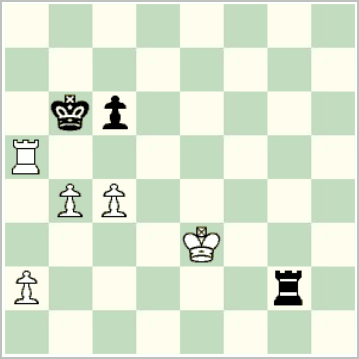
40… ?
Drawn with best play

The EEC Team Championships were very strong events, with a much smaller ‘tail’ than Olympiads. In the third and last of these, in West Berlin in 1980, Anthony McCarthy of Cork was defending the position above against Louis Roos of France.

Though White is two pawns up, Lichess Op1 shows that the game is drawn with best play. It is not that straightforward, though, and both players went astray in the sequel.

After 40… Rb2 41. Ra4 Rh2 42. Ra8 Kb7 43. Ra5, McCarthy’s 43… Rh4? was wrong; 43… Rh3+, 43… Kb6, and 43… Kc7 were the only moves to hold the balance. In turn, Roos’ reply 44. Kd3? was wrong; 44. Rc5! was the only winning move. The evaluation stayed the same until move 54, when McCarthy erred, allowing Roos to regroup on the queenside and win.

[Click to replay the full game.]

Here is another Irish game for which Lichess Op1 has something to reveal:

Daly - J. Delaney, National Club Championship 2016

Daly – J. Delaney, National Club Championship 2016
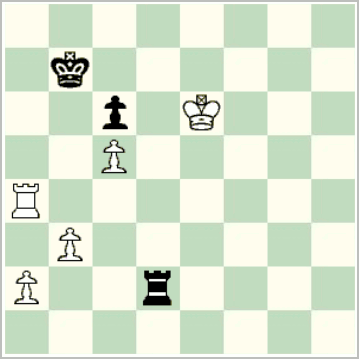
61… ?
Drawn with best play

Déjà vu; this is almost identical to the position above. Once again, Lichess Op1 shows that this is drawn with best play, and once again each player goes astray in the sequel. The reader is invited to work out why various moves are or are not correct; it doesn’t seem at all straightforward.

John Delaney’s 61… Rd5? was wrong; 63… Rc2, 63… Re2+, and 63… Kc7 were the only moves to preserve a draw with best play. After 62. Rb4+ Kc7 63. Rc4 Rd2, Colm Daly erred in turn with 64. Ra4?; 64. a4! (only move) wins. The evaluation changed twice more, and the game ended in a draw.

[Click to replay the full game.]

Posted in Games, News | Leave a comment

Sligo Masters 2026

The annual Sligo Spring Tournament has expanded even further this year to a Sligo Chess and Culture Festival, comprising a five-section Weekender, a 9-round Open in which norms might be possible, a rapid and a blitz, as well as various non-chess events. Congratulations to the organisers, who have taken a very ambitious approach.

The Weekender took place this last weekend. A full report on the Masters section (for rating 1900+) has been added to the Tournament pages here.

The event consisted of five rounds, and was contested by a field of 30 players. Top seed Jacob Flynn won his first three games and stood clear first, but could only draw his last two games, having been a pawn down in each, against Lukian Hushpit and Oliver Barnes; Barnes could well have played on.

Flynn still stood in clear first after round four, on 3½, but was followed by seven players on three points. All last-round games between players on 3 points had decisive results, so the final result was a four-way tie between Flynn, Shane Melaugh, Oisín O’Cuilleanáin, and Yannick Woods. I did not see any tie-break method specified.

All games are available via live boards.

Perhaps the most interesting game, from many strong candidates, was the second round game between Jamie Comley and Robert Ashworth.

Comley - R. Ashworth, Sligo Masters 2026

Comley – R. Ashworth, Sligo Masters 2026
19. ?

After the prosaic 19. Na4, White would stand slightly better. Instead the game saw the startling 19. Nf7?!!. Though enterprising, this is objectively bad, and after 19… Bxf7 20. e6 gxf6 21. exf7+ Kxf7, Black stood better. Five moves after that, White was winning, but he missed the best continuation, and the game oscillated for a while between winning for Black and level. Black established a clearly winning position, and seemed to have navigated all obstacles, only to agree a draw in a winning position. Quite an eventful game!

[Click to replay.]

The last-round game between Mustakim-Ul Haque and England’s Kevin P. Millward had an interesting finish.

Haque - Millward, Sligo Masters 2026

Haque – Millward, Sligo Masters 2026
34… ?

With rook, bishop, and knight for a queen, Black had been winning on material just a couple of moves earlier, but the position has turned treacherous. He still stands much better after 34… Be5!. After the game continuation 34… Bd7?, White responded 35. Rg5!, and suddenly Black has no defence against 36. Rb5. After a few checks, Black resigned.

[Click to replay the full game.]

Posted in Games, Sligo Spring Tournament, Tournaments | Leave a comment

William Crawford Palmer

DEATH OF A WELL-KNOWN CHESS PLAYER

The announcement of the sudden death of Dr. Crawford Palmer from heart disease will come as a great shock to chess players throughout Ireland. The sad occurrence took place on Friday at Birkenhead Workhouse Hospital, while in the act of writing out a prescription for a patient. For over twenty years Dr. Palmer was well-known to chess players, be it at the D.B.C., the Dublin Chess Club, or even to the frequenters of the late Morphy’s Divan in Grafton street in the ‘eighties, and everywhere he was popular, and always a genial opponent. The deceased was the second son of the late Venerable Arthur Palmer, Archdeacon, of Toronto, and the funeral will take place to-morrow at Dean’s Grange.
(Dublin) Evening Herald, 1 October 1906, page 5

W.C. Palmer was a son of Irish parents, the afore-mentioned Arthur Palmer (who was appointed Rector of St. George’s Anglican Church, Guelph, Ontario in 1832) and Hester Madeline Palmer, née Crawford. He was very likely born in Guelph in late 1840. He died in Birkenhead, Liverpool, England on 28th September 1906, aged 65.

Regarding his chess career, he competed at both the 1st Irish Chess Association (ICA) Congress, Dublin in 1885 and its Congress the following year in Belfast. He played in the controversial correspondence match against the Sussex Chess Association during 1885-6 for an ICA team, alongside such luminaries as W.H.K. Pollock, Porterfield Rynd, George Soffe, W.H.S. Monck, George F. Barry, John Morphy and Thomas Long. He was a member of the Phoenix team which won the inaugural Armstrong Cup in 1889.

Our featured game was played in Belfast during the ICA Congress. Up to now, it does not seem to have been included in any of the modern game databases. A.S. Peake, the ICA Secretary and fellow contestant at the Congress had sent the game (and probably other material about the event) to the editor of the Liverpool Weekly Courier chess column. The game appeared in the newspaper’s 30 October 1886 issue.

Tim Harding at page 323 of his British Chess Literature to 1914 (McFarland, 2018) states that Robert Frederick Green was the editor of Liverpool Weekly Courier column from 7 November 1885 to 29 January 1889 and it seems likely that the unattributed notes given in the game are by Green.

Palmer set out from the beginning to go for a direct attack on his opponent’s King, with an early pawn sacrifice opening lines towards the Black King. With his Queen entering the fray, the Black King was chased across to the Queenside, but Palmer could not quite land a finishing blow. His 23.c4 would have brought about a quick conclusion, were it not for the en passant rule. There may have been an element of bluff about Palmer’s 25.Qh5 and after Black decided not to capture the offered Knight with 25…Rxd6 (26.Qc5+ Kc7!) the game remained complicated but roughly equal. However 29…Rd1 allowed White to snaffle Black’s advanced c-pawn and resume his attack. Palmer then seized an opportunity to trade off Queens and transition into a won endgame. A final flourish, sacrificing the exchange, forced Black’s resignation with his King too far away to prevent Palmer’s h-pawn from Queening.

William Crawford Palmer – John D. Chambers
2nd Irish Chess Association Congress, Belfast 
Even Tournament (Round 7), 28 September 1886
[Annotations by R.F. Green in the Liverpool Weekly Courier]

1.e4 c5 2.Bc4
The old fashion in vogue in the days when the theory of the opening was imperfectly understood. It permits of the effectual advance of Black’s d-pawn, thus getting rid of the chief weak point in the defence. The Bishop manoeuvre losses time, and, as pointed out by Zukertort, would be much better posted at e2. The recognised move is 2. Nc3.
2…e6 3.Nc3 Nc6 4.f4
4.Nf3, followed by 5.d4, seems a more promising line of play.
4…Nf6 5.e5
Although he weakens his pawn position, still more by this move, it is possible that White had views of his own in yielding to his opponent’s temptation.
5…Ng8 6.Nf3 d6 7.0-0 dxe5
Black should not have gone in for winning the pawn, which obviously is deliberately sacrificed. 7…d5 not only gained time, but left him with a superior position.
8.fxe5 Nxe5 9.Bb5+ Nc6
The attack is embarrassing, and we would incline to the awkward looking defence 9…Ke7.
10.d4 cxd4 11.Ne5

11…Qb6
This loses the “exchange”, but we question if there is anything better.
12.Bxc6+ bxc6 13.Na4 Qb5 14.Nxf7 Qxa4 15.Nxh8 Nf6 16.Bg5 Be7 17.Bxf6 Bxf6 18.Qh5+

18…Kd7
Plainly 18…g6 is worse than useless because of 19.Qxh7 and if then 19…Bxh8 20.Rf7 and mate is unavoidable. If 19…B elsewhere, then 20.Nxg6 wins a piece or forces mate.
19.Qxh7 Kd6 20.Nf7+ Kc5 21.b4+ Kb6
He has evidently had enough of the Greek gifts, and this one is “declined with thanks.”
22.Nd6 Ba6 23.c4 dxc3 24.Rf4 Rd8 25.Qh5
Necessary before moving the Knight to prevent the awkward effects of 25…Rd1+. It also indirectly protects the Knight from capture by threatening 26.Qc5+.


25…e5 26.Nc4+ Bxc4 27.Rxc4 c2 28.Rf1 Rd2 29.Qf3 Rd1 30.Qf2+ Kb7 31.Qxc2 Rxf1+
This last exchange destroys any chance of a draw Black might have had, and he might as well have resigned at once.
32.Kxf1 Qa6 33.a4 Qb6 34.Qb3 a6 35.b5 axb5
[The ambiguous 35…PxP is given in the text.]
36.axb5 cxb5 37.Rb4 Ka6 38.Qa2+ Kb7 39.Qd5+ Ka6 40.Qa8+ Qa7 41.Qxa7+ Kxa7 42.Rxb5

42…Ka6 43.Rb3 Ka5 44.Ke2 Ka4 45.Rb6 Ka5 46.Rxf6 gxf6 47.h4 1-0

[Click to replay the game]

Biographical Sources:
Birkenhead News: 29th September 1906, page 5 and 3rd October 1906, page 5
Belfast Weekly Telegraph: 6th October 1906, page 6
Wikipedia: Arthur Palmer (father) and Arthur Palmer (brother)
Wikitree: Hester Madeleine Palmer, nee Crawford (mother) plus other family pages
St. George’s Anglican Church Guelph, Ontario (Father’s ministry)

Posted in Uncategorized | Leave a comment

Williamson Shield 2026

The latest instantiation of the long-running Williamson Shield was held in Belfast last weekend. In a departure from recent practice, one combined event was run, instead of an upper and lower section. In all, 35 players played, including four former winners: Mandar Tahmankar, who had won the previous four years, Gareth Annesley, Stephen Scannell, and David Blair. The latter shared the Shield twice, in 1972 and 1975, per David McAlister’s records.

A full report has been added to the Tournament pages here. The top six games were available via live boards, so 30 of the 83 games are available.

The Ulster Chess Union Facebook page had a post with 18 photos of the event and a short video of round 1.

Stephen Scannell suffered an early reverse in his second round loss to Anayraj Tripathi, in a game where he stood well early on, but seemed to lose the thread badly.

Third seed Ethan Cole dropped half a point, also in the second round, in a way that will have disappointed him.

Bradshaw - Cole, Williamson Shield 2026

Bradshaw – Cole, Williamson Shield 2026 (2)
Position after 57… Qxc1+

In the diagrammed position, Cole has just won a piece. The exposed position of the black king creates some problems, but even after the best 58. Bf1, Black should be able to win. After the game’s 58. Kh2?, the response 58… Qe1 would have won on the spot. Instead the game continued 58… Qb2?. Although the position should still be winning, Black did not manage to find a clear-cut continuation, and not very much later allowed White an inescapable series of checks. The game ended in a draw under the fifty move rule.

[Click to reply the full game.]

Tahmankar had no such troubles, and after four rounds had full points, half a point ahead of Cole and Gabriel Landmark of Curragh C.C. Tahmankar and Landmark had a shortish draw in the last round, and Cole also drew against Scannell.

This left Mandar Tahmankar as clear winner, for the fifth consecutive year. Congratulations! Landmark, Cole, Andew Campbell, and Jack Edens finished joint second on 4/5; tie-break applied to place Landmark second, Campbell third, and Edens fourth.

Posted in Tournaments, Williamson Shield | Leave a comment

Irish New Year Open 2026

The Irish New Year Festival 2026 was held at the Talbot Hotel Stillorgan from December 31 to January 4. It comprised an Open, the Irish 50+ and 65+ championships, a Norm tournament, a blitz, and the Leinster Junior Championships in age groups from U19 to U9.

A report on the Open has been added to the Tournament pages here. This attracted 46 players, down quite a bit from the 75 for last year’s Irish International Open. It resulted in a three-way tie for first between Andrey Ivanov, Shane Melaugh, and Pratik Mulay, on 5½/7.

The top 8 boards were live in all but the first round, so 48 of the 149 games are available.

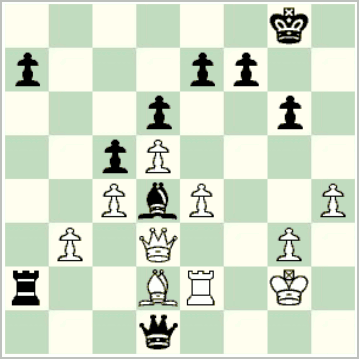
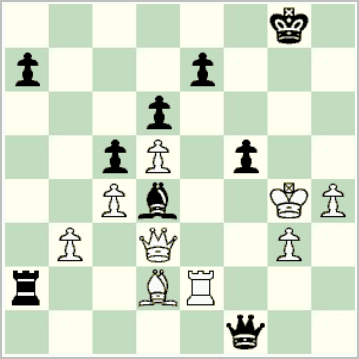
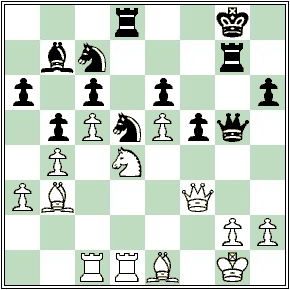
Braine - S. Melaugh, Irish New Year Open 2026

Braine – S. Melaugh, Irish New Year Open 2026 (3)
31. ? and 38. ?

The top board game in round 3 featured a dramatic turnaround in fortune. The left diagram shows the position after move 30, with White in complete control, and an evaluation of around +5. Now simply 31. O-O-O leaves Black helpless (31… Qd8? 32. Rxh7+ and mate next move, and White can simply play h4-h5, etc.) Instead White snatched at a minor material gain via 31. f7? Rxf7 32. Nxf7+? (it would be better to admit the error and simply castle) 32… Qxf7. Most of White’s advantage was now gone, but in addition White’s position was starting to look overextended. After just three further moves White was lost, and a couple of moves later, the diagram at right was reached.

[Click to replay the full game.]

Posted in Tournaments | Leave a comment