Disinformator 42

It has been an unusually eventful couple of weeks in Irish chess, with one of the closest (relegation) finishes ever in the Armstrong Cup on Sunday last, and the second e2e4 Dublin Masters beginning today.

More on those items later as more information rolls in. In the meantime, this week also had very welcome and unexpected news with the return of DisinformatorTM after an extended break. This, the club magazine of Oxford City C.C., has been edited for years by Seán Terry, formerly of Dublin C.C., and was previously discussed here. Highly recommended!

I haven’t had a chance to go through the latest issue yet, but the Irish games from Disinformator 41 have been added to the archive: 20 games of Seán Terry’s, and 6 more involving Rod Nixon.

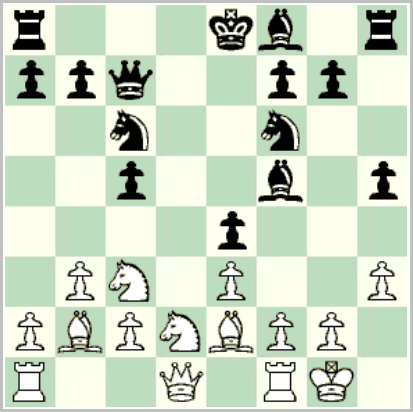
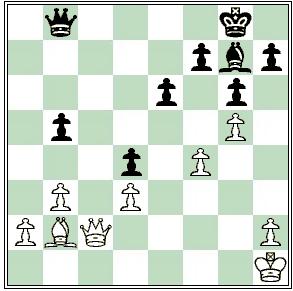
Brown-Terry, Disinformator 41Here is one excerpt from these games, from the feature “Blunder and/or Brilliancy?”, from the game Brown-Terry, Chiltern League Div. 1 2010-11. Play continued 11. … Ng4!? 12. hxg4 hxg4 13. g3. Blunder and/or brilliancy?

Once you’ve answered that, a second question based on the game continuation. What is the verdict with best play after Black’s 18th?

Answers in a few days.

Posted in Games, Puzzles | 1 Comment

The New Winawer Report, issue 3

The third issue of The New Winawer Report has been posted: see the tnwr page. This one moves on to the main line of the poisoned pawn variation.

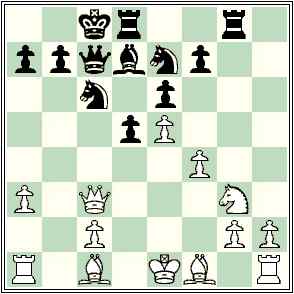
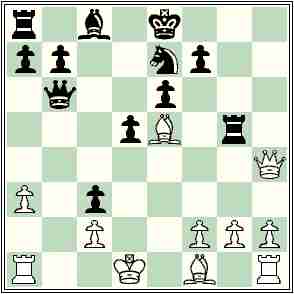
Moskalenko's suggestionIn the main line with 10. Ne2 Nbc6 11. f4 Bd7 12. Qd3 dxc3, White’s most critical continuation is probably 13. Qxc3. This is often, even usually, met by 13. … 0-0-0. But Moskalenko suggests in his recent book The Wonderful Winawer that this is an inaccuracy that allows 14. Ng3, which he awards a ‘!’, reaching the diagram at right, and a position he evaluates as better for White. Similarly the older 13. Ng3, if met by the common 13. … 0-0-0, allows White to reach the diagrammed position with 14. Qxc3. Moskalenko therefore suggests that 13. Qxc3 should be met by 13. … Nf5, ‘!’, and 13. Ng3 by 13. … d4 ‘!’.

Is he right? Issue 3 considers the point in detail, along with the theory of the 13. Ng3 variation.

Posted in Articles | Leave a comment

Monthly updates: December, January, and February

Here is an update on the items over the past three months that weren’t the subject of separate posts.

Extra search feature:

Most new games are added to a “Sundry” folder, with a new folder created for each month. A new addition to the search feature allows these “Sundry” folders to be searched individually. To search for February 2013, for example, type “-month2013-02” in the “Search Games” box. This makes it easy to search for new games. The results for the past three months can be found in searches for December (227 games, 15 results without moves, 1 bye/walkover/default), January (11 games), and February (73 games, 15 results without moves, 4 byes/walkovers/defaults).

Games collection:

In addition to the “Sundry” games, we’ve started the process of porting games over from OlimpBase. In addition to the Irish games from Warsaw 1935, the subject of a recent post, the archive also has 8 games and 3 results without moves of C.H.O’D. Alexander’s from the 5th Olympiad in Folkestone, 1933, where he was representing Great Britain. (He played 11 games so all are covered.) The ICU games archive contains 5 of these.

The en passant bug:

In playing through one of the recent games added, I found a strange bug in which the HTML didn’t render some en passant captures correctly: if White captured exf6, say, the pawn on f5 would stay but any piece on d5 would disappear. I tracked the bug down to my misunderstanding of how the javascript file underlying the Palview system works. En passant captures are represented by one of two different symbols (“d” or “t”). I thought one of these was for captures by White and the other for captures by Black. But no: it turns out that one is for captures to the left as White looks at the board (e.g., dxc6 for White or dxc3 for Black), and the other is for captures to the right as White looks at the board, e.g., exf6 or exf3. (!) So captures of the type exf6 or dxc3 are implemented incorrectly.

This has now been corrected on many of the older files in the site, but not yet all.

Posted in Administrative | Leave a comment

A missed opportunity

The Bunratty Festival, now up to the 20th in the series, goes from strength to strength. This year’s event had not only the usual very strong Masters, an event that has been described as a ‘ridiculously strong weekender’, but also for the first time an all-play-all event offering the opportunity of GM and IM norms. Gerry Graham’s report is available on the ICU web site.

The Classic featured some very interesting chess but unfortunately no norms. Very unfortunately indeed, in fact. Colm Daly needed 4½/9 for an IM norm (average opponent rating 2460 5/9, rounded up to 2461, and the rest given by Tables 1.49a in the FIDE Handbook). Going into the last round he needed a win with Black against Sam Collins, a tall order.

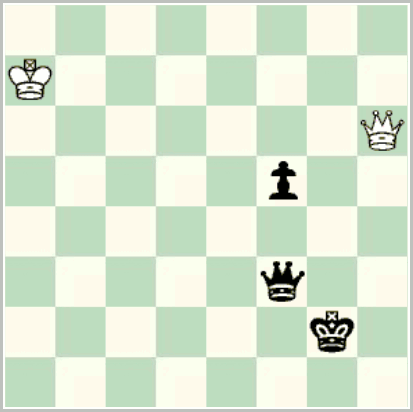
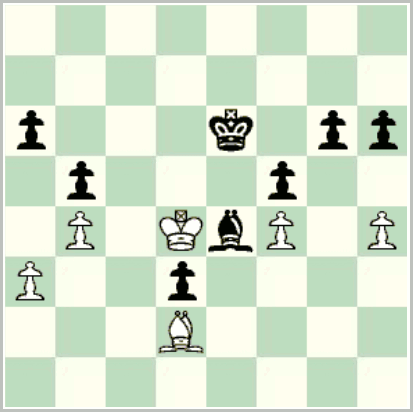
Collins-Daly, Bunratty Classic 2013But after many twists and turns he managed to get to a queen ending that the Nalimov tablebases confirmed was winning. At that point I had to pack up to head to the airport for a trip to Shanghai. Given the disappointment I felt later on seeing the result, I can only imagine how galling it was for Colm. After 39 moves with no progress, Colm gave it up as a draw. Even the final position, at right, is a win if the 50-move rule can be avoided.

[Click to replay.]

Posted in Games | 1 Comment

The Chess Map of Ireland 1993: 20 years on

When I played in the 1994 National Club Championship at the Winston Hotel Bangor, I received the parchment map below. My slightly faded recollection is that all the participants received a copy to mark their participation in the event, but perhaps there were various prizes handed out and this was one of them.
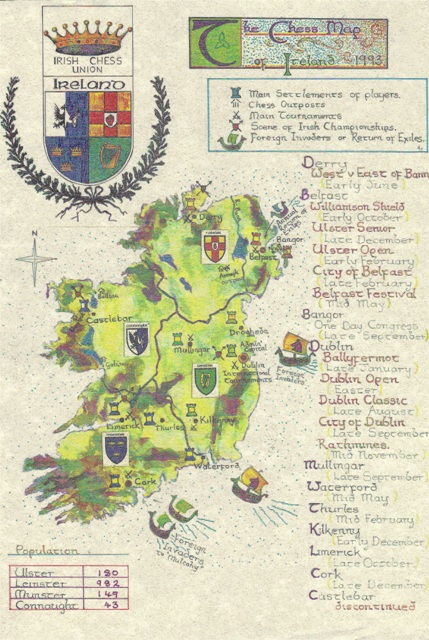
The original map is also a little faded but hopefully those reading this will be able to make out the details. Essentially the map is a snapshot in time – revealing the numbers of (ICU registered) players, the places where chess players were mainly congregated and the towns and cities where the major tournaments took place.

20 years on, there have been many changes in the tournament calendar. In the North, gone are the West v East of the Bann match, the Bangor Rapidplay, the Ulster Open and the Belfast Festival, while the Ulster Senior and Williamson Shield are now held at different times of the year. Of the Dublin tournaments, Ballyfermot, the Dublin Classic and Rathmines are no longer held; the Dublin Easter Open (aka the Irish Open) disappeared but has recently been replaced by the prestigious e2e4 Dublin Easter International.

Of the other tournaments at various towns and cities around the island, Mullingar and Thurles are no more, while the one at Waterford has only recently been revived. Just at about the time the map was created, Kilkenny morphed into a major international weekend open, while the next year saw the start of Bunratty, now the biggest weekend open in Ireland (and which this year sees the innovation of a FIDE-rated all-play-all added to the Congress). The event in Cork was the Mulcahy Memorial, which shortly after had a near 10 year hiatus, before resuming in 2003; of course Cork also had, and still does have, a strong annual Congress in the Spring. Drogheda appears on the map but there is no specific reference to its annual June Bank Holiday event (still going strong) and which itself was a successor to the Wexford Congress.

New names have come along to fill the gaps. The Ulster Masters has recently replaced the Ulster Open while last year the new Ballynafeigh CC in Belfast held a series of four rapidplay events over the summer months. In the Dubin area, the Malahide Millennium and Gonzaga tournaments are now well established, as are the annual Congresses at Ennis and Galway.

Anyway, a long preamble to a shameless plug. Elsewhere on the internet, some years ago, I started a website called Irish Chess History to act as a sort of research tool for those interested in the history of chess tournaments in Ireland.  However, it was one of those free websites with all these adverts popping up, so I took the plunge with a new version at www.irishchesshistory.wordpress.com. There you’ll find, as I gradually update and move the content over, a record of the tournaments mentioned above (and many more, historic and still current).

There are a lot of stories to tell, and games to dig out, from these events. Expect these to feature here at IRLchess.

And finally, one small contribution to that process. I only played in one of the three rounds in the 1994 National Club Championship – to be precise in round 2 against a Fisherwick team with Brian Kelly on top board, that trounced my team Newtownards 5-1 on the way to overall victory. The ICU database does not have any games from the event, so here is my game – not the most eye-catching of efforts but probably a reasonably good game technically. Anyway it’s a start, only another 35 to find!

Stuart Farnan – David McAlister: Bangor, 20 November 1994
National Club Championship (Round 2)Fisherwick v. Newtownards (Board 3)

1.e4 c5 2.Nc3 e6 3.f4 d5 4.Nf3 dxe4 5.Nxe4 Nf6 6.Bb5+ Bd7 7.Bxd7+ Nbxd7 8.d3 Be7 9.Qe2 0–0 10.0–0 Qc7 11.Kh1 Rac8 12.c4 Rcd8 13.Bd2 a6 14.Ne1 Nb8 15.Bc3 Nxe4 16.Qxe4 Nc6 17.Nc2 b5 18.b3 Qb6 19.cxb5 axb5 20.Rf3 Nd4 21.Nxd4 cxd4 22.Bb2 Bf6 23.g4 g6 24.g5 Bg7 25.Rf2 Rc8 26.Qg2 Rc7 27.Rc2 Rfc8 28.Rac1 Rxc2 29.Rxc2 Rxc2 30.Qxc2 Qb8 (diagram) 31.Qf2 A mistake. 31.Bc1 had to be played, when Black would only have had a slight advantage. 31…Qa8+ 32.Kg1 Qxa2 33.Bxd4 Black should have played first 33…Qb1+ and after 34.Kg2 only now 34…Qxb3 because after 35.Bxg7 Qd5! 36.Kg1 Kxg7 White no longer has the perpetual check played in the game continuation. 33…Qxb3 34.Bxg7 Kxg7 35.Qd4+ Kg8 36.Qd8+ Kg7 37.Qf6+ Kg8 38.Qd8+ ½–½

[Play through the game]

One final curiosity; why is my scoresheet (see below) headed “Munster Chess Union” for an event organised by the Irish Chess Union and played in Ulster?
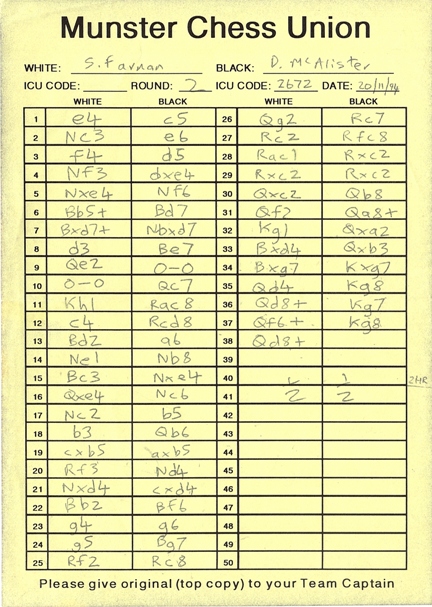

NCC 1994 scoresheet

Posted in Uncategorized | 1 Comment

The New Winawer Report, issue 2

The New Winawer Report issue 2The second issue of The New Winawer Report has been posted: see the tnwr page. This one continues with the 10. Kd1 line in the Winawer poisoned pawn, which is rare but features some very interesting chess.

Modern practice has converged on a line leading to the diagram at right, where White has just played 15. Qh7-h4!. The point is that the bishop is indirectly protected (15. … Rxe5 16. Qh8+), so White gains control over d4 after either 15. … Rg8 16. Qd4 or 15. … Rf5 16. Qh8+! Kd7 17. Bd4, and there’s still a theoretical debate over which of these lines Black should choose.

However Black has a third possibility that seems to have been overlooked entirely, leading the game in an entirely different and ultra-sharp direction. It’s all very complicated indeed, but as far as I can see Black survives in all variations. I could be wrong! Full details in the second issue.

Posted in Articles | Leave a comment

Warsaw Olympiad 1935

Ireland’s first Olympiad was Warsaw 1935, the 6th overall. As with all Olympiads, and indeed many other team tournaments, the definitive reference is the OlimpBase report, and there would be no point in assembling a different report here. However we aim to make the games archive a comprehensive source of Irish games, so the games certainly belong, and have now been added. There are 52 games in all: 43 games by the Irish team (Brian Reilly, James Creevey, T.G. Cranston, J.J. O’Hanlon, and reserve Austin de Búrca) and a further 9 games by C.H.O’D. Alexander (b. Cork, 1909), who was representing Great Britain. (Was this really “Great Britain”, as given by OlimpBase, or “England”? A question for another day.) There were a further 38 games involving these players for which the scores are not available.

Most of these games are available on the ICU web site, of course. But every so often a long-lost game score turns up, and this seems to have happened recently at OlimpBase, which has the game Cranston-Sørenson from board 4 of the Ireland-Denmark match in round 16, played on 28th August 1935. The source isn’t given explicitly but OlimpBase’s “What’s new” page says that 15 games by Danish players were added (2nd April 2010) based on information from P. Skjoldager. (Is this Per Skjoldager, co-author of Chesscafe.com’s 2012 Book of the Year Aron Nimzowitsch 1886-1924? Probably.)

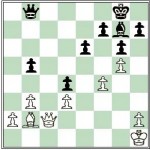
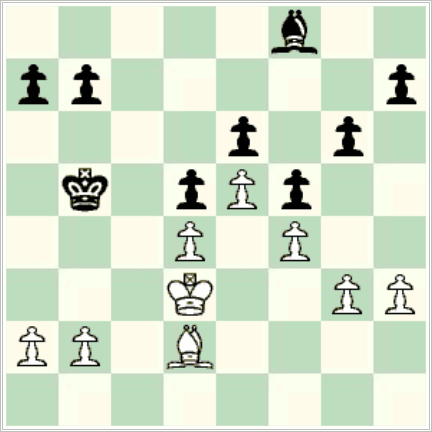
Cranston - Sorensen, Waraw Olympiad 1935The game ended badly for Ireland. In the diagrammed position, it’s Cranston (White) to play, facing considerable difficulties. Cranston played 37. a3? and after 37. … Ka4 38. Kc2 Bxa3! was already lost.

[Click to replay.]

If instead 37. b3 Ba3 38. Kc2 a5 followed by … a4 and … Bb4, it seems White also loses. But after 37. Kc2!?, what is the verdict? The point is that 37. … Kc4 can be met by 38. Be3, planning a4 and b3+ and a perpetual. If 37. … Bb4 38. Be3 Be1 39. g4, it all looks very precarious for White, but where’s the breakthrough? I think White hangs on. Corrections are welcome: can any reader prove that Black can win?

Posted in Games, Tournaments | Leave a comment

Irish championship 1998

The ICU web site has an interview with Stephen Brady from 1995. His views on the Irish chess scene of the day make interesting reading. One comment that jumps out concerns Colm Daly, and whether he would ever win the Irish championship. No, Stephen thought: “If he was going to win it he’d have done so in the last three years”.

(!)

Colm has won so many times now that this seems hard to credit, but it’s true that there’s a first time for everything. His first title was in 1998, where he made up for lost time by running away with it on a score of 8½/9, a clear 2½ points ahead of the field. A report has been added to the tournament page, with all 88 games.

Posted in Irish championships, Tournaments | Leave a comment

Waterford 2012

Rory Quinn won last year’s Waterford Open in style, with 6/6, retaining his title from the year before. I asked him for his games for the archive, and he very kindly sent them. Alas! I ran into all sorts of time constraints (as so often happens) and have only now managed to get around to processing them.

The first-round game against Gerry Casey isn’t available, but all the others are now in the archive:
Rory Quinn-Nick Larter (round 2)
Orison Carlile-Rory Quinn (round 3)
Rory Quinn-D.J. O’Donoghue (round 4)
John Joyce-Rory Quinn (round 5)
Paul Kiely-Rory Quinn (round 6).

Kiely-Quinn, Waterford 2012Here’s a critical stage in the last round game, where Paul Kiely (White) lost a pawn early on and has been hanging on ever since, giving up a second pawn to convert to this opposite-coloured bishops ending.

At this stage White embarked on an extended king tour, going via b6 to d8 (attacking the bishop, which was on e8). This allowed Rory to win with a timely … g5! break. Instead from the diagrammed position it seems White should be fine if he just sits tight: I can’t see how Black makes any progress.

We don’t have very much information here on the Waterford events. I played in one myself many years ago (1979?); has it run as a continuous series ever since?

Posted in Games, Tournaments | Leave a comment

The New Winawer Report

How do junior players today build an opening repertoire? Do coaches play a role in advising on a balanced set of openings? How much comes from the now-ubiquitous repertoire books? I have the sense that it’s much more structured than it used to be, but am uncertain about the details.

At the beginning of my playing days it was all quite haphazard. There was no coaching, and very few books were available. A choice of opening could and usually did depend on the random chance of borrowing a book, and for me I can identify the inspiration for my choice of the French: a fellow clubmember at Dundrum (I don’t quite recall who it was; Jimmy Joyce, perhaps?) lent me the then-new RHM book The French Defence by Gligorić and Uhlmann. That’s quite a good book, and certainly gives many inspirational victories by Black; perhaps it errs a little too much on the optimistic/motivating side. A little while later I bought John Moles’ book The French Defence Main Line Winawer (Batsford, 1975), which I read cover to cover. I thought then and still think that this is a truly outstanding book, very thorough and rigorous, delving much deeper than almost any other book and thereby conveying a deeper understanding of the opening. The Winawer was thereafter my main line with Black, with significant relative success. Ever since, whenever I see an interesting Winawer I add it to the collection.

The New Winawer Report title

If you’re a fellow Winawer fan, you may remember The Winawer Report, a free email newsletter edited by John Knudsen, a correspondence chess Senior International Master. This had a mixture of games and analysis, with articles by various contributors. Sadly it folded after just six issues, the last of which was a little over ten years ago. (One of the promised articles that never appeared was by Jonathan O’Connor, on 7 Qg4 0-0: see TWR-03.) Inspired by the example, I’ve started The New Winawer Report, a monthly newsletter with a different format but the same general idea. The first issue is available at the newsletter’s page here, along with pgn and playable games: take a look if you’re a Winawer fan.

Posted in Administrative | Leave a comment