EU Youth Championship 2013

Though there’s a lull in activity at a senior level in the summer, it’s the time when junior chess hits high gear. So many events are scheduled that it’s hard to keep up with them all.

The Glorney Cup events were held in Wales late last month, and resulted in an historic win for the Irish team in the Bernadette Stokes Cup (U12). Congratulations to the team: Pádraig Hughes, Ross Beatty, Tom O’Gorman, Michael Higgins, Fiachra Scallan, David Halpenny. I haven’t seen any games from this event, though. The live boards covered the Glorney Cup (see the games archive for Irish games) and the Glibert Cup (not yet in the archive). See Pat Fitzsimons’ report on the ICU web site.

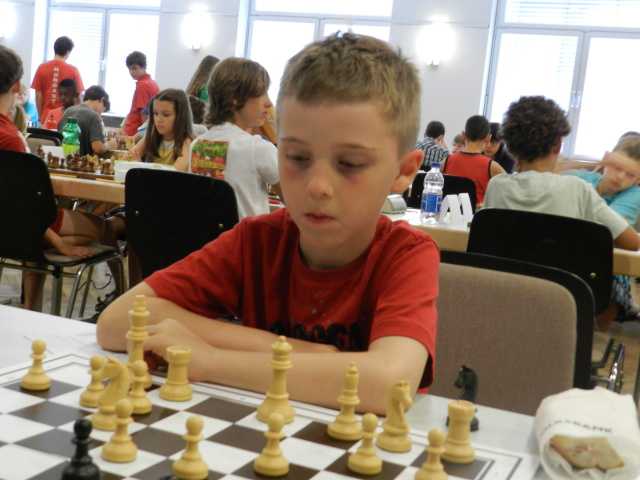
Danny Dwyer at EUYCC2013Later the European Union Youth Chess Championships were held in Mureck, Austria. (Not to be confused with the European Youth Chess Championships, to be held in Montenegro in September/October; it’s hard to keep track.) The Irish players were Diana Mirza (St. Michael’s & Adare C.C.s), Tom O’Gorman (Shankill), and the Irish U8 champion Danny Dwyer (Blanchardstown), pictured here (from the tournament web site). Diana Mirza recorded a major success, winning a Gold Medal in the U13 event for best girl, finishing joint second overall. Tom O’Gorman finished 6th in the U11 event and Danny Dwyer finished 11th in the U9 event. (See Rory Quinn’s blog.)

The organisers did a tremendous job in making games available, and all the Irish games are now available in the archive.

Update, 24th August 2013: all the Irish Gilbert Cup games (except one) have now been added to the archive. The exception is a game containing an illegal move, which complicates the processing quite a bit. In addition, 19 games from the Irish Championship AM Tournament (1st: John Hughes) have been added.

Update, 30th August 2013: the final Gilbert Cup game, Petrie-Ní Mhuireagáin, Scotland-Ireland (2), has now been added, complete with illegal move.

Posted in Games, News | Leave a comment

Lothar Schmid 1928-2013

“Lothar Schmid, Chess Referee” ran his recent obituary in the New York Times, referring to his distinction of serving as arbiter in Fischer-Spassky, Karpov-Korchni 1978, and Karpov-Kasparov 1986, while the Daily Telegraph led with his extraordinary collection of chess books, comprising over 50,000 items. He was of course also a very strong player, attaining the grandmaster title in both over-the-board and correspondence chess.

But there is another aspect of his chess career that has been less discussed: he played the French Winawer, and indeed made important theoretical contributions, with both colours. His games seem now to be very far ahead of their time. The latest issue of The New Winawer Report considers three of his most significant Winawer games: Schmid-L. Pedersen, Max Blümich Memorial corr 1948-1951; Paoli-Schmid, Venice 1953; and Schmid-Díez del Corral, Clare Benedict Cup 1963. As is so often the case, even these much-analysed games still have much that has not previously been discovered …

Posted in Articles | Leave a comment

Irish championship 2013

And they’re off … this year’s much-anticipated Irish championship has started. Already there’s a major shock in round 1 with Colm Daly (with White!) being routed by Ciarán Quinn.

With the demise of the LCU Blog, it’s not clear where any on-line discussion will take place this year (the tournament web site? Irish Chess Cogitations? Colm Daly’s Irish Chess Championships site? the Ennis C.C. blog?, ?). It’s best if there’s one main place. Unfortunately IRLchess isn’t suitable, as I’ll be away and out of email contact for the last three rounds.

However I’ve started the tournament report, which will be updated round by round until round 6, with a final wrap-up on the Monday after it finishes.

Round 2 update: The tournament report now incorporates round 2 (still missing the moves of the two games not shown on live boards). The game of the round was undoubtedly Rory Quinn’s spectacular win against Philip Short. It seems this was an outstanding piece of preparation, as Rory used a sideline of the Max Lange Attack that first appeared almost a hundred years ago, at least according to a Kenilworth C.C. article I found, analysing the game Fahrni-Tartakover, Baden-Baden 1914 (!). It was a clever idea also, because it seems Black’s approach against the main line 9. Ng5 (see for example P. Delaney-Hebden, Kilkenny 1999 from the archives here) is wrong against 9. Bg5!?. Philip Short duly followed the standard approach and came a cropper in short order. Devious thinking! (And therefore worthy of admiration.)

Elsewhere it seems there’s a view that Colm Daly’s round 1 loss was due to a simple blunder with 36. d5?. Colm himself says so at irishchesschmapionships.com, and I saw Jonathan O’Connor say the same thing in another forum. But while 36. d5? certainly made matters much worse, Black seems to be winning anyway, as the d-pawn can’t be saved in any case.

Round 3 update: Round 3 now added (missing moves from the last two boards in rounds 2 and 3, and also the game Hughes-R. Quinn from round 3). Rory Quinn is now in the sole lead with 3/3. Draws in Redmond-Fitzsimons and Ó Cinnéide-Orr allowed Colm Daly to approach within ½ point of the other top seeds with a win over Anthony Fox (the game score of which must be incomplete).

Rounds 4 and 5 update: Rounds 4 and 5 now added (missing moves from three games in round 5). Thanks to the organisers for uploading full pgn for the first four rounds! There was an interesting and crucial game in round 4 between Mark Orr and Colm Daly, well annotated by Colm on his tournament site (link included here). Rory Quinn’s momentum finally took a breather as he took ½ point out of two games with White. Elsewhere John Hughes is new to Irish chess but looks set to bring entertaining games: in round 4 he managed to salvage a draw from a position most people would long since have resigned (not without a lot of help from Ciarán Quinn), and in round 5 he had a won game against Mark Orr, needing only to promote a pawn, but veered off and eventually lost a K+B+N v. K ending.

Round 6 update: Colm Daly threw the championship wide open with a tremendous win as Black against David Fitzsimons. Where did White go wrong? (No peeking at engines!) Possibly he should have forced Black to resolve the K-side at some point? By 24. h3 for example: 24. … fxg3 25. fxg3 and surely White’s not losing? As it was Colm retained the option of a timely … f3 putting the White king in danger. 34. … Rf7! was a nice touch, holding the White king in place just as a convenient shuffle out of the danger zone with Kf1 was threatened. Elsewhere Philip Short had a great win against Mark Orr with a devastating attack that welled up out of nowhere. Mel Ó Cinnéide won against Rory Quinn, who doesn’t seem to be playing any worse than in the first three rounds but whose opposition has been much stronger, and John Redmond gave Jonathan O’Connor a belated birthday present, though he was running into trouble already at that point.

So now we’re left with six players all within half a point of each other with three rounds to go. Any one of them could win at this point, especially since some risks will have to be taken. (Good thing the organisers specified what happens in the case of a tie!)

Round 9 update: Most of the drama ended after round 8, when Colm Daly won, but David Fitzsimons lost to Philip Short. In the last round Daly and Short agreed a quick draw, making Colm Daly Irish champion for the sixth time. (Why did Short agree the draw rather than pressing for a win that would have given him the title?) The tournament report has been updated, though only 8 games from the last three rounds are available so far.

Posted in Irish championships, Tournaments | 11 Comments

Norms and titles

FIDE has recently issued a requirement that all old title norms and rating qualifications have to be re-registered by this July 31st or be lost forever: apparently the rules have changed so often that it imposes a strain on the Qualifications Commission to keep track of everything. See FIDE’s announcement and the ICU notice for details.

It’s rather odd to see the rating requirements also have to be re-registered: this would be understandable for those ratings achieved momentarily, and never appearing in a published FIDE list. But read literally, FIDE seems to be requiring that even the published norms must be re-registered?

Only records from before 1st July 2005 need to be re-registered.

Martin Crichton has suggested a post to collect data and records to assist with the process. In most cases the player concerned will resubmit, but why take chances? The idea is to assemble the data and then submit before the deadline to Ireland’s FIDE delegate, Kevin O’Connell.

Here’s a starting list, based on suggestions from Martin, with a couple of my own added in also:

GM:

Sam Collins, GM norm First Saturday GM; GM norm Arctic Chess Challenge 2010 (both on FIDE site, and post-2005-07-01 anyway)
Brian Kelly, GM norm Staffordshire Millennium GM International 2000; rating 2504 achieved (July 2005 list)

IM:

Colm Daly, IM norm 4th Bangkok CC Open 2004 (on FIDE site)
John Delaney, IM norm Thessaloniki Olympiad 1984 (not on FIDE site)
Ryan-Rhys Griffiths, IM norm 4NCL 2012-13 (on FIDE site, and post-2005-07-01 anyway)
Conor O’Shaughnessy, IM norm Hastings Challengers 1992-93 (per Martin)
Joe Ryan, IM norm I Tancats Estiu Mataro MI 2007; IM norm Tancat Foment Martinenc MI 2008 (both on FIDE site, and post-2005-07-01 anyway)

FM:

David Cox, rating 2325 (July 1973 list)
Paul Henry, rating 2400 (January 1979 list)
Bernard Kernan, rating 2395 (January 1979 list)
Conor O’Shaughnessy, rating 2340 (July 1993 list)

Others (CM, WIM, etc.)

?.

Any other suggestions? Comments and extra details welcome!

Update, 5 July: added Bernard Kernan.
Update, 8 July: added Brian Kelly’s GM norm from 2000 (thanks to David McAlister for providing the details).
Update, 24 July: added details of Conor O’Shaughnessy’s IM norm and peak rating.

Posted in News, Players | 5 Comments

Hastings 1895

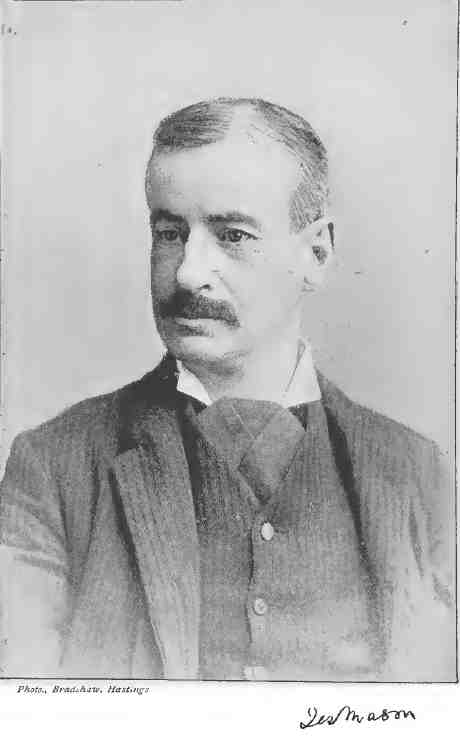
James Mason, Hastings 1895 tournament bookHastings 1895 has been described as ‘the greatest chess tournament of all time’, with ‘the strongest field of players ever assembled’, whose ‘games were exceedingly difficult and hard fought, possibly the severest test of chess mastery ever conducted’, and which has ‘kept growing in importance year after year’.

These descriptions are all from the publisher’s blurb for the Centennial edition of the tournament book, and allowances have to be made when reading sources such as this. But in this case it’s true that the tournament was of exceptional importance and interest, and even the sweeping description given above is hardly out of place.

All of the top players of the day took part, and one of these was the Irish-born James Mason (1849-1905). Though his best days were behind him, he had a creditable score of 9½/21, sharing 12th-14th places out of 22 players.

All of his 21 games have now been added to the archive. But since much of the interest lies in the overall event, there’s also a tournament report, giving crosstable, round-by-round bulletins, and so on, with playable versions of all the games, not just Mason’s. (New feature! The other games don’t show up in the search function, but otherwise all is as in the other tournament reports here.)

Posted in Tournaments | Leave a comment

From My Six Memorable Games

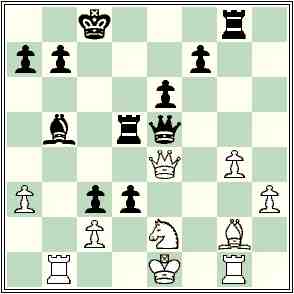
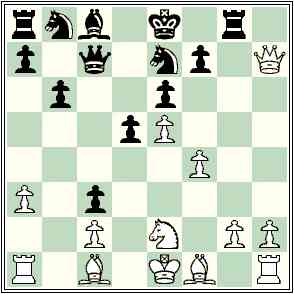
Watkins-Coffey, World Cadet Ch 1980The sixth issue of The New Winawer Report has been posted: see the tnwr page. This issue considers the late Robert Byrne’s idea of 12. h3 and 13. g4. This is still a dangerous idea and it seems surprisingly under-utilised, especially as theory’s main recommendation for Black for many years has now proven to be unsound.

This issue considers the theory of that historical theoretical line, via the game Watkins-Coffey, World Cadet (U17) Championship, Le Havre 1980 (which is not in any of the databases, by the way). Up to the diagrammed position, reached after Black’s 22nd, we had been following the classic game R. Byrne-Uhlmann, Monte Carlo 1968, and it seems to be the only game since then that has followed it this far: at least, if there are any others, they don’t appear in the databases either.

Note: There are some references that I have been unable to locate, and any help would be appreciated. First, Moles (p. 33) refers to Byrne originally trying this idea during blitz play. Are there any references for this? (Byrne doesn’t mention it in his annotation of his game in Chess Life.) Secondly, after the alternative 18. Qg3, Moles (p. 34) attributes 18. … Be4 to Larsen. Does anyone know where this reference comes from?

Posted in Articles | 3 Comments

The early days of ICU Ratings

Edited 17 June 2013

If you are playing in a tournament and someone you’ve never come across before sits down at the board opposite you, there’s a fair chance he’ll ask what you rating is (unless you get that question in first). Believe it or not, there was a time when there would not have been an answer.

Tournament chess in Ireland is more than 150 years old but it is less than a third of that time since the Irish Chess Union instituted a national rating system. The October 1966 ICU Newsletter announced under the heading “Ranking List”:

For some years Ireland has suffered the want of a ranking list and a provisional one has been compiled based upon the results in the major Irish tournaments since Easter. Some players are only represented by one tournament which is undoubtedly unsatisfactory, but the ICU feel that a start must be made sometime. The attached list will, it is hoped, form the basis for a more comprehensive ranking system in the future.

From little acorns, great oaks grow. The list referred to appears below.
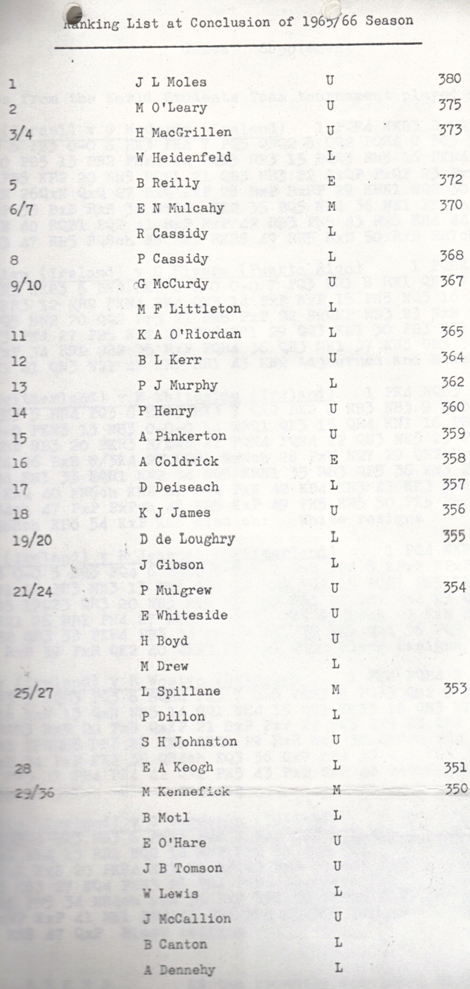
October 1967 ICU Newletter Rating List

October 1966 ICU Newsletter Rating List

A provisional list, and with ratings ranging from 350 to 380 which do not equate to the three main rating systems then used – USCF/Elo, BCF or Ingo – it is difficult to know what rating system was used.

Moving forward nearly two years, the Limerick Leader for 17th August 1968 referred to “the first rating list published by the ICU” which was “published early this year.” According to this list the top twelve rated players and the competitions in which players could qualify for it were:

Early 1968 Rating List
1.  Heidenfeld
2.  O'Leary
3.  Moles
4.  Keogh
5.  Littleton
6.  Tomson
7.  Graham
8.  Henry
9.  R. Cassidy
10. Gilroy
11. P. Cassidy
12. Reilly

Qualifying tournaments
Irish Championship
Ulster Championship
Leinster Championship
Williamson Shield
Ulster Team League
City of Dublin Tournament
UCC New Year Tournament

No actual ratings were given to go with the ranking order and we cannot therefore tell what rating system was being used. It is also unclear whether the ICU had issued any rating list in the interim since the October 1966 provisional list. Indeed the phrase “first rating list published by the ICU” begs the question whether the author was aware of the October 1966 list or whether this was the first “official” list.

The Limerick Leader does however point out that the list has not been officially revised since its publication in early 1968. As it happens, there was soon to be a development on that  front. In the UCU Archive (in one of UCU Secretary Albert Long notebooks) there is a rating list for August 1968 . As you can see from the list below, the Elo rating system is now being used. The numbers of players listed has been reduced from the original October 1966 list and as the accompanying commentary makes clear there has been at least one intervening list. However, it is not the list referred to in the Limerick Leader. Therefore, we might speculate that there have been two lists promulgated in this time-frame, one taking in events in the 1966-1967 season up to the Farrington Memorial at Easter 1967, and then a subsequent list bringing things up to the very beginning of 1968, with the final event being the UCC New Year Open Tournament (29 December 1967-Monday 1 January 1968).
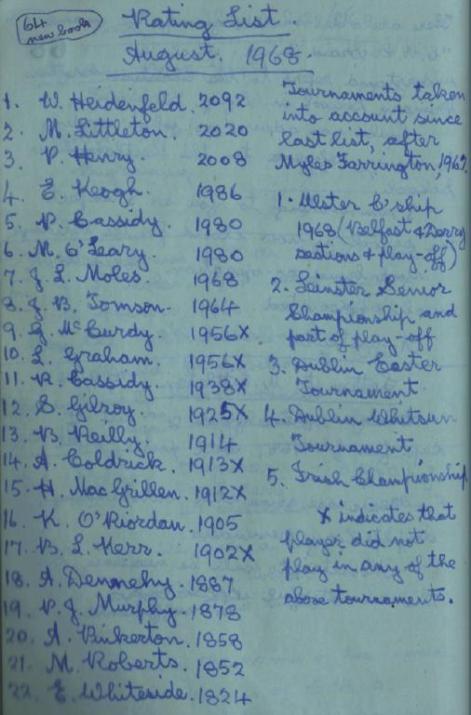
August 1968 UCU Archive Rating List

August 1968 UCU Archive Rating List

The Irish Times for 14th September 1968 announced that

The initial Irish national grading list for Irish chess players has been issued by the Irish Chess Union. Twenty-four players have qualified for inclusion…

The article went on to list the top seven players and these are identical as those given in Long’s handwritten list above. It is reasonably safe to assume this is the same list as his August 1968 one. Again the use of the phrase “initial Irish national grading list” raises the issue as to the precise point in time these grading lists became official.

The next list emanating from the ICU was dated 31st December 1968 but it was only some time later that it entered the public domain with it appearing in the J.J. Walsh chess column in Irish Times on the 27th February 1969 and a few days later in the Limerick Leader on the 8th March 1969. The Leader very helpfully provided the full commentary to the list:

1. An analysis of the Lugano Olympiad results showed that Irish ratings required an increase of 120 points to bring them into line with international standards. This has been done. (An international master rating is 2.300 minimum, a grandmaster 2.500).
2. The committee feels that feels that it cannot take the results of tournaments abroad into account unless there is complete and reliable information available on the ratings (whether U.S.C.F., Ingo, B.C.F.) of a majority of the players. Thus Lugano was taken into account, but not the Students’ Olympiad. This is manifestly harsh on McGrillen, but the standard he has attained will in due course bring him very much higher.
3. X denotes a player who has not played in Ireland since Farrington 1967. This situation is being considered.
4. Requirements for rating are:
(a) 20 games minimum in rated tournamnts in 12 months;
(b) 8 games minimum against rated players:
(c) minimum of 1900 for publication on list. P. O’Kane is almost qualified – the Cork tournament has not yet been reckoned.
5. Provincial and team championships – and in fact all tournament results – should be sent to I.C.U. as soon as possible.

31st December 1968 Rating List
1.   W. Heidenfeld  2223 
2.   M.F. Littleton 2153
3.   J.L. Moles     2132
4.   P. Henry       2129
5.   P. Cassidy     2100
6=7. E. Keogh       2091
6=7. M. O'Leary     2091
8.   J.B. Tomson    2084
9.   L. Graham      2076 x
10.  R. Cassidy     2058 x
11.  G. McCurdy     2049
12.  S. Gilroy      2046
13.  A. Coldrick    2033 x
14.  H. McGrillen   2032 x
15.  B. Kerr        2022 x
16.  B. Reilly      2020
17.  K. O'Riordan   2010
18.  A. Dennehy     2007
19.  A. Pinkerton   1991
20.  M. Roberts     1983
21.  P.J. Murphy    1979
22.  J.F. Gibson    1952
23.  E. Whiteside   1944
24.  D. Wilson      1930

One point to note in the list is that after the tragic death in an aeroplane crash of Noel Mulcahy in the spring of 1968 there were no Munster names in the list, with 12 coming from Ulster, 11 from Leinster and the English-resident Reilly. Perhaps if the cut-off point had been a little later (as it had been the year before) to take in the Mulcahy Memorial in Cork, some Munster players would have found their way into the list.

The next national grading list came out after the 1969 Irish Championship, held in July. The top ten only were given in the Irish Times for 12th August 1969:

August 1969 Rating List
1.  J.L. Moles       Ulster    2199
2.  W. Heidenfeld    Leinster  2165
3.  E.A. Keogh       Leinster  2154
4.  P. Henry         Ulster    2138
5.  M.F. Littleton   Leinster  2118
6.  R. Byrne         Leinster  2084
7.  A. Dennehy       Leinster  2069
8.  H. McGrillen     Ulster    2060
9.  L. Graham        Ulster    2054
10. B. Reilly        England   2038

One interesting point noted in the Irish Times is that the new Irish champion, N.J. Patterson had not played a sufficient number of games against graded players to obtain a rating.

The end of 1969 was the cut-off point for the succeeding list, though it is dated March 1970 and this time the Mulcahy Memorial was included in the calculations:
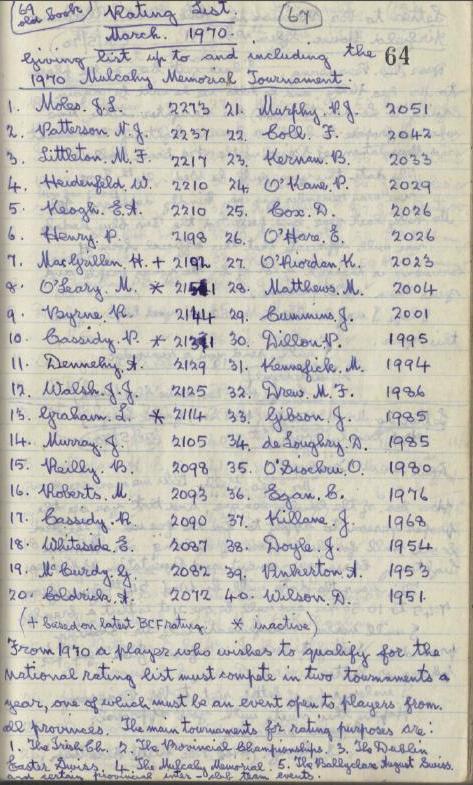
March 1970 UCU Archive Rating List

March 1970 UCU Archive Rating List

Patterson is now included in the list at number two. As can be seen from the commentary at the end of Albert Long’s handwritten list, some new conditions have been attached to be eligible for list. Comparing this list with the previous one(s) it might also be speculated whether there has been a further general increase in the ratings. Assuming this is a complete list, the cut-off point for inclusion seems to have been raised to 1950 (and if my speculation is correct maybe that general boost to the ratings was 50 points.)

The amount of time it took to inform the Irish chess playing public (not to mention the fourth estate) of the most recent grading list is illustrated by the fact that this list calculated to the beginning of 1970 only appeared as the “latest Irish chess union rankings” in the Irish Times on 21st May 1970. The information gap between an insider like Long and the masses is further illustrated by only the 14 names over 2100 being given.

It may therefore have come as a surprise to the general chess public when only just over a month later, on the 25th June to be precise, the Irish Times published the top 14 from the ICU’s “mid-summer grading list.” Albert Long’s notebook can again eliminate the information deficit by providing us with the full list of 50 names and ratings.
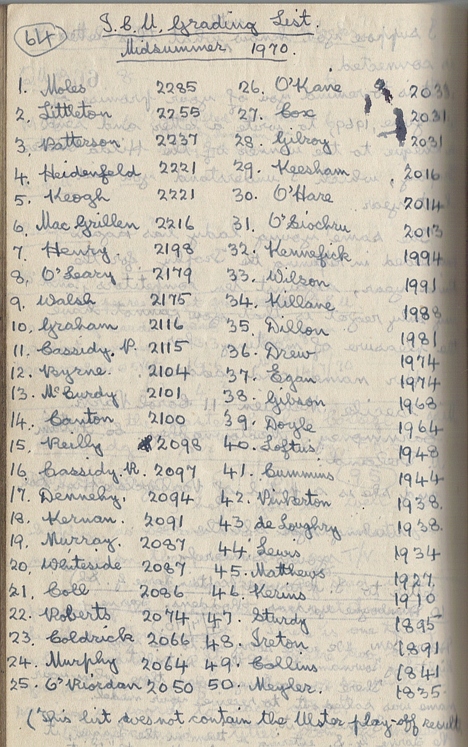
Midsummer 1970 UCU Archive Rating List

Midsummer 1970 UCU Archive Rating List

The next ICU grading list had the autumn label affixed to it but it made its appearance in the Irish Press as early as the 3rd September 1970. More than fifty players were now said to be on the national list, with the top 15 listed in the newspaper.

Autumn 1970 Rating List
1.   M.F. Littleton   2255
2.   N. Patterson     2237
3.   J.L. Moles       2226 
4.   P. Henry         2224
5=6. W. Heidenfeld    2221
5=6. E.A. Keogh       2221
7.   H. McGrillen     2216
8.   M. O'Leary       2179
9.   J.J. Walsh       2177
10.  F. Coll          2131
11.  L. Graham        2116
12.  P. Cassidy       2115
13.  R. Cassidy       2111
14.  R. Byrne         2104
15.  B.Canton         2100

Most of these listed immediately above had not played in the interim, with Littleton inheriting the number 1 spot due to Moles’s poor performance in the 1970 Irish Championship. Almost four years after the first provisional ICU gradings were produced, the rating lists now seemed to be coming thicker and faster, perhaps a portent of things to come when nowadays the ratings juggernaut seems to consume all our attention.

Posted in Ratings | 1 Comment

Heidenfeld and the 1958 Irish Championship

There’s one simple way for an Irish chess website to increase its traffic: start a debate on the eligibility to play in the Irish Championship, more specifically should it be an open or closed tournament (and if it’s a closed tournament, just how closed it should be.)

The return to a closed format in 2013 (after the series of open championships that was first sparked off by the ICU executive in 2004) has not been without its controversies. In the previous post Breaking news from 1906 Sean pointed out that this is not just a recent debate. In the comments to the post he referred to a championship roughly half-way between 1906 and 2004, when the Irish (Closed) Championship suddenly went a little bit open. That was Belfast in 1958, won by the German-born Wolfgang Heidenfeld, who was South African champion in 1957 and 1959 and played for South Africa in the Munich Olympiad in 1958.

Heidenfeld reported on the 1958 Championship in the British Chess Magazine (September 1958, pages 225-7) and this is what he had to say about the “Irishness” (or perhaps I should say the relative lack of it) of this particular closed championship.

The Belfast tournament was dominated by three “foreigners”: our General Editor, B. Reilly, who has been in the Irish team since 1935 without ever having played in any Irish tournament; Dr. V. Maher, twice Irish Champion in the past, who has recently been living in Berlin; and the writer, who transferred to Dublin from South Africa in November last. Without the foreign invasion the field would have been dismal in the extreme, with all the strongest Southern players (Mulcahy, O’Sullivan, Walsh, Murphy, Canton and Ryan) conspicuous by their absence.

Almost exactly a year before these words were published, the imminent arrival of Heidenfeld on the Irish chess scene had been announced by J.J. Walsh in his Irish Times chess column for 5th September 1957:

There are many indications that the chess season which starts during the next few weeks will rank as one of the most important and varied in the history of the game in Ireland.

The chief interest will undoubtedly centre around the South African master, W. Heidenfeld, who recently announced his intention of  settling in this country. Heidenfeld will be recalled by Irish chess players as having played in Dublin during May 1956. His presence here should indeed stimulate interest in domestic competitions; our leading players cannot fail to benefit greatly from playing against this experienced master.

In his 24th October column Walsh updated his readers:

During the week I had a pleasant meeting with Wolfgang Heidenfeld, the South African chess master, who has just arrived in Ireland … he has now decided to settle permanently in Dublin.

I was very pleased to learn that he intends to take a very active interest in our local chess affairs…

As we shall see below. Heidenfeld did throw himself wholeheartedly into the Irish chess scene, but it still seems surprising that he would become eligible, presumably qualified by residence, for a closed championship so soon after arriving.

Despite his avowed intention to settle permanently in Dublin, Heidenfeld was to leave these shores before 1958 was out. Here’s J.J. Walsh again on this development (Irish Times, 22nd December 1958).

It is always very sad to lose a friend, and the departure of W. Heidenfeld to Frankfurt will be regretted by many Irish players.

Since coming to Dublin from South Africa just over a year ago, Heidenfeld has been enthusiastically associated with all our local chess activities. His great experience and ability gained him many successes here despite being a constantly “marked man.” At Belfast last July he won the Irish championship without losing a game, and he secured the brilliancy prize in that tourney for his win over B. Reilly. Heidenfeld had previously won the Derry Feis tournament with a superb 7 wins from seven games.

The South African master, as he was invariably labelled, never refused any invitation to give a simultaneous display or deliver an instructive talk and, apart from aiding several Dublin clubs, he also helped chess players at Maynooth, Adare, Kilfinane and Limerick.

Walsh went on to chronicle Heidenfeld’s significant contribution to Dublin Chess Club’s win in the 1957-58 Armstrong Cup, winning every game at the top board, and ended by wishing him happiness in his new surroundings. If that was the end of Heidenfeld’s connection with Irish chess, his win in 1958 might now seem very curious indeed. However there was another twist in this tale.

Although now resident in Germany, Heidenfeld did not lose touch with Ireland completely. He acted as adjudicator for the Irish Times “Game of the Year” competition (which he had himself won during his short sojourn for one of his wins in the Armstrong Cup.) While corresponding with Walsh in Spring 1962 he expressed his delight with the warm reception he had received from Dublin chess players during a recent three-day visit to Ireland. In his 31st May 1962 column Walsh made this announcement, echoing his earlier one of September 1957:

It is now possible to confirm [Heidenfeld’s] intention of settling here permanently as he has made definite arrangements to arrive in Dublin about mid-September, just in time for the start of the new competitive season.

This time Heidenfeld remained for an extended period, winning five more Irish Championship titles, the first of these in Cork, again less than a year after arriving in Dublin, before finally returning to the land of his birth in the 1970s.

Posted in Irish champions, Irish championships, Players | Leave a comment

Breaking news from 1906

Anticipation is building for the Irish Championship, to be held at the University of Limerick from July 6-14. It’s the centenary of the Irish championship as organised by the Irish Chess Union, and is shaping up to be an excellent event.

An impassioned debate has broken out in several places, such as the new Irish Chess Cogitations site, the newly-invigorated boards.ie Chess pages, and Rory Quinn’s Ennis C.C. blog, over the restriction this year to IRL-registered players only, whereas all championships from 2007–2012 were open, with the highest-placed Irish players receiving the title of Irish champion.

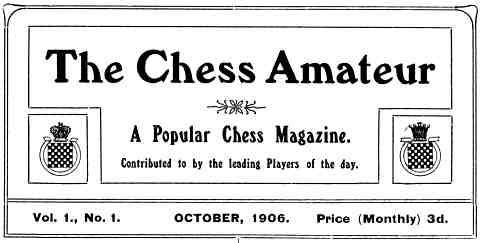
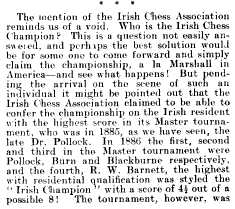
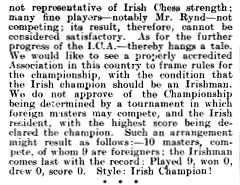
This debate is not new, and indeed goes back to the era before the ICU. Here’s the discussion from the first issue of the magazine The Chess Amateur, which was based in Gloucestershire:

Chess Amateur 1906 vol. 1 no. 1, front page

Chess Amateur 1906 vol. 1 no. 1, p. 8

Chess Amateur 1906 vol. 1 no. 1, p. 9

If I understand correctly, the description of the 1885 event is not accurate: it’s doubtful whether this was an Irish championship and Pollock wasn’t a resident around then anyway. (David McAlister is an expert on this era and can correct me if I’m wrong here.) The description of the 1886 event is accurate: (later Sir) Richard Whieldon Barnett, 1863-1929, finished fourth in the 2nd Irish Chess Association Congress in Belfast, 1886, after Pollock, Blackburne, and Burn, and thereby became Irish champion. This was definitely an Irish championship and the rules were clear, but–as the discussion above shows–the topic of closed vs. open format was a hotly disputed matter even then.

(While The Chess Amateur also seems dismissive of the win on the basis that many of the strongest eligible Irish players didn’t compete, this is too harsh a standard: we’d have to dismiss most Irish championships if we took that as the standard.)

Posted in News | 11 Comments

Gerry McCurdy

GerryMcCurdy_2012In putting together a post on a different topic, I found an article indicating that Gerry McCurdy, who was a strong player in Ireland in the ’60’s, before emigrating to France, has returned to the game.

There’s an article on the Cahors Echecs blog on his win in last year’s “Championnat du Lot” (Mid-Pyrenees). There are several photographs in the article, none with labels, but it seems from context that the picture here must be him. (Please correct me if I’m wrong.)

Here’s my translation of the relevant passage from the article:

Gerry McCurdy of Prayssac, already in the lead after day 1, didn’t weaken and won with 4½/5. We can’t wait to see his first official FIDE rating! He has just returned to competition and shows that he still knows how to push wood as in former times: https://www.365chess.com/players/Gerald_McCurdy.

Well done, because I know from personal experience that it’s not easy at all to get back to a reasonable level after such a long break.

He was first reserve on the Irish Olympiad team, Lugano 1968, scoring 5½/13 (+2 =7 -4), and played on various boards in the Irish team for the European Team Championship preliminaries, Copenhagen 1967, and also represented Ireland in the Student Olympiads of Örebro1966, Harrachov 1967, and Dresden 1969. His best result in an Irish championship was =3rd in the 1966 championship in Belfast on 5½/8, a point behind Moles. He was first in the Belfast Feis, 1966, and played in Castlebar 1969.

Posted in Players | 6 Comments