Who?

No Irish player has ever beaten a reigning world champion. (In a regular game, that is, leaving aside simuls.) Even victories over future or past world champions have been very rare: half a dozen or so in all.

One such victory was achieved by a player, born in Belfast, who has been described as “among the foremost British players of the sixties”. Who does this describe, and which future or past world champion did he defeat?

Posted in Players, Puzzles | 1 Comment

Jackson-Bourached, City of Dublin Masters 2013

Another interesting game from this year’s City of Dublin was the round 3 clash between Carl Jackson and Anthony Bourached. [Click to replay.]

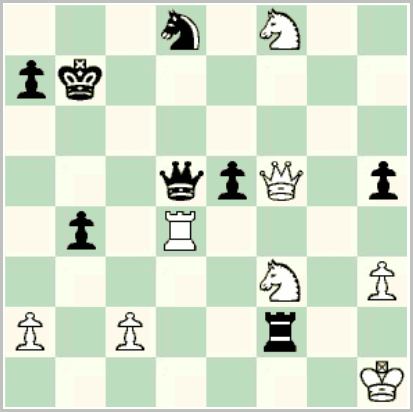
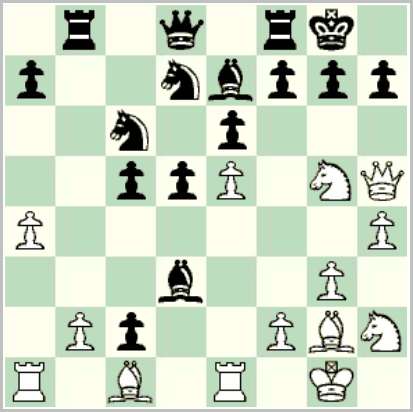
jackson-bourached-2013Black had a simply overwhelming position throughout and it seemed only a question of choosing which way to win. Even after allowing White an unnecessary attack, all seemed under control, e.g., 43. … Qxa2 seems to leave White with nothing. Disaster struck, though, and after 43. … Nd8? White uncorked 44. Rxd4!, reaching the diagrammed position, and Black resigned.

But is this justified? The win may be gone, but after 44. … Qxf3+ 45. Qxf3 Rxf3 46. Rxd8 Rxh3+ 47. Kg2 Ra3, White’s a-pawn will drop, and the c-pawn must surely follow and with it any chance for White to win: indeed White might have to be careful here. Was it a loss on time? Or a case where the shock of 44. Rxd4, combined with disgust at missing earlier chances, prompted an unjustified resignation?

Posted in Games | 1 Comment

City of Dublin championships 2013

The City of Dublin is an event that, while formerly a major draw, has struggled a bit in recent years. But this year’s version had an excellent turnout: 160+ over four sections, well up on last year. The turnout of 20 in the top section was also well up on the last few years.

Juri Firstov continued his excellent run of recent form by finishing clear first on 4½/5. In the October FIDE list his rating is 2305, so presumably he now qualifies as an FM? Very well deserved! Surely he must be an excellent candidate for IM norm invitationals in Ireland now, as a titled player who helps add to the non-IRL-registered player requirements?

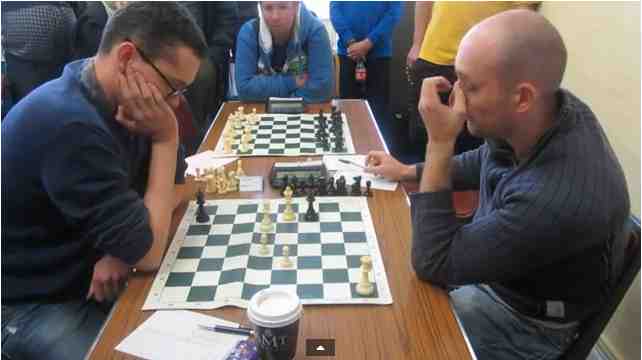
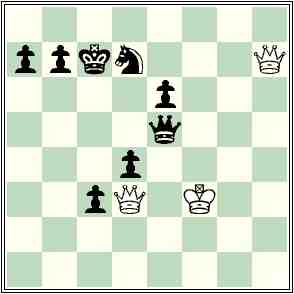
Second was top seed Sam Collins, who featured in three of the toughest battles of the event, versus Firstov, Valentine Kalinins, and Colm Daly. His miraculous save against Kalinins, captured on video by Colm Daly, was one of the highlights of the event. The critical moment is captured below.

Kalinins-Collins, City of Dublin 2013

The organisers are to be congratulated in making all 45 games from the Masters available. They’ve all been compiled into a full tournament report, now posted on the tournament pages.

Posted in City of Dublin championships, Tournaments | Leave a comment

Monthly update, September 2013

A total of 52 games have been added to the archive this month: the full monthly list is available, as usual, by entering “-month2013-09” in the search box.

This month sees the return to the game of another veteran, Brian MacRéamoinn. He was a team-mate of mine at Dundrum for several years, including our 1985 Armstrong Cup win, the only time Dundrum won the Armstrong. He also played later that year in the European Club Cup match against MTK Budapest, discussed here last year. I think he hadn’t played for years, but this month’s collection has a dozen of his games. Though he seems a bit rusty, very understandably, he hasn’t lost his enterprising and entertaining style: he has never been one for boring chess.

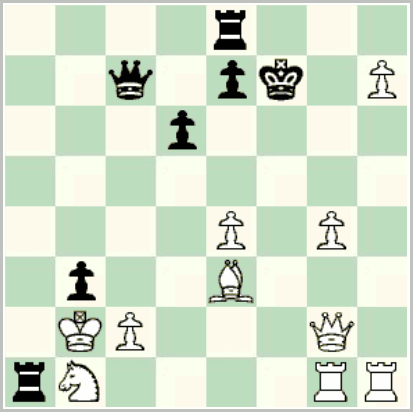
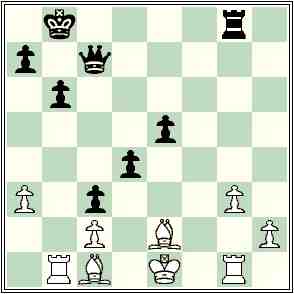
bartlett-macreamoinn-2013One representative example is Bartlett-MacRéamoinn, Paignton Premier 2013, with Black to move, having just sacrificed two pieces in successive moves (knight on g4 and bishop on b2). After 26. … Ra2+ 27. Kc1 Rxc2+ 28. Kd1 Rxg2 29. Rxg2, Brian went wrong with 29. … Rh8? and lost; instead 29. … Qc4 would leave him very much in the game.

P.S. I have games from six people (for which thanks) that I have not had a chance to process and add to the archives yet. Apologies: in some cases I have been planning separate posts on the games, requiring some extra time.

Posted in Games, Players | 1 Comment

Kendall-Patterson, British U21 championship1967

BritBase is back!“, announces John Saunders on his blog. He clarifies that it never went away: rather he hadn’t been updating it for a couple of years, but now has restarted doing so.

Among the first few new items on the “What’s New” page there are two containing games by Irish players: the British championship subsidiary events in 1967 and 1968, with three games of Nick Patterson from the 1967 British U21 championship, and four of John Moles from the 1968 British U21.

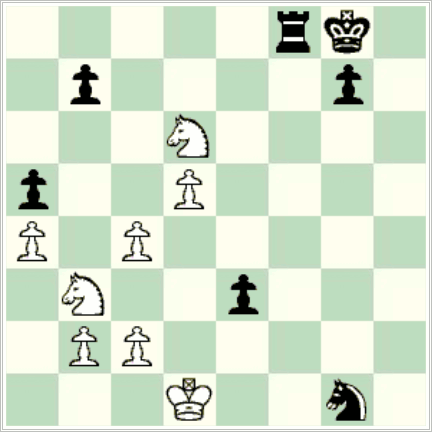
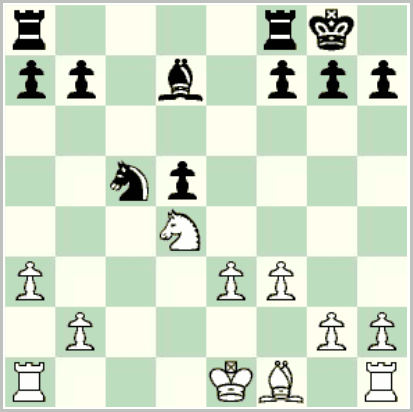
Kendall-Patterson,British U21 championship 1967The eventful game Kendall-Patterson, British U21 championship 1967 reached the diagrammed position. Play continued 16. Re4 h6 17. Ng4 dxe4 18. Nxe6 e3 19. Nxd8 Bg6 20. Nxh6+ gxh6 21. Qe2 Nxd8 22. Qxe3 Re8 23. Qc3 and Black won fairly quickly.

In truth White has nothing in the diagrammed position. Nevertheless in the critical sequence above Black made some serious errors that could have resulted in a less favourable outcome. Where, and how could White have taken advantage? (Answer in a couple of days.)

There were several other Irish players in the 1968 championships at least: an Irish Times article from August 10, 1968 (p. 8) describes the progress of David Wilson, William Collins, and Michael Harkness (all Belfast) and Edward Lewis (Dublin) in the British Boys U16 championship, and Peter O’Kane, Martyn Matthews, Alan White, and Brian Ruderman (all Belfast) in the British Boys U18 championship, but none of their games appear in the BritBase collection. However the 1967 BritBase file has a game of “DC Wilson” from that year’s British Boys U16. Is this David Wilson of Belfast who played in the same competition the following year?

Posted in Games | 2 Comments

Winawer Praxis

This month’s issue of The New Winawer Report, now posted on the tnwr page, considers two games from the past few months, each featuring lines covered in previous issues.

rimkus-rekhtman-2013The first, Rimkus-Rekhtman, WS/M/428 ICCF corr 2013, is in a sacrificial line that has only emerged in the last few years. Watson’s recent Play the French, 4th edition evaluates the diagrammed position as =. The present game is of considerable theoretical interest: it seems to be only the second known example. It’s interesting as White follows the initial choices of Houdini 3.0–as this is a correspondence game under ICCF rules, he was allowed to use engines and may well have been running Houdini 3.0–but runs into severe difficulties and loses.

diepeveen-meessen-variationThe second game, Diepeveen-Meessen, Interclubs Nationaux (Belgian Team Ch) ’12-13 2013 was a roller-coaster game in which Black had a winning position not far out of the opening, didn’t find the best continuation and found himself dead lost, then was granted a reprieve, before finally blundering. With the better (and much more natural) continuation, the second diagrammed position could have been reached: yet another bizarre position from the Winawer. What is the verdict with best play? After examining it for a while I’m still not at all sure, but will hazard a guess it’s a draw.

Posted in Articles, Games | Leave a comment

Williams-Collins, Cork Masters 2013

williams-collins-2013The Quality Chess blog has a post today (“Bored to Death?”) covering Simon Williams’ win against Sam Collins at the Cork Masters this year. The starting point for the post is the diagrammed position, rather a simple-looking one, with Sam, as Black, to move. But if it was so simple, how was it that he was unable to hold it?

In addition to being a GM, award-winning author, and founder of Quality Chess, Jacob Aagaard is a successful trainer, and many of the posts on the (high recommended) Quality Chess blog consider various training-related issues. In this post, he gives a thoughtful–and very plausible–explanation of why “simple” positions can be difficult.

Posted in Articles, Games | Leave a comment

August

Two posts back I said that we were in a lull at the senior level. It seems I spoke too soon, as this month several enterprising players have had a busy tournament schedule outside Ireland. 79 games are available, including:

Andrew Philip Smith at the British Championship
Matthew Dignam and Anthony Bourached at the British Championship Major Open–won by Matthew Dignam
James McDonnell in the British Championship 1st and 2nd Week AM Opens
Pete Morriss in the British Senior Championship
Alexander Baburin and Sam Collins in the 3rd Riga Technical University Open
Alexander Baburin in the 24th Porto Giorgio Open
Conor O’Donnell and Paul Wallace in the e2e4 Coventry Open
Paddy Divilly in the e2e4 Coventry U1950.

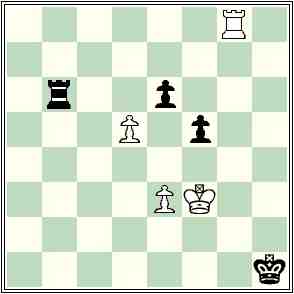
hill-mcdonnellHere’s a game with a dramatic end: James McDonnell is Black against Clive Hill, the eventual tournament winner, in the first round of the 2nd Week British Championship AM Open. White has just played 53. d5.

(a) how should Black continue, and what should the result be with best play?
(b) what move should Black avoid above all else, and why?

See the game for a solution to question (b)!

Update, 2 November 2013: Clive Hill corrects the record (see comments): the white rook should stand on g6 rather than g8. This version indeed makes more sense, and it seems Black was dead lost. The archives now show the corrected version.

Posted in Games, Puzzles | 1 Comment

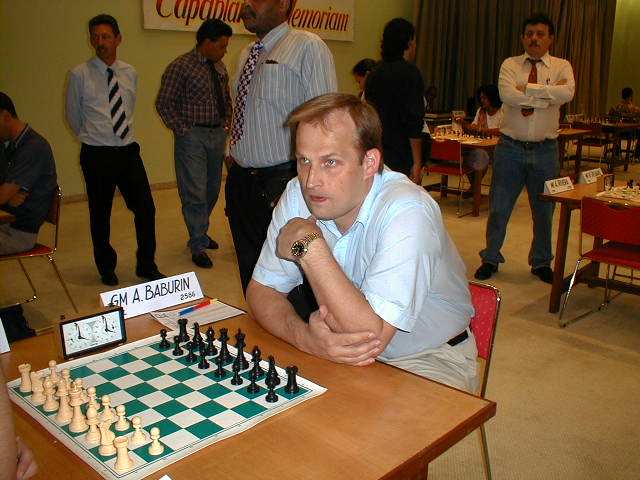
34th Capablanca Memorial, Havana 1999

Alexander_Baburin_Havana_1999

The “Other tournaments” page gives details of tournaments held outside Ireland that involved Irish players. The first on the list was an easy choice, as Hastings 1895 ranks as one of the most famous of all tournaments.

But there are many others of interest, and now the 34th Capablanca Memorial, Havana 1999 has been added. Ireland was represented by Alexander Baburin, who finished in the middle of the table, roughly in line with rating in what was a very strong tournament (average rating 2550).

Posted in Tournaments | Leave a comment

An Argentine variation

Argentine variationThe latest issue (#8) of The New Winawer Report has been posted (along with the games). This one considers a provocative sideline, in which Black adopts an alternative to the usual setup, via 10. … dxc3 and 11. … b6, reaching the diagrammed position. This was introduced in Argentina in the ’40s, and was pioneered by Rossetto and Eliskases for years.

In many variations of the poisoned pawn Winawer Black’s position holds together via a miraculous-seeming series of “only moves”. This Argentine variation tempts fate by spending an extra tempo: surely there must be a refutation? In fact many tempting White approaches lead nowhere, as illustrated by a crushing correspondence win by the late Tom Clarke, and even the almost-universal recommended antidote by White allows Black to survive. But it seems there’s a refutation after all …

Posted in Articles | Leave a comment