The Alekhine (or Maróczy) Gambit Accepted–Modern Version

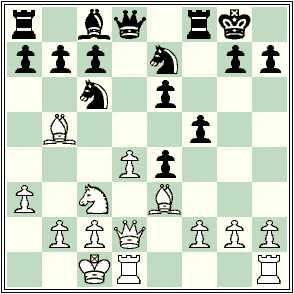
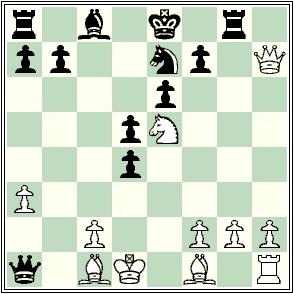
Issue 12 of The New Winawer Report has now been posted on the Winawer page. It continues the discussion in last month’s issue of the gambit lines in the Alekhine (or Maróczy) Gambit. This month starts from the diagrammed position, in which White has just played 11. 0-0-0, instead of ‘the hasty’ 11. f3, as Vitiugov calls it in his recent book.

Alekhine Gambit Accepted--Modern VersionThis change might not look like much, but appearances are deceptive and White has a string of spectacular victories to his credit. The main game in this issue is Braakhuis-Neven, WC.2000.S.00001.1999 IECG email 1999; Black went from equality to a lost position in one move: quick, where was it?

The best-known game in this line is probably Miles-Reefschläger, Porz 1981-82, but the issue also has the lost game King-Menzel, World U16 Team Championship, Viborg 1979, another crushing win for White. It’s ‘lost’ in the sense that it isn’t in the databases (at least it’s not in ChessBase’s Big Database 2012); rather odd, since it appeared in BCM at the time.

The conclusion is that Black is fine in all variations provided he plays accurately. But the smallest slip can have catastrophic consequences.

Posted in Articles | 1 Comment

A MacGuffin, a play-off and a foreshadowing

On the 28th November Edward Winter’s Chess Notes ran a story about a chessplayer called Aaron Sayers who had fallen on hard times and run into a bit of trouble with the law. Mr Winter quoted from the April 1928 edition of the Chess Amateur that at Bow Street Police Court Sayers was “alleged to be known in Ireland as a champion chessplayer.”

Sometimes references outside the world of chess to someone being a “champion chessplayer” grossly exaggerate the person’s prowess at chess. However, the name Sayers seemed familiar to me and I was able to supply Chess Notes information from contemporary Irish newspaper reports which at least established there was an A. Sayers who had played at a very decent level in Ireland in the period 1914-1927. For the details see item 8417 of Chess Notes.

Among his achievements, this A. Sayers was a member of the victorious Sackville Armstrong Cup team of 1926. All this provides a pretext to present here at IRLchess the dramatic conclusion of the 1926 Armstrong Cup and a few other things besides.

Sackville Chess Club had been established at the beginning of the 20th century and quickly rose to the top of Dublin club chess, winning the Armstrong title for three successive years from 1904. Dublin Chess Club, established in 1867 and despite being the pre-eminent chess club in Dublin (or perhaps because it was), did not enter the Armstrong Cup when it started in 1888. Its first appearance in the Cup did not come until the 1906-1907 season and when that debut ended with a tie between Sackville and Dublin, an acrimonious row broke out over the tie-breaking rules.The ruling went in favour of Sackville and Dublin refused to enter the Armstrong the following season and the one after that. Fortunately time healed the wounds and Dublin returned to the competition in the 1909-1910 season.  [I hope to come back to this controversy on another occasion.]

For over 30 years, only Dublin and Sackville won the Armstrong Cup until their domination was finally ended in 1936. Such was the intensity of their rivalry that on four occasions in the years 1925 to 1931 it took a tie-match between these two clubs to determine the winner. In the 1925 Armstrong both had won all eight of the their matches against the other clubs and scored a win apiece in their own encounters. The tie-match was won by Dublin who thus recorded their fourth successive Armstrong overall victory since its resumption in the 1921-1922 season.

Sackville gave themselves a good chance of ending that run by beating Dublin at home by five points to three in the 1925-1926 season renewal. With both teams then proceeding to beat all the other four teams twice, the destination of the Cup depended on the outcome of their return match at the Dublin CC clubrooms on the 15th April 1926.

The Irish Times reported on the match the following day:

“Some notion of the strength put forward on the occasion may be gleaned from the fact the the seventh player on the Dublin team was so accomplished an exponent of first-class chess as Mr. Moffat Wilson; and no fewer than four winners of the Leinster Championship appeared on the same side.”

Those four Leinster champions on the Dublin team were Messrs. Wallace, Cranston, Doyle and Gerrard. To this could have been added that Cranston had also won the Irish Championship in 1922. From our standpoint in the present day we can inform you that he would do so again in 1931 and that Dublin board 4 James Creevey took consecutive Irish titles in 1933 and 1934. Our earlier post P.J. Laracy, Philip Baker and the 1927 Leinster Championship discusses board 5 Laracy’s later Leinster titles.

However the Sackville team were no slouches either, their top board Philip Baker had won the Irish championship in 1924 (wresting the title from Cranston in a challenge match) and went on to win it on three other occasions. Charles Barry at that time had three Leinster Championship wins and notched up a further four, while P.W. Whelan went on to win the Leinster individual title twice in the late 1940s.

Taking up again the Irish Times report:

“The first victory recorded was Mr. Moffat Wilson’s but Sackville retrieved the reverse soon afterwards by Mr. Bowesman’s defeat of Mr. Gerrard. In the last half-hour Dublin made three successive scores [wins from Wallace, Creevey and Watkinson]. Meanwhile Mr. Sayers was pressing Mr. Laracy hard, and at 11 o’clock his victory seemed assured. In the remaining two games any result might occur.”

So Dublin ended the evening leading 4-1 and only needing another half-point to force a tie with Sackville in the overall competition. On the 20th April the Irish Times reported on the outcome of the adjourned games. Sayers and Kane both won to bring Sackville to only 4-3 behind.

“The final issue lay between Mr. Cranston (Dublin) and Mr. C.J. Barry (Sackville). For two hours the contest in a very even game continued, and neither of the very sound and deliberate players gave his opponent the slightest chance to turn the scale. Mr. Barry exhausted every possibility before he would consent to a draw. This result could not be avoided.”

Dublin          4.5-3.5 Sackville

N.H. Wallace      1-0   P. Baker
T.G. Cranston     Draw  C.J. Barry
J.J. Doyle        0-1   T.P. Kane
J. Creevey        1-0   P.W. Whelan
J.J. Laracy       0-1   A. Sayers
J.T. Gerrard      0-1   H.N. Bowesman
W. Moffat Wilson  1-0   J. Taylor
A.P. Watkinson    1-0   N. McCluskey

So a tie-match, to be played within a fortnight, would be needed to determine the destination of the Cup. The rules slightly favoured Sackville. Should the tie-match be drawn, a further match would be played at the beginning of the next season. If that also ended drawn, then the game points scored throughout the competition would result in final victory going to Sackville by 66 to 61.

The previous season the tie-match had been on neutral ground, hosted by Dublin University CC at Trinity College, but this time it was arranged to be played at 20 Lincoln Place, the home of the Dublin Chess Club. However, at the request of both clubs, Major Cotter of the National Army GHQ club (which had finished in 5th position) was to have charge of the arrangements as he had done in 1925. To ensure the greatest level of neutrality his club was to supply the boards and chess pieces to be used.

On the 30th April the two teams lined out at the Dublin CC clubrooms. Dublin retained seven of the team that had won in their recent encounter, the absence of Gerrard slightly weakening their team for the play-off, and the holders also tweaked their board order. Sackville replaced their bottom two boards, who had both lost in the regular season decider, with G.M. Hickey coming in at 4 and Whelan dropping below Sayers to board 6.

Sackville struck first with wins from Whelan and Jacobs on boards 6 and 8 but Doyle pulled one back for Dublin and about an hour later Watkinson brought the scores level a 2-2. Next Bowesman and Laracy drew before Sackville’s long-time captain Kane won against Creevey to put his team ahead by a point. Only the top two boards were left and Baker reversed the result from his game two weeks earlier against Norman Wallace to take Sackville over the finishing line. The board 2 game was adjourned and finished on the 4th May with Cranston’s win over Barry, as the Irish Times put it, “reduc[ing] the winner’s score to the smallest margin consistent with success.”

Dublin          3.5-4.5 Sackville

N.H. Wallace      0-1   P. Baker
T.G. Cranston     1-0   C.J. Barry
J. Creevey        0-1   T.P. Kane
J.J. Doyle        1-0   G.M. Hickey
A.P. Watkinson    1-0   A. Sayers
W. Moffat Wilson  0-1   P.W. Whelan
P.J. Laracy       Draw  H.N. Bowesman
H. McIlwaine      0-1   G.H. Jacobs

On the 10th June, the Irish Times reported on the ceremonial conclusion to the 1926 Armstrong Cup:

“The formal transfer of the Armstrong Cup, in such years as it happens to change hands, is taken to mark the close of the season for chess competitions in Dublin. It is a red-letter day for chess-players and accordingly the function which took place last week in the rooms of the Dublin Chess Club brought together an exceptional assemblage. It is four years since such a ceremony took place before, when Sackville surrendered custody of the Cup to Dublin.

Players from virtually all the competing clubs were present, but the most numerous body of visitors came from the Sackville Chess Club, which once more enters into possession of what was twenty years ago its unchallenged inheritance. Mr. Frank Hobson took the chair, in the absence of the Dublin President, Mr. Moffat Wilson. He congratulated the Sackville team on their victory and on the spirit they displayed throughout the contest.

After a brief review of the history of the Armstrong Cup, he handed the trophy to Mr. Bowesman, the Sackville President.”

Turning from the history of one competition, thoughts focused on the creation of a new one.

“Mr. Bowesman made a graceful speech in reply, in which he took occasion to enforce a hint of Mr. Hobson’s to the desirability of a Junior Cup for the less formidable clubs.

Speaking as a player of one of the minor clubs, Blackrock, Mr. R.T. Varian supported the proposal. Major Cotter spoke later on behalf of the youngest of the competing clubs, G.H.Q.”

The newspaper report concluded by alluding to the competition’s earliest days:

“A vote of thanks to Mr. Hobson, who is a surviving member of the original Phoenix team, which was the first to win the Armstrong Cup thirty-eight years ago, was then passed with enthusiasm.”

Taking a time machine forward to the 1926-1927 season, I can tell you that the suggested Junior Cup took physical form in the Ennis Shield. The bottom two teams from the 1926 Armstrong Cup, UCD and GHQ, were placed in the new league and were joined there by a team representing the non-commissioned officers at Army headquarters, Dublin Corporation, the Jewish Union and Rathmines. University College Dublin won the first Ennis Shield and replaced their fellow University team, Dublin University, in the Armstrong Cup in the first ever promotion and relegation in Leinster league competition.

Despite the modesty of Ralph Varian, Blackrock remained in the top division and in 1936 it was his club that finally ended the Dublin-Sackville Armstrong Cup hegemony.

Posted in Armstrong Cup | 1 Comment

Rendle-Crichton, Hillingdon League 2011-12

Martin Crichton sends in several games for the archive. The first, Rendle-Crichton, Hillingdon League 2011-12, has some interesting background. In Martin’s words (slightly modified to fit the blog format):

“I went into semi retirement from chess in mid 2010 (my daughter was born on 11-01-2011) and I hadn’t played a game in the Hillingdon league for my local team Greenford in nearly 2 years. My captain pleaded with me to turn out for a special appearance as the team needed to avoid relegation and were paired against a strong West London team where their board 1 was expected to be about 180 (approx 2075 Elo).

I turned up with my captain to the West London venue which is played in a majestic old room complete with 20 foot high ceilings, 10 foot high portraits decorating the walls and mini throne type chairs. I met an old chess friend whom I had not seen in 10 years. I was surprised to see Jason and after a quick chat learned that he had only recently joined West London chess club. I asked was he playing as I thought he might be playing on one of the lower boards but he explained that he was only here to watch the top board! A few minutes later I recognised Thomas Rendle walking into the venue. I was surprised. Thomas had never played in the Hillingdon league before and has never played since. The Hillingdon league is a local low division type with an average rating in the top division of about 150 or 1800 Elo. As far as I know Thomas was the highest rated player to ever play in the league.

West London won the toss and they chose the white pieces on the odd boards so I had the black pieces. The game didn’t quite go according to the script and after the match was finished we retired for a quick drink to a nearby pub. I went along for a diet coke as I was in a good mood. One of the West London players had a tablet with a chess program on it so they, along with Thomas and myself, went over our game as we input it. I would just like to say that Thomas Rendle is one of the nicest chess players on the tournament circuit. In front of all his new team mates and the Greenford players he was explaining that he was basically being outplayed for most of the game and he didn’t deserve the draw in the end. (I dropped a pawn in time trouble.) Jason got his free master class after all, just not from the player he was expecting to give it.

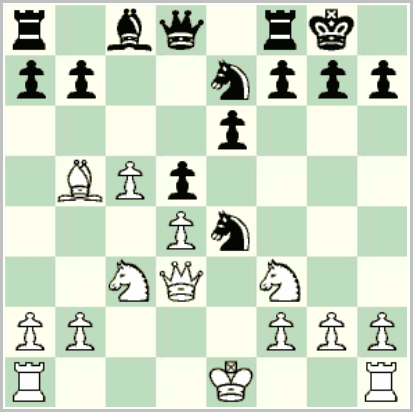
A funny aspect of the game was that Thomas told me he had been coincidentally studying the Panno variation 3 days before the match and he had gotten his variations mixed up when he played Qd3

Rendle-Crichton, Hillingdon Leaggue 2012
and that he was expecting me to reply with …f5 instead of the natural …Qa5 (when he then had to expend 30 minutes to find a way of avoiding losing a whole piece).”

I should note that after tracking down the league’s final table for 2011-12, I found that far from being relegated, Greenford finished runners-up overall. The captain must have been exaggerating the emergency.

Posted in Games | Leave a comment

Monthly update, November 2013

November saw 190 games added to the games archive, of which 90 were from the 2004 Irish championship, and the remaining 100 from a variety of tournaments (number of games in parentheses):

Irish Championship 1950 (3)
Irish Championship 1971 (1)
Bangor C.C. 20th Annual Congress (Rapid) 1999 (2)
Ulster Junior (U1500) Championship 2001 (4)
Ulster Championship 2001 (12)
UCU February Open Rapidplay 2002 (1)
Belfast Summerfest Novices 2002 (1)
Belfast Summerfest Open 2002 (3)
British Senior Championship 2002 (7)
Ennis Open 2010 (1)

from previous years, and recent games from:

Shane Hall Memorial Senior 2013 (2)
Bodley Cup Group B 2013-14 (1)
Armstrong Cup 2013-14 (1)
e2e4 Gatwick U1950 2013 (5)
TCh-NOR Eliteserien 2013-14 (2)
Bodley Cup Group A 2013-14 (1)
23rd World Seniors 2013 (22)
4NCL 2013-14 (6)
Ulster Masters 2013 (2)
Kilkenny James Mason 2013 (7)
Kilkenny Major 2013 (2)
Kilkenny Masters 2013 (18)

The ICU games archive has all the 2004 Irish championship games, but is missing many of the extra 100: in fact, though I don’t have an exact count, it seems to be missing the vast majority.

Posted in Administrative, Games | Leave a comment

Irish championship, Limerick 2004

This year’s Irish championship was the fourth ever held in Limerick, after the 1991, 2000, and 2004 championships: see David McAlister’s comprehensive compilation on his Irish Chess History web site.

The 2004 championship was notable as the first championship of the modern era to have an open format, with players of any nationality allowed to play, and the title of Irish champion going to the highest placed Irish player. (The entry form says that this was for the first time in the championship’s history: this is not accurate since the 1886 championship was explicitly open, and championships in the late 1950’s had more relaxed rules than today’s. But certainly it was a major departure from long-standing practice.)

All 90 games are available, and in addition we have the full set of bulletins provided at the time by Gerry Graham: these appeared on a predecessor of the current ICU site but weren’t ported over to the new site. These have been integrated into the full tournament report, now posted.

The tournament featured a great start from Karl McPhillips, who raced into a 4/4 lead, a full point clear of the field, but who stumbled with a winless 1½ out of the last 5. Defending champion Stephen Brady had a nightmare tournament by his standards (4 losses!). Instead Joe Ryan won his second title, after sharing first with Gawain Jones, then resident in Ennis and an up-and-coming FM, who thereby joined the list of players who finished equal first in an Irish championship but were never Irish champion (see also later information).

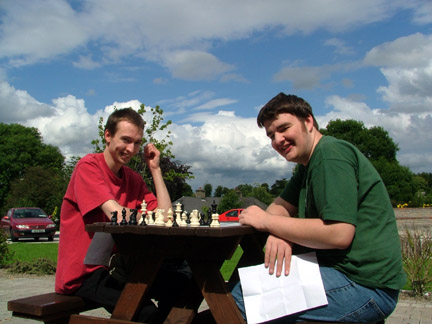
Gerry Graham’s long-lost report also contains several photos. Here’s one of Gawain Jones in a post-mortem discussion with Gordon Freeman of their last-round game:

Freeman-Jones analysis 2004

Posted in Irish championships, Tournaments | Leave a comment

The Alekhine (or Maróczy) Gambit Accepted

It’s strange how the same move in the same position can have drastically varying meanings and interpretations in different games. The classic example is a sharp and startling innovation, successfully and tenaciously defended over the board and ending in a thrilling draw, producing one game that features the best of chess: resource, invention, drama and tension. But if we saw the same move played in the same position a year later, after worldwide exhaustive analysis of the first game, we’d suspect the player of tacitly offering a quick known draw, and our worst suspicions would be confirmed if the players proceeded to rattle off the same continuation as the first game, with a quick handshake. Not the same thing at all–even though the moves are exactly the same.

One of the most solid and reliable ways for White to bypass the critical main lines of the Winawer is 4. Ne2. For much of its history this heralded a quieter, positional game in the then main line 4. … dxe4 5. a3 Be7: still an acceptable defence for Black, though without many positive prospects. More recently the most popular defence has been 4. … Nc6!?, leading to positions that have been described as ‘more French in nature’ and with more prospects for both players to play for a win.

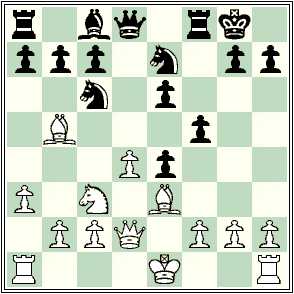
Lasker consultation game 1938But at the beginning, 4. Ne2 was seen as a gambit. Though it’s known to be too risky to accept it immediately via 4. … dxe4 5. a3 Bxc3+ 6. Nxc3 f5?!, the alternative 6. … Nc6! leads after 7. Bb5 Ne7 8. Bg5 f6 9. Be3 0-0 10. Qd2 f5 to the diagrammed position, a true gambit.

This position is still debated; Vitiugov and Watson give differing analyses in their recent books. For decades the line was considered a little dubious for Black. But the theory manuals ignored the first known example of the diagrammed position, a consultation game involving Lasker, played in Washington, D.C., in January 1938, illustrating the best defence for Black.

The full details and an evaluation of the latest theory are in the latest issue of The New Winawer Report, which was posted on the tNWR page on Tuesday.

Posted in Articles | Leave a comment

Monthly update, October 2013

Another 229 games involving Irish players or teams have been added to the archive this month.

Of these, one featured in the Steatham & Brixton Chess Blog’s “Worst Move on the Board” series, unfortunately on the wrong side for the Irish player: Gavin Wall had an unfortunate experience in the 4NCL Team Rapid. (Diagram omitted!)

Elsewhere Brian MacRéamoinn continued his return to the game at the e2e4 High Wycombe Open. With Brian, even the draws are interesting, as his third-round game shows; though some of the interest came at the expense of accuracy, e.g., 23. … Qa3+ would have won.

Posted in Games | Leave a comment

125 years of the Armstrong Cup

Today (20th October) marks the 125th anniversary of the first ever Armstrong Cup match.

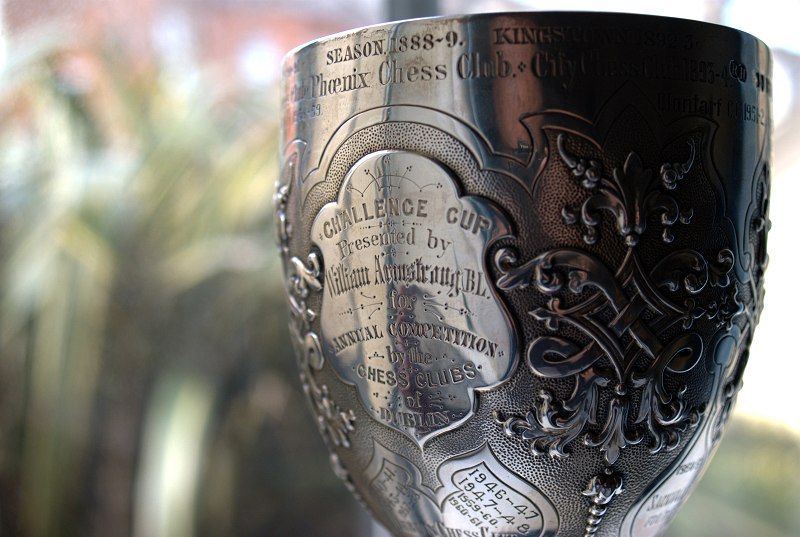
The cup was donated by William Armstrong B.L. as a challenge cup “for annual competition by the chess clubs of Dublin”. Its first season was 1888-89, and six teams entered: the Phoenix, City, Kingstown, Dawson Street, Dublin University, and National C.C.s. Matches were over six boards, each team was to play each of the others twice, and only overall match results counted. The competition resulted in a resounding victory for the Phoenix with 9 match points out of 10, well ahead of City and Kingstown, each with 6½ (though Kingstown had two unplayed matches). The picture below, taken from Elm Mount’s website, shows the full inscription with the names of the first winners inscribed at the top.

Armstrong Cup

We’re fortunate to have an account of the first Armstrong match, Phoenix v. City, played at 79 Grafton Street on October 20th, 1888. Today that’s the address of Bewley’s, but in 1888 it seems to have been the site of “John Morphy’s Chess Divan”. A report appeared the following Monday in The Freeman’s Journal, which David McAlister has provided, from which we have the full scorecard:

Phoenix City
G. D. Soffe 0 – 1 P. Rynd
J. Morphy 1 – 0 P. Murray
F. Hobson 1 – 0 P. Dunscombe
D. O’C. Miley 1 – 0 N. J. Prentice
W. Nicholls ½ – ½ J. Young
T. M. Kenny 0 – 1 W. Walshe
3½ – 2½

We even have the game from board 1 between J. A. “Porterfield” Rynd, Irish champion 1865-1886 and 1892-1913 (based on the 1865 and 1892 championships) for City, and George D. Soffe, Irish champion 1889-1892 (based on the 1889 championship) for the Phoenix.

To mark the occasion, a new Armstrong Cup page has been added here. David McAlister has managed to reconstruct the entire Roll of Honour, available at his Irish Chess History site. The page here will add details of players and matches; gradually of course, as there’s a huge amount of information.

Finally, at the beginning of last season there was an extended debate on the late (much-missed) LCU Chess Cogitations blog about the trend for teams to switch to holding home matches on Saturdays, which many felt was a departure from tradition. It’s therefore interesting to note that the 20th of October 1888 fell on … a Saturday!

[Updated April 27, 2018: changed board 4 on City team to “N. J. Prentice” (as given in the Freeman’s Journal report, rather than “M. J.” as previously given here); changed board 6 on City team to “W. Walshe” (matching later scorecards from the season, rather than “W. Walsh” as given in the Freeman’s Journal).]

Posted in Armstrong Cup, News, Tournaments | 3 Comments

‘A Famous Old Line’

Issue 10 starting positionThis month marks 60 years since the tournament at Venice 1953, and the game Paoli-Schmid, in a then-critical variation of the Winawer. Schmid uncorked a startling innovation, forcing White to sacrifice an exchange, reaching the diagrammed position. Black, to move, is undeniably precariously placed, but here it is White who is down material and with something to prove.

This variation is renowned (or notorious, depending on your point of view) for its dizzying complications and very dense theory. However the theory has been stuck in a state of suspended animation for decades: in particular the line is too specialised to justify the space it would require in textbooks. John Watson, in his recent Play the French (4th edition) gives it more attention than most when he says this ‘famous old line’ has draws for Black ‘if he desperately needs them’.

Actually it seems to me that Black is better placed than that. White gets an edge, certainly, but theory has greatly overestimated its scope. The details are all in issue 10 of The New Winawer Report, now posted on The Winawer page.

Posted in Articles | Leave a comment

Francis Burden

From a player profile on David McAlister’s Ulster Chess History website, citing the Weekly Northern Whig, 11 June 1914:

An Eminent Belfast Chess Player

Among the foremost British chess players of the sixties was Francis Burden, who was born in Belfast in 1830, and who died there on January 13th, 1882, the same day as his intimate friend the renowned Stanley Boden.

By profession Burden was a civil engineer, and in that capacity in 1870 went to Venezuela. Where he contracted malaria, which rendered him an invalid for the remainder of his days, and which necessitated his retirement from public chess. Burden was a dashing and brilliant player, and in the halycon days of Simpson’s Divan was certain to draw a galllery. He played all and sundry for nothing, and among his various opponents were Buckle, Boden, Wormald and Harrwitz. Wherever burden was there was fun. A good problem would be brought out and whoever touched a piece without having found a solution was fined a cigar all round. The man who paid the most forfeits and with the worst grace was Henry Jessel, brother of the Master of the Rolls. Burden taught de Vere chess. De Vere was sometime chess editor of the “Field” but consumption and an ill-considered life ended a brilliant chess career at the age of 30.

Burden was a man of many parts. He was a strong whist player with eccentric notions as to original leads. At billiards he was, for an amateur, fairly expert. Besides these recreations he was a chemist, a mathematician, and a scholar of no mean repute. His great handicap was his lack of health.

This is the player referred to in the puzzle from a few days ago. He was thus one of the foremost British players of the eighteen sixties.

Steinitz - Burden, 1862The same page goes on to give his win over Steinitz, at Mr. Rie’s Chess Divan in the Strand in July 1862, which appeared in The Field and the Weekly Northen Whig a few days later: see diagram for the final position. [Click to replay (in IRLchess format)]. The Weekly Northern Whig comments on Burden’s opponent: “Herr Steinitz is a new player to us in England, and promises to become a great one”. Indeed!

The game wasn’t played in any tournament, so you may ask whether it really counts? Surely it must: whether a game is a serious one must depend on the conditions of the day, and in an era when tournaments and matches were very rare, games played at the various divans were taken seriously by the players and the wider chess world. If we’re to count only tournament or match wins, we may as well insist on rated games as well, ruling out everything before 1970 or so.

Note: post modified (Sunday, October 13, 2013)–quoted text reformatted for clarity. The paragraph breaks are not in the original.

Posted in Games, Players, Puzzles | Leave a comment