Samuel Beckett and the Armstrong Cup

“Samuel Beckett’s obsession with chess: how the game influenced his work” runs the headline of a recent article in the Guardian by Stephen Moss, which continues “Chess was one of Samuel Beckett’s great obsessions, touching everything from Murphy to Endgame.” Indeed the novel Murphy features an unusual chess game (which can be played over on the Elm Mount C.C. web site, courtesy of Oliver Dunne); the chess content of the play Endgame seems strictly limited to the title.

Moss’s article describes other evidence of Beckett’s interest in chess, including a score of chess books, ‘filled with his comments’, and his reputed off-hand games with the artist Marcel Duchamp, who was certainly a strong player: he competed in several French championships and Olympiads. (Though there is some dispute over whether they actually played each other.)

I admit that this evidence by itself leaves me with some scepticism. That Beckett had at least some interest in the game is clear enough, but how far did it really go, and is there any evidence that Beckett was a chess player, as chess players would understand the term? These matters can be exaggerated. What I have in mind is some tangible evidence that Beckett had more involvement with chess than I have with golf, or snooker, say. I have played both games, sometimes with expert players, and I even think there’s the odd book on each scattered around the house. But it would astonish anyone who knew me to hear me described as a golfer or a snooker player. As far as I know, no evidence has ever been presented to show that Beckett exceeds this threshold.

Until now!

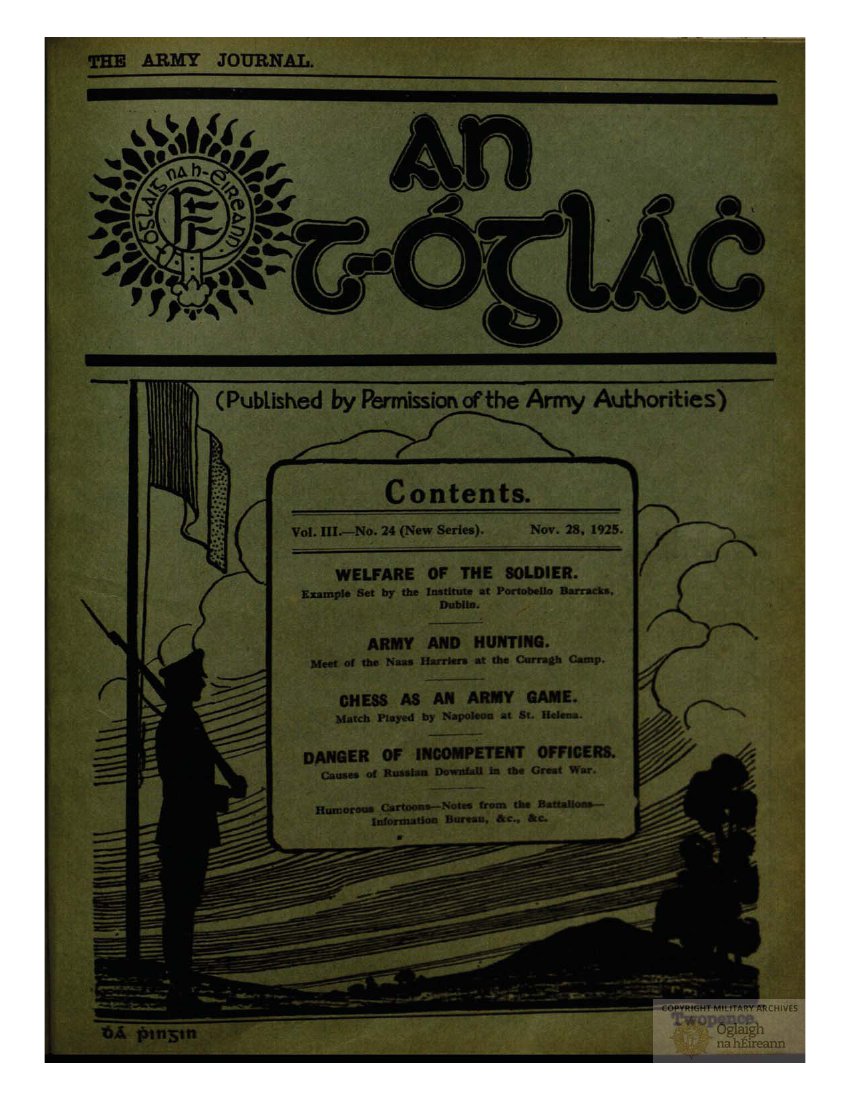
Samuel Barclay Beckett was an undergraduate at Trinity from 1923 to 1927. In the 1925-26 season of the Armstrong Cup, the six teams included both Trinity (or Dublin University) and National Army G.H.Q. The Army magazine An t-Óglách has a full set of issues online at https://antoglach.militaryarchives.ie/. Here’s the front cover of vol. 3, no. 24, from November 28, 1925:
An_t-Oglach_1925_11_28_p1

(there’s a spurious fada on the ‘a’: An t-Óglach = The Volunteer)

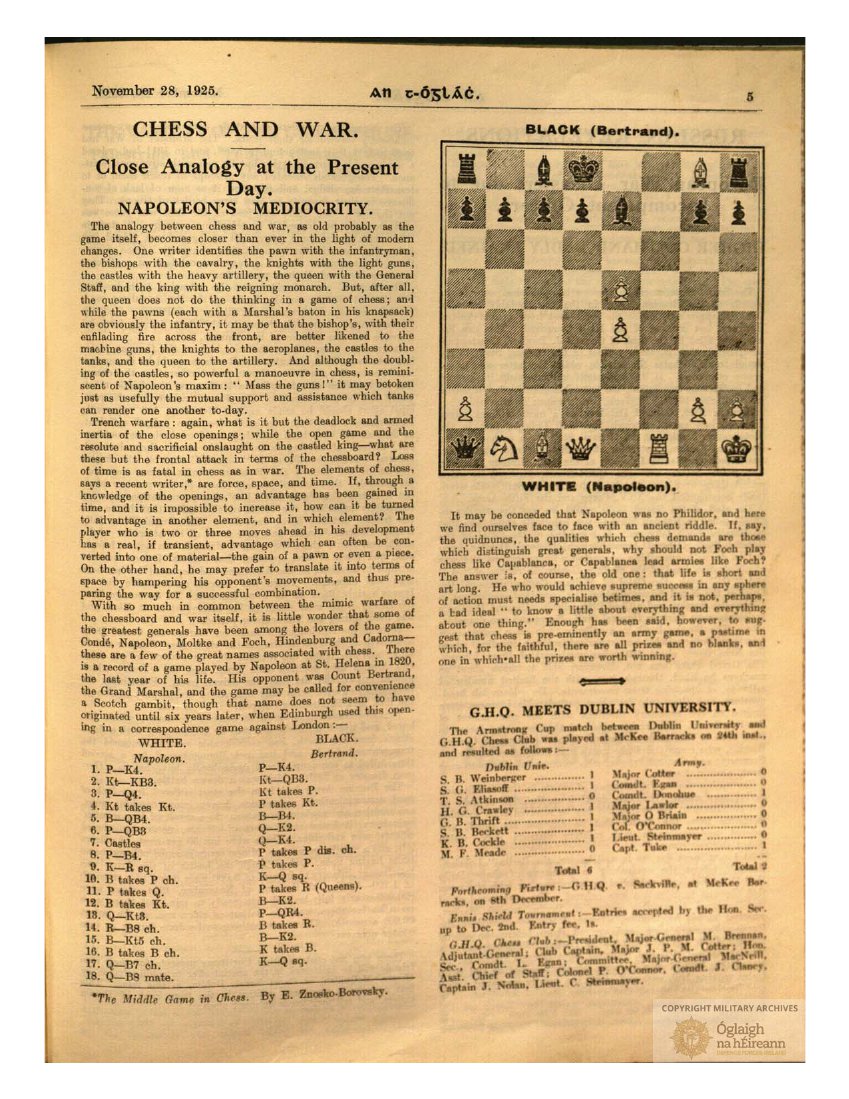
and page 7 5 of the same issue is devoted to chess:
An_t-Oglach_1925_11_28_p7

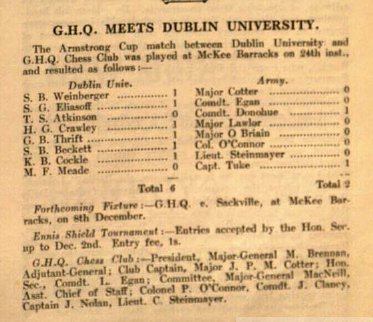
At the end of the right column there’s a scorecard of the Armstrong Cup match between National Army G.H.Q. and Dublin University, played at McKee Barracks on November 24, 1925:
An_t-Oglach_1925_11_28_p7-detail

Board 6 for Dublin University is S. B. Beckett.

I suppose it’s possible that it’s not the same person, and that some other S. B. Beckett was at Trinity at the same time, and also interested in chess. But I don’t believe it: that’s our man!

Posted in Articles | 3 Comments

Gonzaga Masters 2014

The Gonzaga Classic was held two weeks ago, a little earlier than usual. In the Masters, David Fitzsimons had a 200+ point rating advantage over the field and had won the event for the four previous years. Once again in Irish sport, however, 5-in-a-row was a bridge too far, and this time victory went instead to Killian Delaney.

The organisers deserve great credit for making the games available: Herbert Scarry’s report on the ICU web site has 49 of the 50 games. A full tournament report has now been posted here.

There were several interesting games, in particular John Healy’s win as Black against Conor O’Donnell in round 1 and the marathon Janusaitis-Nikrow game in round 3, as well as Scott Mulligan’s shock win against Fitzsimons in round 1.

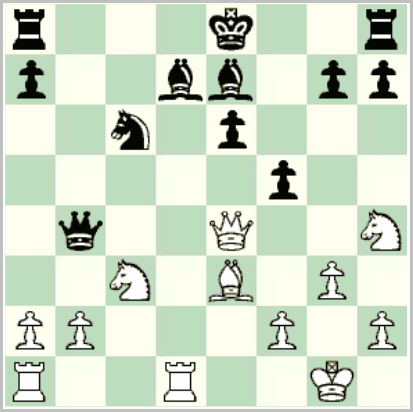
Delaney-Fitzsimons, Gonzaga Masters 2014The most interesting of all was the deciding last-round game between Killian Delaney and David Fitzsimons. Delaney, playing White, was a full point ahead and needed only to draw. In the diagrammed position he uncorked the amazing 21. Nxf5 ?!!?. I did not understand the thinking behind this move so finally resorted to Houdini 3.0, which finds itself baffled also. After 21. … exf5 22. Qf3 Qg4? (22. … Rd8 and Black must be close to winning) 23. Qd5 Rd8 24. Bc5 f4? (24. … Bxc5 with complications) 25. Re1 fxg3 26. hxg3 Qf5 27. Bxe7! the players agreed a draw. After 27. … Nxe7 28. Re5 Qf7 29. Rae1 White recovers the piece and emerges a pawn up, e.g. 29. … 0-0 30. Rxe7 Qxd5 31. Nxd5 with good winning chances.

[Click to replay the full game.]

[Update, February 12, 2014: the first posted version of the tournament report had some glitches, spotted by the eagle-eyed David McAlister. The most serious was the entire omission of the game Aherne-Murray from round 4, which caused knock-on effects throughout. Another glitch was caused by a discrepancy between the ICU ratings report and the actual results: David Murray was initially defaulted in round 1 in error, and that’s how it is still shown in the ratings report, but in fact he received a ½-point bye, as again confirmed by David McAlister after checking with Herbert Scarry; this affected the prize list as Murray finished clear second on 4½/6.]

Posted in Gonzaga Classics, Tournaments | 1 Comment

Ruane-O’Boyle, Heidenfeld 2013-14

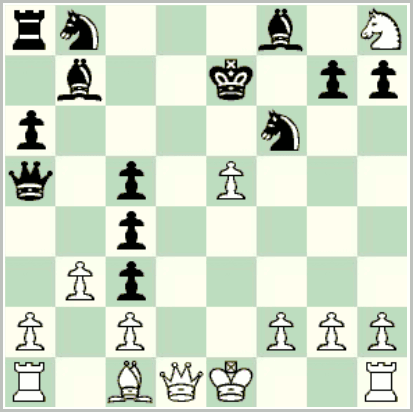
ruane-oboylle-2014An entertaining game from last weekend’s Heidenfeld match Drogheda-St. Benildus has been posted on the Benildus web site (The Madness of the St George–good title!). In the diagrammed position it’s Black to play his 14th.

The madness was all set in motion by 7. … bxc3 ??! (the ‘!’ is for entertainment value).

[Click to replay the full game.]

Update, February 13, 2014: Dónal O’Boyle adds a comment on the Drogheda C.C. web site, claiming that capturing the knight on move 7 is fine: “After 10.-Bc4, I should have played …-cxb2 11.-Bxb2 (others are bad)-Qa5+ 12.-c3-Nh6! and black is winning, for example: 13.-O-O-d6 14.-Bd5-dxe5 15.-Bxb7-Ra7 and black is ok.”

Posted in Games | 4 Comments

Crichton-Wall, Leinster championship 2005

Many thanks to Martin Crichton for supplying his game against Gavin Wall in the last round of the 2005 Leinster championship (not available anywhere else).

This must have been one of the strongest Leinster championships ever, with 8 of the 15 competitors rated over 2200, including Alexander Baburin and Gawain Jones. Gavin Wall had started well with 3½/4, only conceding a draw to Gawain Jones. He lost the crucial round 5 game against Baburin, also on 3½/4, though, setting the stage for a last-round game against bottom seed Martin Crichton.

Crichton-Wall, Leinster championship 2006It was, as Martin puts it, a topsy-turvy game. After a significant amount of pressing Wall managed to win a pawn, though there were so few pawns left on the board it was going to be hard to convert to a win. The disastrous 46. … Rc1?? blundered a piece. Wall must have spotted immediately what he had done, as he offered a draw .

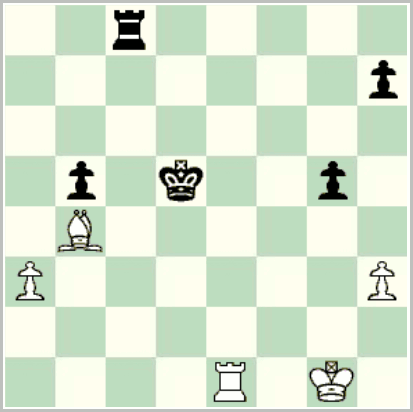
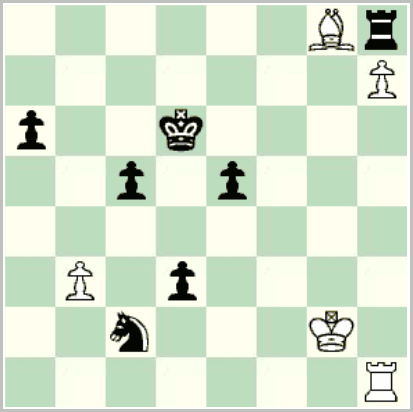
The diagrammed position was reached after 49. Rxe1. And now, is this a win for White with best play? Martin thinks so, but I’m not so sure. It’s a bishop of the wrong colour for the a-pawn, so if Black manages to exchange White’s h-pawn, he need only put his rook on c4 and he must have enough to draw.

[Update, May 8, 2020: I must take back the last statement above. If the king-side pawns are removed, the Lomonosov tablebases show that it’s a win for White. The problem for Black is that the b-pawn is weak and will eventually be lost.]

In fact both players were increasingly short of time–there was no increment–and after several more twists and turns all pawns were finally eliminated, getting down to the theoretically drawn ending of R+B v. R. This is not always easy to show in practice, though, and in addition both players were down to 90 seconds or so. This was the last game to finish everyone else was crowded around the board, adding to the pressure. Wall indeed went wrong, but 71. Bc5? let him off the hook. As it was, he was down to 12 seconds on the clock and missed the chance with 71. … Ra1? and had to resign after 72. Rb8. But as late as this last move he could have drawn. How?

[Click to replay the full game.]

Posted in Games | 3 Comments

Irish Women’s Championship 2013

Among the events around last year’s Irish championship in Limerick was the Irish Women’s Championship 2013. Over the years this event has been held on a very sporadic basis, but recently there seems to be a significant effort to promote it. In 2010 April Cronin won the first championship in decades (though bizarrely the event isn’t listed on the ICU web site) and in 2012 Karina Kruk won in Kilkenny.

The latest event was a 6-player all-play-all, and (for the first time?) games were available from live boards, and are given in the report, now posted on the Tournaments page here. Incidentally the games don’t appear in the ICU games archive.

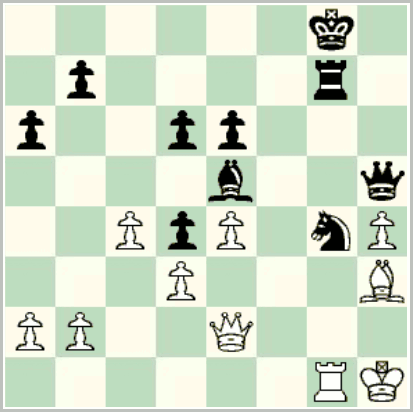
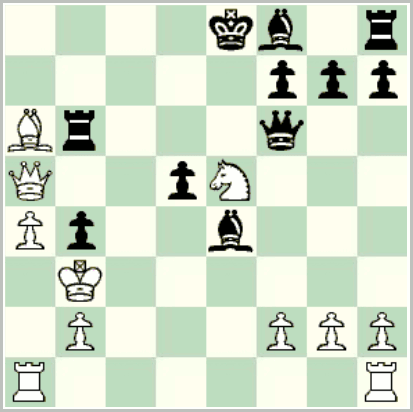
Mirza-McCarrick, Irish Women's Championship 2013The new champion is Diana Mirza after a surprisingly competitive event. The second round featured a surprise that could have been a shock, when the winner dropped half a point against Clare McCarrick of Longford Juniors. In the diagrammed position, McCarrick, as Black, had a clear win with 37. … Nf6, when she emerges a piece up. Instead she played the natural-looking 37. … Qxh4? and was caught by surprise by the resourceful 38. Qxg4!=. McCarrick was not listed in the ICU rating list before the event, but the one after shows her conceding over 750 rating points (1650 vs. 897); it must have been an interesting atmosphere during the game!

[Click to replay the full game.]

uilaighleis-mirzaThe championship came down to the final round game between Gearóidín Uí Laighléis and Mirza, with Mirza half a point behind and needing to win with the black pieces. She won a pawn and seemed to be heading to a smooth win, but unaccountably allowed her opponent to develop a dangerous passed pawn. In the diagrammed position White, to play, had 65. Kf3, when the d-pawn will drop, with surely at least a draw. Instead after 65. Kf2? e4 the passed pawns became too dangerous.

[Click to replay the full game.]

Posted in Irish women's championships, Tournaments | 1 Comment

Two Side Lines

Emanuel Berg’s The French Defence Volume 2 arrived last month: 304 pages of ‘Grandmaster Repertoire’-style discussion on the Winawer with 7. Qg4, covering both the Poisoned Pawn and the 7. … 0-0 line. I can’t really give a full review yet: I believe that while you can see fairly quickly when an openings book is bad, it takes time to judge a good book. After all there have been many other books on the same subject, to say nothing of articles, game annotations, and the like, all of whose authors these days have access to the same engines and databases, so a really good book has to dig deep to provide worthwhile new analysis, evaluations and improvements. This inevitably takes some time to evaluate properly–it certainly can’t be done with the ‘read and nod’ method–and the better the book, the longer it takes.

By this standard, it will take quite a while to evaluate Berg’s book, because so far it seems very good indeed: it’s very thorough, digs well beyond existing analysis and evaluations, and it has comprehensive coverage, even of side lines.

crespo-veenThe latest issue of The New Winawer Report considers two such side lines. Again (“yet again”–but this month marks the first anniversary of the newsletter, so please indulge me) it deals with the 10. Kd1 line in the Poisoned Pawn, which Berg treats quite thoroughly, with two chapters totalling 33 pages.

Of course it’s no fun if everyone agrees on everything, so the new issue differs in some ways from Berg and from John Watson’s (also excellent) Play the French, 4th edition. Both books give an accurate overall assessment, but neither gives the strongest continuations.

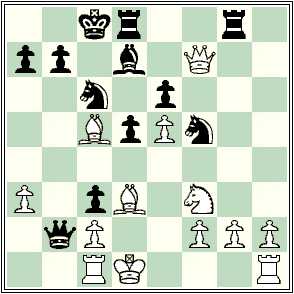
The diagrammed position is from Crespo-Veen, 19th World corr Ch ½-final-01, 1991-97. White threatens Ke2 and Rb1 trapping the black queen. Black played 17. … Rde8? followed by … Nd8 and drew. Much better is 17. … Rxg2!N. After 18. Ke2 Rg4 19. Rb1 Re4+ 20. Bxe4 dxe4 White successfully rounds up the queen, but after 21. Rxb2 exf3+ must either lose his own queen (22. Kxf3 Nxe5+; 22. Kd3 Be8+) or allow Black to promote (22. Ke1/f1?? cxb2).

Posted in Articles | Leave a comment

J.C. Hickey

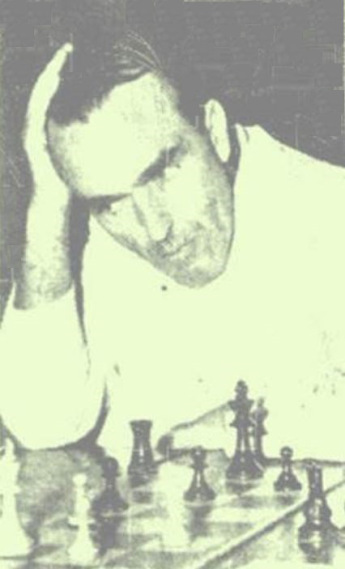
The answer to Sunday’s puzzle is John C. Hickey.

I said it was a hard puzzle, and indeed I’ll bet most readers will be unfamiliar with the name. But he had quite a distinguished career in both over-the-board and correspondence chess.

(a) He was Irish correspondence champion four times, in 1941, 1942, 1943, and 1950 (year championship ended). He also won national championships in over-the-board chess, though not the Irish championhip: he spent the years 1949-1960 in Singapore, and was Malayan champion in 1951 and 1957, and Singaporean champion in 1952, 1957 (j.), and 1958.

(b) The Dublin zonal in 1957 had two Irish players, Dónal O’Sullivan representing Ireland and C.H.O’D. Alexander representing England. This fell during Hickey’s time in Singapore, and he played instead in the Baguio City zonal, December 22, 1957-January 4, 1958, finishing 5th-6th out of 6 with 3/10 (+3 =0 -7). (The reference gives “J. B. Hickey” but based on other sources that’s a misprint.)

(c) He also played over-the-board chess in Ireland before, during, and after his stay in Singapore. The Irish Times of October 4, 1974 previewed the new Armstrong Cup season: “The other promoted teams, Phibsboro, augmented this year by the inclusion of J. C. Hickey a finalist in the recent City of Dublin championship, Sandymount, and Ierne will also be ambitious to justify their inclusion in the top section.”

The photo is taken (with permission, for which thanks) from Olimpiu Urcan’s web site Chess: A Singapore Column, items 817 (puzzle) and 824 (solution).

Posted in Puzzles | Leave a comment

Who?

who-january-2014Can anyone identify this Irish player?

Some clues:
(a) he won several national championships
(b) he played in a zonal tournament in 1957
(c) he played Armstrong Cup chess for Phibsboro.

Warning: hard!

The picture is shown with permission, but I’ll omit the reference until the solution is posted, as it would give too much away.

[Update, January 22, 2014: the picture is from Olimpiu Urcan’s web site Chess: A Singapore Column.]

Posted in Photos, Puzzles | 1 Comment

Thorpe-Hughes, WYCC U14 Open 2013

Ireland had three representatives at the World Youth Chess Championships in Al Ain, United Arab Emirates last month: John Hughes (5/11, U18 Open), Diana Mirza (6/11, U14 Girls), and Kevin Singpurwala (4½/11, U14 Open). All games were made available by the organisers, and the ones involving Ireland’s representatives are now in the archive here.

There are several interesting games in this collection, but none more than John Hughes’ penultimate round game against Thomas Thorpe (Wales). In the diagrammed position it’s Hughes, as Black, to play. Is there any way of saving the game? I haven’t run it through an engine but would guess that Black would have to look earlier to improve. In any case, Hughes’ 19 … Qxf2 didn’t suffice. [Click to play through the full game.]

Posted in Games | 4 Comments

Korchnoi photograph


Korchnoi in Armagh

Ulster player Cathal Murphy stumbled upon this super old photograph in the 1970s Armagh Memories Facebook page and sent it to me. It was dated November 1976 but was actually taken in February 1981 at the event I had previously written about in Korchnoi and the car.

I was previously unaware of the existence of the photo. It was therefore a real pleasure over 30 years after the event to see the great Korchnoi just about to make his first move against me in the simultaneous exhibition. The young lad two boards down from me is the future two-time Irish champion Niall Carton. Can anyone identify other people featured?

Posted in Photos, Simuls | 7 Comments