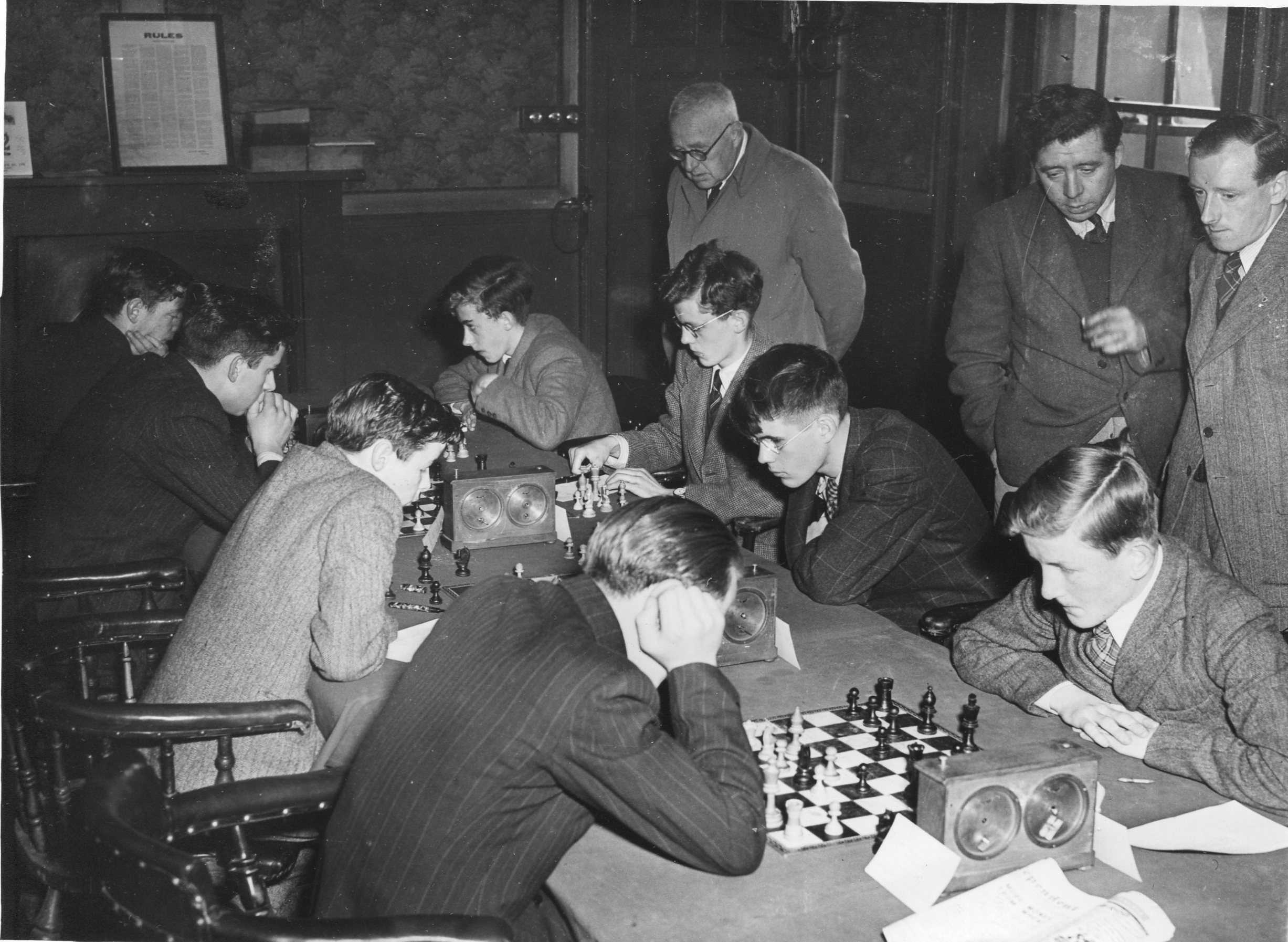
Oliver Dunne has sent the picture above, which he bought several years ago at a stall or second-hand bookshop. There were no details of event, year, participants, or location. (See a larger version.)
Does anyone have any suggestions?
Oliver Dunne has sent the picture above, which he bought several years ago at a stall or second-hand bookshop. There were no details of event, year, participants, or location. (See a larger version.)
Does anyone have any suggestions?
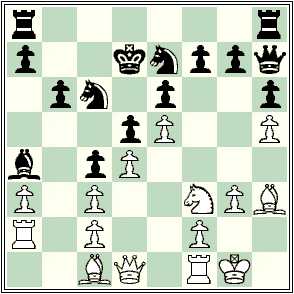 The latest issue of The New Winawer Report has been posted on the Winawer page. This one covers the positional lines, in which Black tries the setup … Ba4 and … c4, recommended in several recent books: Vitiugov, Moskalenko, and Berg.
It is hard to find examples of Black’s setup from the early years, perhaps because White usually played a4 at an early opportunity. One of the first significant examples is Grefe-Mednis, US Championship, El Paso 1973, covered here. In a major surprise, the late John Grefe (1947-2014) recorded eight wins and finished equal first, sharing the title: even at the time it was a surprise that this could be done by an untitled player. He didn’t even have a FIDE rating!
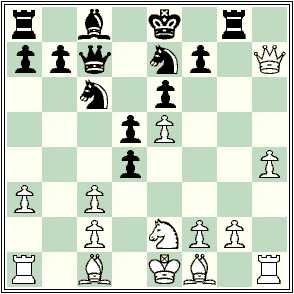
The setup did not gain significant popularity until the mid-’80’s, when Hertneck introduced the ‘deep idea’ (Berg) … Qg8-h7. Most games in this issue start from the diagrammed position, which was reached in the stem game. That game resulted in a defeat for Black, and indeed White has a significant plus record from this position. Black needs to exercise care …
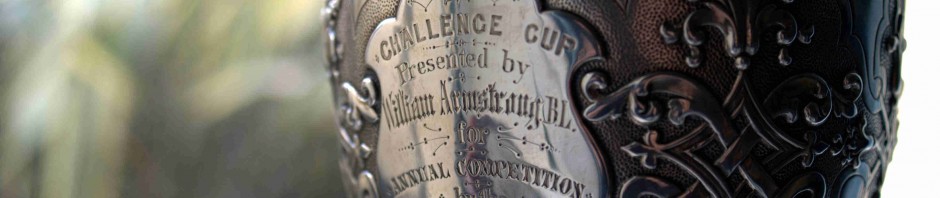
This Sunday sees the final round of the Armstrong Cup. Dublin University has been ahead all season, but stumbled slightly recently with a loss to Gonzaga. With a 2-point lead, and with the only other possible winners Elm Mount and Gonzaga playing each other, they must still be solid favourites. But strange things can happen in last rounds …
The 1976-77 Armstrong Cup was added to the Armstrong Cup page here recently, and the records have now been expanded out to give that season its own page, with all known match scorecards.
One aspect that stands out is the number of players who played in both the 1976-77 Armstrong and again in this one. I had assumed there might be three or four, but in fact there are at least ten, and maybe more than a dozen. In alphabetical order, and with their 1976-77 and current teams respectively, they are:
Brian Beckett (Dublin A, Bray/Greystones)
Ray Byrne (Collegians, Gonzaga)
Tony Dennehy (Collegians, Dún Laoghaire)
Oliver Dunne (Dundrum, Elm Mount)
John Gibson (Collegians, St. Benildus)
Tim Harding (Dundrum, Dublin University)
Eamon Keogh (Ierne, Kilkenny)
Joe Noone (Kevin Barry, Celbridge)
Bernard Palmer (Dublin B, Dún Laoghaire)
Herbert Scarry (Printers, Phibsboro)
and some I’m less sure of:
J. Bradley, U.C.D. / John Bradley, Kilkenny
C. Egan, Collegians / Colm Egan, Dublin
F. McMahon, Portmarnock / Frank McMahon, Phibsboro.
I may have missed some; corrections welcome.
The list of players who played in the Leinster Leagues in both seasons must be a long one. I’ll note Art Coldrick (Collegians, Armstrong ’76-’77; Phibsboro, Heidenfeld this season), Jack Killane (Rathmines in both years; Armstrong ’76-’77, Heidenfeld this season) and Mick Germaine (Printers, Armstrong ’76-’77; Phibsboro, Heidenfeld this season).
The theory of the Winawer Poisoned Pawn has built up over decades into such a dense and complex thicket that it requires something out of the ordinary for any variation to be called by the impressive title above. But this is exactly how Emanuel Berg labels the variation starting with 12 h4 (‘!’ according to Berg), instead of 12 Qd3, in his recent book on the 7 Qg4 Winawer. Certainly White has so far recorded excellent results with it.
John Watson’s Play the French, 4th edition (Everyman, 2012) considers the same line, though much more briefly, and he recommends the response 12 … b6, with analysis leading to equality. Berg devotes one full chapter to this line and concludes that it’s insufficient for Black.
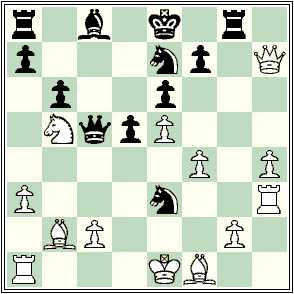 The latest issue of The New Winawer Report, now posted on the Winawer page, considers this line, via the very recent game (from last month) J. Geller-Bellahcene, Meurthe-et-Moselle IM 2014. In the diagrammed position Black has just played 16 … Ne3, leaving Berg’s analysis. His GM opponent went wrong immediately and was crushed in a mere five more moves.
A curious aspect of this new cutting edge, the last word in computer-aided theory (at least for the moment), is that it has much in common with Pickett’s line 11 h4 considered in the last issue, introduced in the 1970’s and practically ignored since then. In particular some lines, notably those where Black plays 12 … b6, feature the same Rh3 theme, covering the third rank.
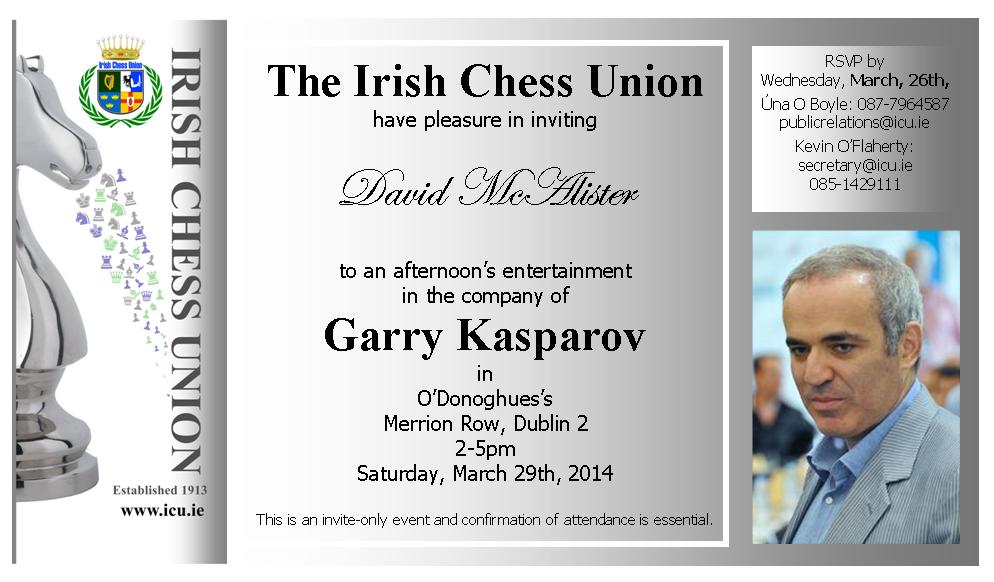
The 13th World Champion is currently on the campaign trail as he bids to unseat Kirsan Ilyumzhinov from the Presidency of FIDE. His principal purpose in coming to Dublin was to meet delegates from Ireland and neighbouring Federations who will be attending the FIDE Congress in August when the vital vote will be held.
Kasparov arrived in Ireland on Friday 28th March and that evening he made an appearance on RTE’s The Late Late Show. The following morning was taken up with the business session with the delegates and then his afternoon was given over to attending what the ICU described as a “special meeting of Irelandâ’s finest and most dedicated chess enthusiasts.”
Someone pointed out that Ireland’s finest would be competing at the concurrent Cork Congress. In deciding whether those present were worthy of such a description, I must declare an interest, because (as the invitation above shows) I was one of the invitees.
Arriving at the venue, my first thought was that the room was a bit on the small size. Still, having arrived precisely at the appointed hour, I had time to order a pint at the bar before the room got busy. The said pint was then captured en passant without anyone noticing but the staff were kind enough to provide a free replacement. When Kasparov arrived a short time later the room was already seriously crowded (well what else would you expect form an Irish pub?) and Eamonn Keogh ordered the traditional pint of Guinness for our visitor.
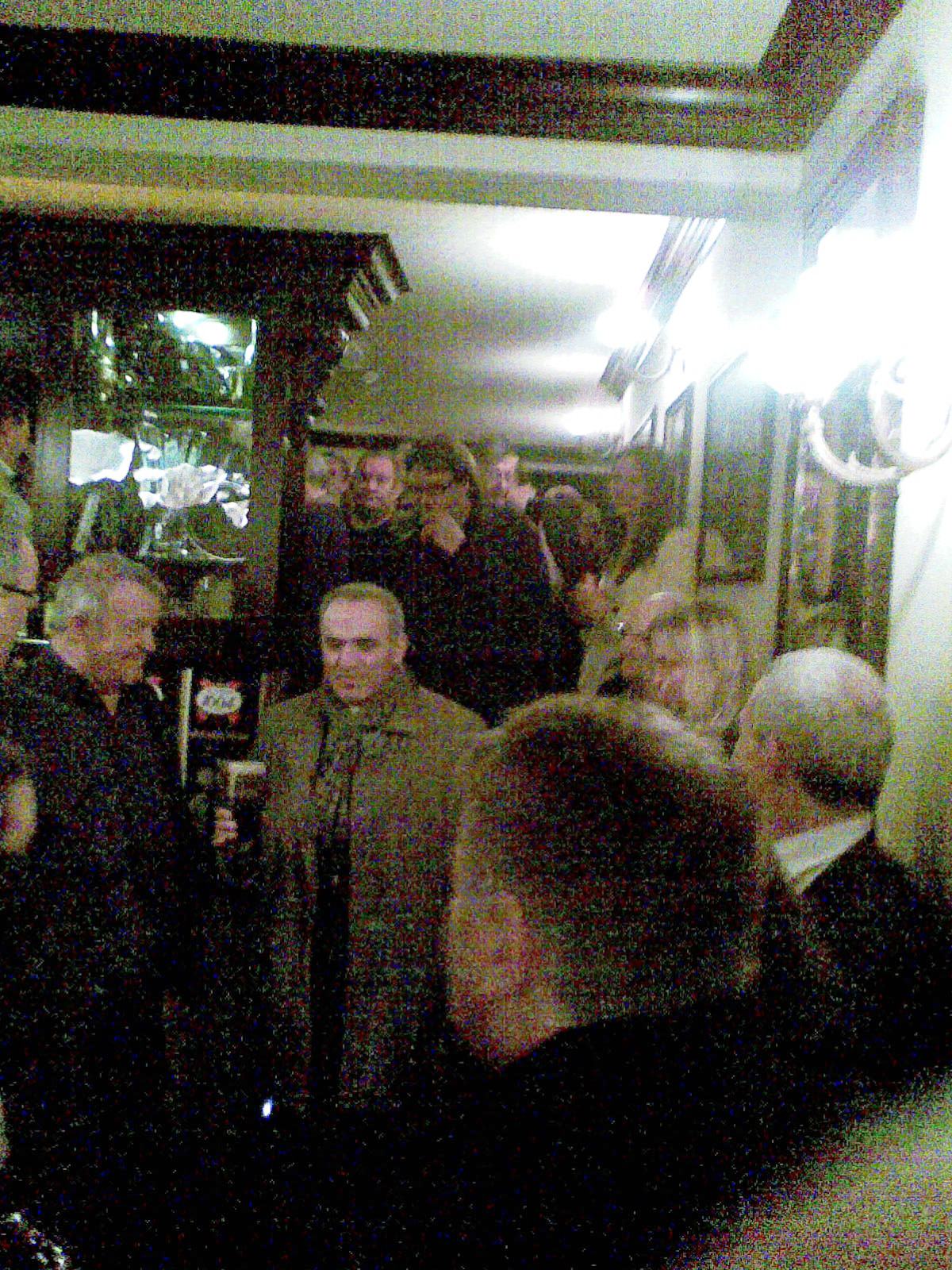
Sorry for the grainy image of Kasparov but that’s the best I could do with the camera on my ancient mobile phone. I’m not sure how much Kasparov actually drank from the pint, but soon after he was shepherded through the room to a place where he could be photographed with many of those present. Garry complied willingly with photo requests but I think he might have preferred something a little more structured and after about an hour he was on his way. The room slowly began to lose a few more of those present and it became possible to mingle again. It was an interesting and memorable experience to be in the same room with perhaps the greatest player ever but also to meet many Irish chess personalities in a non-competitive setting. Maybe, as someone suggested to me, we could make this a regular informal gathering of Irish chessplayers. I’m not sure how regular these awards are but maybe we could tie it in with inductions to the Hall of Fame.
It isn’t often that we have access to full blitz games, but the final of this year’s Bunratty Blitz tournament is an exception: Damien Cunningham at Ballynafeigh Chess put togther an excellent video, from which it’s possible to reconstruct the entire game:
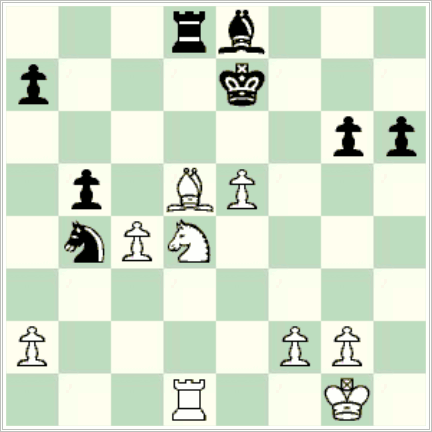
1. d4 e6 2. Nf3 c5 3. c3 Nf6 4. Bg5 h6 5. Bxf6 Qxf6 6. e4 cxd4 7. cxd4 Bb4+ 8. Nc3 O-O 9. Rc1 Nc6 10. e5 Qe7 11. Bd3 d6 12. O-O dxe5 13. dxe5 Rd8 14. Qe2 Bd7 15. Qe4 g6 16. h4 Be8 17. h5 Bxc3 18. Rxc3 Rd5 19. hxg6 fxg6 20. Qf4 Qf8 21. Qxf8+ Kxf8 22. Bc4 Rc5 23. Bxe6 Rxc3 24. bxc3 Rd8 25. c4 b6 26. Bd5 Nb4 27. Nd4 Ke7 28. Rd1 b5 (diagram)
29. Ne6 Rc8 30. Rb1 Nxa2 31. Ra1 Nb4 32. Rxa7+ Bd7 33. Nf4 g5 34. Ng6+ Ke8 35. e6 Bc6 36. Rh7 Kd8 37. Rh8+ Kc7 38. Rxc8+ Kxc8 39. Ne7+ Kc7 40. Nxc6 Nxc6 41. Bxc6 Kxc6 42. cxb5+ 1-0
The answers to Thursday’s puzzle are Joe Noone (Player A) and David Denny (Player B).
The original source is David Denny’s Flickr account. The players, from left to right, are Joe Noone, Martin O’Neill, David Denny, Brendan Bartley, Tom McHugh, and Gerry Doyle.
Joe Noone’s long and continuing career includes a joint Leinster champion title in 1984.
David Denny played mostly with Kevin Barry, but was on the winning U.C.D. team in the 1976-77 Armstrong Cup. His brothers Brian (three years younger) and Kevin (six years younger) also played: David and Brian both played on the 1974 Glorney Cup team, along with another set of brothers, Paul and Martin Delaney. (Kevin was a contemporary of mine: I remember him from Community Games competitions, and also from Leinster Schools leagues.)
There are several more (high quality) chess photos on David Denny’s Flickr account that capture the Community Games atmosphere very well.
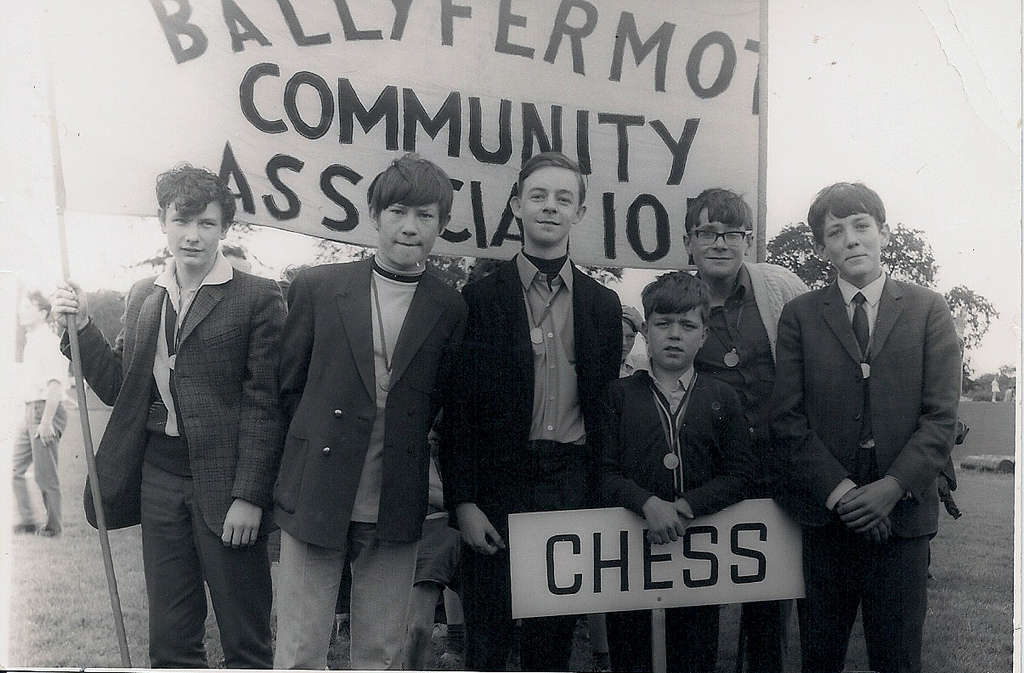
This photo shows the Ballyfermot team that won the national Community Games championship in 1970. (Click on the picture for a larger version.)
One player in this picture (call him Player A) was later a Leinster champion. He’s still playing, and in fact he’s playing in this year’s Armstrong Cup. Who is he?
Another player in the picture (call him Player B) came from a chess-playing family, was one of a pair of brothers on the same Glorney Cup team and was on an Armstrong Cup-winning team. Who is he?
The second question is much harder, I think, as Player B hasn’t played in decades.
The photo is shown with permission (for which many thanks), but I won’t give the reference just yet as it would give away some of the solution.
 The latest issue of The New Winawer Report has been posted on the Winawer page. This deals with a side line in the Poisoned Pawn, which was the subject of new analysis in Emanuel Berg’s new volume on the 7 Qg4 Winawer: White plays 11 h4!? instead of the virtually universal 11 f4 in the main line Poisoned Pawn.
Though Berg’s analysis is excellent, he misses the background and the original game in this line. The idea is due to the London player and author Len M. Pickett, later recommended by Andrew Martin, and the original game appeared in CHESS in November 1975. It’s not too surprising that Berg missed it, as it appears in no modern database (and, to be fair, was played well before Berg was born).
Berg gives an effective antidote to Pickett’s original idea of 11 h4 and 12 Rh3. But for reasons discussed in this month’s issue, the move order 11 h4 and 12 f4 brings some benefits to White.
The Armstrong Cup page has been updated with details of the 1976-77 season. In a close finish U.C.D. retained the cup, fighting off the challenge of Portmarnock, Dublin A, and Collegians. The winning team consisted of Bernard Kernan, Oisín McGuinness, Paul Wallace, Conor Barrington, J. Bradley, M. O’Donnell, Ciarán O’Hare, B. Redmond, D. Denny, and C. McGuinness (from two scorecards).
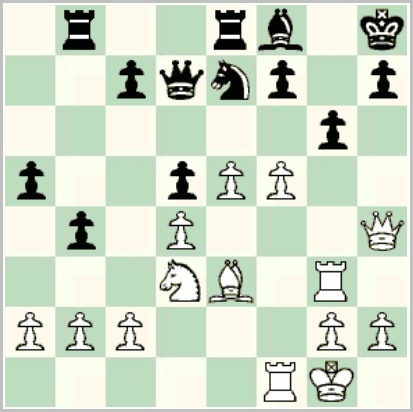 No games from this season are in the ICU games archive, but here’s one from J.J. Walsh’s scorebook, where he has White against U.C.D.’s board 2 Oisín McGuinness. McGuinness struggled in the opening and was already lost around move 11. The diagrammed position is with White to move. The finish was 24. e6 fxe6 25. Ne5 Qc8 26. fxg6 1-0, though there must be many other ways of winning also. [Click to replay the full game.]
Oddly, this is the first game of J.J. Walsh’s in the games archive here.
[Update, February 24, 2014: David McAlister has provided two more Irish Times articles that I didn’t have (October 14, 1976 and February 11, 1977), with the results of three more matches, for which thanks.]