Tomson solution

The solution to the Tomson problem in the last post is here. (I’ll omit a diagram here to allow later readers a chance to try the problem for themselves.)

The knight manoeuvres allow the bishop to move into place by shielding the white king from check twice. And the order of moves is unique: this is not a requirement for a series problem but is much more artistic than having multiple solutions.

Posted in Players, Problemists | Leave a comment

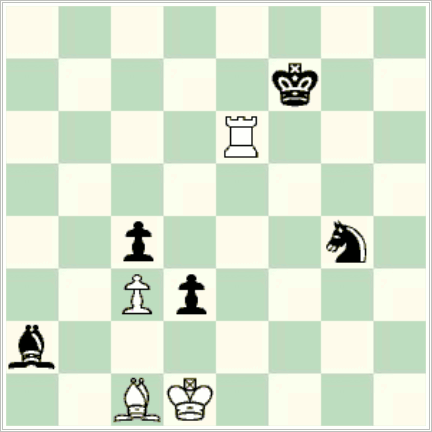
J.B. Tomson, series helpmate in 13

Brian Tomson’s career as a player and (especially) a problemist was extensively discussed here last year (Brian Tomson 1942-1986; see also his biographical summary). Born in Belfast, he finished =4th in the 1965 Irish championship and played for Ireland in the Student Olympiad in Harrachov, 1967, before emigrating to Australia in 1968. Although he continued to be active in over-the-board play, his primary interest was in problem composition and it’s as a problemist that he was best known. Sadly he died at a very early age, two days before his 44th birthday.

He was born on 22nd June 1942, and so today would have been his 70th birthday. To mark the occasion here is another of his problems:

J. B. Tomson, series helpmate in 13J.B. Tomson, Problem Observer 1980
Series helpmate in 13

This is another series helpmate, a popular genre in the problem world. The idea is that White and Black are working together to help White mate Black (hence ‘helpmate’), and the problem begins with a series of 13 Black moves, the White pieces remaining fixed (hence ‘series’). All 13 moves must be legal Black moves, and all except the last must leave a position where it would be legal for Black to move next, so there can be no checks in the first 12 moves. At the end of this series of 13 Black moves, White plays one move to deliver mate.

I’d classify this problem as being of medium difficulty: I wasn’t able to solve it but kicked myself when I saw the solution. Some common advice for solving these problems is to try to see what the mating position is, and then often or even usually it’s relatively straightforward to work out how to get there. It’s an elegant solution and well worth trying for yourself, so I’ll hold back the solution for now and post it in a few days.

Posted in Players, Problemists | 1 Comment

Znosko-Borovsky’s visit to Ireland

Seán made reference in the May 2012 update to Znosko-Borovsky’s simultaneous displays in Armagh and Limerick in December 1926. There is a game dated 1927 between Znosko-Borovsky and O’Hanlon listed in the Games section of the ICU website. It is highly probable that the year given is wrong and that the game was in fact played in the same time period as the Armagh and Limerick exhibitions. The evidence for this is tbat the exact same game was published in the Belfast News Letter chess column for 3rd February 1927, with the following preamble:

“The following very interesting game was played between the Irish champion and E. Znosko-Borovsky during the latter’s recent visit to Ireland. It was a strenuous contest lasting six hours, and 26 moves were played before even a pawn was captured. The finish was carried through in good style. One other game was played, and this the Russian master won in about 30 moves.”

Moreover the timing of the game is of rather larger significance. The 1926 Irish Championship in Belfast (won by O’Hanlon) commenced 6th December. Looking at the timing of the Armagh and Limerick exhibitions the most likely time for the two O’Hanlon – Znosko-Borovsky games is 4th and/or 5th December 1926, immediately before the Irish Championship. Not a bad way to prepare for a championship! O’Hanlon owned a hotel in Portadown at that time, so Znosko-Borovsky probably stayed with him during his time spent in the North.

O’Hanlon, John J – Znosko-Borovsky, Eugene
Ireland (probably Portadown) December 1926

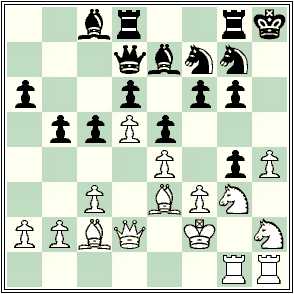
O'Hanlon - Znosko-Borovsky after Black's 26th

Diagram 1

1.e4 e5 2.Nf3 Nc6 3.Bb5 a6 4.Ba4 Nf6 5.0-0 b5 6.Bb3 d6 7.c3 Be7 8.Re1 Na5 9.Bc2 c5 10.h3 0-0 11.d4 Nc6 12.Be3 Qc7 13.Nbd2 Bb7 14.d5 Nd8 15.Nf1 Ne8 16.g4 g6 17.Ng3 Ng7 18.Qd2 f6 19.Rad1 Nf7 20.Kg2 Rad8 21.h4 Bc8 22.Nh2 Qd7 23.Rh1 h5 24.f3 Kh8 25.Rdg1 Rg8 26.Kf2 hxg4 (Diagram 1) The first capture and a mistake. Having over the last four moves placed his Rooks on the g- and h-files and tucked his King away on f2, thematic and good for White was 27.h5! One possibility now would be 27…Nxh5  28.Nxh5 gxh5 29.Nxg4 Rg7 30.Rxh5+ Rh7 31.Rxh7+ Kxh7 32.Ke1!  and the threat of 33.Qh2 is decisive.
27.Nxg4 Nh5 28.Nh6 Nxh6 29.Bxh6 Qa7 30.Be3 Rdf8 31.Ke1 Bd8 32.b4 Bb6 33.bxc5 dxc5 34.Nxh5 gxh5 35.Rxg8+ Rxg8 36.Qf2 Ba5 37.Bxc5 Bxc3+ 38.Kd1 Qg7 39.Qe3 Ba5 40.Bb3 Qg6 41.Be7 Rg7 42.d6 Kh7 43.Qf2 f5 44.Bf8 Rd7
A mistake, allowing a decisive infiltration by the White Rook. The Belfast News Letter noted that O’Hanlon had expected 44…Qg2. Unfortunately the rest of its note on the move is unclear but the general thrust was that White would still have been better after the Queen move.

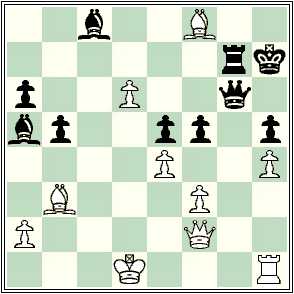
O'Hanlon- Znosko-Borovsky after White's 44th

Diagram 2

Perhaps that is a little optimistic but one plausible variation (though admittedly not forced) is (see Diagram 2) 44…Qg2 45.Rh2 Qxf2 46.Rxf2 Rg1+ 47.Ke2 Be1 48.Rf1 Rxf1 49.Kxf1 Bxh4 50.Be7 Bxe7 (50…Bg3 51.exf5 and if 51…Bxf5 allows a pretty finish with 52.Bc2!) 51.dxe7 Bd7 52.Bf7.
45.Rg1 Qf6 46.Rg5 Rxd6+
46…Qxf8 loses to 47.Rxh5 when Black must give up his Queen to prevent mate.
47.Bxd6 Qxd6+ 48.Bd5 Bd8 49.Qd2 Qf6 50.Rxh5+ Kg7 51.Rg5+ Kf8 52.Qb4+ Ke8 53.Qc5 Kd7 54.Rxf5 Bb6 55.Qxc8+ 1-0

[Click to replay.]

Posted in Games, Players | 1 Comment

Monthly update, May

It has been quiet here lately because I’ve been spending my chess time budget on two new features:

Search Posts and Search Games: The inbuilt WordPress search feature is very limited, searching only posts and not pages. Since all the tournament reports and playable games are on ‘pages’ (fixed background content) this meant that none of this information was searchable.

Until now, that is: now there are Search Pages and Search Games functions in the right column, and the same ‘Search Games’ feature is on the Games page. Access is by entering search terms directly rather than via a form where you could search separately by White name, or ECO code, or Event, say, but I think it should be fine this way.

Currently 2,719 games are indexed, including all the TWIC games, most but not all tournament report games, and some extra e2e4 games (see below). The tournament reports need to be re-run to add the required indexing lines and this isn’t quite complete yet. The 2,719 total above includes playable games, games with results but no moves, and walkovers & byes.

Extra e2e4 games: Last October’s e2e4 Gatwick International had a significant Irish contingent. The games would normally have shown up promptly in TWIC, but in this case they were held back to help the chances of several young competitors who were heading off to Brazil for the World Youth Championships. (See David McAlister’s comment here, pointing to a discussion on the English Chess Forum.)

But with TWIC, it seems that only this week’s tournaments are covered, so once a tournament’s natural place has been missed, it never reappears. Whether or not that’s true in general, these games never appeared in later TWICs. However they did eventually appear on e2e4’s website, and are now included here. (Search for “Gatwick 2011.10” in the Search Games feature: 60 games, including 3 byes and 9 games from the Major.)

TWIC also seems to exclude sections other than the top one, i.e., the various Challengers, Majors, etc., but again these are usually available on e2e4’s site. A partial selection has been included here, with games from the Sunningdale Major (May 2011), Sunningdale Challengers G (August 2011), and the Brighton Major International B (February 2012), in addition to the Gatwick International Major above: total 85 extra e2e4 games.

Elaine Pritchard: Elaine Pritchard, who played in Castlebar 1969, along with her husband David, died earlier this year, on her 86th birthday. BCM had an on-line obituary. The Castlebar 1969 pages have been updated accordingly.

More simuls: Early December 1926: is there any epoch that is a less likely candidate for chess activity in Ireland, outside of Dublin or Belfast? But it turns out there were some significant events: E.A. Znosko-Borovsky gave three simuls in Armagh and Limerick, as part of an extensive tour in which he gave many simuls in England:

1926.12.03, Armagh (Armagh C.C.). +20 =0 -2.
1926.12.07, (Consultation), Limerick (Limerick C.C.). +3 =0 -0.
1926.12.08, Limerick (Limerick C.C.). +14 =1 -0.

Posted in Administrative | 1 Comment

First Branagan Cup

This year’s Branagan Cup approaches its conclusion, with Elm Mount surprisingly winning easily against a much higher-rated Rathmines team in the first semi-final (so no double for Rathmines this year).

The new mixed league/knockout system this year seems to have generated a slightly higher entry than in the past few years. But nothing like the first Branagan Cup back in 1973! Here is the draw from the first ever Branagan Cup round (source: Irish Times, 14th February 1973):

U.C.D. “B” v. Rathmines “A”
Phibsboro “A” v. Rathmines “B”
Four Knights v. Consultants “B”
Dublin “A” v. Rathmines “F”
U.C.D. “D” v. Portmarnock “A”
E.S.B. v. U.C.D. “C”
Naas v. Rathmines “E”
Arklow “X” v. Irish Life “B”
Phibsboro “C” v. Phibsboro “B”
Irish Life “A” v. Phibsboro “D”
Dublin “B” v. Dublin “C”
U.C.D. “A” v. Rathmines “C”
Portmarnock “B” v. Kevin Barry
Phibsboro “D” v. Sandymount
Arklow “Y” a bye.

First-named teams were at home and the matches had to be completed by March 10th.

That’s 29 teams of 6 players each: quite a turnout.

Records are scarce thereafter, and all I can find is a report from February 26th 1974 reporting that the “long-deferred” semi-final of the Branagan Cup between U.C.D. and Kevin Barry had resulted in a 4-2 win for U.C.D., who would go on to face Phibsboro in the final. Could these fixtures have been part of the event that started in February 1973? I don’t see how a semi-final in February would have been “long-deferred” otherwise.

Posted in Club chess | 2 Comments

MTK Budapest-Dundrum, European Club Cup 1985

My earlier post promised more information on this match, including two games that are not in the databases, so here they are:

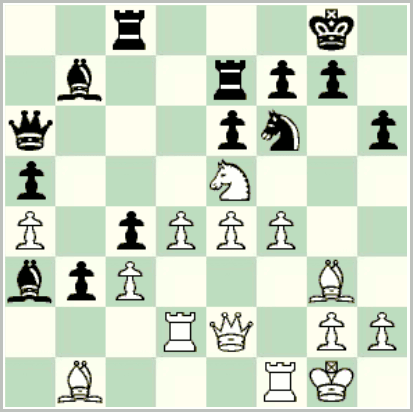
Varnusz-Drakeford after Black's 25th

Egon Varnusz — David Drakeford
MTK Budapest-Dundrum, European Club Cup (1.4), Budapest, September 1985

26. Bh4 Rec7 27. Bxf6 gxf6 28. Ng4 Kg7 29. f5 Be7 30. e5 exf5 31. Rxf5 fxe5 32. Qxe5+ f6 33. Qf4 Qe6 34. Qxh6+ Kf7 35. Rdf2 Qe1+ 36. Rf1 Qxc3 37. Rxf6+ Bxf6 38. Qxf6+ Ke8 39. Bg6+ 1-0.

[Click to replay.]

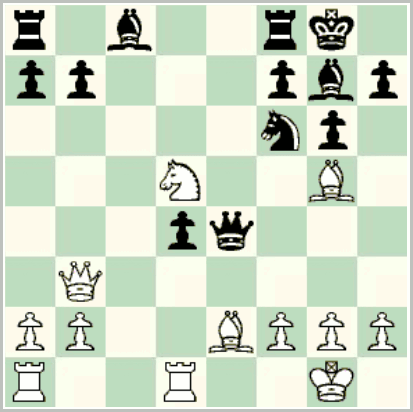
Lengyel-McHugh after Black's 16th

Levente Lengyel — Kevin McHugh
MTK Budapest-Dundrum, European Club Cup (2.3), Budapest, September 1985

1. Nf3 Nf6 2. c4 g6 3. Nc3 Bg7 4. d4 d5 5. e3 O-O 6. Qb3 dxc4 7. Bxc4 Nc6 8. Be2 Qd6 9. O-O e5 10. d5 Ne7 11. e4 c6 12. dxc6 Nxc6 13. Rd1 Qe7 14. Bg5 Nd4 15. Nxd4 exd4 16. Nd5 Qxe4 (diagram)

17. Nxf6+? Bxf6 18. Bxf6 Qxe2 19. Bxd4 b5 20. Re1 Qc4 21. Qf3 Bf5 22. Qe3 a5 23. b3 Qd5 24. Bb2 f6 25. Rad1 Qc6 26. Rc1 Qb7 27. h3 Rad8 28. Qf4 Rf7 29. Rcd1 Qb6 30. g4 Bc8 31. Rxd8+ Qxd8 32. g5 fxg5?? 33. Qe5 1-0.

[Click to replay.]

Kevin McHugh’s attempt at an early simplification had a flaw, though GM Lengyel overlooked it. In the diagrammed position, the computer finds 17. Bxf6! Qxe2 18. Qb4! winning, since White threatens 19. Ne7+ Kh8 20. Nxg6+ as well as 19. Qxd4. After the game’s 17. Nxf6+?, Black still has an uncomfortable position because of the weakness of the long diagonal, but was weathering the pressure reasonably well until the disastrous 32. … fxg5??. After 32. … Bxh3 instead, it’s still all to play for.

My earlier post expressed doubts about the accuracy of the scores given by Sakkélet, but John Griffin has written in and comments that these were indeed correct.

The earlier post mentioned that only one of the games from the match, Portisch-Curtin, was given on OlimpBase. I received a message from Wojciech Bartelski the following day, requesting the game scores. Impressive! Here is the pgn file.

And here is the original article in Sakkélet. No reports, unfortunately, in Fiacla Fichille or in any of the Irish papers, at least not that I could find.

Posted in Club chess | Leave a comment

P.J. Laracy, Philip Baker and the 1927 Leinster Championship

When compiling the Roll of Honour for the Leinster Championship, there was a particularly tricky decision to make about the 1927 renewal. There was evidence pointing towards two possible candidates. They were Philip Baker, champion the previous year (and also in 1922) and P.J. Laracy.

The evidence for Baker was that he was referred to as the “present holder” in a 17 January 1928 Irish Independent preview of that year’s Championship, while the evidence for Laracy came from his 1960 obituary.

So initially for 1927 the winner was given as “P. Baker or P.J. Laracy”. However, having discussed the pros and cons of each candidate with Sean, I decided to give the matter some further anxious consideration.

The evidence for Laracy was weaker. The obituary only mentioned him winning in 1927 but he had in fact “also” won in 1929 and 1931. The likelihood therefore was that about 30 years after the event the compiler of the obituary knew that Laracy had won the Leinster Championship but was wrong about the date.

Trawling through the sources again produced strong contemporary evidence to rule out Laracy. In particular the Irish Independent for 10 March 1928 gave the entrants for the 1928 Leinster Championship (which included Laracy) and specifically stated that the only previous champion in the entry list was J.T. Gerrard.

So that seemed to leave Baker. However, a third possibility then suggested itself. That item in the Irish Independent had stated that Baker was the “present holder” rather than last year’s winner. While these two things are not mutually exclusive, it does at least leave open the possibility that Baker continued to hold the title which he had won in 1926, rather than having won it in 1926 and again in 1927.

What contemporary evidence is there from 1927? Actually very little. On 14 February 1927 both the Irish Independent and the Irish Times gave the information that the closing date for entries to the Leinster Championship was 1 March, but neither paper then carried any reports on the championship. When the Irish Times for 30 April 1927 disclosed in a short article that the competitive Dublin chess season has ended, it referred to the winners of the two Leinster team competitions but there was no mention of the individual championship.

Of course, the Leinster individual may have taken place between the beginning of March and the end of April but it was simply not reported in the press; in those days chess coverage in the Dublin papers was somewhat patchy. However we could speculate that there may not have been enough time left in the season to fit in the Leinster Championship. The final and deciding match of the Armstrong Cup between the Dublin and Sackville Clubs was played on 14 March and it is unlikely that the Leinster Championship would have commenced before this vital encounter. Of the eight games in the match four were adjourned and the last of these only finished on 4 April. In that game two former Leinster champions Norman H. Wallace (Dublin) and Charles J. Barry (Sackville) faced each other with Wallace finally winning after three sessions and ten hours play. Wallace’s win produced a four-all draw in the match and this was enough to secure the Armstrong Cup for Dublin but if Barry had managed at least half-a-point, this would have required the two teams to play a tie-match for the Cup, further encroaching on the available time until the end of the season.

So with all these developments, it is at least plausible that the Leinster Chess Union decided not to proceed with its individual championship. By now another hurdle was potentially in the way. The LCU had to organise the Irish Championship Congress (comprising the championship itself and a Major Open Tourney) in Dublin over the Easter holiday. On 28 March the LCU Council met to finalize arrangements with the dates set for 19 to 23 April. Again it is at least plausible that the LCU would want to concentrate on the major occasion in the Irish chess year and decide to set aside arrangements for the Leinster individual. One other point to make is that all the eventual entrants for the Irish Championship (the disappointingly small total of four, all from Leinster, from whom Baker emerged the winner) had all featured in the adjourned games from the Dublin-Sackville match.

So, on the evidence currently available, the balance seems to tip in favour of a verdict that there was no Leinster championship in 1927. However, further evidence may yet appear (the most likely place – and one I have not been able to consult – is in the Dublin Evening Herald which had a chess correspondent at that time).

So for now, in the Roll of Honour for the Leinster Championship, the listing for 1927 will have to read “Philip Baker or no championship held”.

After this rather lengthy speculation, P.J. Laracy has faded from view. However I mentioned his obituary and it actually makes very interesting reading: we learn his first name (reports on chess events always seemed to refer to him merely by his initials), his own eventful life is well if briefly chronicled and we find out he had a very interesting son-in-law. So here it is: (from the Irish Independent for 12 November 1960)

Mr. Patrick J. Laracy, M.B.E. Highfield Road, Rathgar, who has died, aged 78, was a former Assistant Accountant in the G.P.O. He retired in April 1947. During the first World War he served with the Third Royal Irish Regiment, with the rank of Lieutenant, in Flanders and fought on the Somme. He was wounded in March, 1917, and lost a leg.

A brilliant chess player, he was champion of Leinster in 1927 [this should read 1929 and 1931] and reached the final of the Irish championship on a number of occasions. [In fact only once would this apply – in 1929 he played in the Irish Championship qualifying tournament to decide who was to be the challenger to the title-holder Baker] He was a member of the Dublin Chess Club and also of the Rathmines club.

He is survived by his daughters – Mrs Ignazio Silone, Rome (whose husband is the well-known writer). Miss Cecily Laracy, Dr. Moira Quinlan and Mrs. Eithne Kavanagh, Dublin.”

One final point that should be added to the record: Laracy was undoubtedly at his most brilliant when he won the 1931 Leinster Championship: the Irish Independent reported that in his final game he beat Philip Baker to finish well clear of his seven opponents “with the remarkable high score of seven points.” It was an extremely strong renewal with his opponents including Baker (four times Irish champion), T.G. Cranston (who went on later than year to win the Irish title for the second time), C.J. Barry (many times Leinster champion) and two other previous Leinster champions, J.T. Gerrard and R.T. Varian.
Posted in Armstrong Cup, Irish championships, Leinster championships, Players, Tournaments | 1 Comment

Leinster Championships centenary

The Leinster Championships are being held over the May Bank Holiday weekend, the usual slot for the Malahide Millennium Tournament. In fact these two tournaments have amalgamated this year, and pre-event it was being anticipated that the quality and quantity of those competing would be greater than the two events have been able to achieve on their own. If all goes well maybe a long-term collaboration will be on the cards.

Perhaps less well-known is that this is the centenary Leinster Championship. Sean and I have put together a Roll of Honour, featuring all the champions from 1912 to date that we are aware of. If any of our growing band of followers can add to the list, we would be glad to hear from them.

Leinster Championship Roll of Honour

Posted in Leinster championships, Tournaments | 1 Comment

Monthly updates, March and April

Here is a summary of the changes in the past two months that were not the subject of separate posts:

Branagan Cups: There have been quite a few updates here. Anthony Fox sent in details of the 2003 final, for which many thanks. I also found a clipping on the 1979 final, which I had downloaded some time ago, because I played in it myself! (On the losing side, unfortunately.) Other results that showed up were 1974, 1978, 1983 and 1984, and the finalists in 1975. I think Kevin Barry may have won in 1985: they won the National Club Championship and I have a vague recollection they must have qualified by winning the Branagan?

Simuls: Many more simuls have been added: Wade (in Rathmines) and Soultanbéieff 1954, Gligorić (four simuls in 1971), Euwe (two simuls in 1972), and Nunn (1985 in Belfast). For simuls by Irish residents, newly added items are Mary Rudge, G.D. Soffe, and J. Porterfield Rynd in 1889, the last of these blindfold, and another by Mary Rudge in 1893. She was English but resided in Ireland for some time and played in a few Armstrong Cups, and seems to have been living in Clontarf in 1889. Others added were Barney O’Sullivan (1974 in Waterford) and Alexander Baburin (Ballina 2002).

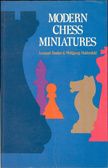
Modern Chess Miniatures coverAll these are based on newspaper reports. But there’s one other very obscure simul that didn’t appear in any reports, given by Wolfgang Heidenfeld at St. Benildus College in 1978. This had nothing to do with the current St. Benildus C.C., which didn’t exist until 1990 or so, but was instead arranged by the school (Frank Scott) as part of its German Night, and all the players were pupils. Winners were to receive a signed copy of Modern Chess Miniatures by Barden and Heidenfeld.

I hope he brought enough copies! He lost five games, rather a high loss rate for an 18-board simul. The winners were Oliver Dunne, J. Hayes, Jimmy McAndrew, Owen O’Mahony, and Ciarán Walker. (Source: Owen O’Mahony score book.)

TWIC Irish games: These had not been updated for a while. TWICs 904-912 were finally processed, with 327 new Irish games, taking the total up to 1392, from 82 Irish players. There are some duplicates, though, where the same game is given in different weeks: eventually I’ll figure out some way of filtering these out.

Comments: Quite a few people have sent in comments and others have sent email messages. This is all very welcome and encouraging, let me say: it’s very gratifying to see that anyone’s reading all this! In addition to comments from Anthony Fox, Ciarán O’Hare, and Paul Cassidy, we also received comments from Nena Jover Kelty (daughter of Tommy Jover and the author of My Father Was Carmen Miranda: Memoirs of an English Show Girl) and from Rafael Jover re David McAlister’s post from November on Tommy Jover’s win against J.J. O’Hanlon. Many thanks!

Posted in Administrative | Leave a comment

A neat finish: Lewis-Duffy, Armstrong Cup 1958

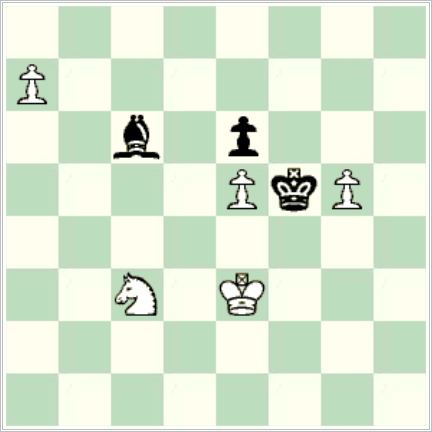
Lewis - N. Duffy, Armstrong Cup 1958From the Armstrong Cup 1958-59, W. Lewis – N. Duffy, Dublin-Phibsboro, board 6, played in late 1958 (and, by the way, not in the ICU games archive or other databases):

In the diagrammed position Black sealed. It looks as though he should be able to draw easily enough: the sealed move must be 1. … Kxe5, and then the pawn on g5 must drop also.

But after resumption there resulted what J.J. Walsh, writing in the Irish Times shortly afterwards, described as the neatest finish he had seen in a long time. Can you see what happened?

See the solution.

Posted in Armstrong Cup, Games | Leave a comment