Monthly update, June

Some items this month that weren’t the subject of separate posts:

Games archive: The ICU games archive is an excellent resource and represents a huge amount of effort by its originators (John Hurley and Mark Orr deserve much of the credit, I believe). But it seems there is no particular effort being made to keep it up to date. I’d like to aim at making the IRLchess archive the most comprehensive and current resource for Irish games.

With this in mind, I’ve steadily been adding games to the archive on these pages, all searchable via the “Search Games” feature in the right column. After some reworking of the routines this month, the process is now much simpler, so whenever a new game appears on a club web page or blog, it’s relatively straightforward to grab it and convert to a playable .htm file. I’m leaving out comments (too tricky to handle, apart from any issues of getting permission) but am adding sources, references and links where available.

Games added this month include:

Sheehan-Gibson, “Dublin league” 1997
Dooley-Dunne, Branagan Cup 1997
K. Delaney-R. Quinn, National Club Ch 2009
O’Brien-O’Donnell, Munster League 2011-12
Noonan-O’Grady, Shannon Masters 2011-12
Masterson-Waters, Ballynafeigh June Rapid 2012
Wall-Curtin, UT San Antonio Open 1992

plus half a dozen more.

You may notice that the search takes a few seconds (10-20) to generate results. In one sense this isn’t ideal, of course, but there’s a reason: each search causes each and every .htm file on the site to be opened and checked to see if it matches the search terms. So search results are always automatically up to date: as soon as a new .htm file is loaded, it appears in the search results. For future development: a speedier search, and a speedy way of generating an up-to-date pgn file of all the games on the site (to this end, the pgn source is embedded into the .htm file, as you’ll see if you do a ‘View Source’ on the files above).

Simuls: A couple of new events have been added to the Local Simuls page: these were simuls given by Alexander Baburin in 2005 and 2006. In addition, Ciarán Quinn and Philip Reilly sent in comments on simuls given by Bronstein, Spassky, and Geller. For Bronstein, I’m happy to say there is plenty of information: David McAlister sent a scan of the report in the ICJ, complete with several games, so it’s just a matter of getting around to processing it. For Spassky and Geller, though, any help would be greatly appreciated. I think Geller also played a game against three opponents in consultation? (David Dunne, Jonathan O’Connor, Paul Delaney?). I recall seeing a photo in the Dublin C.C. rooms.
Posted in Administrative | Leave a comment

Double seesaw/windmill

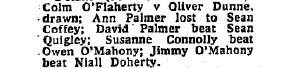
On looking through the chess historical site Chess Notes, a search for items of Irish interest came up with the following curious example, submitted by Oliver Dunne–an old team-mate of mine, as it happens. In fact here’s a clipping of one of the matches we played in, from the Irish Times, 9th July 1977:

From the Irish Times, 9th July 1977
I’ve left it as a puzzle to guess team names and event. Warning: not easy; not easy at all. Here’s another clue: in the previous round, Oliver played John Delaney, and I played Ann Delaney.

Anyway, on to Oliver’s submission to Chess Notes, played some thirty years after the event above:

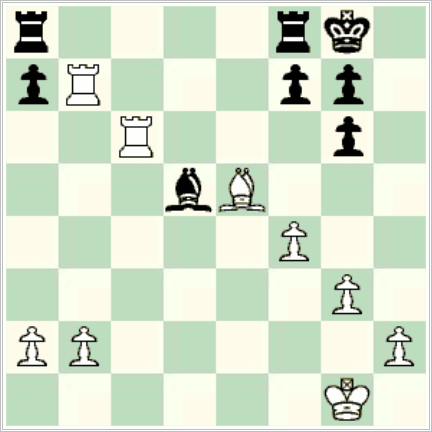
Dunne - Fitzsimons, Armstrong Cup 2007-08Oliver Dunne – Pat Fitzsimons
Armstrong Cup (1.6)
[Elm Mount A – Elm Mount B] 24th Sep 2007

White now continued 26. Rxg6! with the unusual theme that a seesaw/windmill can occur with either rook. Black can’t avoid this, since 26. … Rae8 and 26. … Rfe8 each lead to Black being mated quickly, or suffering worse material losses than the windmill.

[Click to replay the full game.]

Posted in Games, Players | Leave a comment

Keres-Dennehy, simul, Trinity 1962

Among the events listed on the Simuls page is the one given by Paul Keres at Trinity on December 2nd 1962, where he played 24, drew two, and lost one, to Tony Dennehy.

That the loss is not recorded in Big Database 2012 is perhaps not surprising, since they don’t really go in for games from simuls (even though they have–stop me if I’ve mentioned this before–5,000,000+ games). But it’s a little surprising that it’s not listed in the ICU games archive either. The game is available, courtesy of A.A. Luce’s very interesting booklet A History of Dublin Chess Club (Dublin, c. 1965), and here it is.

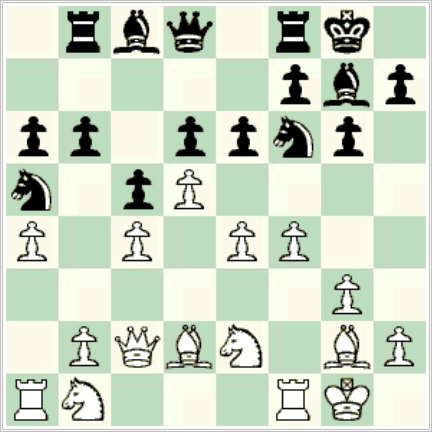
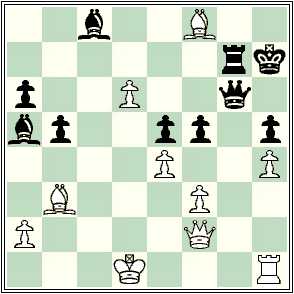
As far as I can determine on a quick play-through (these days I try to avoid using engines if I can avoid it, on the principle that they encourage passivity) the diagrammed position is where it all starts to go pear-shaped for Keres. This is one of those games where the winner hopes his opponent doesn’t resign, as the situation becomes more and more spectacular.

Keres - Dennehy, Simul 1952Keres, Paul – Dennehy, Tony
Simul, Trinity College 1962.12.02

1. d4 Nf6 2. c4 g6 3. g3 Bg7 4. Bg2 O-O 5. e4 d6 6. Ne2 c5 7. O-O Nc6 8. d5 Na5 9. Qc2 a6 10. a4 Rb8 11. Bd2 b6 12. f4 e6 (diagram)

13. e5? dxe5 14. fxe5 Ng4 15. Nf4 Nxe5 16. dxe6 fxe6 17. Bxa5 bxa5 18. Nc3 Nxc4 19. Qe2 Ne3 20. Rfe1 Bd4 21. Kh1 g5 22. Nh5 Nxg2 23. Qxg2 Rf2 24. Qh3 Rbxb2 25. Rad1 e5 26. g4 Bxg4 27. Rxd4 Qa8+
0-1

[Click to replay.]

Posted in Games | Leave a comment

Collins-S. Williams, e2e4 Diamond Jubilee Premier

Recently Peter Cafolla recommended the “fantastically entertaining” final round games of Alex Lopez, Sam Collins, and Mark Hebden at the e2e4 Diamond Jubilee Premier earlier this month. He was hardly exaggerating. Here’s the Collins game, versus Simon Williams.

Collins - S. Williams, e2e4 Diamond Jubilee Premier 2012Collins, Sam – Williams, Simon K.
e2e4 Diamond Jubilee Premier (9.4) 2012.06.06

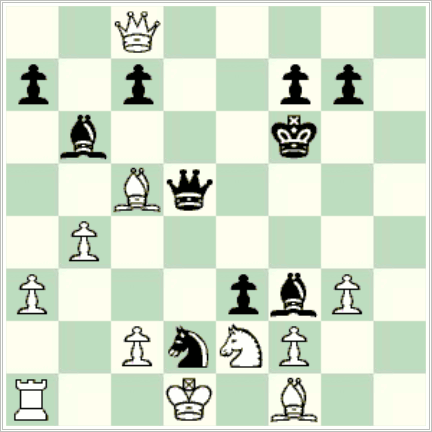
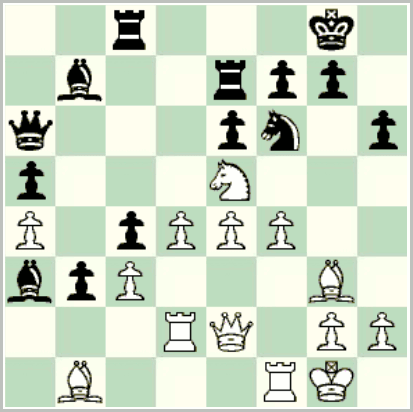
1. e4 e6 2. d4 d5 3. Nc3 Bb4 4. Ne2 Nc6 5. a3 Ba5 6. b4 Bb6 7. Bb2 Nh6 8. g3 Qf6 9. Qd3 Ng4 10. Nd1 dxe4 11. Qxe4 e5 12. h3 Bf5 13. Qg2 exd4 14. hxg4 Bxg4 15. Qe4+ Kf8 16. Rxh7 Rxh7 17. Qxh7 Ne5 18. Ne3 Nf3+ 19. Kd1 Qg5 20. Qh8+ Ke7 21. Qxa8 dxe3 22. Qxb7 Nd2 23. Bd4 Bf3 24. Bc5+ Kf6 25. Qc8 Qd5 (diagram)

26. Kc1 Bxc5 27. bxc5 Nxf1 28. Nc3 Qd4 29. Qa6+ c6 30. Kb2 Nd2 31. fxe3 Nc4+ 32. Kb3 Qxe3 33. Rd1 Bxd1 34. Qxc6+ Kg5 35. Kxc4 Bxc2 36. Qd5+ f5 37. c6 Qb6 38. Qd2+ Kg4 39. Qxc2 Qxc6+ 40. Kb3 Qe6+ 41. Kb2 Kxg3 42. Qd3+ Kh2 43. Qd2+ Kh3 44. Qd3+ Kg2 45. Qd2+ Kh3 46. Qd3+ Kg2 47. Nd5 Qe5+ 48. Ka2 Qe4 49. Qd2+ Kf3 50. Nc3 Qe6+ 51. Ka1 f4 52. Qd3+ Kg4 53. Ne4 Qe5+ 54. Ka2 f3 55. Nf2+ Kg3 56. Ne4+ Kf4 57. Nd2 Qe2 58. Qd4+ Kg3 59. Qxg7+ Kf2 60. Qb2 Kg2 61. Nxf3 Qxb2+ 62. Kxb2 Kxf3 63. Kc3
½ – ½

[Click to replay.]

Posted in Games | Leave a comment

Tomson solution

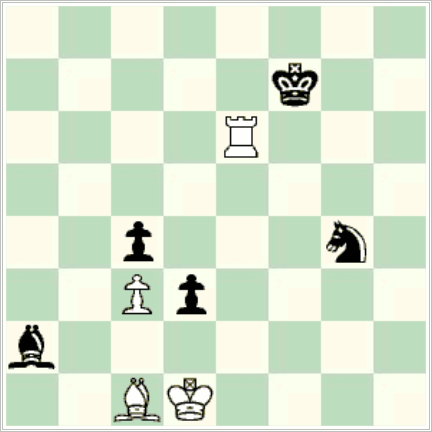
The solution to the Tomson problem in the last post is here. (I’ll omit a diagram here to allow later readers a chance to try the problem for themselves.)

The knight manoeuvres allow the bishop to move into place by shielding the white king from check twice. And the order of moves is unique: this is not a requirement for a series problem but is much more artistic than having multiple solutions.

Posted in Players, Problemists | Leave a comment

J.B. Tomson, series helpmate in 13

Brian Tomson’s career as a player and (especially) a problemist was extensively discussed here last year (Brian Tomson 1942-1986; see also his biographical summary). Born in Belfast, he finished =4th in the 1965 Irish championship and played for Ireland in the Student Olympiad in Harrachov, 1967, before emigrating to Australia in 1968. Although he continued to be active in over-the-board play, his primary interest was in problem composition and it’s as a problemist that he was best known. Sadly he died at a very early age, two days before his 44th birthday.

He was born on 22nd June 1942, and so today would have been his 70th birthday. To mark the occasion here is another of his problems:

J. B. Tomson, series helpmate in 13J.B. Tomson, Problem Observer 1980
Series helpmate in 13

This is another series helpmate, a popular genre in the problem world. The idea is that White and Black are working together to help White mate Black (hence ‘helpmate’), and the problem begins with a series of 13 Black moves, the White pieces remaining fixed (hence ‘series’). All 13 moves must be legal Black moves, and all except the last must leave a position where it would be legal for Black to move next, so there can be no checks in the first 12 moves. At the end of this series of 13 Black moves, White plays one move to deliver mate.

I’d classify this problem as being of medium difficulty: I wasn’t able to solve it but kicked myself when I saw the solution. Some common advice for solving these problems is to try to see what the mating position is, and then often or even usually it’s relatively straightforward to work out how to get there. It’s an elegant solution and well worth trying for yourself, so I’ll hold back the solution for now and post it in a few days.

Posted in Players, Problemists | 1 Comment

Znosko-Borovsky’s visit to Ireland

Seán made reference in the May 2012 update to Znosko-Borovsky’s simultaneous displays in Armagh and Limerick in December 1926. There is a game dated 1927 between Znosko-Borovsky and O’Hanlon listed in the Games section of the ICU website. It is highly probable that the year given is wrong and that the game was in fact played in the same time period as the Armagh and Limerick exhibitions. The evidence for this is tbat the exact same game was published in the Belfast News Letter chess column for 3rd February 1927, with the following preamble:

“The following very interesting game was played between the Irish champion and E. Znosko-Borovsky during the latter’s recent visit to Ireland. It was a strenuous contest lasting six hours, and 26 moves were played before even a pawn was captured. The finish was carried through in good style. One other game was played, and this the Russian master won in about 30 moves.”

Moreover the timing of the game is of rather larger significance. The 1926 Irish Championship in Belfast (won by O’Hanlon) commenced 6th December. Looking at the timing of the Armagh and Limerick exhibitions the most likely time for the two O’Hanlon – Znosko-Borovsky games is 4th and/or 5th December 1926, immediately before the Irish Championship. Not a bad way to prepare for a championship! O’Hanlon owned a hotel in Portadown at that time, so Znosko-Borovsky probably stayed with him during his time spent in the North.

O’Hanlon, John J – Znosko-Borovsky, Eugene
Ireland (probably Portadown) December 1926

O'Hanlon - Znosko-Borovsky after Black's 26th

Diagram 1

1.e4 e5 2.Nf3 Nc6 3.Bb5 a6 4.Ba4 Nf6 5.0-0 b5 6.Bb3 d6 7.c3 Be7 8.Re1 Na5 9.Bc2 c5 10.h3 0-0 11.d4 Nc6 12.Be3 Qc7 13.Nbd2 Bb7 14.d5 Nd8 15.Nf1 Ne8 16.g4 g6 17.Ng3 Ng7 18.Qd2 f6 19.Rad1 Nf7 20.Kg2 Rad8 21.h4 Bc8 22.Nh2 Qd7 23.Rh1 h5 24.f3 Kh8 25.Rdg1 Rg8 26.Kf2 hxg4 (Diagram 1) The first capture and a mistake. Having over the last four moves placed his Rooks on the g- and h-files and tucked his King away on f2, thematic and good for White was 27.h5! One possibility now would be 27…Nxh5  28.Nxh5 gxh5 29.Nxg4 Rg7 30.Rxh5+ Rh7 31.Rxh7+ Kxh7 32.Ke1!  and the threat of 33.Qh2 is decisive.
27.Nxg4 Nh5 28.Nh6 Nxh6 29.Bxh6 Qa7 30.Be3 Rdf8 31.Ke1 Bd8 32.b4 Bb6 33.bxc5 dxc5 34.Nxh5 gxh5 35.Rxg8+ Rxg8 36.Qf2 Ba5 37.Bxc5 Bxc3+ 38.Kd1 Qg7 39.Qe3 Ba5 40.Bb3 Qg6 41.Be7 Rg7 42.d6 Kh7 43.Qf2 f5 44.Bf8 Rd7
A mistake, allowing a decisive infiltration by the White Rook. The Belfast News Letter noted that O’Hanlon had expected 44…Qg2. Unfortunately the rest of its note on the move is unclear but the general thrust was that White would still have been better after the Queen move.

O'Hanlon- Znosko-Borovsky after White's 44th

Diagram 2

Perhaps that is a little optimistic but one plausible variation (though admittedly not forced) is (see Diagram 2) 44…Qg2 45.Rh2 Qxf2 46.Rxf2 Rg1+ 47.Ke2 Be1 48.Rf1 Rxf1 49.Kxf1 Bxh4 50.Be7 Bxe7 (50…Bg3 51.exf5 and if 51…Bxf5 allows a pretty finish with 52.Bc2!) 51.dxe7 Bd7 52.Bf7.
45.Rg1 Qf6 46.Rg5 Rxd6+
46…Qxf8 loses to 47.Rxh5 when Black must give up his Queen to prevent mate.
47.Bxd6 Qxd6+ 48.Bd5 Bd8 49.Qd2 Qf6 50.Rxh5+ Kg7 51.Rg5+ Kf8 52.Qb4+ Ke8 53.Qc5 Kd7 54.Rxf5 Bb6 55.Qxc8+ 1-0

[Click to replay.]

Posted in Games, Players | 1 Comment

Monthly update, May

It has been quiet here lately because I’ve been spending my chess time budget on two new features:

Search Posts and Search Games: The inbuilt WordPress search feature is very limited, searching only posts and not pages. Since all the tournament reports and playable games are on ‘pages’ (fixed background content) this meant that none of this information was searchable.

Until now, that is: now there are Search Pages and Search Games functions in the right column, and the same ‘Search Games’ feature is on the Games page. Access is by entering search terms directly rather than via a form where you could search separately by White name, or ECO code, or Event, say, but I think it should be fine this way.

Currently 2,719 games are indexed, including all the TWIC games, most but not all tournament report games, and some extra e2e4 games (see below). The tournament reports need to be re-run to add the required indexing lines and this isn’t quite complete yet. The 2,719 total above includes playable games, games with results but no moves, and walkovers & byes.

Extra e2e4 games: Last October’s e2e4 Gatwick International had a significant Irish contingent. The games would normally have shown up promptly in TWIC, but in this case they were held back to help the chances of several young competitors who were heading off to Brazil for the World Youth Championships. (See David McAlister’s comment here, pointing to a discussion on the English Chess Forum.)

But with TWIC, it seems that only this week’s tournaments are covered, so once a tournament’s natural place has been missed, it never reappears. Whether or not that’s true in general, these games never appeared in later TWICs. However they did eventually appear on e2e4’s website, and are now included here. (Search for “Gatwick 2011.10” in the Search Games feature: 60 games, including 3 byes and 9 games from the Major.)

TWIC also seems to exclude sections other than the top one, i.e., the various Challengers, Majors, etc., but again these are usually available on e2e4’s site. A partial selection has been included here, with games from the Sunningdale Major (May 2011), Sunningdale Challengers G (August 2011), and the Brighton Major International B (February 2012), in addition to the Gatwick International Major above: total 85 extra e2e4 games.

Elaine Pritchard: Elaine Pritchard, who played in Castlebar 1969, along with her husband David, died earlier this year, on her 86th birthday. BCM had an on-line obituary. The Castlebar 1969 pages have been updated accordingly.

More simuls: Early December 1926: is there any epoch that is a less likely candidate for chess activity in Ireland, outside of Dublin or Belfast? But it turns out there were some significant events: E.A. Znosko-Borovsky gave three simuls in Armagh and Limerick, as part of an extensive tour in which he gave many simuls in England:

1926.12.03, Armagh (Armagh C.C.). +20 =0 -2.
1926.12.07, (Consultation), Limerick (Limerick C.C.). +3 =0 -0.
1926.12.08, Limerick (Limerick C.C.). +14 =1 -0.

Posted in Administrative | 1 Comment

First Branagan Cup

This year’s Branagan Cup approaches its conclusion, with Elm Mount surprisingly winning easily against a much higher-rated Rathmines team in the first semi-final (so no double for Rathmines this year).

The new mixed league/knockout system this year seems to have generated a slightly higher entry than in the past few years. But nothing like the first Branagan Cup back in 1973! Here is the draw from the first ever Branagan Cup round (source: Irish Times, 14th February 1973):

U.C.D. “B” v. Rathmines “A”
Phibsboro “A” v. Rathmines “B”
Four Knights v. Consultants “B”
Dublin “A” v. Rathmines “F”
U.C.D. “D” v. Portmarnock “A”
E.S.B. v. U.C.D. “C”
Naas v. Rathmines “E”
Arklow “X” v. Irish Life “B”
Phibsboro “C” v. Phibsboro “B”
Irish Life “A” v. Phibsboro “D”
Dublin “B” v. Dublin “C”
U.C.D. “A” v. Rathmines “C”
Portmarnock “B” v. Kevin Barry
Phibsboro “D” v. Sandymount
Arklow “Y” a bye.

First-named teams were at home and the matches had to be completed by March 10th.

That’s 29 teams of 6 players each: quite a turnout.

Records are scarce thereafter, and all I can find is a report from February 26th 1974 reporting that the “long-deferred” semi-final of the Branagan Cup between U.C.D. and Kevin Barry had resulted in a 4-2 win for U.C.D., who would go on to face Phibsboro in the final. Could these fixtures have been part of the event that started in February 1973? I don’t see how a semi-final in February would have been “long-deferred” otherwise.

Posted in Club chess | 2 Comments

MTK Budapest-Dundrum, European Club Cup 1985

My earlier post promised more information on this match, including two games that are not in the databases, so here they are:

Varnusz-Drakeford after Black's 25th

Egon Varnusz — David Drakeford
MTK Budapest-Dundrum, European Club Cup (1.4), Budapest, September 1985

26. Bh4 Rec7 27. Bxf6 gxf6 28. Ng4 Kg7 29. f5 Be7 30. e5 exf5 31. Rxf5 fxe5 32. Qxe5+ f6 33. Qf4 Qe6 34. Qxh6+ Kf7 35. Rdf2 Qe1+ 36. Rf1 Qxc3 37. Rxf6+ Bxf6 38. Qxf6+ Ke8 39. Bg6+ 1-0.

[Click to replay.]

Lengyel-McHugh after Black's 16th

Levente Lengyel — Kevin McHugh
MTK Budapest-Dundrum, European Club Cup (2.3), Budapest, September 1985

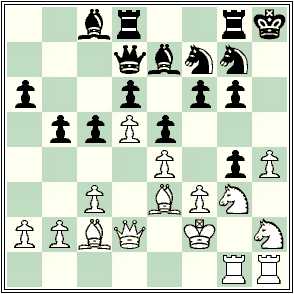
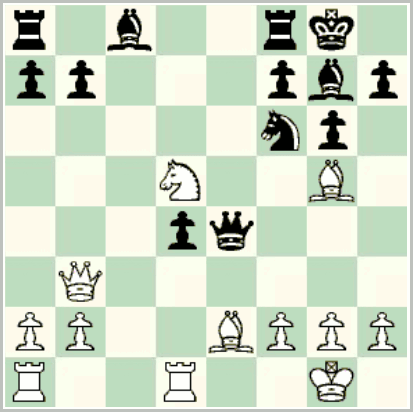
1. Nf3 Nf6 2. c4 g6 3. Nc3 Bg7 4. d4 d5 5. e3 O-O 6. Qb3 dxc4 7. Bxc4 Nc6 8. Be2 Qd6 9. O-O e5 10. d5 Ne7 11. e4 c6 12. dxc6 Nxc6 13. Rd1 Qe7 14. Bg5 Nd4 15. Nxd4 exd4 16. Nd5 Qxe4 (diagram)

17. Nxf6+? Bxf6 18. Bxf6 Qxe2 19. Bxd4 b5 20. Re1 Qc4 21. Qf3 Bf5 22. Qe3 a5 23. b3 Qd5 24. Bb2 f6 25. Rad1 Qc6 26. Rc1 Qb7 27. h3 Rad8 28. Qf4 Rf7 29. Rcd1 Qb6 30. g4 Bc8 31. Rxd8+ Qxd8 32. g5 fxg5?? 33. Qe5 1-0.

[Click to replay.]

Kevin McHugh’s attempt at an early simplification had a flaw, though GM Lengyel overlooked it. In the diagrammed position, the computer finds 17. Bxf6! Qxe2 18. Qb4! winning, since White threatens 19. Ne7+ Kh8 20. Nxg6+ as well as 19. Qxd4. After the game’s 17. Nxf6+?, Black still has an uncomfortable position because of the weakness of the long diagonal, but was weathering the pressure reasonably well until the disastrous 32. … fxg5??. After 32. … Bxh3 instead, it’s still all to play for.

My earlier post expressed doubts about the accuracy of the scores given by Sakkélet, but John Griffin has written in and comments that these were indeed correct.

The earlier post mentioned that only one of the games from the match, Portisch-Curtin, was given on OlimpBase. I received a message from Wojciech Bartelski the following day, requesting the game scores. Impressive! Here is the pgn file.

And here is the original article in Sakkélet. No reports, unfortunately, in Fiacla Fichille or in any of the Irish papers, at least not that I could find.

Posted in Club chess | Leave a comment