This article, co-authored with David McAlister, appeared in the Irish Chess Journal, August 2011, pp. 14-16. (Adapted in very minor ways for this post.) ICJ issues are available on the ICU web site, with the current issue restricted to ICU members and back issues available for all.
From a player profile in a 1971 Australian magazine:
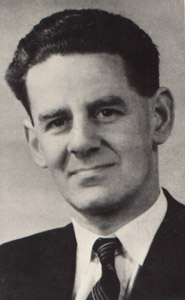
“Brian Tomson is a lecturer in English at the University of Newcastle. Before coming to Australia he had gained fourth place in the Irish National Title, played for Oxford University and represented Ireland in an international universities tournament played in Europe against top class competition including the crack Russians. He modestly stresses the fact that the Irish team finished in last place on this occasion.”
These matters are all relative and your mileage may vary, but I’ll admit that these achievements sounded quite respectable to me (SC). But the name was entirely unfamiliar. No such name appeared in the ICU web site’s tables for Irish championships in the 1960’s: the closest was a “J. Thomas” who was listed as finishing 4th-6th in the 1965 championship—and that didn’t seem all that close. OlimpBase listed a “J. Tomson” as playing board 3 for Ireland in the 1967 Student Olympiad at Harrachov (then Czechoslovakia), and the same name appeared in the lists for the 1966 Irish championship. The final piece of the puzzle came from an article from the Ulster Chess Union Yearbook, in which Arthur Pinkerton recalled drawing with “J. B. Tomson” in the 1966 championship, and the mystery player stood revealed as J. Brian Tomson.
(The ICU report on the 1965 championship has been corrected accordingly.)
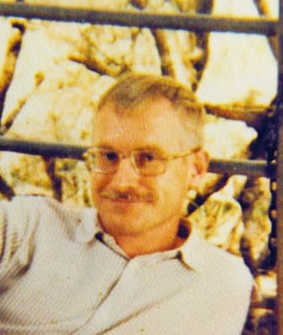
 A University of Newcastle web site had much further information, including collected correspondence and the information that he was a problemist, and had edited the problem column for Chess in Australia from 1984 to his death.
He had even published a book, Fifty Chess Problems, privately printed, and only 7 copies.
The story to this point was sent to David McAlister, who found more information:
Tomson had one of his best results at the inaugural Australian Open in Adelaide 1971 (Karlis Lidums International). This strong tournament resulted in a win for Portisch (11/13), followed by 2nd-4th. Schmid, Gheorghiu, Browne (10), 5th. Matanović 9½, six players sharing 6th-11th on 9 points, and Tomson in a group sharing 12th-24th places on 8½ (15th on tie break). 155 played.
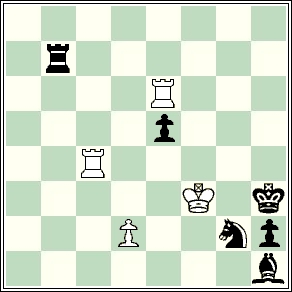
His ending against Matanović made the endings section in Informator 11:
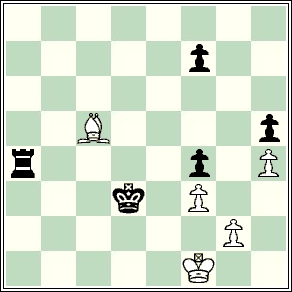 Matanović-Tomson, Adelaide 1971
The solution, as given by Matanović, was 1. Bb6!= Ra1+ 2. Kf2 Rh1 3. Bc7! [3. … Rxh4? 4. Kg1!] ½ : ½. [Click to replay.]
There’s a minor puzzle here. According to Ozbase, the diagrammed position never actually arose in the game: the nearest was after 69. … f4, when White’s bishop stood on d8. And the draw was agreed on move 88, not a few moves later as Matanović indicates. Apparently these endgame features in Informator are touched up from time to time; who knew?
The game against Portisch in the penultimate round was a missed opportunity:
Tomson, J.B. – Portisch, L., Adelaide 1971 (12) [A67]
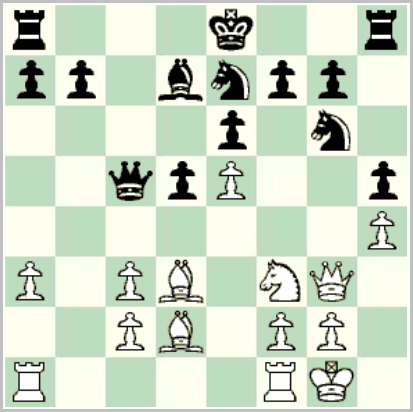
1. d4 Nf6 2. c4 c5 3. d5 e6 4. Nc3 exd5 5. cxd5 d6 6. e4 g6 7. f4 Bg7 8. Bb5+ Nfd7 9. Bd3 Qh4+ 10. Kf1 Na6 11. Nf3 Qd8 12. Kf2 Qb6 13. Kg3 Nb4 14. h3 Nxd3 15. Qxd3 Qa6 16. Qxa6 bxa6 17. e5 O-O 18. exd6 Rb8 19. Re1 Rb6 20. Nd2 Nf6 (diagram)
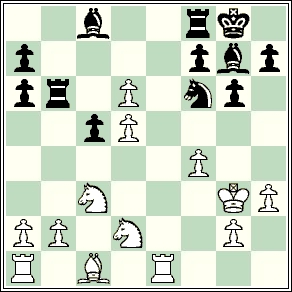 Something has gone badly wrong for Portisch and now with the straightforward 21. Nc4 Rb4 22. Na5 or 22. Ne5 White stands much better. Unfortunately Tomson takes the time for a preparatory move, apparently based on a miscalculation.
21. a3?! Nh5+ 22. Kf3 Rxd6 23. Nde4 Bxc3 24. bxc3?!
24. Nxc3 still leaves White a little better.
24. … Rxd5 25. g4?
The final error. After 25. Be3 White is still in the game, though any advantage is long gone.
25. … f5!
Was this what Tomson missed earlier? Now White is in serious trouble. Portisch converted without further incident.
26. Nf2 fxg4+ 27. hxg4 Nxf4 28. Bxf4 g5 29. Re4 Bb7 30. Ke2 gxf4 31. Re7 Rf7 32. Rxf7 Kxf7 0-1. [Click to replay.]
The UCU Archive has the list sent by Albert Long to W. Lewis of the ICU putting forward the list of players the UCU wanted to enter in the 1965 Irish Championship. Amongst the six put forward was
“J.B. Tomson, 37 Old Cavehill Rd. Belfast 15. All-Ireland Schools Champion 1959. Played No. 1 and 2 boards in T.C.D. club 1960/2. Won Belfast Feis Major, 1965.”
He attended Belfast Royal Academy and played in the 1959 Glorney Cup, at board 2.
He reached the final of the 1967-68 Williamson Shield, beating Michael Roberts (a team-mate in the Harrachov Student Olympiad) in the semi-final. The other semi-final was between Paul Henry and John Moles, but before it could be played, Tomson emigrated to Australia, on 28th March 1968. The other fixture became the final instead, Henry winning 1½-½. (Source: Albert Long notebook.)
In the Student Olympiad in Harrachov 1967, Ireland first faced the Soviet Union (Tukmakov, Kuzmin, Gulko, Faibisovich), and lost 4-0, Tomson losing to Gulko. The Student Olympiads were generally very strong events, with far fewer weaker teams than Olympiads, and in Harrachov the Irish team found the going tough all along. Tomson’s score of 2½/9 on boards 2 and 3 was one of the relative bright spots, eclipsed only by John Gibson, the reserve player, with 3/8, the other scores being Gerry McCurdy ½/11 on board 1, NickNoel Kerins 1/8 on board 2, and Michael Roberts ½/8 on boards 3 and 4. Tomson’s score could have been better if he had not managed to lose from an overwhelmingly won game as black against László Perecz (Hungary). But these things even themselves out, and in a later round he enjoyed good fortune in a spectacular win on board 2 against the Netherlands:
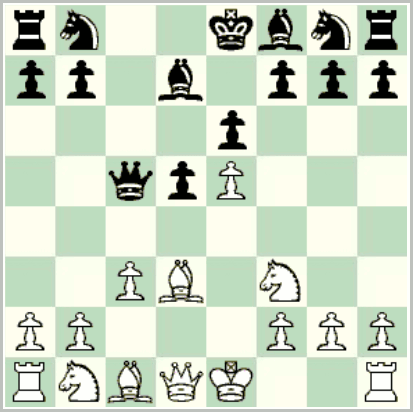
Kort, Jacob – Tomson, J.B., Student Olympiad, Harrachov 1967, Final-B (6) (Netherlands-Ireland, board 2) [E25]
1. d4 Nf6 2. c4 e6 3. Nc3 Bb4 4. f3 d5 5. a3 Bxc3+ 6. bxc3 c5 7. cxd5 Nxd5 8. dxc5 Qa5 9. e4 Qxc3+?!
Better 9. … Ne7.
10. Bd2 Qe5 11. Ne2 Nf6?
Now 11. … Ne7, covering c8, was essential. Tomson’s move allows 12. Bc3, after which 12. … Qxc5? fails to 13. Rc1. So 12. … Qc7, and then after 13. Qd6 White stands clearly better.
12. Bf4? Qxc5 13. Bd6 Qa5+ 14. Kf2 Qb6+ 15. Kg3?? (diagram)
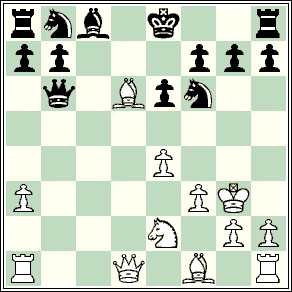 A severe case of over-optimism. At this point the computer starts straining at the leash, urging 15. … Nxe4+ with great and increasing insistence. After 16. fxe4 Qe3+ 17. Kh4 g5+ 18. Kh5 Qxe4 White can only avoid mate by giving up large amounts of material, with an easily won game for Black. Tomson misses the chance, perhaps thinking the text came to the same thing …
15. … Qe3? 16. Qd4 Nh5+ 17. Kh4 Qh6 18. g4??
… and as it happens he’s right. But White could have escaped with 18. Qc5 Nc6 (nothing more direct seems available) 19. Qg5. He may have wanted to avoid playing the pawn-down ending, but instead allows a mate in three.
18. … g5+ 19. Kh3 Nf4+ 0-1. [Click to replay.]
The ICU archive has 4 of his games, listed under “J. Tomson”, all from Harrachov 1967 and not including the game above. From Ozbase and BigBase we have 16 more, and we also have one game, a win against Eddie Whiteside, in an Ulster championship qualifier in 1968.
On the problemist side, 29 of his problems appear in the Chess Problem Database. And (amazingly) we even have his book Fifty Chess Problems, which is available on Google Docs (see references).
Fifty Chess Problems gives Tomson’s frank assessments of his own problems—and problemists are very self-critical—but he nominates this one as his best problem not to feature in an award, with a key that impressed solvers:
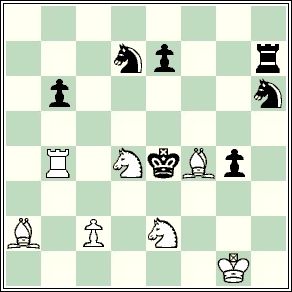 J.B. Tomson
The Problemist, March 1981
White to play and mate in 3.
[See solution.]
Many of his later compositions were ‘series’ problems. Anyone who has tried John Nunn’s Christmas Puzzles at ChessBase.com will be familiar with this genre, which is popular in the problem world.
 J.B.Tomson
BCM, December 1982
Series helpmate in 28
For those to whom this is new, the idea is that White and Black are working together to help White mate Black (hence ‘helpmate’), and the puzzle starts with Black playing a series of 28 consecutive moves, while White’s pieces remain fixed (hence ‘series’). All 28 must be legal moves, and all but the last must leave a position that would be legal for Black to move next, so there can be no check in the first 27 moves. After this series of 28 Black moves, White plays one move to checkmate Black. [See solution.]
The book was published in December 1983. In the foreword he says “some day I may produce another work with 50 problems, strictly selected and better worth looking at”. It was not to be: Brian Tomson died two days before his 44th birthday, on 20th June 1986, 25 years ago this summer.
Tomson, Brian
[J. Brian Tomson]
* 22-06-1942 Belfast
† 20-06-1986 Newcastle, AUS
r. Australia (28-03-1968-†)
Irish championship b.r. 4th-6th 1965
Student Olympiad 1967
Glorney Cup 1959
Belfast Feis Major, 1st 1965
Nemtzov Cup (while Belfast C.C. c’ship), 1st 1968
Williamson Shield finalist 1968
Country Chess Championship of NSW, 1st 1971, 1973, 1982
All-Ireland Schools’ champion 1959
Columnist, Newcastle Morning Herald
Problem corner ed., Chess in Australia, 1984-†
Author, Fifty Chess Problems
C.C.: T.C.D. (1960-1962),
Belfast (-1968),
Newcastle AUS (-1971-)
University of Newcastle Cultural Collections, https://uoncc.wordpress.com/category/chess/;
Ozbase, http://www.ozbase.com.au/;
OzProblems: Australian Chess Problem Composition, http://www.ozproblems.com/archives/problemists-history
(includes link to Fifty Chess Problems)
OlimpBase, https://www.olimpbase.org/1967y/1967in.html;
Irish chess history: Irish championships, https://irishchesshistory.wordpress.com/official/irish-championship/;
Ulster Chess Competition Records,
ICU tournament records, https://icu.ie/tournaments/77
Update, March 23, 2022: Fifth Chess Problems is also available here.