Irish championship 2009

The 2009 Irish championship, described by Peter Cafolla as one of the most enjoyable for years, had a larger-than-usual field of 29 players, featuring all the perennial contenders and in addition IM Mark Quinn, playing for the first time since 1998, and four-time champion John Delaney, playing for the first time since 1991. The highest-rated player was IM Valeri Atlas from Austria (the tournament was open to non-Irish players but they were not eligible for the title of Irish champion).

Colm Daly ended up champion, a clear point ahead of Atlas and Quinn on 7½/9, for his fourth national title, the others being 1998, 1999, and 2005.

A report is now up on the Tournaments page, with 91 of the 123 games. The chess was excellent and entertaining, and it was difficult to trim the selection of interesting games down to a manageable collection. As it is, 20 games are on the shortlist.

[12 November 2011, later: after uploading the first version I played through Cafolla-O’Leary from round 6, a very interesting game that Peter Cafolla annotated on the ICU web site. But the finish of the game as shown in the first version didn’t match, and didn’t seem to make sense. I tracked the problem down to the ICU web site itself, which has two versions of this game, one with notes (number 29422) and one without (number 29493). I had taken the one without notes, as this is easier for the processing routines. But the versions don’t match! Now corrected.]

Posted in Irish championships, Tournaments | Leave a comment

TWIC 887

This week’s issue of TWIC contains just three Irish games. It did not contain any games from last week’s e2e4 Gatwick International; the FIDE tournament reports don’t give the games either, and they’ve even disappeared from the organiser’s web site. I’m still hoping they’ll reappear: sometimes it’s a matter of the last-round games not being quite finished.

In any case this week’s games, now up on the Games page, include one by Sarah Hegarty and two by Joe Ryan. Of these the most interesting is Ryan-Cruz. There was a discussion a while back on the LCU Blog on the merits or otherwise of 1. b3. Based on much personal experience I think this is correctly written 1. b3?, and this game, in which Joe Ryan tries it against a 2400+ opponent, is a searing example.

Posted in Games | 2 Comments

Lilienthal in Dublin

Andor Lilienthal died last year at the age of 99. At the time Chessbase published this fine tribute to him. Featured in that article is Lilienthal’s famous queen sacrifice victory over Capablanca, played at Hastings on the 1st January 1935. Coincidentally earlier the same day the Irish Independent had reported that:

“The Irish Chess Union, through their representatives at the Hastings Tournament, have engaged the services of the world-famous young Hungarian master, A. Lilienthal, to give exhibitions in Dublin next week.”

On the evening of the 7th January Lilienthal paid an informal visit to the Dublin Chess Club where he engaged in lightning, blindfold, simultaneous and consultation play. However the major public exhibition was held the following night at Regent House, Trinity College where he encountered 45 players simultaneously. At the end of the evening Lilienthal had won 28, drawn 10 and lost 7. The first player to beat the simul-giver on the night was the Cork player Barry St John Galvin, one of Munster’s best players.

Lilienthal, Andor – Galvin, Barry St John
Simultaneous display, Dublin 1935 [D90]
[Source: Irish Independent, 9th January 1935]

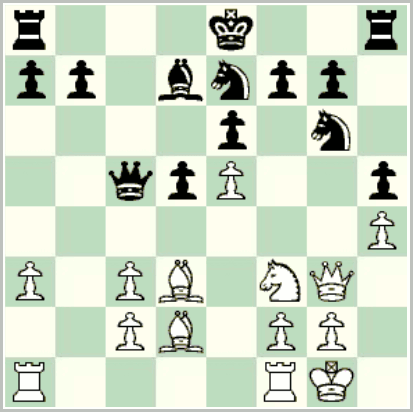
Lilienthal-Galvin after White's 13thGalvin made an enterprising piece sacrifice on his 13th move and Lilienthal soon went spectacularly wrong. Lilienthal could have safely resigned when queens were forced off on the 21st move, but perhaps he wanted to get a few wins of his own first. He later praised his opponent’s forcing tactics.

1.d4 Nf6 2.c4 g6 3.Nc3 d5 4.Nf3 Bg7 5.e3 0-0 6.cxd5 Nxd5 7.Qb3 Nxc3 8.bxc3 c5 9.Bc4 h6 10.Ba3 Nc6 11.Be2 cxd4 12.cxd4 Qa5+ 13.Nd2 (diagram) 13…Bxd4 14.exd4 Nxd4 15.Qc4 Nxe2 16.Bb4 Qe5 17.Kd1 Qxa1+ 18.Kxe2 Qxh1 19.Qh4 Qxg2 20.Bxe7 Qg4+ 21.Qxg4 Bxg4+ 22.Kd3 Rfe8 23.Bc5 Rac8 24.Be3 Red8+ 25.Ke4 g5 26.h4 f5+ 27.Ke5 f4 28.Bd4 Rxd4 29.Kxd4 Rd8+ 30.Kc3 Rxd2 31.Kxd2 gxh4 0-1 [Click to replay]

Posted in Simuls | 1 Comment

Eugene O’Hare

Eugene O'HareEugene O’Hare of Derry was Ulster champion six times and played in three Olympiads, all in the 1960’s, but he was still an active player long after that, winning a City of Derry Championship in 2004 at the ripe old age of 86. (I played in the same event as him at least once, in the 1979 Irish championship–and we finished in the same half of the field–but can’t recall whether I ever played him.)

His memoirs, Roast Beef on Sunday, were published in 2008 and are a really excellent read, highly recommended. (I found the entire book on the web, but am not sure if this is an authorised copy. To be on the safe side I will omit a link; in any case you should be able to find it easily with any search engine.) He was a pharmacist by trade, and was also a councillor in Derry, serving on Londonderry Corporation from 1964 until its abolition in 1969, and his account of these turbulent times is well worth reading. (These memoirs deserve to be much better known.)

Though there are no actual games, there is also much discussion of chess. Here is one excerpt, set after the 1962 Varna Olympiad, which the team (John B. Reid, Ray Cassidy, P. J. Murphy, Des De Loughrey, and O’Hare) had reached by car:

We left the Olympiad without waiting for the final banquet and started out at 10pm to drive through the night. We crossed the border early afternoon the following day and reached Belgrade around tea time. European games were being held there and accommodation was extremely hard to find. We drove away from the town centre and stopped in a tree-lined square in the suburbs. Here we formed three parties to search for somewhere to stay. I went with Cassidy, Reid with De Loughrey, and Murphy went on his own. I drew blank, Reid drew blank, but Murphy came back waving his arms.

“I’ve got us digs,” he shouted, “round this way.”

We followed him and around the corner stood a lovely fair haired girl of about twenty five, smartly dressed but not obviously a hotel clerk. Poor innocent family man P. J. Murphy from Dublin was not a man of the world. The girl’s face was a study, P. J., by sign language, had indicated five. She took a rather different meaning of the figure, and her look as she surveyed the five of us could not be described. We burst out laughing and she caught on and joined in. The only one bewildered was Murphy. In halting German and English I did my best to explain. She nodded and in a few minutes had got us bed and breakfast nearby.

A biography has been added on the Players section.

Posted in Players | 1 Comment

The Week in (Irish) Chess

Essentially all readers are familiar with The Week in Chess. (For those who are not: it’s a weekly report on tournaments worldwide in the previous week, usually with several thousand games; one of the Seven Wonders of the Modern Chess World and indispensable for the tournament player.) But (I will guess) most are not familiar with a small format change that occurred about a year ago, starting with TWIC 829: for the first time, all games included the FIDE IDs of each player.

With this change, it is much easier to filter for games by Irish players, since FIDE rating lists with FIDE ID and nationality are available on-line. You might think that it should be easy to compare player names to FIDE or ICU (or UCU) lists. Not so! In practice the same name is often given in several different forms in different lists, and even from year to year in the same list, so the same player will appear as Joe Ryan (FM), J. Ryan, Jo. Ryan, Joseph Ryan, or Joseph D. Ryan, say. In some cases two (or more) players have the same name: the “A. Smith” problem. And so on. All quite messy, and all solved by adding FIDE IDs.

On the (new) Games page, I’ve added the results of filtering all TWICs that include these IDs, i.e., issue numbers 829 to 884, 27th September 2010 to this week. Any game in which either player is Irish is included, and also any game played in Ireland is included: the tournaments covered were Bunratty, Kilkenny, the Irish championship, and the City of Dublin IM. 835 games in all, with 67 Irish players featured. The players, with number of games for each, are:

Allen, Keith: 6
Astaneh Lopez, Alex: 20
Baburin, Alexander: 13
Benson, Nicola: 9
Benson, Oisín P.: 8
Brady, Stephen: 18
Breen, Anthony: 65
Byrne, Ray: 6
Cafolla, Peter: 27
Cassidy, John: 4
Collins, Sam: 74
Courtney, John: 14
Crichton, Martin: 9
Daly, Colm: 27
Daly, Patrick: 2
Delaney, John: 9
Doyle, Hugh: 15
Duffy, Séamus: 6
Egan, Colm: 2
Fitzsimons, David: 26
Fox, Anthony: 29
Freeman, Gordon: 26
Griffiths, Ryan-Rhys: 43
Hayes, Peter J.: 5
Healy, Tom: 4
Hearne, Sarah-Jane: 9
Hegarty, Sarah N.: 76
Heidenfeld, Mark: 15
Keogh, Eamon: 9
King, Melvyn: 9
Larter, Nick J.: 6
Loughran, John: 9
Lynch, Peter J.: 2
Magee, Rónán: 17
McCabe, Darren: 8
McGovern, Mark E.: 4
McMahon, Daire: 9
McMaster, Richard: 6
McMorrow, John: 5
Meskens, Stephan: 6
Mirza, Diana: 9
Mirza, Gabriel: 3
Moran, Stephen: 9
Moynihan, Kieran: 6
Murray, David: 16
Murray, Jim G.: 2
Nicholson, John: 6
O’Connell, Gerard: 9
O’Connor, Jonathan: 12
O’Driscoll, Kieran: 10
O’Leary, Matt: 11
O’Rourke, Ray: 9
Orr, Mark J. L.: 1
Osborne, Sam: 5
Porter, Liam: 6
Quinn, Mark: 1
Quinn, Rory: 14
Redmond, John P.: 16
Reynolds, Pat: 9
Ryan, Joe: 28
Shaughnessy, Elizabeth: 8
Short, Philip: 15
Smith, Andrew Philip: 8
Twomey, Pat: 8
Wall, Gavin: 21
Wallace, Paul: 18
Welsh, Michael: 9

Of course there’s some overlap with the ICU games archive, but I count 264 games there in the same time period so most of the games here are not on the ICU site.

All in pgn format for the moment; at some point the games will be run through the same processor as is used for the tournament reports. Also we’ll be updating the list week by week.

Posted in Games | 1 Comment

Irish championship 2006

Participation in recent Irish championships has ebbed and flowed. In 2007 participation hit an all-time high of 52 players; for 2006, on the other hand, the participation was very much at low ebb, with only 12 taking part.

Still, on the positive side it was a stronger-than-average championship—certainly as measured by average rating—with all the regular contenders present, and in addition a strong challenge from Stephen Jessel, who however fell just short, losing out by ½ point to Stephen Brady. The chess was also interesting, particularly the Short-Daly game from round 2. This must have been annotated somewhere, surely? I don’t have access to the ICJ issue with the report on this tournament.

Anyway, a report has been added to the Tournaments page. 14/52 games, and missing the ICJ report.

Posted in Irish championships, Tournaments | Leave a comment

Club championships

Very little detailed information exists on club championships down the years: most of these have been fairly informal tournaments with results not reported anywhere. But there are exceptions: Phibsboro C.C.’s 2010 championship was FIDE-rated, which I think (open to correction here) is the first time ever for an Irish club championship. It was a 7-player all-play-all, and a relatively strong event (1st Francisco Canosa Sierra, ahead of Stephen Brady), well worth covering.

Being FIDE-rated meant that most of the data required to reconstruct the tournament is available from the FIDE tournament report, and Mick Germaine, who controlled the tournament, provided the extra missing information (on walkovers). The report has been added to the Tournaments page.

Posted in Tournaments | Leave a comment

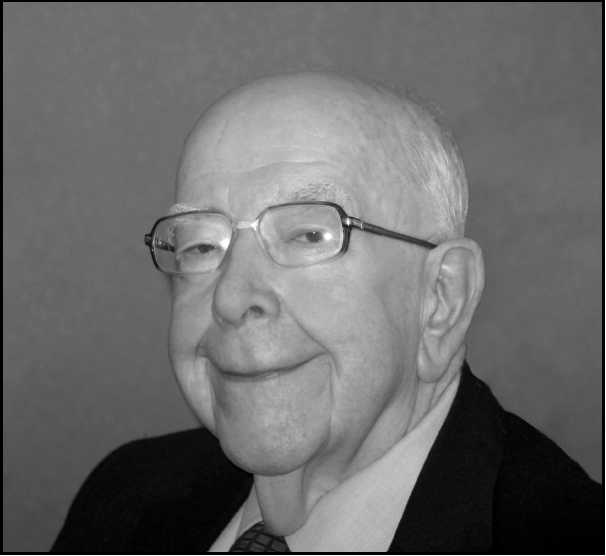
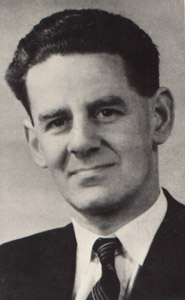
E. N. Mulcahy

E. N. MulcahyA profile of E. N. Mulcahy has now been added. Today his name is familiar to most players from the long-running E. N. Mulcahy Memorials, set up in the immediate aftermath of his tragic death in the Viscount air disaster. He was Irish champion in 1953, and a strong contender several other times throughout the 1950’s, including another joint first finish, losing on tie-break.

Posted in Players | Leave a comment

Eamon Keogh

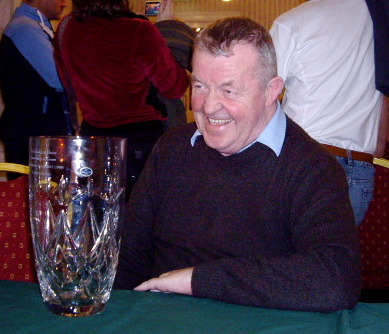
Eamon Keogh, 2007There are brief biographical sketches of a few players on the Players page, but up to now these have just had a bare-bones description, a two-line summary of an entire chess career.

Much more can (and will) be said, so we’ll be expanding these descriptions to much fuller profiles and many more players. To begin with, here’s a profile of Eamon Keogh. Complete? No, far from it, but we’ll be adding to it over time. Any extra information would be greatly appreciated.

Posted in Players | Leave a comment

Déjà vu

Blunders: the bane of every chessplayer. There is almost nothing that can cure the sting, except perhaps for Time, the Great Healer, to work its soothing magic.

Sometimes a small amount of solace can be derived from seeing the same mistake made by a better player, sometimes even–in the ideal case–by a reigning World Champion.

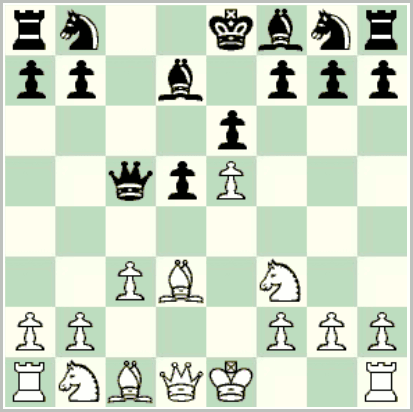
In the 2000 Irish championship in Castleconnell, Co. Limerick, the tournament had hardly begun when disaster befell Eamon Keogh:

Wall-Keogh, Irish Chamionship 2000Gavin Wall — Eamon Keogh
Irish Championship (1), Castleconnell 2000

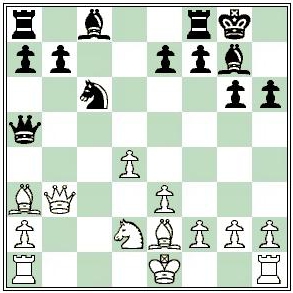
1. e4 e6 2. d4 d5 3. e5 c5 4. c3 Qa5 5. dxc5 Qxc5 6. Nf3 Bd7 7. Bd3 (diagram)

And now the blunder: 7. … Bb5?? 8. Be3!

1-0.

After 8. … Qc6 9. Nd4 Black loses a piece. There’s not much to say about that, except to point out the following:

Liberzon-Petrosian, Moscow 1964Vladimir Liberzon – Tigran Petrosian
Championship of the Professional Unions, Moscow 1964

1. e4 e6 2. d4 d5 3. Nc3 Bb4 4. e5 c5 5. a3 Bxc3+ 6. bxc3 Ne7 7. Qg4 Ng6 8. h4 h5 9. Qg3 Qa5 10. Bd2 Nc6 11. Bd3 Nce7 12. dxc5 Qxc5 13. Nf3 Bd7 14. 0-0 (diagram)

14. … Bb5?? 15.Be3 1-0.

[Click to replay both games.]

 
There’s a slight puzzle here. With … d4 followed by … Qd5, Black doesn’t have to lose a piece in either case. Instead he’d be a pawn down with a bad position to boot, and would still be lost. Did Petrosian see this possibility? Sources differ: John Moles, in his The French Defence Main Line Winawer (Batsford 1975), p. 104, says no: “1-0?? … Petrosian thought that he would lose a piece after 15…. Qc6?? 16. Nd4 overlooking that he could have got away with the loss of a pawn after 15. … d4! 16. c/B xd4 Qd5!” On the other hand, Tim Krabbé, in his column “A Guided Tour of Chess” at ChessCafe.com, September 2000, says, or rather implies, yes: “Black resigned. Against a lesser opponent, that would have been early. After 15. … d4 16. cxd4 White ‘has the pawn and the compensation’, as Roman Dzindzichashvili used to say, but Black could struggle. Surprisingly he could even have struggled after 15…. Qc6; 16. Nd4 Bxd3 17. Nxc6 Nf5 18. Qg5 Bxf1 19. Nd4 Nxd4 20. cxd4 Ba6 and White still has some work to do. Understandably, Petrosian did not fancy being subjected to that kind of work, and was probably too disgusted anyway.” Taylor Kingston says no, in a bulletin board post at ChessKB.com (14th August 2010): “Petrosian thought he was losing a piece here (15. … Qc6? 16. Nd4), but in fact he need lose only a pawn (15. … d4!).”

Is there any evidence on whether Petrosian did or did not see this? And did Eamon Keogh see it?

Posted in Games | Leave a comment