DisinformatorTM

With excellent timing, two magazines have produced a new issue this week, just in time for the Christmas stocking. The first is of course Tony Foley’s Irish Chess Journal. The second, which may not be familiar to Irish readers, is DisinformatorTM, the club magazine of Oxford City C.C., edited by Seán Terry. I came across it for the first time earlier this year, but it has been going since early 1995, now up to issue 41. It’s a substantial magazine that captures very well the atmosphere of club chess, with the subjects of blunders and swindles always hovering in the background, along with what to do when you don’t know any theory, and so on and so forth. Many, many games and all very entertaining.

As I was reading through the back issues, I started to say to myself, “Hmm, this fellow seems to know quite a lot about Irish chess”, with various mentions of the Armstrong, Irish players and clubs, etc. But it still came as a complete shock when I found the game Coffey-Terry from the Armstrong Cup in 1982. My subconscious must have started working on forgetting as soon as the scoresheets were signed, and clearly met with great success as I have no memory whatsoever of this game. It was in issue … well, it doesn’t really matter what issue it was in, the important point is that Seán Terry turns out to be from Ireland, and a veteran of Dublin C.C.

From Disinformator 6 (with permission, for which thanks), and very slightly adapted, here’s an account of the final of the 1977 Branagan Cup, Dublin v. Dundrum, played on the 14th March 1977 in Dublin C.C.’s (excellent) club rooms at 20 Lincoln Place. It comes up in a discussion of blunders and their causes, where he’s discussing various examples of where you forget that later on in an analysis, a piece currently occupying a square will no longer be there. (I used to call these “ghosts”.)
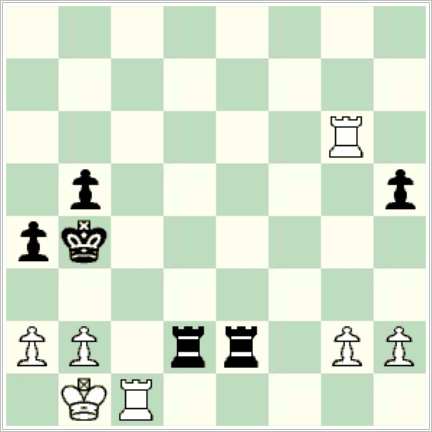
Terry - Frain, Branagan Cup final 1977, final position“Playing for Dublin C.C. in the final of the Branagan (knock-out cup) in 1977, I reached the diagrammed position, by which time (a) I was in terrible time trouble and stressed; (b) I had to win, as otherwise the match would be lost on board count. Black had just played Rd1-d2, threatening mate in two, and offered a draw. Notwithstanding the fact that I could see the following (fairly obvious) variations, I accepted!! 37. a3+ Ka5 (37. … Kb3 38. Rc3 mate) 38. Rcc6 b4 39. Rc5 mate, a point which was reinforced seconds later when an exodus of kibitzers descended to demonstrate the forced win.

What decided me against playing 37. a3, and accepting the draw, was not the variation above–I’m not that Irish–but the following analysis: 37. a3+ Ka5 38. Rcc6 Rxb2+ 39. Ka1(?) Ra2+ 40. Kb1 Rxa3, where Black escapes the mate and wins. Of course 39. Ka1 is a ??schlocker?? of a move, but I hadn’t realised that 39. Kc1 was possible: in my mind’s eye, it was still occupied by the rook. Stress had refused to erase the image from my brain. A convincing explanation to me, although my team-mates weren’t all that delighted at the time. [Nor, incidentally, was I. Sorry, JJ.]

Seán has also provided the full game score, for which thanks also: click to replay.
Posted in Branagan Cups, Games | 2 Comments

Did Diskin resign in a winning position?

The last post gave P. A. Duignan’s brilliancy prize win against P. Diskin in the 1949 Irish championship in Galway. But there’s a flaw! David McAlister spotted that Diskin may have been winning in the final position.

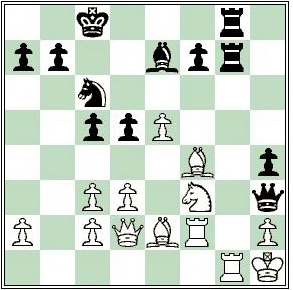
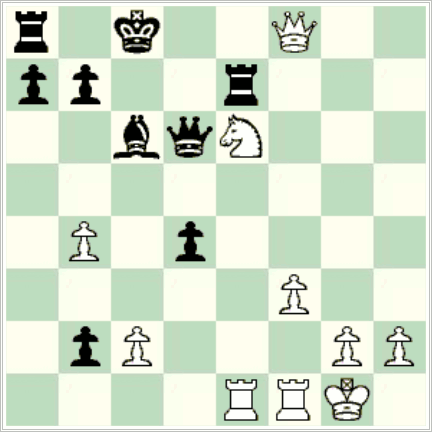
Duignan - Diskin, Irish Championship 1949White’s last move was 23. Qf7-f8+, and Black resigned. David points out that he should have played 23. … Be8!. Now the key line runs 24. Re4 (initially computers think this is winning, but …) Rxe6 25. Qxd6 Rxd6 26. Rxe8+ Kd7! 27. Rxa8 Ra6 28. Re1 Ra1 29. Rae8 Rc1 and wins.

The best chance for White seems to be 24. Qf5 b1=Q! 25. Nxd4+ Bd7 (25. … Kb8!?) 26. Qf8+ Kc7 27. Nb5+ Bxb5 28. Qxe7+ Qxe7 29. Rxe7+ Kd8 30. Rxb1 Kxe7, with three pawns for the bishop and some hope for survival, but surely Black must be winning here also.

(Click to replay.)

Posted in Connacht champions, Games, Irish champions, Players | Leave a comment

Duignan-Diskin, Irish championship, Galway 1949 (brilliancy prize)

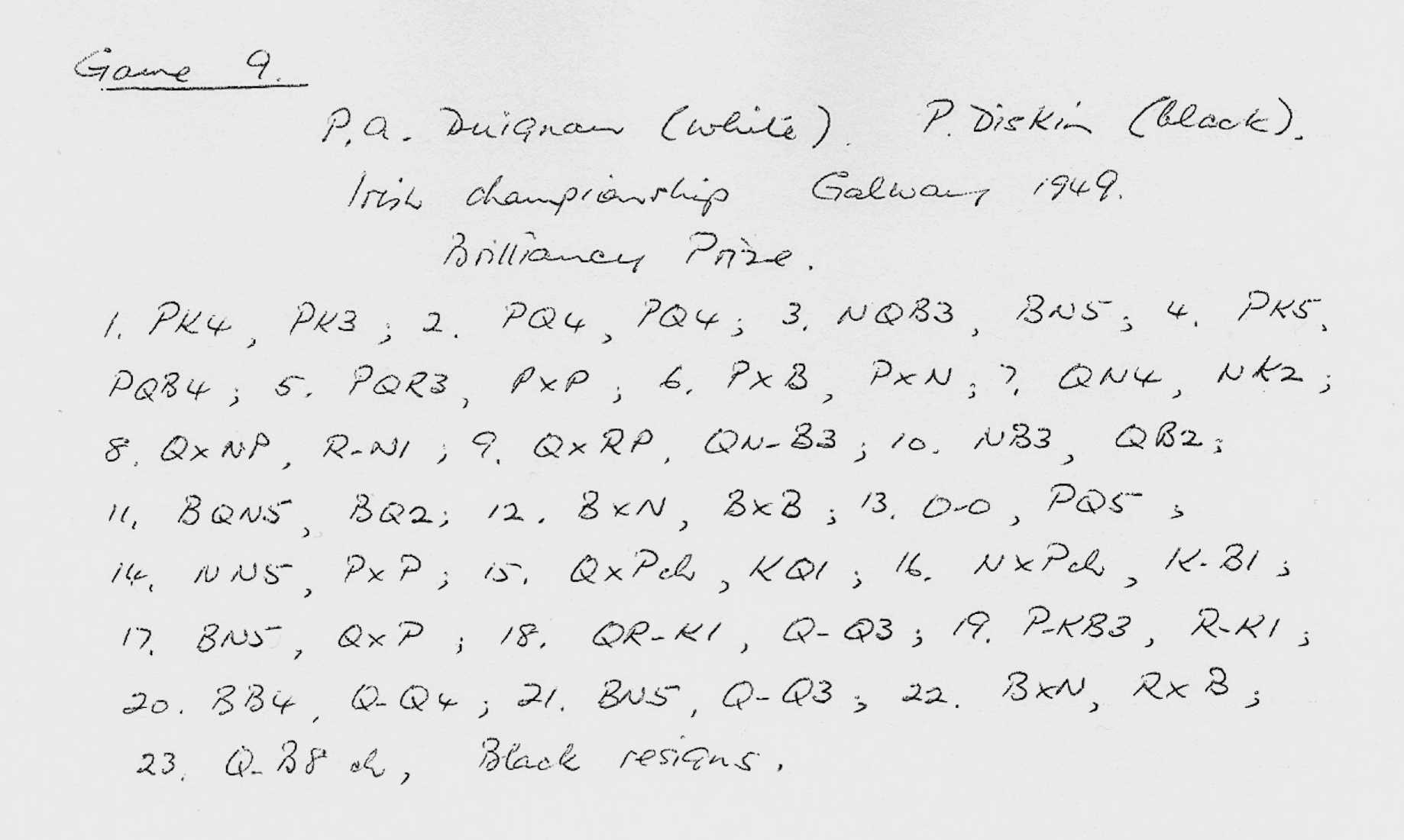
Returning to J. J. Walsh’s unpublished manuscript of selected Irish games, 1896-1967, the next on the list is another win by P. A. (Paddy) Duignan, this time against P. Diskin in the 1949 Irish championship in Galway, winning the tournament brilliancy prize.

Manuscript score for Duignan-Diskin

P. Diskin of Galway was Connacht champion in 1950, 1951, 1954 and 1955, and his best result in an Irish championship was =5th in Cork 1951 (sources: the Connacht championships and Irish championship pages on David McAlister’s Irish Chess History website).

The 1949 championship in Galway was a 7-round, 16-player Swiss that resulted in a runaway 7/7 victory by 20-year-old P. B. (Paddy) Kennedy, 2½ points ahead of the field, for his only Irish championship win. It seems only the top 7 finishers are known [but see Update], the others being 2nd-4th. Warwick Nash, George J. Boyd and Donal J. O’Sullivan 4½; 5th-7th. John C. Hickey, J. J. O’Hanlon and R. Dundas 4. So no mention of either Duignan or Diskin. The game isn’t in the ICU games archive, which has all of Kennedy’s games but no others.

The game itself (click for playable version) featured a variation of the Winawer, 5. … cxd4?!, that even in 1949 was under a cloud, and 7. … Ne7? (instead of 7. … cxb2 or 7. … Kf8) further compounds Black’s problems. White misses the strongest continuation, 11. Ra3! with a clear advantage, and a complicated battle ensues.

[Update, April 26, 2026: Modified post to correct Donal J. O’Sullivan’s first name (no fada), re-add link to post on J. J. Walsh’s unpublished manuscript, update links to Connacht championship and Irish championship pages on David McAlister’s Irish Chess History website, update link to ICU article on P. B. (Paddy) Kennedy, remove link to ICU games archive (which now contains this game, via this source), and add note on the comment that only the top 7 finishers of the 1949 Irish Championship are known (see post and tournament report here).]

Posted in Connacht champions, Games, Irish champions, Irish championships, Players | 1 Comment

Irish correspondence champions

Following up on the last two posts (blogging being a stream-of-consciousness matter), two of the unlucky almost-winners of the Irish championship had the consolation of winning the Irish correspondence championship.

W. J. Allen was chess editor of the Belfast News-Letter from 1911 to 1956. Around the time he missed out in the playoff for the 1926 Irish championship, he was embarking on an extended winning run of 6 Irish correspondence championships out of 7: 1926, 1927, 1928, 1929, 1930, and 1932.

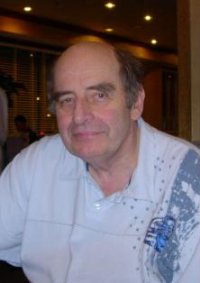
Alex MontwillAfter missing out on tie-break in the Irish championship in 1962, Alex Montwill was joint winner of the Irish correspondence championship in 1963. Although he seems to have given up chess a long time ago, we do have a recent photo (see right), based on a new book that came out last month: The Quantum Adventure: Does God Play Dice?.

There have also been three players who have won both the over-the-board and correspondence titles: John B. Reid, Tony Doyle, and A.T. Ludgate. There is an on-line correspondence roll of honour that is almost complete. (A complete list is in Correspondence Chess in Britain and Ireland, 1824-1987, by the 1996 Irish correspondence champion, Tim Harding.)

Posted in Irish champions, Players | Leave a comment

Equal first in an Irish championship, but never Irish champion

The answer to Thursday’s trivia question, what do

William Edward Thrift
P.J. McMahon
W.J. Allen
Oscar Aidan Quigley
William Richard Dunphy
Alex Montwill
Matt O’Leary
Tom Clarke

have in common, is as in the title: all finished equal first in an Irish championship, but for one reason or another didn’t win or share the title that year, and never won or shared it any other year either. The reasons why the tie wasn’t enough varied from losing on tie-break to losing a playoff match to forfeiting when a playoff match schedule couldn’t be agreed.

The full details can be tracked down on the ICU web site with a bit of work, but are much more conveniently presented all on one page on the Irish championship page on David McAlister’s Irish Chess History web site.

1925 8-player all-play-all, Dublin, J. J. O’Hanlon and W. E. (William Edward) Thrift =1st on 5½/7. “It was intended to have a play-off match but “Thrift being unable to continue the play” the ICU awarded the championship to O’Hanlon.”

1926 8-player all-play-all, Belfast, J. J. O’Hanlon, W. J. Allen, and P. J. McMahon =1st on 5/7. O’Hanlon won the double-round playoff tournament convincingly on 3½/4.

1937 9-player all-play-all, Dublin, Thomas Cox and O. A. (Oscar Aidan) Quigley =1st on 6½/8. Cox won the playoff match 3-2.

1957, 8-round 20-player Swiss, Galway, D. J. O’Sullivan and W. R. (William Richard) Dunphy =1st on 6/7. O’Sullivan won on tie-break.

1962, 8-round 16-player Swiss, Derry, John B. Reid, Michael Littleton, Alex Montwill and Brian Reilly =1st on 5½/8. Reid and Littleton were declared joint champions on tie-break. (Reilly was champion in 1959 and 1960.)

1972, 9-round 20-player Swiss, Dublin, Wolfgang Heidenfeld and Matt O’Leary =1st on 7/9. Heidenfeld won the playoff match 2½-1½.

1996, 9-round 25-player Swiss, Dublin, Richard O’Donovan, Tom Clarke and Colm Daly =1st on 6½/9. O’Donovan won on tie-break. (Daly was champion in 1998, 1999, 2005, and 2009.)

[13 Dec 2011, correction added: in 1962 the joint winners scored 5½/8, not /7.]

Posted in Players, Puzzles, Tournaments | 2 Comments

Trivial pursuit (Irish chess edition)

Here’s a puzzle: what do the following players have in common?

William Edward Thrift
P.J. McMahon
W.J. Allen
Oscar Aidan Quigley
William Richard Dunphy
Alex Montwill
Matt O’Leary
Tom Clarke

Answer in a couple of days.

The players all have something definite in common. In fact when I emailed the question to David McAlister, he spotted it immediately, with full details also.

Posted in Players, Puzzles | Leave a comment

J.J. Walsh unpublished manuscript: selected Irish games 1896-1967

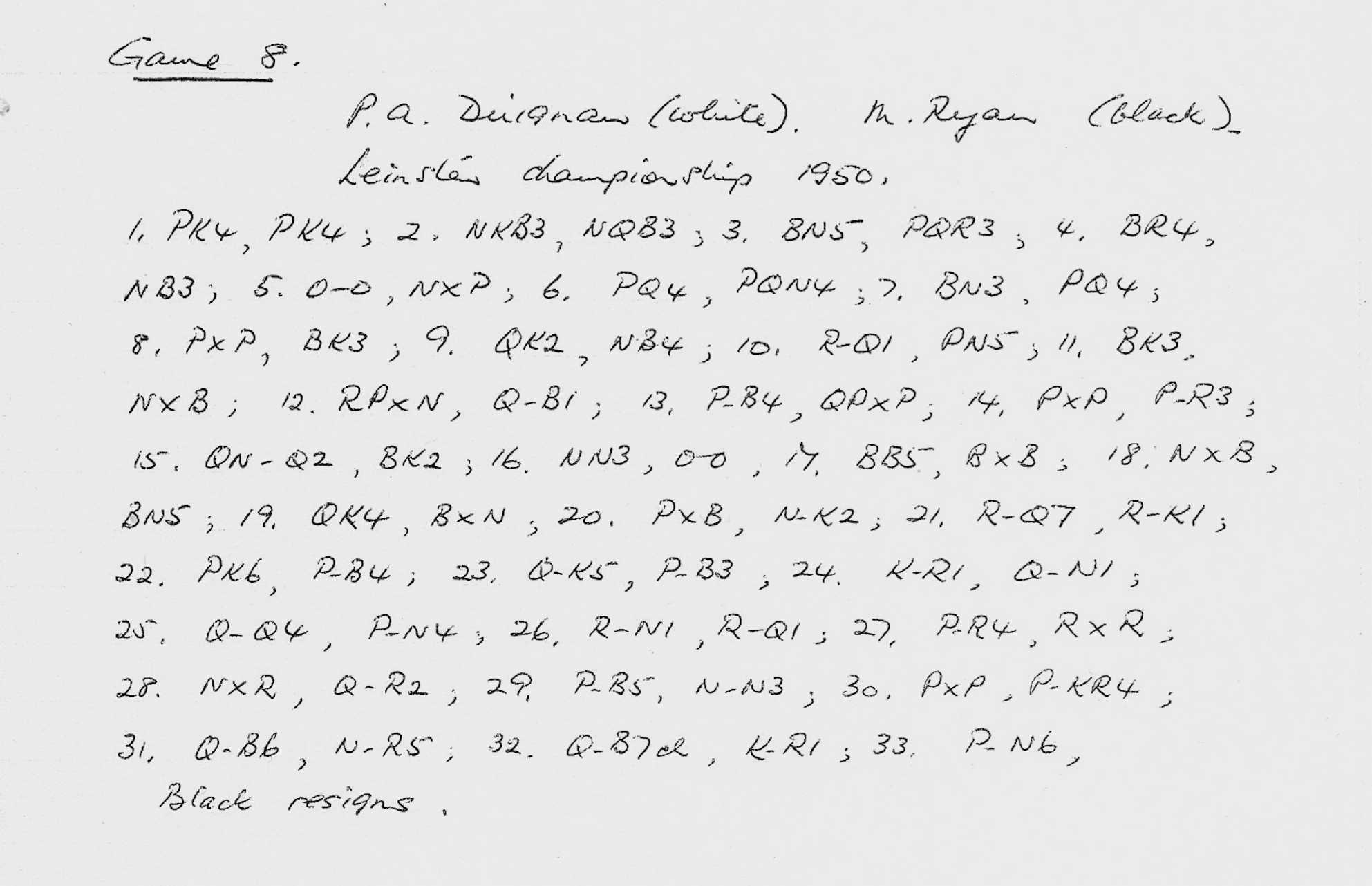
At IRLchess we’re interested in all aspects of Irish chess history and records, but above all in games. The ICU games archive has good coverage, of course, but there are many other published games that are not included there. And every so often a new source of unpublished games turns up, best of all. One such source is an unpublished manuscript of J.J. Walsh, containing 99 selected Irish games from 1896 to 1967. I visited him in April—and as you can imagine, he has an absolute mine of information about Irish chess down the years—and he kindly allowed me to copy the manuscript. It has taken me a while to get around to comparing it to the ICU archive, but having finally done so I find that 41 games are already in, leaving 58 ‘new’ ones. I recognise a few (8 or so) from other sources, leaving around 50 that were completely new to me, which I plan to put up here. (Gradually, of course! I don’t want to run out of topics to post on.)

Duignan-Ryan: JJ Walsh manuscript, game 8

The first ‘new’ game is game 8. White was P. A. (Paddy) Duignan, Irish champion in 1947 and Leinster champion in 1946 and 1950 (source: Irish Times, 4 April 1957, p. 4), and this is a win from his second Leinster championship (click for playable version). Some more information on him is contained in a brief profile on the ICU web site.

Posted in Games, Irish champions, Leinster championships, Players | 2 Comments

Monthly roundup

I haven’t posted in a while, due to a nasty problem with my computer: the hard disk became corrupted. It seems that all the data is fine (touch wood), but most of the software wouldn’t run, so the complete operating system had to be reinstalled. For various reasons this took 10 days.

As it happens, I wouldn’t have had that much to post anyway, beyond the weekly set of Irish games from TWIC and one or two minor revisions of other pages. From now on, I think I’ll just upload these directly to the relevant pages, without also having a separate post, and will collect all such minor items into one post at the end of each month. The changes for November are:

TWIC: TWIC 889 (21st November) had 6 Irish games: 5 with Anthony Breen and 1 with Joe Ryan. TWIC 890 (28th November) had 1 Irish game, with Joe Ryan. The relevant files are on the Games page.

Simuls: Details on 9 more simuls have been added to the main Simuls page. These are all from the leadup to An Tóstal 1955, with simuls given by Albéric O’Kelly de Galway, Ossip Bernstein, and T. D. van Scheltinga in various locations around the country. Last year Tony Foley had a great series of posts on An Tóstal 1955 itself.

Up to now all the simuls listed have been by visiting players. Of course there have been many by local players also, indeed so many that they dwarf the simuls given by visitors. Rather than lump them together, therefore, there’s a new Local simuls page, which we’ll be building up gradually. Currently only one simul is listed but we have to start somewhere.

Irish championship 2010: The report on last year’s Irish championship has been revised slightly. The new version (v1.2) adds an Annotations index and a link to John Redmond’s blog.

FICHEALL: Úna O’Boyle’s Ficheall, the first ever chess book in Irish, was shortlisted some time ago for Gradam Réics Carló (Irish Language Children’s Book of the Year) 2011. The final decision was due on November 15th, but I haven’t seen any results announced yet, even after doing a search on the other shortlisted books.

Posted in Administrative | 2 Comments

O’Hanlon, Cox and the female impersonator

John (“J.J.”) O’Hanlon won the Irish championship nine times between 1913 and 1940. His most significant international successes were at Broadstairs 1922 where he tied with the future World Champion Max Euwe (winning their individual encounter) and Hyѐres 1928 where he tied with the famous artist Marcel Duchamp and Vitaly Halberstadt.

Thomas Cox only started playing chess in 1933 but within 3 years had already won the Leinster championship. He then went on to take the Irish championship title in 1937 and 1938, before sadly succumbing to tuberculosis at the age of 27 in October 1939.

The Jover family entertained in circuses, theatres and music halls all over the world for three generations. The family, headed by Julian Jover had performed as “The Mirthful Jovers” at the Royal Variety Performance in 1922. Amongst the troupe was Julian’s son, Tommy. By 1937 Tommy was now part of a duo “The Comical Jovers” and at the beginning of March that year they were topping the bill at the Gaiety Theatre in Dublin. When that duo broke up two years later, Tommy started a new act with his son Raf and daughter Nena. Nena’s autobiography “My Father was Carmen Miranda: Memoirs of an English Show Girl” chronicles their performances in Britain during the Second World War when Tommy did a turn as a female impersonator – topping his head with a fruit basket like Carmen Miranda.

Tommy Jover was also a chess player of some ability. The Irish Independent for the 5th March 1937 put it this way:

“In his travels all over Europe Mr Jover, who is an accomplished linguist, has played with the leading masters. The experience thus gained has given him a very attractive style of play.”

During his stay in Dublin performing at the Gaiety Theatre Jover found time to play friendly games with O’Hanlon, at the time the Irish champion and who was a personal friend, and Thomas Cox, then Leinster champion, on the 4th March. The second of those games against Cox was drawn but, as the Irish Independent put it, Jover “caught the Irish champion napping.”

O’Hanlon, John – Jover, Tommy
Friendly game, Dublin 1937 [C29]
[Source: Irish Independent, 5th March 1937]

O'Hanlon-Jover after White's 20thJover offered a pawn sacrifice with a view to attacking down the g-file against O’Hanlon’s castled King. In a normal tournament game, O’Hanlon might have decided to take a more careful course but he snapped up the proffered pawn, perhaps to ensure his friend had an entertaining game. Jover gained sufficient compensation for the pawn but then unsoundly sacrificed a bishop. However when O’Hanlon then played an obvious move to occupy the g-file (but also the one his opponent was probably hoping for), Jover then uncorked a queen sacrifice leading to checkmate.

1.e4 e5 2.Nc3 Nf6 3.f4 d5 4.fxe5 Nxe4 5.Nf3 c5 6.d3 Nxc3 7.bxc3 Be7 8.Be2 Be6 9.O-O h6 10.Qe1 Nc6 11.Qg3 Qd7 12.Qxg7 O-O-O 13.Qg3 Rdg8 14.Qe1 Rg7 15.Rf2 h5 16.Kh1 h4 17.Bf4 Rhg8 18.Qd2 Bh3 19.gxh3 Qxh3 20.Rg1 (diagram) Qxf3+ 0-1 [Click to replay]

Posted in Uncategorized | 3 Comments

TWIC 888

This week TWIC has 25 Irish games: 2 each from Sam Collins, Ryan-Rhys Griffiths, and Gavin Wall (4NCL), 1 from Joe Ryan (III Tancat IM), 5 from Sarah Hegarty (4 from European Women’s Team Ch and 1 from 4NCL), 7 from John Nicholson (37th Guernsey Open), and 6 from Anthony Breen (FSFMC November). These are all available in pgn format on the updated Games page.

This reminds me that the original post introducing this feature didn’t give the exact definition being used for an Irish player. The script runs through all FIDE rating lists from 2002 to the present day, and if a player has ever been recorded as Irish on any of those lists, the player is Irish for purposes of this feature. So Sarah Hegarty, for example, currently registered as English, is included based on her registration as Irish in FIDE lists in 2003, even though none of the games included here were played while she was Irish-registered. This is a little arbitrary, of course, but it’s all much easier if a FIDE ID maps to a definite permanent nationality without having to fiddle with different nationalities at different times, and besides it does no harm to take the inclusive definition.

Posted in Games | Leave a comment