From the 2011 Irish championship

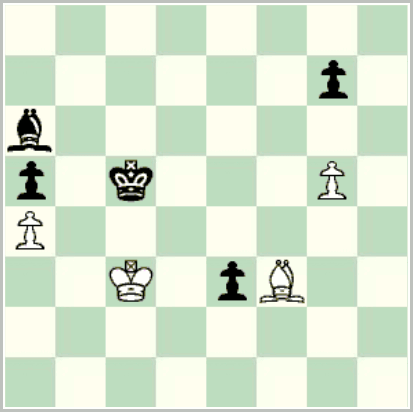
Keogh-Doyle, Irish Championship 2011The 2011 Irish championship was hugely enjoyable and a credit to the players and organisers. Is it a trick of the imagination, due to the presence of live games and almost instant availability of game scores, or was the chess really more entertaining than usual? Perhaps a mixture of both?

Here is a finish with a timeless appeal:

Black now played 49 … h3. How do you evaluate this move and the resulting position with best play? Was there anything better?

See the solution.

Posted in Irish championships, Puzzles | Leave a comment

And they’re off …

The 2011 Irish championship has started. There is some excellent live coverage available from the organisers, the highly reputed e2e4 Chess, including live games for the first time ever in an Irish championship.

We gather all the information we have in a tournament report, which we’ll update continually while the championship unfolds.

July 10: Stephen Brady wins the Irish championship for the 7th time. Rory Quinn wins the weekender. July11: Eric Bennett earlier won the intermediate. Mark Finnigan won the junior.

Continue reading

Posted in Irish championships, Tournaments | Leave a comment

Short-Brady, Irish championship 2007

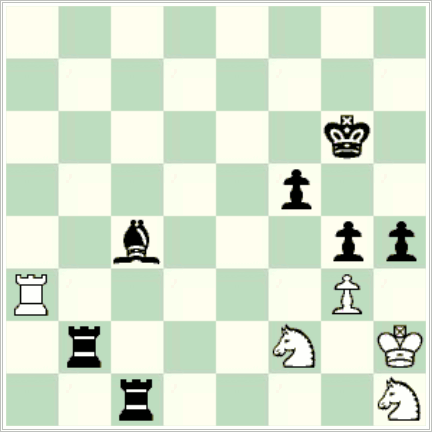
Short-Brady, Irish Ch 2007Short, Philip – Brady, Stephen
Irish Championship (9), Dublin, 8 July 2007

83. Bg2 e2 84. Kd2 Bc4 85. Bh3 Kd4 86. Bd7 Ke4 87. g6 Kf3 88. Ke1 Ke3 89. Be8 Bd3 90. Bf7 Bc2 91. Be8 Bb1 92. Bb5 Bxg6 93. Bxe2 Bc2 94. Bb5 Kd4 95. Kd2 Bb3 96. Ke1 Kc5 97. Kd2 Kb4 98. Kc1 Bxa4 99. Bd3 Bb5 100. Bg6 a4 101. Kb2 a3+ 102. Ka1 Bc4 103. Be4 g5 104. Bg2 g4 105. Ba8 g3 106. Bg2 Kc3 107. Bh3 Kd2 108. Bg2 Ke3 109. Bh3 Kf2 110. Kb1 Be6
0-1 (time)

[Click to replay the full game.]

The 2007 Irish championship came down to the last-round game between Philip Short and Stephen Brady. Each possible outcome would result in a different set of champions: White win–Philip Short sole champion; draw–Philip Short co-champion with Brian Kelly; Black win–Stephen Brady co-champion with Brian Kelly.

All sources of the game score–the ICU tournament report, the ICU on-line database, the Irish Chess Journal, Colm Daly’s “Irish Chess Championships” site, TWIC 662, BritBase and the BCM News Archive for 2007–give the game to Black’s 82nd move, and “0-1”. Fair enough: White has no defence to … Kd6-e5-f4 etc.

But in fact White didn’t resign here, and for that matter Black didn’t play … Kd6-e5-f4. Instead the game ended much later in a time scramble that went down to the wire. As it happens, we are lucky enough to have a complete video of the finish, from Colm Daly’s Irish Chess Championships site, and this allows us to reconstruct the full game (which is new to this post). Black’s 82nd, reaching the position above, is played at 3:17, and then the remaining moves, with approximate times played, were 83. Bg2 (3:34) e2 (5.43) 84. Kd2 (not shown) Bc4 (5:48) 85. Bh3 (5:58) Kd4 (6:14) 86. Bd7 (6:21) Ke4 (6:34) 87. g6 (6:39) Kf3 (6:53) 88. Ke1 (6:54) Ke3 (6:56) 89. Be8 (7:00) Bd3 (7:09) 90. Bf7 (7:10) Bc2 (7:15) 91. Be8 (7:17) Bb1 (7:25) 92. Bb5 (7:27) Bxg6 (7:29) 93. Bxe2 (7:30) Bc2 (7:37) 94. Bb5 (7:39) Kd4 (7:41) 95. Kd2 (7:43) Bb3 (7:51) 96. Ke1 (7:54) Kc5 (7:55) 97. Kd2 (7:58) Kb4 (7:59) 98. Kc1 (8:05) Bxa4 (8:06) 99. Bd3 (8:07) Bb5 (8:08) 100. Bg6 (8:10) a4 (8:11) 101. Kb2 (8:12) a3+ (8:12) 102. Ka1 (8:13) Bc4 (8:13) 103. Be4 (8:17) g5 (8:17) 104. Bg2 (8:19) g4 (8:20) 105. Ba8 (8:25) g3 (8:25) 106. Bg2 (8:27) Kc3 (8:28) 107. Bh3 (8:30) Kd2 (8:31) 108. Bg2 (8:32) Ke3 (8:33) 109. Bh3 (8:37) Kf2 (8:38) 110. Kb1 (8:40) Be6 (8:41). Although not shown on the video, Philip Short ran out of time seconds later. Stephen Brady cut it close: he had 8 seconds left on his clock at the end. And there was no increment!

89. Be6!? might have posed more problems for Black in the time available.

Posted in Games | Leave a comment

To take or not to take?

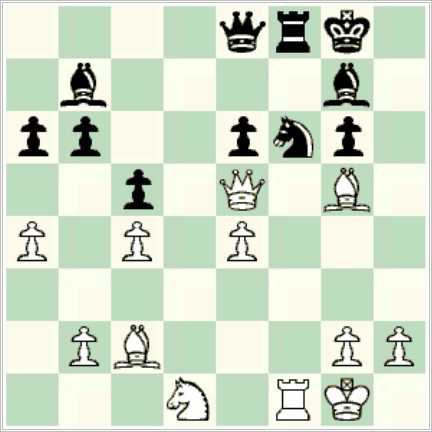
Loughran-O'Leary, Irish Championship 2009A puzzle from the 2009 Irish championship:
Black now played 21 … Nxe4!? How do you evaluate this move and the resulting position with best play?

A. Black wins back a pawn with equality;
B. White regains the pawn and simplifies to a better ending;
C. Black’s concept is flawed and White has a quick forced win.

See the game for the solution.

Posted in Puzzles | Leave a comment

T.G. Cranston: Correcting and improving the record

The first port of call to seek out biographical details about any chess player is Jeremy Gaige’s Chess Personalia. The entry for T. G. Cranston is brief, telling us only that he was born in Dublin circa 1877 and was Irish champion in 1922 and 1931. No information is provided as to when he died or indeed what were the full names behind his initials T.G.

If you look at Gino Di Felice’s Chess Results series of books, he refers throughout to Timothy G. Cranston. A number of chess databases follow this naming, though some vary with G. Timothy. In fact, here lies a clue to the fact that our Cranston was not named Timothy. There is an American player, G. Timothy Cranston, born 1953 according to the FIDE Ratings website, with whom the Irish Cranston has been confused.

So we need to go back to the primary sources.  T.G. Cranston was a member of Dublin Chess Club and its Honorary Secretary from 1919 to 1947. It may well be that the records still held by that club (which I have not had an opportunity to consult – hopefully some day) would tell us his full name, Unfortunately the published record – Professor Luce’s A History of the Dublin Chess Club, written for the club’s centenary year 1967 – does not usually give forenames in its complete listing of all members’ names and Cranston is only referred to as T.G. there, so I needed to research contemporary newspaper reports.

Despite the fact that Cranston competed in a great many of the important Irish chess events for over 30 years, my search in the reports of those events for a reference to his forenames proved unavailing. However, T.B. Rowland (one of the great organisers in Irish chess) produced a lengthy piece entitled Chess in Ireland for the Irish Times of 9th December 1922 and in it the Honorary Secretary of Dublin CC is revealed to be Thomas George Cranston.

In the Irish Times for the 19th April 1954 I found a report on the funeral of “Thomas George Cranston, well-known in the paper trade and chess circles.” A little further research in the Irish Times, this time for the 16th April 1954 found a Death Notice, which tells us that Cranston had died the previous day, the 15th April 1954.

Posted in Players | Tagged | 1 Comment

John Francis O’Donovan

The 1939 International Team tournament (or Olympiad as it is now called) was played in Buenos Aires, Argentina. Ireland was represented by John O’Hanlon, John O’Donovan, Gerard Kerlin, William Minnis and Warwick Nash. During the competition war broke out in Europe and many players decided to remain in South America. One of those was O’Donovan.

On the 12th November 1941 the Irish Independent reported under the heading Sailed in 1939: Irish Chess Expert in Argentine that: “Of a team of five chess experts who left Antwerp in July 1939, to play in an international tourney in Buenos Aires, all except one are back in Ireland.

He is Mr. J.F. O’Donovan, aged about 23, a native of Cork. According to latest messages received Mr. O’Donovan is safe and happy in Argentine – still playing chess.”

John O’Donovan played Board 2 (de facto Board 1 after O’Hanlon returned home after the preliminary stage) for the Irish team at the 1939 Olympiad. He won the 1936 London Boys’ Championship (30 Dec 1935 – 4 Jan 1936 to be precise) and played for Cambridge University in the annual varsity match with Oxford in 1937, 1938 and 1939 (in the final year he was President of Cambridge University Chess Club). He also played with success in the subsidiary sections of some of the major English tournaments of the late 1930s (e.g. Margate 1937, BCF Championships Blackpool 1937, BCF Championships Brighton 1938).

He had a couple of endgame studies published by the British Chess Magazine in 1956. I have been unable to find out if he played competitively in Argentina (or whether he kept in touch with any other chess exiles there). Also I have not found any reference to him playing in Ireland – the fact that he won the London Boys’ title suggests he may have moved to England at a relatively young age.

I wrote some years ago to his University College (Jesus College Cambridge) and received this reply from Mrs Muriel Brittain, “Fellow Commoner, Assistant Keeper of the Records” at Jesus College:

“John Francis O’Donovan was born on 10th April 1918 at Queenstown, Cork, the son of the Revd. Richard Henry O’Donovan, deceased. He took a first class in the first part of the Mathematical Tripos in 1937 and graduated BA in 1939.

He taught English at the Engineering School in Buenos Aires for 26 years.

I last heard from him in 1996 when he replied to my letter of good wishes on the 60th anniversary of his entering the College.”

Mrs Brittain supplied an address in Argentina and as a result of that information in 2001 Mark Orr, when he was editing The Irish Chess Archive, was able to contact O’Donovan’s daughter Patricia. She replied that: “John O’Donovan, my father, died on November 5th, 1999 in Buenos Aires. He left his wife Sabina, whom I brought to Israel to live close to me , their only daughter.”
Posted in Players | Tagged | 3 Comments

Irish championship 2010

The 2011 Irish championship begins two weeks from tomorrow. To whet the appetite, we have a report on last year’s championship (1st Alex Lopez) on the Irish championships page.

Posted in Irish championships, Tournaments | Leave a comment

IRLchess

Eh… what … is this on? Er … SCCCCCRRRRREEEEEEECHHHHHHHHHHHHHHH! Ah…

After we figure this WordPress thing out, this site will cover Irish chess history & records. Watch this space!

Posted in Administrative | Leave a comment