Garry Kasparov in Dublin

Garry Kasparov Meeting

The 13th World Champion is currently on the campaign trail as he bids to unseat Kirsan Ilyumzhinov from the Presidency of FIDE. His principal purpose in coming to Dublin was to meet delegates from Ireland and neighbouring Federations who will be attending the FIDE Congress in August when the vital vote will be held.

Kasparov arrived in Ireland on Friday 28th March and that evening he made an appearance on RTE’s The Late Late Show. The following morning was taken up with the business session with the delegates and then his afternoon was given over to attending what the ICU described as a “special meeting of Irelandâ’s finest and most dedicated chess enthusiasts.”

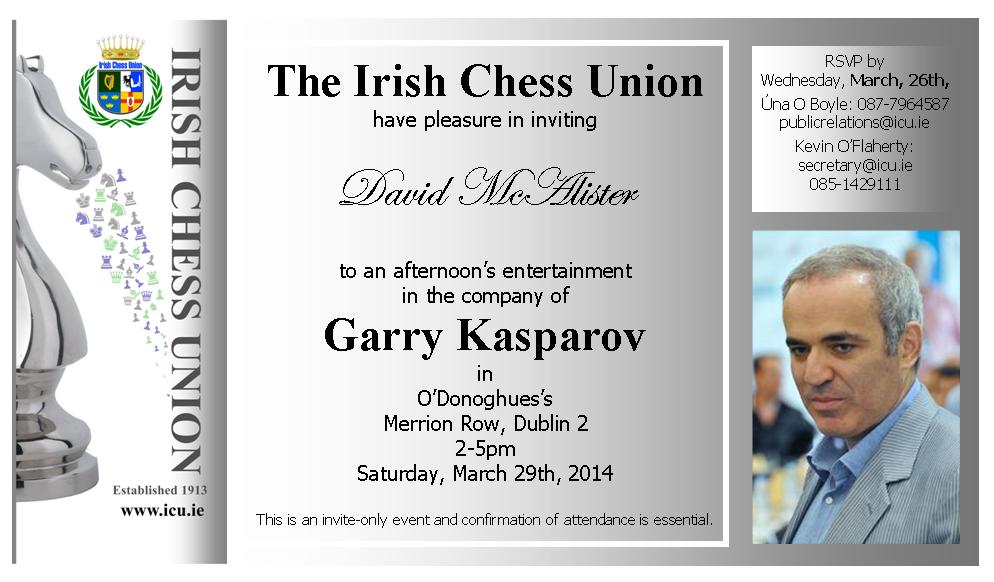
Someone pointed out that Ireland’s finest would be competing at the concurrent Cork Congress. In deciding whether those present were worthy of such a description, I must declare an interest, because (as the invitation above shows) I was one of the invitees.

Arriving at the venue, my first thought was that the room was a bit on the small size. Still, having arrived precisely at the appointed hour, I had time to order a pint at the bar before the room got busy. The said pint was then captured en passant without anyone noticing but the staff were kind enough to provide a free replacement. When Kasparov arrived a short time later the room was already seriously crowded (well what else would you expect form an Irish pub?) and Eamonn Keogh ordered the traditional pint of Guinness for our visitor.
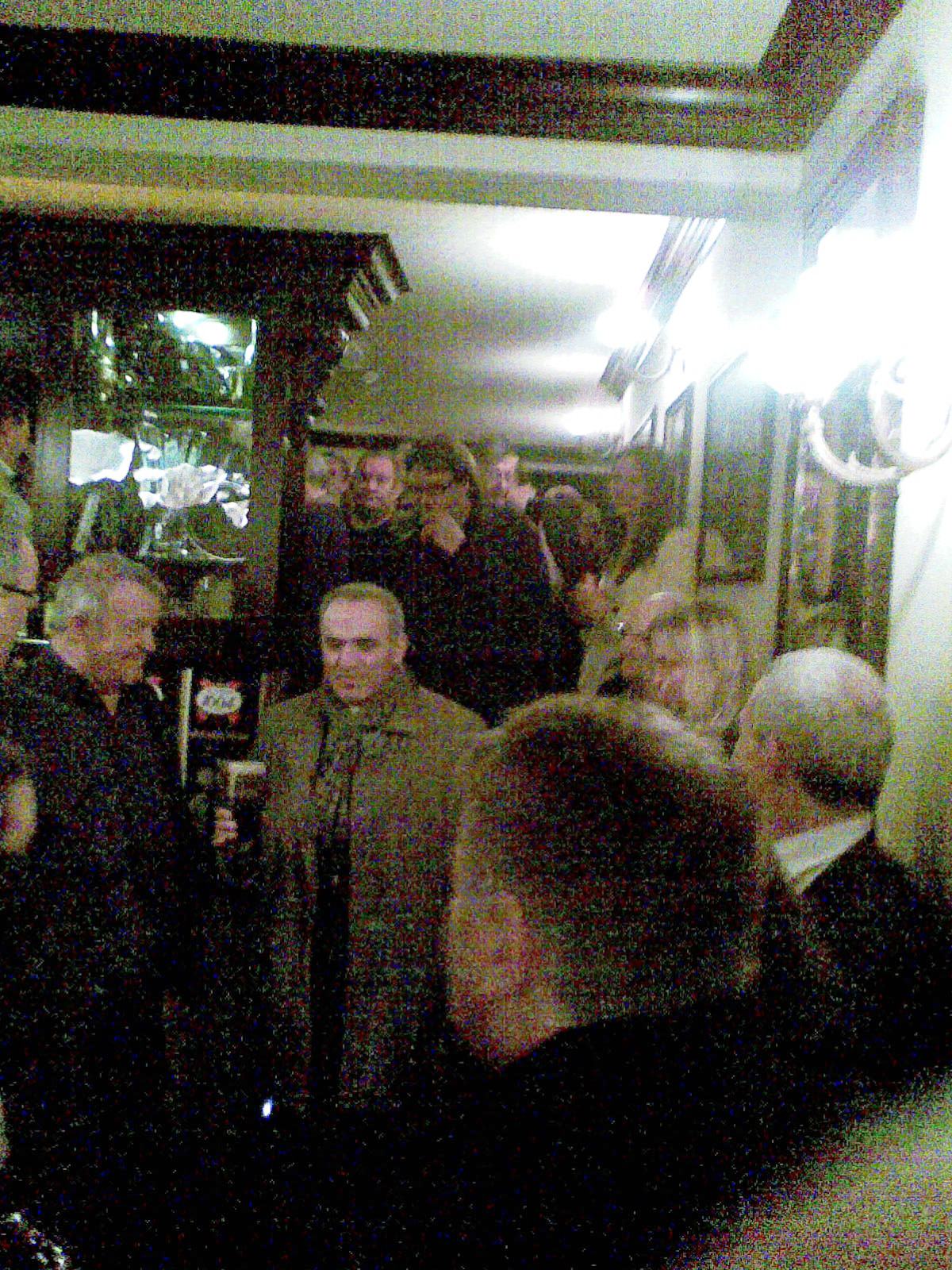
Kasparov  with pint of Guinness

Sorry for the grainy image of Kasparov but that’s the best I could do with the camera on my ancient mobile phone. I’m not sure how much Kasparov actually drank from the pint, but soon after he was shepherded through the room to a place where he could be photographed with many of those present. Garry complied willingly with photo requests but I think he might have preferred something a little more structured and after about an hour he was on his way. The room slowly began to lose a few more of those present and it became possible to mingle again. It was an interesting and memorable experience to be in the same room with perhaps the greatest player ever but also to meet many Irish chess personalities in a non-competitive setting. Maybe, as someone suggested to me, we could make this a regular informal gathering of Irish chessplayers. I’m not sure how regular these awards are but maybe we could tie it in with inductions to the Hall of Fame.
Posted in News | 1 Comment

Hebden-Lalić, Bunratty blitz final 2014

It isn’t often that we have access to full blitz games, but the final of this year’s Bunratty Blitz tournament is an exception: Damien Cunningham at Ballynafeigh Chess put togther an excellent video, from which it’s possible to reconstruct the entire game:

Hebden - lalic, Bunratty blitz 2014
Hebden – Lalić
Bunratty Blitz 2014 (final)

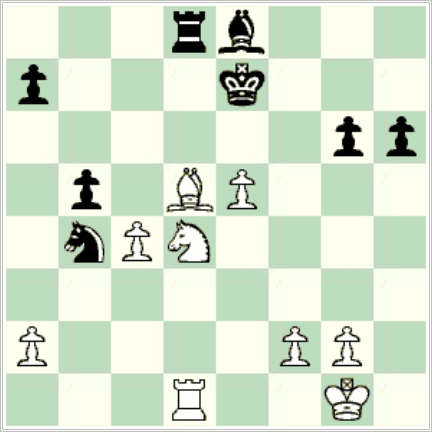
1. d4 e6 2. Nf3 c5 3. c3 Nf6 4. Bg5 h6 5. Bxf6 Qxf6 6. e4 cxd4 7. cxd4 Bb4+ 8. Nc3 O-O 9. Rc1 Nc6 10. e5 Qe7 11. Bd3 d6 12. O-O dxe5 13. dxe5 Rd8 14. Qe2 Bd7 15. Qe4 g6 16. h4 Be8 17. h5 Bxc3 18. Rxc3 Rd5 19. hxg6 fxg6 20. Qf4 Qf8 21. Qxf8+ Kxf8 22. Bc4 Rc5 23. Bxe6 Rxc3 24. bxc3 Rd8 25. c4 b6 26. Bd5 Nb4 27. Nd4 Ke7 28. Rd1 b5 (diagram)

29. Ne6 Rc8 30. Rb1 Nxa2 31. Ra1 Nb4 32. Rxa7+ Bd7 33. Nf4 g5 34. Ng6+ Ke8 35. e6 Bc6 36. Rh7 Kd8 37. Rh8+ Kc7 38. Rxc8+ Kxc8 39. Ne7+ Kc7 40. Nxc6 Nxc6 41. Bxc6 Kxc6 42. cxb5+ 1-0

[Click to replay the game.]

Posted in Games | 1 Comment

Joe Noone, David Denny

The answers to Thursday’s puzzle are Joe Noone (Player A) and David Denny (Player B).

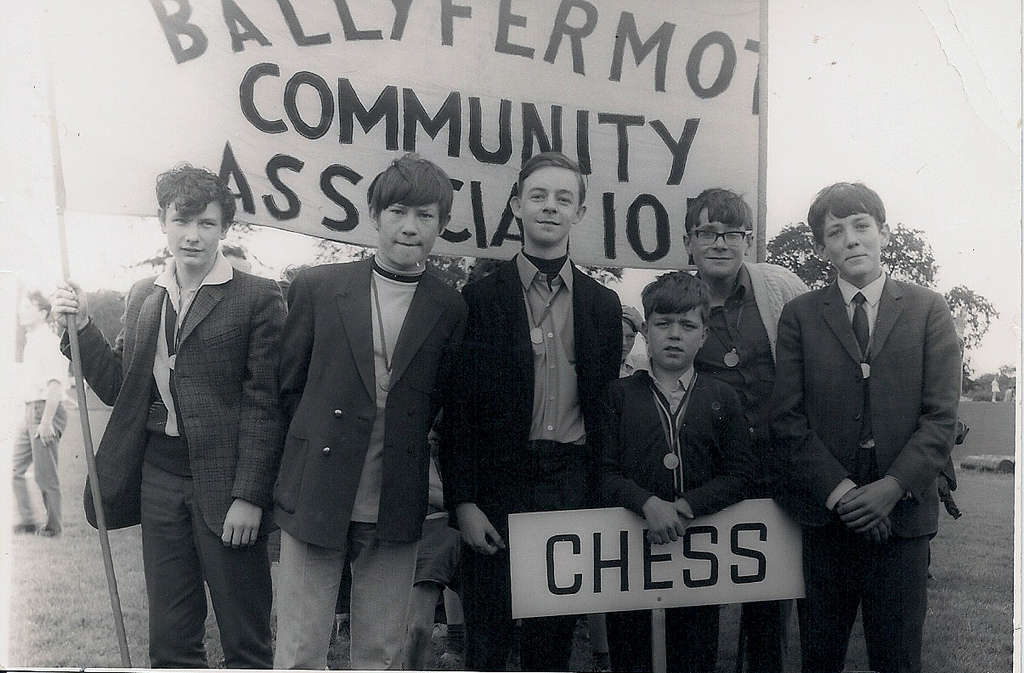
The original source is David Denny’s Flickr account. The players, from left to right, are Joe Noone, Martin O’Neill, David Denny, Brendan Bartley, Tom McHugh, and Gerry Doyle.

Joe Noone’s long and continuing career includes a joint Leinster champion title in 1984.

David Denny played mostly with Kevin Barry, but was on the winning U.C.D. team in the 1976-77 Armstrong Cup. His brothers Brian (three years younger) and Kevin (six years younger) also played: David and Brian both played on the 1974 Glorney Cup team, along with another set of brothers, Paul and Martin Delaney. (Kevin was a contemporary of mine: I remember him from Community Games competitions, and also from Leinster Schools leagues.)

There are several more (high quality) chess photos on David Denny’s Flickr account that capture the Community Games atmosphere very well.

Posted in Photos, Puzzles | 1 Comment

Who?

Ballyfermot 1970

This photo shows the Ballyfermot team that won the national Community Games championship in 1970. (Click on the picture for a larger version.)

One player in this picture (call him Player A) was later a Leinster champion. He’s still playing, and in fact he’s playing in this year’s Armstrong Cup. Who is he?

Another player in the picture (call him Player B) came from a chess-playing family, was one of a pair of brothers on the same Glorney Cup team and was on an Armstrong Cup-winning team. Who is he?

The second question is much harder, I think, as Player B hasn’t played in decades.

The photo is shown with permission (for which many thanks), but I won’t give the reference just yet as it would give away some of the solution.

Posted in Photos, Puzzles | 1 Comment

Pickett’s Charge

Pickett's lineThe latest issue of The New Winawer Report has been posted on the Winawer page. This deals with a side line in the Poisoned Pawn, which was the subject of new analysis in Emanuel Berg’s new volume on the 7 Qg4 Winawer: White plays 11 h4!? instead of the virtually universal 11 f4 in the main line Poisoned Pawn.

Though Berg’s analysis is excellent, he misses the background and the original game in this line. The idea is due to the London player and author Len M. Pickett, later recommended by Andrew Martin, and the original game appeared in CHESS in November 1975. It’s not too surprising that Berg missed it, as it appears in no modern database (and, to be fair, was played well before Berg was born).

Berg gives an effective antidote to Pickett’s original idea of 11 h4 and 12 Rh3. But for reasons discussed in this month’s issue, the move order 11 h4 and 12 f4 brings some benefits to White.

Posted in Articles | 1 Comment

Armstrong Cup 1976-77

The Armstrong Cup page has been updated with details of the 1976-77 season. In a close finish U.C.D. retained the cup, fighting off the challenge of Portmarnock, Dublin A, and Collegians. The winning team consisted of Bernard Kernan, Oisín McGuinness, Paul Wallace, Conor Barrington, J. Bradley, M. O’Donnell, Ciarán O’Hare, B. Redmond, D. Denny, and C. McGuinness (from two scorecards).

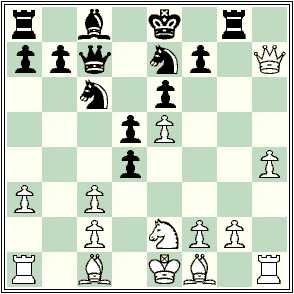
From Walsh-Mcguinness, Armstrong Cup 1977No games from this season are in the ICU games archive, but here’s one from J.J. Walsh’s scorebook, where he has White against U.C.D.’s board 2 Oisín McGuinness. McGuinness struggled in the opening and was already lost around move 11. The diagrammed position is with White to move. The finish was 24. e6 fxe6 25. Ne5 Qc8 26. fxg6 1-0, though there must be many other ways of winning also. [Click to replay the full game.]

Oddly, this is the first game of J.J. Walsh’s in the games archive here.

[Update, February 24, 2014: David McAlister has provided two more Irish Times articles that I didn’t have (October 14, 1976 and February 11, 1977), with the results of three more matches, for which thanks.]

Posted in Armstrong Cup, Games, Tournaments | 2 Comments

Another queen sacrifice

A while back we had a queen sacrifice from Oliver Dunne that was A la Morphy.

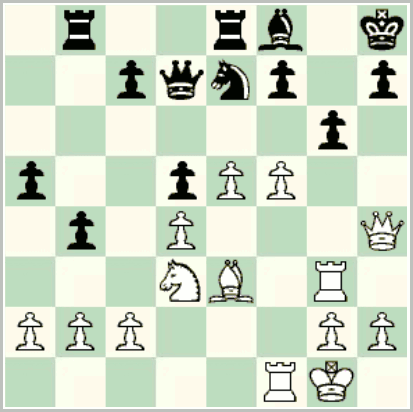
Menon-Dunne, Heidenfeld Trpy 2013-14Oliver has submitted another game, for which many thanks, this time from a Heidenfeld match last weekend. And it’s another queen sacrifice! In the diagrammed position Oliver ventured 27. … Qxd6!!??, sacrificing the queen for two minor pieces.

Let’s set this up as a puzzle.
(a) is this sacrifice sound?
(b) if so, what’s the evaluation after this move?
(c) if not, is there anything better for Black, and how should White continue?

In the game, regardless of the answers to the questions above, White did not make the most of her chances (though Oliver notes that time pressure was a factor) and Black won a resounding victory. [Click to play through the full game.] So an extra question is

(d) where could White have improved?

Posted in Games, Puzzles | 3 Comments

Samuel Beckett and the Armstrong Cup

“Samuel Beckett’s obsession with chess: how the game influenced his work” runs the headline of a recent article in the Guardian by Stephen Moss, which continues “Chess was one of Samuel Beckett’s great obsessions, touching everything from Murphy to Endgame.” Indeed the novel Murphy features an unusual chess game (which can be played over on the Elm Mount C.C. web site, courtesy of Oliver Dunne); the chess content of the play Endgame seems strictly limited to the title.

Moss’s article describes other evidence of Beckett’s interest in chess, including a score of chess books, ‘filled with his comments’, and his reputed off-hand games with the artist Marcel Duchamp, who was certainly a strong player: he competed in several French championships and Olympiads. (Though there is some dispute over whether they actually played each other.)

I admit that this evidence by itself leaves me with some scepticism. That Beckett had at least some interest in the game is clear enough, but how far did it really go, and is there any evidence that Beckett was a chess player, as chess players would understand the term? These matters can be exaggerated. What I have in mind is some tangible evidence that Beckett had more involvement with chess than I have with golf, or snooker, say. I have played both games, sometimes with expert players, and I even think there’s the odd book on each scattered around the house. But it would astonish anyone who knew me to hear me described as a golfer or a snooker player. As far as I know, no evidence has ever been presented to show that Beckett exceeds this threshold.

Until now!

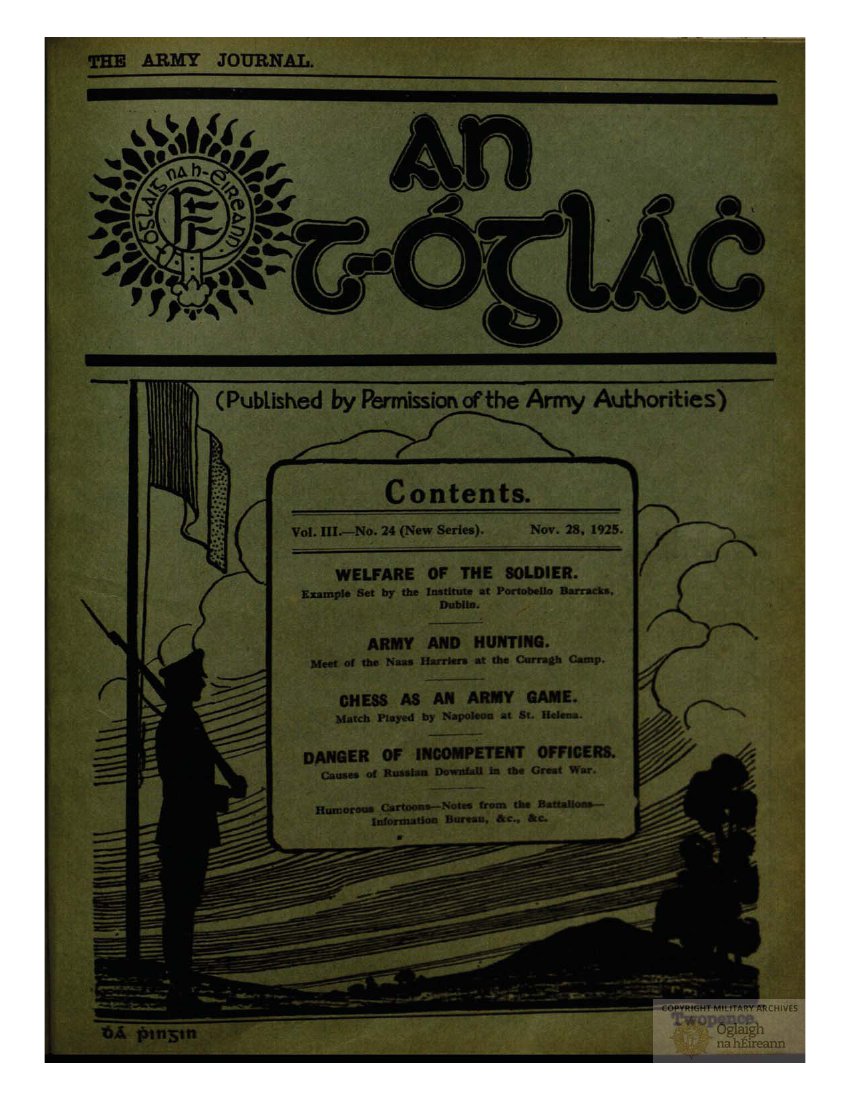
Samuel Barclay Beckett was an undergraduate at Trinity from 1923 to 1927. In the 1925-26 season of the Armstrong Cup, the six teams included both Trinity (or Dublin University) and National Army G.H.Q. The Army magazine An t-Óglách has a full set of issues online at https://antoglach.militaryarchives.ie/. Here’s the front cover of vol. 3, no. 24, from November 28, 1925:

An_t-Oglach_1925_11_28_p1

(there’s a spurious fada on the ‘a’: An t-Óglach = The Volunteer)

and page 7 5 of the same issue is devoted to chess:

An_t-Oglach_1925_11_28_p7

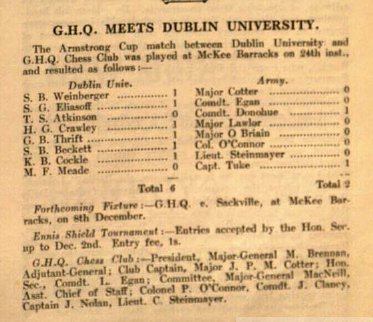
At the end of the right column there’s a scorecard of the Armstrong Cup match between National Army G.H.Q. and Dublin University, played at McKee Barracks on November 24, 1925:

An_t-Oglach_1925_11_28_p7-detail

Board 6 for Dublin University is S. B. Beckett.

I suppose it’s possible that it’s not the same person, and that some other S. B. Beckett was at Trinity at the same time, and also interested in chess. But I don’t believe it: that’s our man!

Posted in Articles | 3 Comments

Gonzaga Masters 2014

The Gonzaga Classic was held two weeks ago, a little earlier than usual. In the Masters, David Fitzsimons had a 200+ point rating advantage over the field and had won the event for the four previous years. Once again in Irish sport, however, 5-in-a-row was a bridge too far, and this time victory went instead to Killian Delaney.

The organisers deserve great credit for making the games available: Herbert Scarry’s report on the ICU web site has 49 of the 50 games. A full tournament report has now been posted here.

There were several interesting games, in particular John Healy’s win as Black against Conor O’Donnell in round 1 and the marathon Janusaitis-Nikrow game in round 3, as well as Scott Mulligan’s shock win against Fitzsimons in round 1.

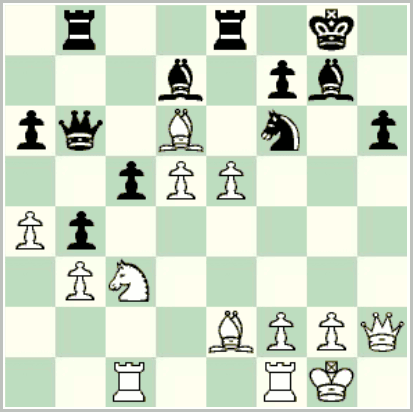
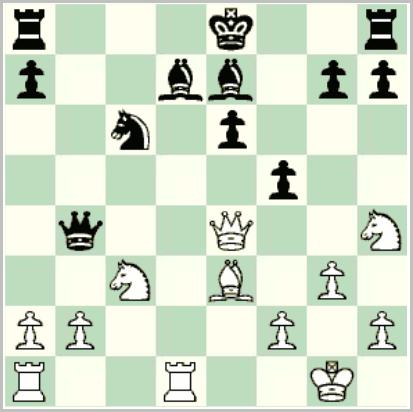
Delaney-Fitzsimons, Gonzaga Masters 2014The most interesting of all was the deciding last-round game between Killian Delaney and David Fitzsimons. Delaney, playing White, was a full point ahead and needed only to draw. In the diagrammed position he uncorked the amazing 21. Nxf5 ?!!?. I did not understand the thinking behind this move so finally resorted to Houdini 3.0, which finds itself baffled also. After 21. … exf5 22. Qf3 Qg4? (22. … Rd8 and Black must be close to winning) 23. Qd5 Rd8 24. Bc5 f4? (24. … Bxc5 with complications) 25. Re1 fxg3 26. hxg3 Qf5 27. Bxe7! the players agreed a draw. After 27. … Nxe7 28. Re5 Qf7 29. Rae1 White recovers the piece and emerges a pawn up, e.g. 29. … 0-0 30. Rxe7 Qxd5 31. Nxd5 with good winning chances.

[Click to replay the full game.]

[Update, February 12, 2014: the first posted version of the tournament report had some glitches, spotted by the eagle-eyed David McAlister. The most serious was the entire omission of the game Aherne-Murray from round 4, which caused knock-on effects throughout. Another glitch was caused by a discrepancy between the ICU ratings report and the actual results: David Murray was initially defaulted in round 1 in error, and that’s how it is still shown in the ratings report, but in fact he received a ½-point bye, as again confirmed by David McAlister after checking with Herbert Scarry; this affected the prize list as Murray finished clear second on 4½/6.]

Posted in Gonzaga Classics, Tournaments | 1 Comment

Ruane-O’Boyle, Heidenfeld 2013-14

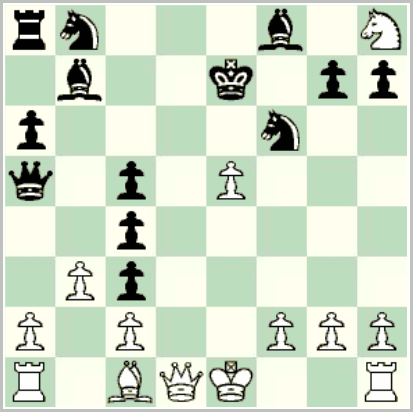
ruane-oboylle-2014An entertaining game from last weekend’s Heidenfeld match Drogheda-St. Benildus has been posted on the Benildus web site (The Madness of the St George–good title!). In the diagrammed position it’s Black to play his 14th.

The madness was all set in motion by 7. … bxc3 ??! (the ‘!’ is for entertainment value).

[Click to replay the full game.]

Update, February 13, 2014: Dónal O’Boyle adds a comment on the Drogheda C.C. web site, claiming that capturing the knight on move 7 is fine: “After 10.-Bc4, I should have played …-cxb2 11.-Bxb2 (others are bad)-Qa5+ 12.-c3-Nh6! and black is winning, for example: 13.-O-O-d6 14.-Bd5-dxe5 15.-Bxb7-Ra7 and black is ok.”

Posted in Games | 4 Comments