Karpov-Moles, Groningen 1967-8

In the comments to Walsh-Botvinnik, Martin Crichton mentions a game between Kiernan (presumably Bernard Kernan) and Karpov, when the latter was World Champion. I’m sceptical that such a game exists (I couldn’t find it in any of the normal databases or a half-dozen or so Karpov books) and think Martin might be mixing it up with a game played by another very gifted (and slightly older) Irish player.

I can still remember 39 years ago buying “The Best of Karpov” by Peter Markland (Oxford University Press, 1975) in a Belfast bookshop. A little sticker “Karpov World Champion” had been added to the cover in a cunning ploy to maximise sales. This was a collection of 75 Karpov games, up to his 1974 Candidates final victory over Viktor Korchnoi. Karpov inherited the world title the following year on Fischer’s “abdication”. By a nice coincidence Game 2 in the Markland collection featured a Belfast man, John Moles, and the course of the game bears a similarity to Martin’s description of the “Kernan game.”

The book Martin refers to as Karpov’s “My 500 Best Games” may well be “Karpov’s Collected Games” by David Levy (Robert Hale, 1975). Subtitled “All 530 Available Encounters”, it was clearly a rival to the Markland book and it ended at exactly the same point in chess history. Karpov had a direct involvement in this book too, by making available all his game scores. He also helped choose which of the 530 games should be annotated, some of those by Karpov himself. Fortunately for our understanding of the Moles game, it has the World Champion’s own annotations.

Karpov had chosen the 75 games for inclusion in “The Best of Karpov” but Markland had annotated them. Markland’s introduction to the game had stated:

“This game shows how relentless pursuit of a straightforward and simple plan can produce a win. The white strategy of bombarding the weakened a-pawn cannot satisfactorily be met and although Black appears to have some counterplay this is merely an illusion.”

All 75 games are deeply annotated by Markland and this was not some quick to publication effort to take advantage of Karpov’s status. At the time, I had no reason to doubt Markland’s take on the game. However when I played over the game again all these years later with the benefit of Karpov’s annotations and an engine running in the background, there was a surprising twist in the tale.

Anatoly Karpov-John Moles
European Under 20 Championship 1967-8, Groningen
Final-Group A (Round 2), 3rd January 1968
[Click to play through the full game]

1.e4 e5 2.Nf3 Nc6 3.Bb5 a6 4.Ba4 Nf6 5.Qe2 Be7 6.c3 b5 7.Bb3 d6 8.a4 Bb7 9.0-0 0-0 10.d3 h6 11.Re1 Nh7 12.d4 Ng5 13.Bxg5 hxg5 14.d5 Na7 15.Rd1 g4 16.Ne1 Bc8 17.axb5 Nxb5 18.Bc4 Bd7 19.Nc2 Qc8 20.Nd2 g6 21.Nb4 Bg5 22.Ra5 Qb7 23.Nb3 Kg7 24.Rda1 f5 25.Nxa6 (Diagram 1)
“White wins a pawn and completely occupies the Q-side. It seems that Black has failed to create any counter chances, but that is only an illusion. Now the game becomes unexpectedly sharp” – Karpov.
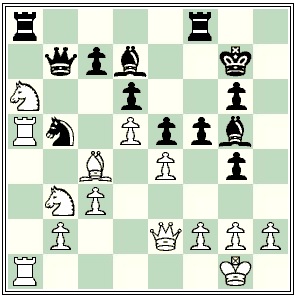
After 25.Nxa6

Diagram 1

25…Qb6
“Black’s only chance. He sacrifices a piece and gets an ominous attack due to the fact that White’s pieces are tied down” – Karpov.
26.Bxb5 fxe4 27.c4
Markland gives this an exclamation mark. Karpov remarks that this is best and provides an analysis of an alternative variation: 27.Bxd7 Rxf2 28.Qxf2 Be3 29.Qxe3 Qxe3+ 30.Kh1 Rh8 31.Bxg4 Qg3 32.Bh3 Rxh3 33.gxh3 Qf3+ 34.Kg1 Qe3+ 35.Kf1 Qf3+ and draws. If 36.Ke1 e3!
27…Rxf2 28.c5
“Black’s attack is over and best here would be to resign” – Markland. However, this may not be at all correct and possibly Karpov should even has chosen his alternative at move 27.
28…Rxe2 29.cxb6 Be3+
“Now I had to think again” – Karpov.
30.Kh1 (Diagram 2)
Karpov was concerned about being mated playing this move but considered “Black has an excellent position” after the alternative 30.Kf1 Rf2+ 31.Ke1 cxb6 (in fact it’s even worse than that; the engine gives 31…Bxb5 and mate in 8)
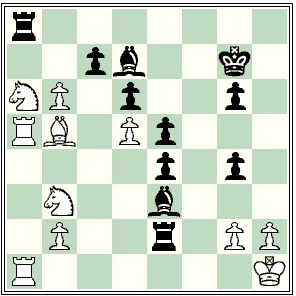
After 30.Kh1

Diagram 2

30…Bxb5
The modern engine again sees more: Karpov had considered the possibility of a mating attack starting with 30…Rh8 and he was going to rely on 31.Bxd7, but after 31…Bf4 32.h3 Rxh3+ 33.gxh3 g3 (Precise move order is important here; Karpov had only considered 33…Rh2+ 34.Kg1 g3 35.Re1 winning for White) 34.Kg1 (the threat was Be3 and Rh2 mate) 34…g2 35.h4 Be3+ 36.Kh2 g1Q+ and Black mates next move.
If Black had gone 30…Rh8 White needed to play 31.Bxe2 when, as Karpov had foreseen, 31…g3 32.h3 Bxh3 33.gxh3 Rxh3+ 34.Kg2 Rh2+ 35.Kxg3 Bf4+ 36.Kg4 Rg2+ 37.Kh3 Rh2+ 38.Kg4 is a perpetual check.
31.b7 Rh8 32.b8Q Rxb8 33.Nxb8
Karpov simply remarks: “White is a rook ahead.” However it appears that things are still not that simple.
33…Bc4 34.R5a3
Probably an error. The engine prefers 34.Na6 assessing it at about -0.5.
34…Rxb2
It would seem that only here did Moles go wrong. If instead 34…Bxd5 White will still have great difficulty unravelling his pieces. Analysing this position is above my pay grade but the engine is confident that White is at least -2.0.
35.Na5 Rxb8 36.Nxc4 Bd4 37.Rd1 Rb4
Here’s another little surprise. We are following the game score as given in the two books. However many modern websites and databases (e.g. the ICU) give the end of the game as 37…Rb3 (which would give away a Rook) 38.Ne3 Rb5 39.g3 Rc5 40.Kg2 Rb5 41.Rc1. A hat tip to the Kibitzers at Chessgames.com.
38.Ne3 Rb5 39.g3 Rc5 40.Kg2 Rb5 41.Rc1 1-0

This game must have meant something to Karpov for him to select it twice for particular attention. Maybe it provided one of the building bricks towards a greater understanding of chess on the way to becoming World Champion.

Posted in Uncategorized | 3 Comments

Walsh-Botvinnik, Munich 1958

It’s a rare honour for any amateur player to play a reigning world champion. How many Irish players can claim this distinction? The number must be very small.

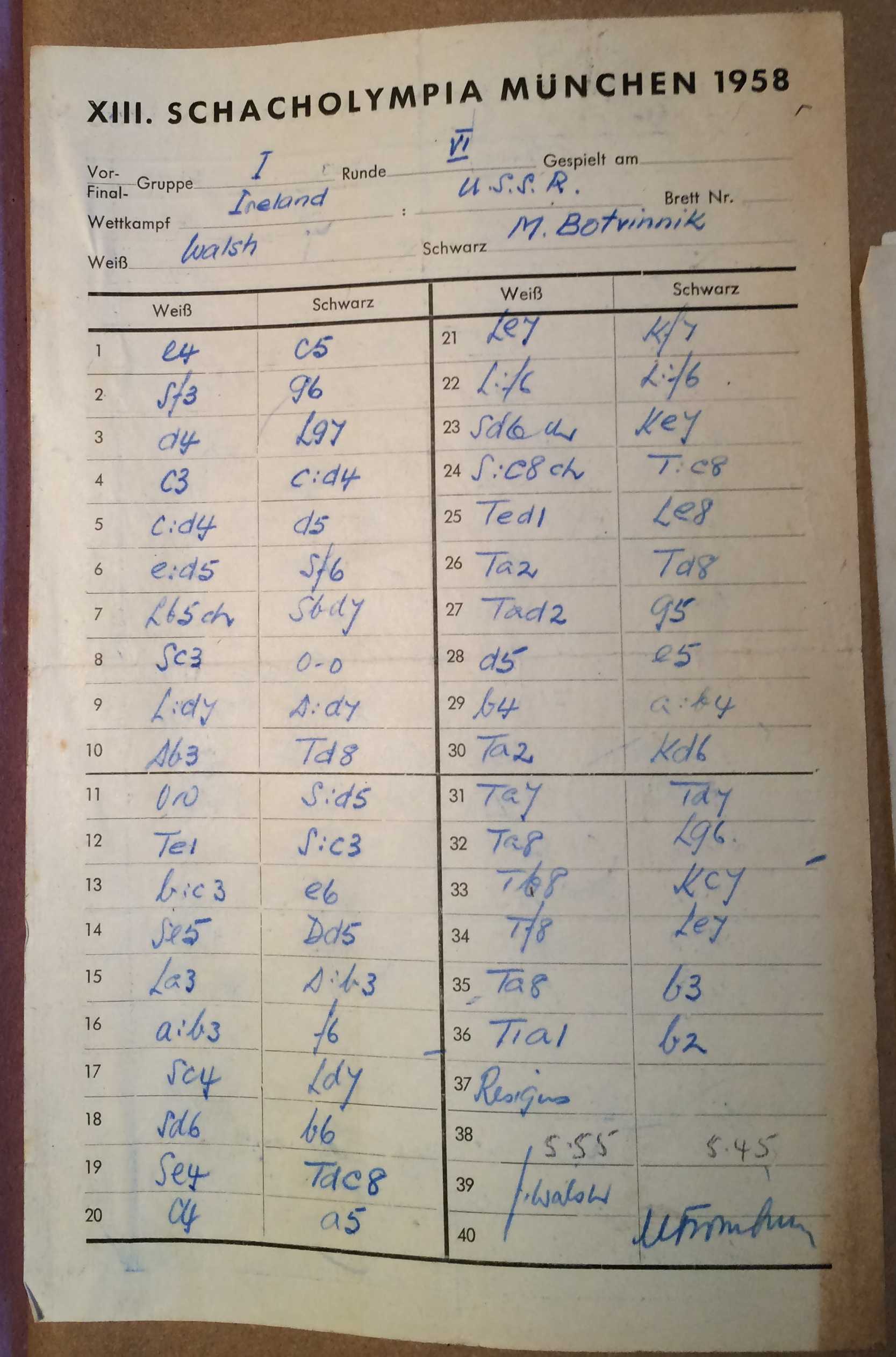
One player who can is J. J. Walsh. And here is the evidence: the scoresheet signed by Botvinnik himself:

Walsh-Botvinnik, Munich Olympiad 1958

Ireland played the USSR in the preliminary rounds of the Munich Olympiad 1958. Botvinnik had regained the world championship title earlier that year, winning his return match against Smyslov. [Click to play through the full game.]

Posted in Games, Photos | 5 Comments

First impressions and second thoughts

The latest issue of The New Winawer Report has now been posted.

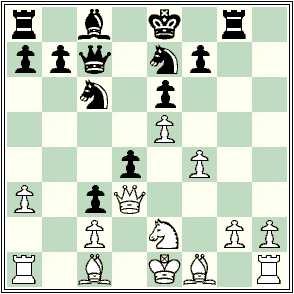
The New Winawer Report, issue 20This one concerns the new main line of the Poisoned Pawn, where Black plays … dxc3 instead of … Bd7, and follows with 12. … d4 (diagram). Theory knew of this as far back as 1957, based on the game Kots-Ilivitsky, USSR Championship ½-final, Sverdlovsk 1957, but it did not catch on. But why not? It’s easy to dismiss such anomalies with a shrug and a comment on “the vagaries of fashion”, but I argue it’s worth making a more searching enquiry about what was missed earlier and why.

Apart from such speculations, the issue has a new game that’s missing from all the databases, as far as I can tell, but that pre-dates all known games in this line. It’s even quite a nice win for Black. See Procter-Knibbs, Postal Chess Club All-play-all 1E, 1949.

Posted in Articles | Leave a comment

Myles na gCopaleen

The last post mentioned that Gerry O’Nolan, member of Dublin C.C. for fifty years, was a brother of the journalist/author Brian O’Nolan, better known as Myles na gCopaleen or Flann O’Brien. As Flann O’Brien he wrote several celebrated novels: At Swim-Two-Birds, The Third Policeman, and The Dalkey Archive. As Myles na gCopaleen he had a long-running column in the Irish Times, Cruiskeen Lawn, a strange mixture of satire and fantasy covering a wide range of stock characters and topics.

He doesn’t seem to have played chess seriously: J. J. Walsh recalls playing one or two offhand games with him, but that’s about it. However chess crops up occasionally in Cruiskeen Lawn. Here is one example. It’s taken from the Irish Times of Saturday, March 25, 1944. And from an actual copy of the newspaper, mind you, which I bought in San Francisco a couple of years ago. It bears the stamp “Office of Strategic Services”: that’s the precursor to the CIA. I wonder what they made of Myles na gCopaleen.

Anyway, on p. 3 we have:

CRUISKEEN LAWN
By Myles na gCopaleen

It has been brought to my attention that an unfortunate misprint occurred in the notation of my chess game with Capablanca, recorded in this column a few weeks ago. I give the game again and thank the many anxious souls who have written to me on the matter, wrung up, sent telegrams, and called personally.

White— Black—
M. na gC. Capablanca
1.   P-K4 P-QKt3
2.   B-B4 B-Kt2
3.   P-Q3 P-KB4
4.   P x P B x P
5.   Q-R5 ch. P-Kt3
6.   P x P Kt-KB3
7.   B-7 mate

I would again counsel all serious students of the game to study this great game and commit it to memory. It is among the finer things done in the masterplay of yesterday.

That’s followed by a Keats and Chapman item that I’ve seen in anthologies: “On one occasion he [Chapman] dreamt that he had died and gone to heaven”, if you’re familiar with the genre.

[Click to replay the full game!]

Posted in Players | 4 Comments

Gerry O’Nolan

The ICU web site has a recent post discussing the history of Dublin C.C.. The major work on this is of course the outstanding history compiled by Dr. A. A. Luce around 1967, at the time of the club’s centenary. This is now available on the Dublin C.C. web site, and is highly recommended if you haven’t seen it before.

I wasn’t aware until I saw the ICU post, though, that there is an additional document on Dublin C.C.’s site, covering the club history from 1967 to the present day, compiled by Denis Dempsey, very much in the same style as Dr. Luce’s booklet and also highly recommended.

One of the players mentioned in the update is Gerry O’Nolan, a member of the club from (approximately) 1934 to his death in 1984. Though the update doesn’t mention it, I understand he was a brother of Brian O’Nolan, a.k.a. Myles na gCopaleen, a.k.a. Flann O’Brien, the celebrated journalist/author.

The ICU games archive has none of his games, and I have never seen any anywhere else either. However we can now rectify this gap with two games, both of which featured O’Nolan with the Black pieces against J. J. Walsh. Both games are from a scorebook of 100 of J. J. Walsh’s games from 1949 to 1961, which J. J. has kindly lent me.

In Walsh-O’Nolan, Club tournament 1951, Black dropped a pawn early in the opening and White had no difficulties converting. (It’s not clear which club this was. J. J. switched from Eogahn Ruadh to Clontarf in 1951, and did not join Dublin until 1957.)

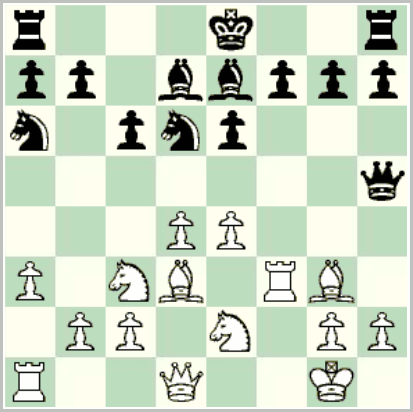
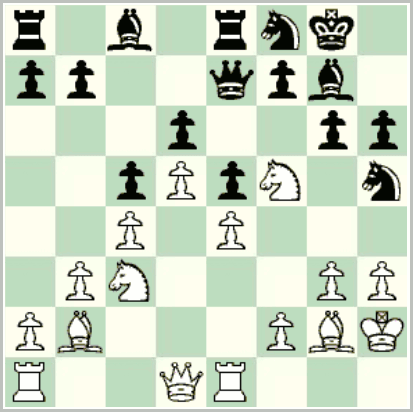
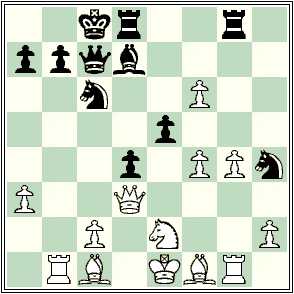
Walsh-O'Nolan, Leinster ch 1954The second game is from the 1954 Leinster championship, the first of two occasions on which J. J. won the championship. In round 5, a Trompowsky led to the diagrammed position with Black to move. J. J.’s notes point out that 13 … 0-0 loses quickly to 14. Bxd6 Bxd6 15. e5 Be7 16. Rh3, while 13. … 0-0-0 is met by 14. b4 with an attack. In the game, O’Nolan tried 13. … g5, but after 14. Bxd6 Bxd6 15. e5 Be7 16. Rh3 Qg4 17. Rh6 with h3 to follow, the black queen had to be given up.

Does anyone know of any other games of Gerry O’Nolan, and in particular any wins?

Posted in Games, Players | 2 Comments

An Armstrong Cup record?

In the last post I mentioned that the 1984-85 season has been up to now one of the most mysterious of all Armstrong seasons. David McAlister’s full roll of honour at irishchesshistory.com contains only the name of Dundrum as the winning team—and even there his only source was myself. I played on that team but had only the haziest of recollections of the season. No reports appeared in Fiacla Fichille, and none in the Irish Times either. Even J.J. Walsh’s scorebooks, an invaluable resource for virtually any other season from 1951 to his retirement, showed nothing for 1984-85: he seems to have taken a break from the game for that one season.

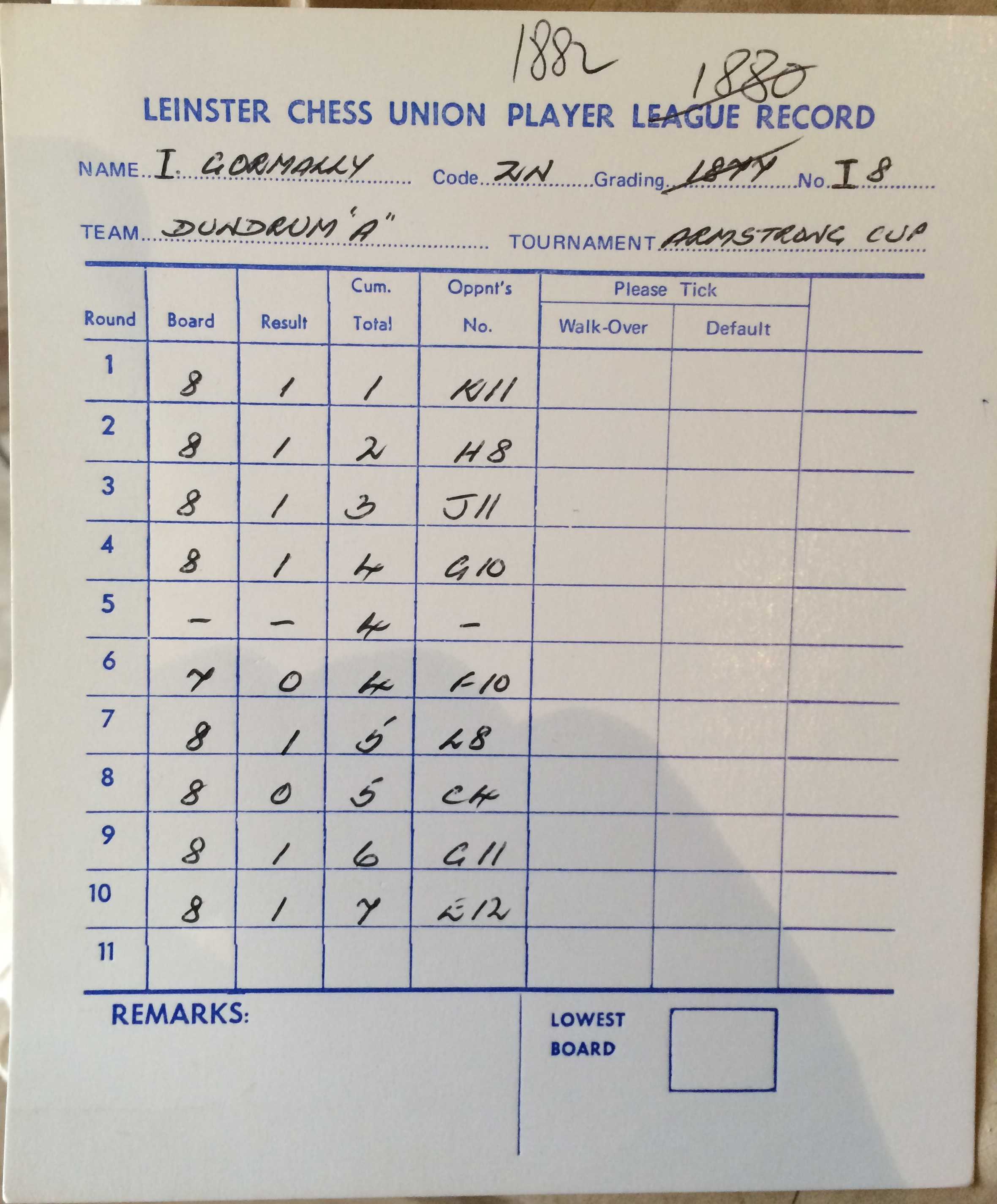
So it was quite a find when John Gibson produced the full set of player cards for that season. With these, the full winning team in board order, and including everyone who played any games that season, was Seán Coffey, Kevin McHugh, John Griffin, Eric McMahon, Brian MacRéamoinn, Brendan Lyons, David Drakeford (capt.), Ivan Gormally, and Paul Fallon.

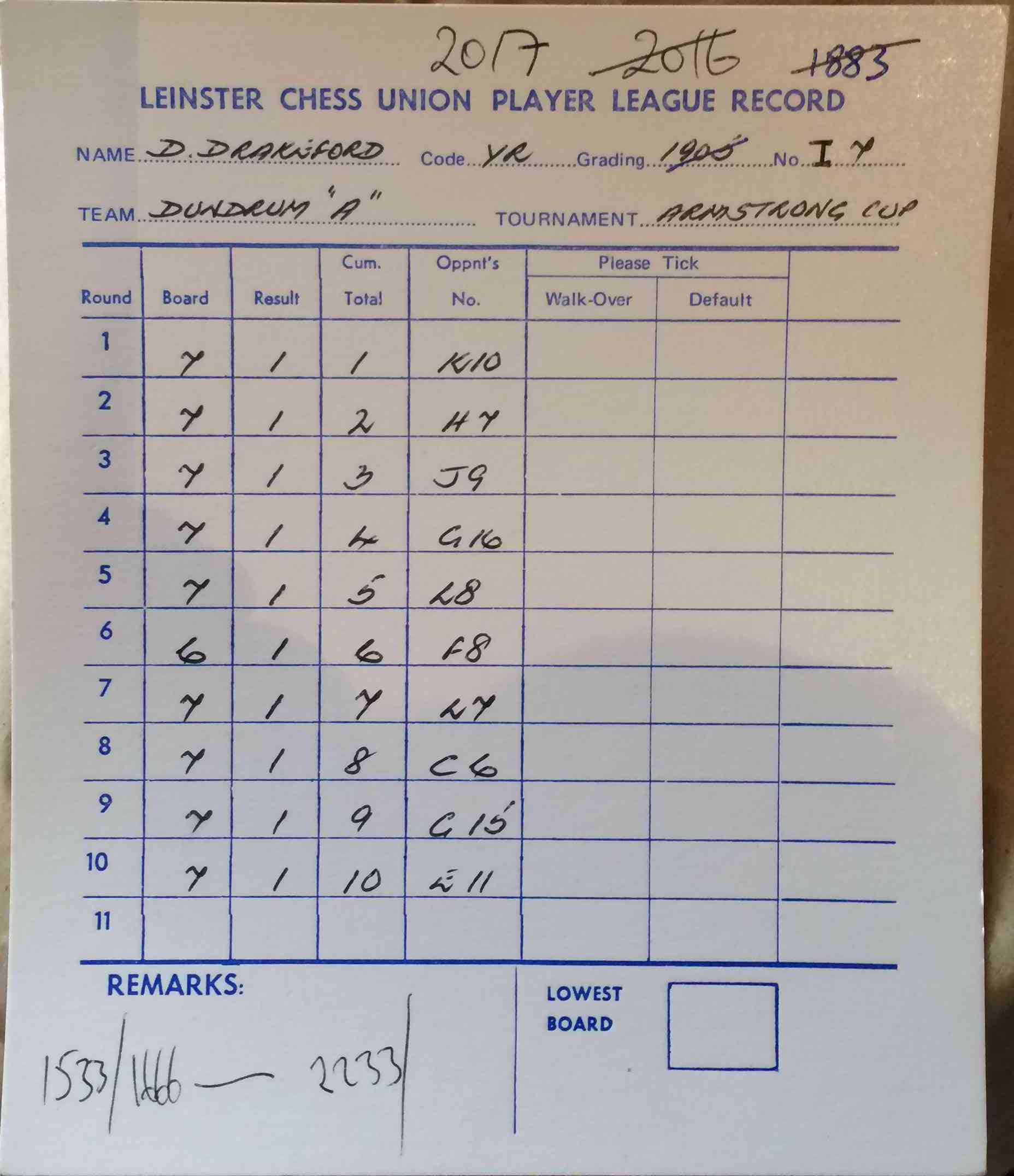
Our captain David Drakeford had a particularly good season. Here’s his player card:

David Drakeford Armstrong Cup record 1985

So that’s 10/10. Furthermore, this was in the brief era when the Armstrong was held in two stages: two qualifying groups of six teams, followed by a championship section of six teams and a relegation section of six teams. The championship section thus formed a sort of ‘super-Armstrong’ and made very high scores even harder to achieve.

10/10 scores in the Armstrong must be rare. But there’s another unusual aspect to the team’s record, for which David as captain deserves credit: the winning squad used a total of 9 players all season, and even then the reserve Paul Fallon played only two games. And in addition the team conceded no walkovers or defaults. This must also be a candidate for an all-time record for the Armstrong.

Posted in Armstrong Cup, Players | 4 Comments

Ivan Gormally c. 1962-2013

Early this year I heard the sad news of the very untimely passing of Ivan Gormally. He was a clubmate of mine from our very earliest days at Dundrum C.C. and would have been a couple of years older than me.

He was one of the Dundrum team that played MTK Budapest in the European Club Championship in 1985, as previously recounted here. Dundrum had qualified by winning the Armstrong Cup in 1984-85, for the first and only time, but I couldn’t recall whether Ivan had played on the Armstrong team. And that particular season is one of the most mysterious of all Armstrong seasons, with essentially no records previously available. Furthermore the ICU games archive had none of his games.

During my last trip to Dublin, however, I visited John Gibson, who turns out to have a treasure trove of records. One item is the complete set of player records from the 1984-85 Armstrong season. From this it is clear not only that Ivan played, he was a key factor in Dundrum’s victory, with a score of 7/9, mostly on board 8:

Ivan Gormally Armstrong Cup record 1984-85

As for games, one fortuitously showed up. Oliver Dunne showed me the tournament booklet for the 1981 Irish championship. At the back there are selected games from the supporting events, including the decisive last round game in the Irish intermediate championship (1500-1900), annotated by the winner of the game and the event.

Gormally-A. Delaney, Irish intermdiate championship 1981Ivan was White against Ann Delaney, and in response to 15 … Qc7-e7? he has just played 16. Nh4-f5. After 16. … gxf5 17. Qxh5 Qg5 18. Qxg5 hxg5 19. exf5 Bxf5 20. Ne4 Black had either to lose a pawn or make the concession 20. … Bxe4 21. Bxe4 when Black has no counterplay and suffers major weaknesses on the light squares. Ivan managed to convert his advantage without further problems. [Click to replay the full game.] Final scores: 1. Ivan Gormally; 2-4. “Dillon, Hassan, Thomson” [no first names given; probably Andrew Thomson?] 5/6; 69 played.

Posted in Games, Players | 2 Comments

B. E. A. Cup 1975-76

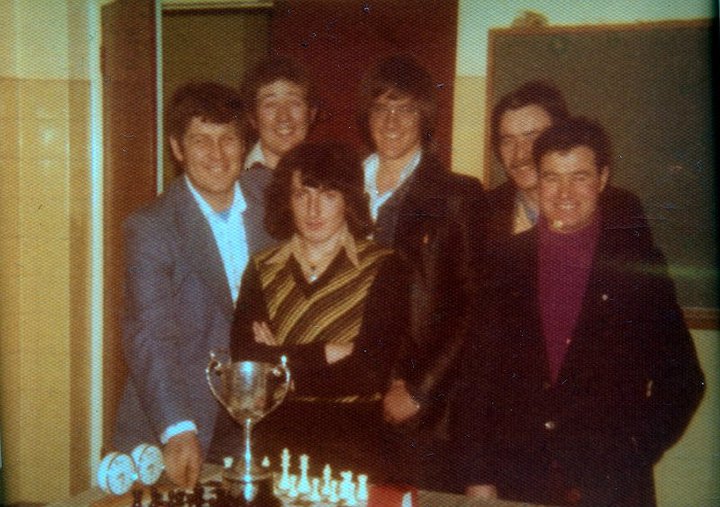
The Elm Mount team that won the B. E. A. Cup in 1975-76, with trophy:

ElmMount_BEA_197576

This is from a Facebook post by one of the players, for which thanks.

How many of the players can you identify?

You might like to compare with the picture of the Elm Mount Branagan Cup-winning team this year, for one of them!

[Update, August 30, 2014:] the photo was of course from Gerry MacElligott’s Facebook page, and he supplies the names in a comment below: left to right Ken Clarke, Seán Kennelly, Gerard MacElligott, Alan MacDonagh, Alek Tyrrell, unknown. Not pictured: Gerry K. Barry.

If I understand correctly, three of that team will be playing, still for Elm Mount, in the Armstrong Cup this season.

Posted in B. E. A. Cup, Photos | 2 Comments

Winawer Praxis—III

The latest issue of The New Winawer Report has been posted (and not before time!). This one again covers some recent games in theoretical lines. This time the games are taken from this year’s Irish championship, which featured a feast of Winawers. Four games featured 6. … Ne7 7. Qg4 alone, and there was another with 6. … Qc7 7. Qg4.

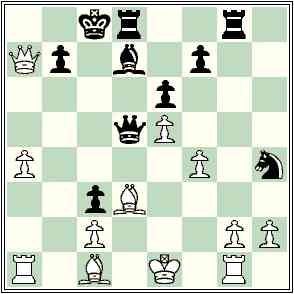
Murray-Brady, irish Ch 2014Murray-Brady from round 7 featured a novelty in a topical line. The diagram shows the position after 19. Qf2xa7 Nf5-h4!?. Previously 19. Qxa7 had never been played, but it was analysed by Berg in his recent book; Black can take a draw with 19. …Rxg2 or accept a slightly worse position after 19. … Bc6. After 19. … Nh4!? Black quickly built up a winning position. Of course it can’t be that easy, but where could White have improved and what is the evaluation with best play?

This issue considers the question, along with O’Connor-Ó Cinnéide from round 8, which delved into a long theoretical line in the 7. … 0-0 variation that has been under a cloud lately from Black’s perspective.

Posted in Articles, Games | 1 Comment

B. E. A. Cup

The recent posts about the Branagan Cup reminded me that there are many other competitions that we haven’t gotten around to covering here yet. At the final day of the Leinster Leagues this year, I was taken aback when I was asked if the intention was to cover the top competitions only: nothing could be further from the truth!

A new page has been added for the B. E. A. Cup, division 5 of the Leinster Leagues. This dates back to 1972:

“The British European Airways perpetual chess challenge cup was presented to the Leinster Chess Union at a reception in the Collegians’ clubrooms, Donnybrook, last night, by Mr. James Dunne, chief sales representative of B.E.A.

… The BEA Cup has an entry of 26 teams and play in this contest will continue until March.”
Irish Times (Thursday) November 23, 1972, p. 5.

That’s quite an initial entry list! Of course this was immediately after the Fischer-Spassky match and at the all-time height of chess interest in Ireland. (The Branagan Cup dates to the same era: its first round was held on February 14, 1973, with a similarly huge entry, though that first competition didn’t finish until 1974.)

Though I never played in the B. E. A. Cup myself, I do have a connection, as my father played in it. From the Irish Times (Wednesday) November 13, 1974, p. 4, a third-round match in the B. E. A. Cup (Central), played at St. George’s Quay:

Caissa “B” E. S. B.
D. Doyle adj. G. Meeghan
J. Power 0 – 1 A. Higgins
B. Doyle ½ – ½ E. Clancy
J. Burke 1 – 0 C. Kavanagh
J. Bowes 1 – 0 J. McCarthy
P. Guiney 0 – 1 K. Coffey
2½ – 2½
Posted in B. E. A. Cup | 1 Comment