Into the Labyrinth—II

The latest issue of The New Winawer Report has (finally!) been posted. It continues from the last issue’s discussion of the 13. Qxc3 line, where 16. … f6, long one of Black’s main defences, is in serious difficulties. The situation is no better for 16. … Be8, another main defence, so what’s left?

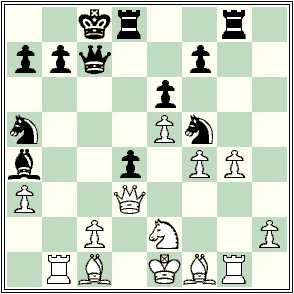
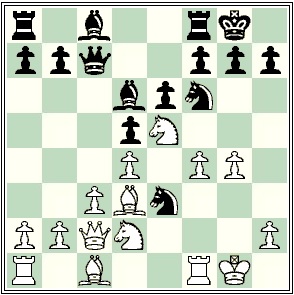
tnwr-22This issue considers the remaining possibility 16. … Na5 via the recently-completed correspondence game Churkina—Kirsanov, ICCF World Cup 20 prelim 1 2013. After 17 g4 (17 Rb4 is the alternative; it’s not covered in any detail in this issue but Black appears to be fine) 17. … Ba4! we reach the diagrammed position, which is critical for the soundness of the entire Poisoned Pawn, and which has received widely divergent evaluations.

Posted in Articles | Leave a comment

Dunsany Premier Tourney 1941

The 1940 Irish Championship was affected by the late withdrawal of the two Ulster representatives, A.L.Davies and J.D. Peebles, because they were unable to travel to Dublin. As the Second World War continued into 1941, the Irish Chess Union Council decided, as the Ulster Chess Union was unable to be represented, to suspend the Irish championship for that year and replace it with a new competition, described as “the Dunsany Premier Tourney.”

The tournament was arranged to take place at the Dublin Chess Club from Monday 21st to Saturday 26th July and to be played on very similar lines to the Irish Championship with two four-hour sessions each day. Lord Dunsany, the President of the ICU, provided three valuable prizes.

There was a strong entry with the 1940 Champion, J.J. O’Hanlon, plus the four players who only finished a half-point behind him – C.J. Barry, Austin Bourke, Gerard Kerlin and Warwick Nash – all taking part. Two-time Irish champion, T.G. Cranston, who had not competed in 1940, was a strong addition.

The surprise of the first two days was O’Hanlon losing both his games on the Tuesday to Nash and Barry and it was Kerlin who was making the running, having won 4 games. On the Wednesday evening the second session was reserved for adjourned games to be played off and Kerlin was then held to a draw by O’Hanlon but still enjoyed a comfortable lead.

Standings after Round 5 and adjourned games played off:
G. Kerlin 4.5
T.G. Cranston 3.0 + 1 adj
W. Nash 3.0
J.J. O’Hanlon, L.J. Close 2.5
A. Bourke, R.T. Varian, C.J. Barry 2.0
T.A. Vard 1.5 + 1 adj
S.A. French 1.0

Day 4 on the Thursday and the tournament was thrown wide open again after Kerlin lost to both Cranston and Bourke respectively in Rounds 6 and 7. Despite this he was still a half-point ahead of Nash, Barry and Cranston, though the last-named had two adjourned games in hand.

Cranston fell out of contention for first by losing both his games on the Friday. Barry, his Round 9 conqueror, finished with 4 straight wins and posted a total of 6 points. Front-runner Kerlin had drawn in the Friday morning session; his Round 9 game against Close was adjourned and now he needed to win it to catch his Sackville CC club-mate Barry. With a number of adjournments scheduled for Saturday, the third prize (and second as well if Kerlin lost) was also still to be decided with four (of five) players in with a chance of winning it (them).

Standings after Round 9 with adjourned games still to be played off
C.J. Barry 6.0
G. Kerlin 5.0 + 1 adj
W. Nash 5.0
J.J. O’Hanlon, T.G. Cranston, A. Bourke 4.5 + 1 adj
L.J. Close 3.5 +1 adj
R.T. Varian 3.0 +1 adj
S.A. French 3.0
T.A. Vard 2.0 + 2 adj

In the Saturday morning adjournment session Kerlin beat Close to catch up with Barry. O’Hanlon, Cranston and Bourke all won their adjourned games to finish a half-point behind. As Bourke could not remain for a play-off for third prize, they drew lots which Bourke won. A play-off game played on the Saturday between Kerlin and Barry to resolve the tie for first place ended in a draw. A three-game match starting on the following Monday, again to be played in the Dublin CC clubrooms, was then arranged.

[The report in the British Chess Magazine (Volume LXI, page 238) does not mention the Saturday play-off game and this omission is repeated in Di Felice, Chess Results 1941-1946 (McFarland, 2008) at page 17. This is unsurprising since Di Felice gives the BCM as his source. The resolution of third place is not clarified by Di Felice, while the BCM specifically indicates there was a tie for third. The correct state of affairs on these issues can be found in the contemporary reports of the Irish Independent, Irish Press and Irish Times. Di Felice also fell into a common error, which we pointed out in our June 2011 article T.G. Cranston: correcting and improving the record in referring to Timothy G. Cranston.]

Two games in the play-off match were played on the Monday. Kerlin won the first of these in 32 moves. Game 2 had a bizarre finale – Barry was in a winning position when he made an illegal move (he took his own Knight with a pawn). He then rectified this and forced Kerlin to resign. The third and final game in the play-off match was an interesting and hard-fought encounter.

Gerard Kerlin – Charles J. Barry
Dunsany Premier (play-off match) (Round 3)
Dublin, Tuesday 29th July 1941

Play through the game

1.d4 d5 2.c4 e6 3.Nc3 Nf6 4.Bg5 Be7 5.e3 0-0 6.Nf3 Nbd7 7.Rc1 c6 8.Bd3 h6 9.Bh4 dxc4 10.Bxc4 Nd5 11.Bg3 N7f6 12.0-0 Bd6 13.Bd3 Bxg3 14.hxg3 Qa5 15.e4 Nxc3 16.bxc3 Qxa2 17.c4 Qa5 18.e5 Ne8 19.Bb1 Qd8 20.Qd3 f5 21.Nd2 Qg5 22.f4 Qe7 23.c5 g6 24.Nc4 Rf7 25.Nd6 Nxd6 26.exd6
White already had good compensation for the pawn and this exchange seems to make the sitiuation more difficult for Black.
26…Qf6 27.Rfe1 b6 28.Re5 b5 29.Rce1 a5 30.Ba2 a4 31.Bxe6
According to the engines 31.Rxe6 was even stronger.
31…Bxe6 32.Rxe6 Qg7 33.d5! a3

Kerlin-Barry

Position after 33…a3

34.Qd1
Seeing the a-pawn advance, White seems to get cold feet. Plunging on with the logical 34.dxc6 should win, e.g. 34…a2 35.d7 a1Q 36.Rxa1 Qxa1+ 37.Kh2 Qa5 38.Re8+ Kh7 39.Rxa8 Qxa8 40.c7
34…a2 35.Qa1 b4 36.R6e5 cxd5 37.c6 Qf6 38.Re8+ Rxe8 39.Rxe8+ Kg7
Wrong square for the King – instead 39…Kh7 should lead to a draw after 40.Qxa2 (best) Qxd6
40.Re5 b3 41.c7 Rf8 42.c8Q Rxc8 43.Re7+ Kg8 44.Qxf6 1-0

Although the Irish Championship did not resume until 1946, the Dunsany Premier Tourney was never held again.

No Name          Total 1 2 3 4 5 6 7 8 9 10 Prize

1  G.J. Kerlin   6     * 1 0 0 = 1 1 1 1 =  First
2  C.J. Barry    6     0 * = 1 1 0 1 1 1 =  Second
3  A. Bourke     5.5   1 = * = = 1 = 0 = 1  Third
4  T.G. Cranston 5.5   1 0 = * = 0 = 1 1 1 
5  J.J. O'Hanlon 5.5   = 0 = = * 0 1 1 1 1 
6  W. Nash       5     0 1 0 1 1 * = 0 1 = 
7  L.J. Close    3.5   0 0 = = 0 = * 1 0 1 
8  R.T. Varian   3     0 0 1 0 0 1 0 * 0 1 
9  S.A. French   3     0 0 = 0 0 0 1 1 * = 
10 T.A. Vard     2     = = 0 0 0 = 0 0 = * 

Play-offs for first: G.J. Kerlin 2.5-1.5 C.J. Barry
Posted in Tournaments | Leave a comment

The trials of Aibhistín de Búrca

At the Annual General Meeting of the Irish Chess Union on the 13th March 1935 the feasibility of sending a team to the International Team Tournament to be held in Warsaw in the second half of August was discussed. It was decided to make an appeal for funds and pending the result, consideration of who should be selected for the team was deferred.

Less than a month had passed when a meeting of the ICU Council on the 8th April was told that there had been considerable support for the venture from all parts of the island, with Dublin, Belfast, Limerick, Cork, Athlone, Kilkenny and Kildare all responding generously. It was confidently anticipated that the full funds needed would be forthcoming and it was decided to send an entry to FIDE. Selection of the five-player team was to be made at a later date.

It is at some point after this that the hero of our piece entered the fray. Apparently fearing that there would be a metropolitan stitch-up of the selection process, he launched a broadside at the ICU.

“At the time, I was a postgraduate student at Cork, and full of youthful confidence and arrogance. When the composition of the Irish team was announced, I immediately sent an indignant telegram to the Irish Chess Union demanding representation for the provinces and challenging the entire team to personal combat! Luckily for me, no doubt, the Irish Chess Union did not take up this challenge, but they did invite me to come to Dublin to play a five-game challenge match against the promising young player, Oscar Quigley.” (Source: International Team Tournament Warsaw 1935 by Austin Bourke: Chess in Ireland, January 1960, page 12)

I have been unable to find any official announcement of the team in the period before the Quigley match. Perhaps de Búrca had heard rumours of its composition. Under a headline “First Three Places Already Filled?” the Irish Independent for the 30th April speculated that Brian Reilly (born of English parents in France and still residing there, but eligible through his County Meath-born paternal grandfather), the Irish champion James Creevey and J.J. O’Hanlon would be on the team. However it did go on to say: “The other two places will be hard to fill, as there are so many to be considered.”

Bourke’s 1960 article did not, at least in hindsight, take issue with Reilly, who was a “natural choice for Board 1” or Creevey “as Irish champion, an automatic choice at Board 2..” He expected O’Hanlon and T.G. Cranston, O’Hanlon’s great rival and fellow-veteran, also to be on the team. In relation to his fifth “suspect”: “It was said that Gerald Abrahams, then lecturing at Queen’s University, Belfast was willing to play on the Irish team.” I am unaware what the residence qualification then was, but while the Englishman Abrahams had lectured in law in Belfast it was probably only during the 1933-1934 academic year and therefore it is highly unlikely he would have been eligible to compete for Ireland.

The schedule for de Búrca set by the Irish Chess Union was an arduous one. The first game of his match against Quigley was held at the Dublin Chess Club rooms at 20 Lincoln Place on the evening of the 22nd May. After five hours play, de Búrca was victorious. The following day, de Búrca won game 2 on the 26th move, but Quigley then hit back with wins in 23 and 30 moves respectively in games 3 and 4. The final game was scheduled for the following morning. Here we pick up de Búrca’s 1960 account again:

 I won the first two games readily enough, but, in the long run, shaded the match only by winning the final game. My relief was shortlived, for, rather unkindly, a new opponent, Tom Cox, was now brought forward and I was required to play a three-game match against him.

De Búrca had won the final match game against Quigley in 32 moves on the morning of the 24th, but precisely when he became aware of the further trial is unclear. The Dublin papers only that morning had announced a two-game match between de Búrca and Cox, play in game 1 to start at 6.00pm in the evening with game 2 commencing at 10.00am on the 25th.

Perhaps de Búrca had been aware that if the Cox match ended tied at 1-1, a third deciding game would be played. In any event the provincial raider made short shrift of his second young metropolitan adversary. Game 1 ended with Cox’s resignation on his 17th move and the second game was even shorter. As Bourke pointed out Cox, at this point in his short career, was “not at all as strong as he was later to become.”

Final position

Final position

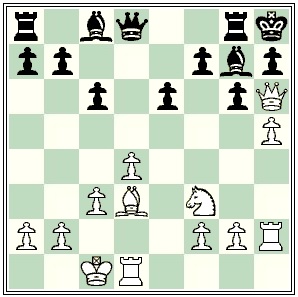
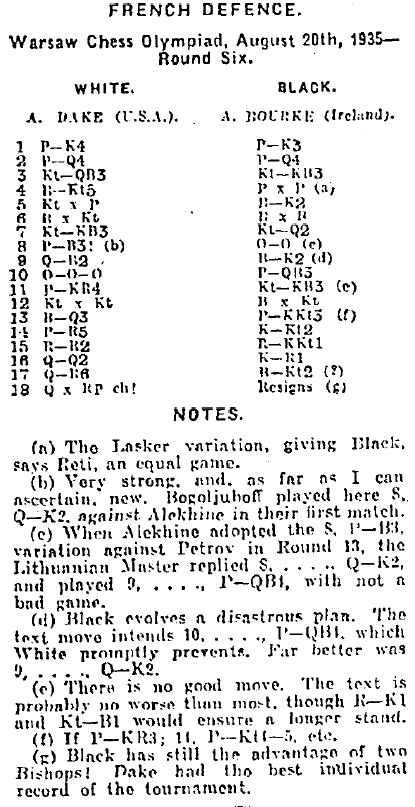
T. Cox – A. Bourke
International Trial Match (Game 2)
Dublin, 25th May 1935

Play through the game
1.e4 c6 2.d4 d5 3.exd5 cxd5 4.Bd3 Nc6 5.c3 Qc7 6.f4 Nf6 7.Nf3 e6 8.0–0 Bd6 9.Ne5 0–0 10.Qc2 Ne7 11.Nd2 Nf5 12.g4? Ne3 White resigned 0–1
[Source: Cork Examiner, 27th May 1935, page 2]

Whether these match wins absolutely guaranteed de Búrca a place in the Warsaw squad is unclear but he clearly believed that he had “fought my way into the team.” Just ten days later the official announcement of the team appeared in the press. At a meeting of the ICU Council held in the Dublin Chess Club, the place of de Búrca’s victories, the five selected (in board order) were B. Reilly, J. Creevey, J.J. O’Hanlon, T. G. Cranston and A. de Búrca.

A short explanation about the name of the winner of the two trial matches is necessary here. In his professional life as a distinguished meteorologist and for the greater part of his chess career Patrick Martin Austin Bourke used the English form of his name. However when he played in the 1935 International Team Tournament he used the Irish version de Búrca. References to the English form of his third forename are plentiful but sightings of the use of its Irish version are very rare. Indeed even Olimpbase, the quintessential source for team competition, refers to Austin de Burca. This is no trivial matter as there is more than one possibility. The best place to find the answer is in reports of the Oireachtas Championships, an event confined to Irish-speakers,. Most of the contemporary press reports of the 1935 trial matches only use the English forms of his name; however on page 9 of the Irish Independent for the 25th May reference is made (without use of the fada) to Aibhistín de Búrca.

Posted in Games, Players | 3 Comments

Irish championship 2008

A tournament report for the 2008 Irish championship has now been added to the archive here. The champion was Alexander Baburin, who was playing in his first, and so far only, championship, after finishing joint first with Alon Greenfeld, who was ineligible for the title.

We’re fortunate to have an almost complete set of games: only one of the 134 games is missing. We’re even more fortunate because of the number of interesting games: the report’s selection contains 22 games, and even at that another dozen could easily have been added.

This report fills the most recent gap in the coverage of the Irish championship. There is much information available about many other championships, and rounding out the coverage will be a priority in 2015.

Posted in Irish championships, Tournaments | Leave a comment

World Under-16 Team Championship, Viborg 1979

The news that an Irish team is currently competing at the World Youth Under 16 Chess Olympiad in Győr brought back memories: I was on the Irish team that participated in the first World U-16 team championship, far back in 1979. Though that event is grouped by Olimpbase with the later Under 16 Olympiads, the connection seems to be in name only, and the original event was a once-off.

The event was held in Viborg, Denmark, a smallish town on the Jutland Peninsula, from October 14-20, 1979. The Irish team in board order was myself (Dundrum), John Kennedy (Fisherwick), Cliff O’Connor (Kevin Barry), Suzanne Connolly (Malahide), and Tim Broome (Belfast), with Tom O’Sullivan as manager.

The event had long since been almost entirely forgotten, and all games lost, until a couple of years ago I was searching online and found a mention of the event by Jesper Nørgaard, who had played top board for Denmark B: he’s now an FM living in Mexico. I emailed him asking if he had any records, and was delighted to receive back the full set of 224 games, compiled by him from the tournament booklet (my own copy of which is long gone). There’s now a full tournament report at OlimpBase. For here I’ll just note that the event was won by England, whose top three boards were Nigel Short, Julian Hodgson, and Danny King—not bad!

In those days FIDE had a 2200 floor on ratings, so very few players in the entire event had FIDE ratings, and none of the Irish team. I recall I was a little over 2000 in the ICU list (2043?), John Kennedy was a bit over 2000, Cliff O’Connor 1900+, and Suzanne Connolly 17-1800.

In the event we finished 11th out of 16 teams, with scores myself 3/7, John Kennedy 4/7, Cliff O’Connor 0/4, Suzanne Connolly 2½/5, and Tim Broome 3/5.

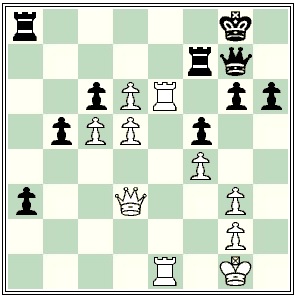
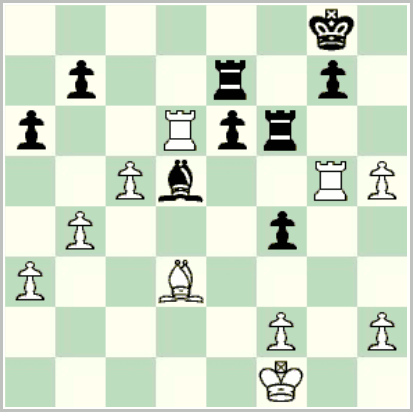
Kennedy-Kivisto, Viborg 1979I’ve uploaded all Irish games to the archive here. I didn’t realise until playing through them that John Kennedy could have finished on 7/7: he had a winning or near-winning position in every game. Here’s one example, from the last-round match against (now FM) Mikko Kivistö of Finland. Kennedy, White to play his 39th, could probably make progress by bringing his king around to e5, but instead found a neat way to tie Black down further first. How?

[Click to play through the full game.]

Posted in Games, Tournaments | 2 Comments

City of Dublin championship 2014

A full report on last September’s City of Dublin Masters (1st Juri Firstov, for the second consecutive year, though not without a little controversy) has been added to the Tournaments page. Though the turnout was on the small side (14 players), the chess was eventful and interesting. Indeed, of the 33 games available (all but one of those played), the “Interesting Games” selection in the report includes 12, an unusually high ratio.

(The “Interesting Games” are admittedly selected rather arbitrarily and superficially, based on a quick play-through. Still, first impressions can often be accurate: see for yourself.)

The diagram is from the game Oisín Benson—Killian Delaney from round 2, with Black to play. Black proceeded with a spectacular series of moves that ripped White apart. How?

[Click to replay the full game.]

Thanks are due to Pat Fitzsimons and Herbert Scarry for making almost all the games available, and very promptly too.

Posted in City of Dublin championships, Tournaments | Leave a comment

Games collection

The games page here had not been updated in over a year. Previously the pgn files provided included most games on the site, but far from all, and there was no easy way to generate a full compilation.

The new page provides comprehensive and fully up-to-date pgn files for the entire site. The files will be updated regularly.

The new system has several features that will only interest those who are interested in strict chess historical accuracy. That group definitely forms a small minority of all chess enthusiasts, so please refer to the games page linked above for details.

Posted in Administrative | Leave a comment

William Armstrong B.L.

Up until recently little was known (at least to me) of the donor of the Armstrong Cup. He appears to have been well known as a philanthropist when the cup was donated, and he died in Dublin on August 5, 1899. (Source: Irish Times, (Wednesday) August 9, 1899, p. 1.).

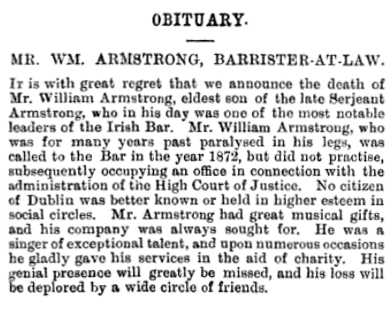
I have found some further information that sheds more light on his life. The Irish Law Times and Solicitors’ Journal, vol. 33, August 12, 1899, p. 333 (available via Google Books) gave the obituary below:

william-armstrong-obituary-1

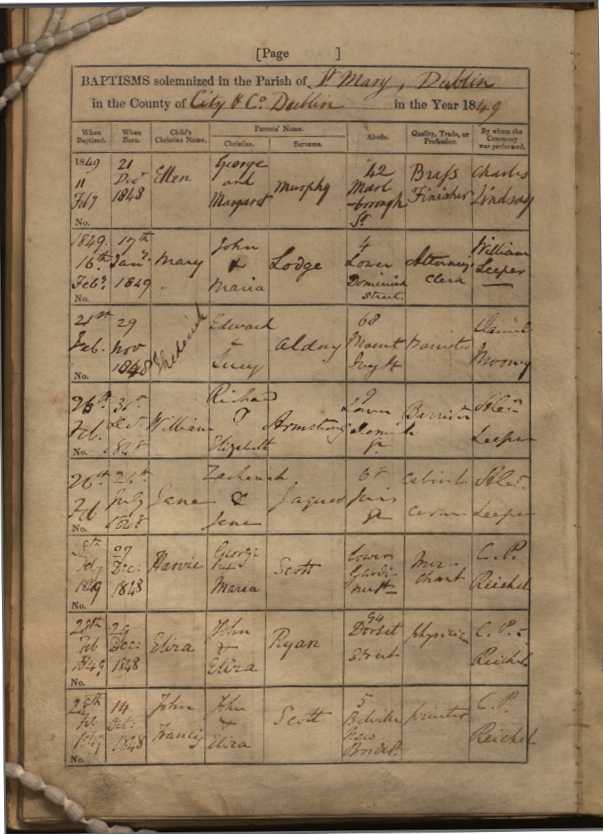
A search with his father’s title (“Serjeant-at-law”) turned up a post on a genealogy site, —by a granddaughter of his cousin (!)—from May 12 this year. And with the date of birth listed by her it was possible to find his baptismal certificate, with date of birth (fourth entry on the page):

william-armstrong-baptism-1

The family was living at 9 Lower Dominick Street at the time of his birth.

Obituaries of his father Richard mention that he (the father) was an M.P. for the borough of Sligo “in the Liberal interest” starting in 1865 (Solicitors’ Journal and Reporter, vol. 24, September 4, 1880, p. 821); he retired at the general election of 1868.

Posted in News | 1 Comment

Games, October and November

The games collection here had not been updated for over a month—pressure of work and massive amounts of travel—but now 71 new games have been added: see the November 2014 folder.

These include:
2 Armstrong Cup (from Colm Daly’s dublinchess.com site)
1 O’Hanlon Cup (from the St. Benildus C.C. web site—the first O’Hanlon game here)
2 Bodley Cup (1 from Mark Dennehy’s site and 1 from Darko Polimac at ChessMicrobase.com)
2 Limerick Open (from Colm Daly’s Irish Chess Cogitations blog)
1 Millfield Inernational 2014 (from St. Benildus C.C. site)
8 games of Paul Wallace from the Oslo International 2014 (from TWIC, as are all the following)
10 games of Gavin Wall from 4NCL Rapid events
9 games of Keith Allen from the PokerStars Isle of Man Masters 2014
11 games of Conor O’Donnell and Kevin Singpurwala from the European Youth Boys U16 Championship, Batumi 2014
1 game of Kieran O’Driscoll from the Scarborough Open 2014
22 games from the World Senior 65+ Championship, featuring Tim Harding and Pete Morriss
1 game of Patrick Daly rom the OIBM Bad Weissee Open 2014 (as Black against GM Rogocenzo)
1 game of Sam Collins from the Eliteserien league in Norway.

Posted in Games | Leave a comment

“A French Labyrinth”

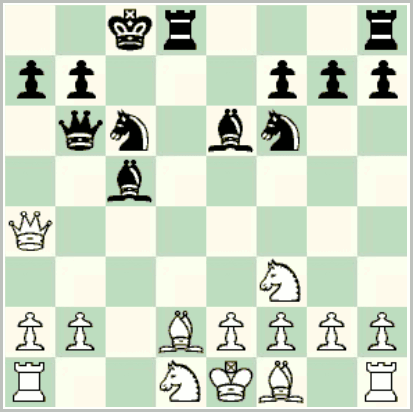
French Winawer, Labyrinth Variation“A French Labyrinth” was an article by Timman in New in Chess 1997/7, concerning the 13. Qxc3 variation in the (traditional) main line of the Poisoned Pawn. This leads to some of the most complicated and difficult lines in the entire Poisoned Pawn. One of Black’s main defences leads to the diagrammed position, with White to play: White is two pawns up, and has three connected passed pawns already, with a fourth on the way. At first glance Black doesn’t seem to have much compensation; but matters are not at all as easy as that.

The latest issue of The New Winawer Report considers the history and latest developments in the theory of this line. And indeed there are latest developments: the line has received a thorough airing in correspondence play over the last several years, with many new and ingenious ideas. It even seems that a final verdict is now possible on the diagrammed position …

Posted in Articles | Leave a comment