The Tait: a remedy

tnwr-24The final issue of volume 2 of The New Winawer Report has been posted. This continues from last time, covering Black’s options against the Tait variation, shown in the diagram.

The last issue covered the former main line defence 16 … f6, which now seems refuted. But what else is there? Most alternatives fail disastrously. The best solution is quite surprising at first sight: why does it work where the others fail so badly?

Posted in Articles | Leave a comment

Election time!

The recent election for the House of Commons was dramatic and unexpected, and the campaign was fiercely contested. But did it measure up to the drama of elections of yore?

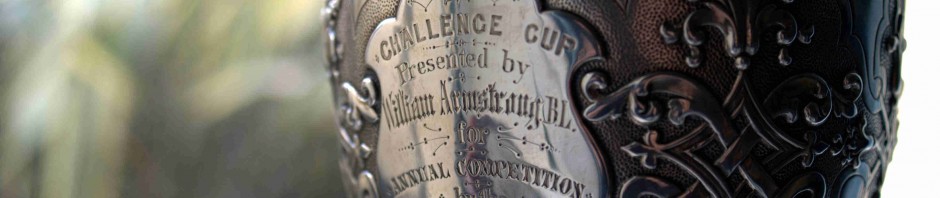
The prominent Dublin barrister Richard Armstrong (1815-1880) was the father of William Armstrong B.L., donor of the Armstrong Cup. He was M.P. for the Borough of Sligo in the Liberal interest from 1865 to 1868, and we have a vivid account of his election and the general conditions in the borough at the time from History of Sligo, County and Town by William Gregory Wood-Martin (Dublin: Hodges, Figgis, 1892).

Some excerpts:

In the election that took place on the 15th July, 1865, Macdonogh [the Conservative incumbent] was defeated, having only 158 votes to 166 recorded for his opponent, Richard Armstrong, S.L. [“Serjeant-at-Law”]

… £ 423 was distributed among voters as a consideration for their having voted for Macdonogh.

… Serjeant Armstrong expended on this election the sum of £ 2240; of this amount £ 615 was applied in defraying the legitimate expenses, £ 140 was distributed among mobs; and the residue (£ 1480) was expended in bribery.


… the number of voters so bribed amounted to ninety-seven, on an average of a little over £ 15 5s. each.

Does that sound a little different to modern practice in these matters? It was itself tame stuff compared to the following election in November 1868, in which Richard Armstrong did not stand. The candidates were Major Laurence E. Knox, then proprietor of the Irish Times, for the Conservatives, and John W. Flanagan for the Liberals. In addition to bribery on a vast scale there was considerable violence: a force of ‘340 police, twenty mounted men, two troops of cavalry, and three companies of infantry’ was drafted in and ‘was barely sufficient’. Voting was by law then open—that is, no secret ballot—and the force was necessary to prevent violence to voters and rioting. In the event one voter, Captain King, was shot dead as he approached the Courthouse to record his vote for Major Knox.

That evening Major Knox was declared the winner with a majority of 12, with 241 votes versus 229 for Flanagan. The election was subsequently challenged in court and voided by reason of bribery by Major Knox’s agents. The judge reported to the House of Commons that ‘he had reason to believe that corrupt practices and bribery extensively prevailed at this and previous elections’.

After an investigation and report—which also found intense and admitted clerical interference in the 1868 election—the House of Commons then disenfranchised the Borough of Sligo: the election of 1868 was the last one.

Wood-Martin concludes: ‘it is remarkable that the prevalence of corrupt practices in Sligo proved to have been greatest when the candidates were of the legal profession’. (This may be a matter of perspective!)

The full passage can be read here.
Posted in Articles | Leave a comment

Ballyfermot Open, circa 1994

002

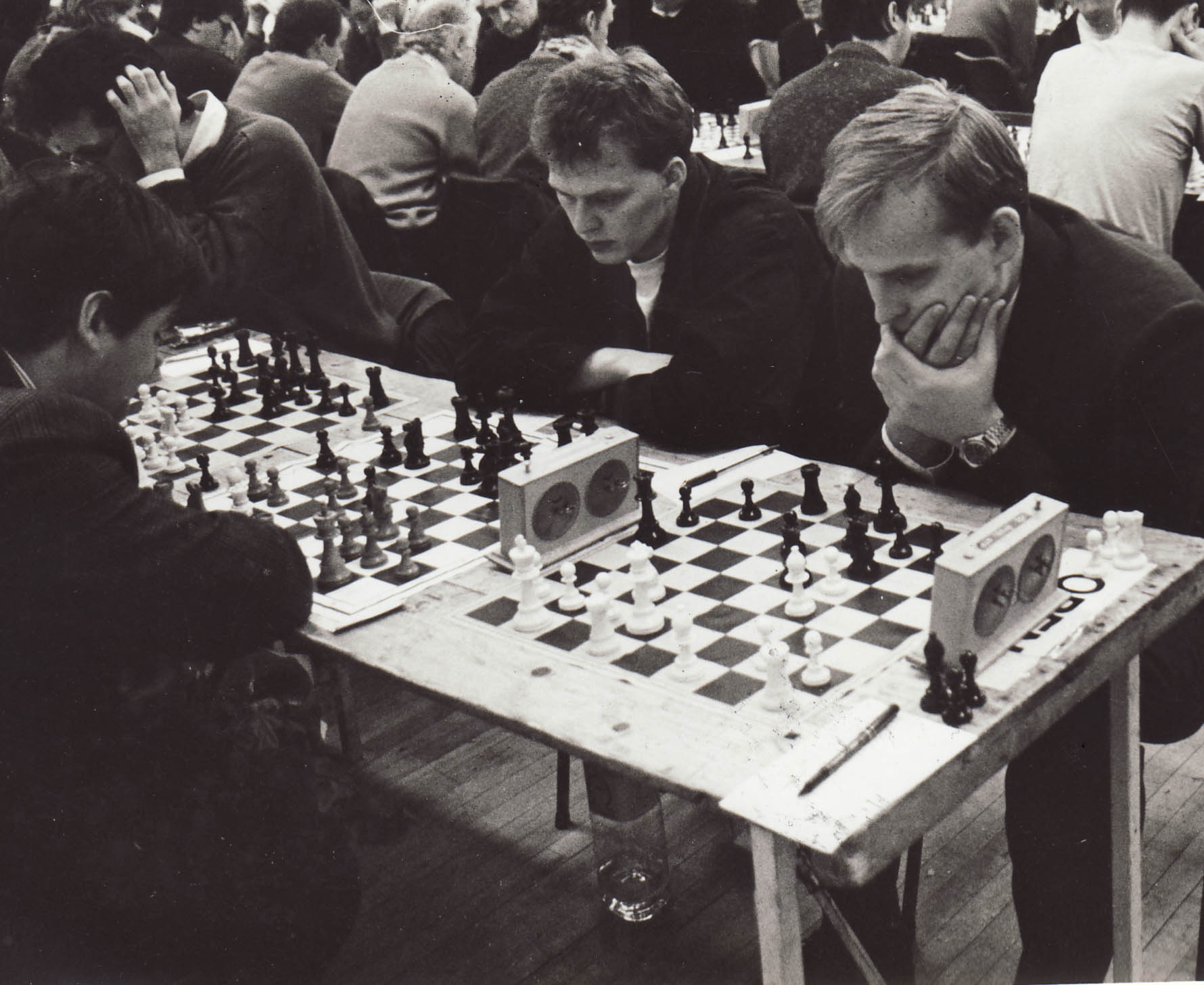
Mnay thanks to Ray Woodhouse for this photo of the Ballyfermot Open, played in the Mansion House, which from memory he says is from around 1994.

(Click here for the full size version.)

Alexander Baburin is at right, and Jonathan O’Connor is facing on board 4. It’s not completely clear but that seems to be Colm Daly playing white on board 2. Can anyone identify his opponent, or provide further information or confirmation on the tournament?

Posted in Photos | 2 Comments

IM norms

The ICU web sites report that Stephen Jessel has recorded his second IM norm. Congratulations!

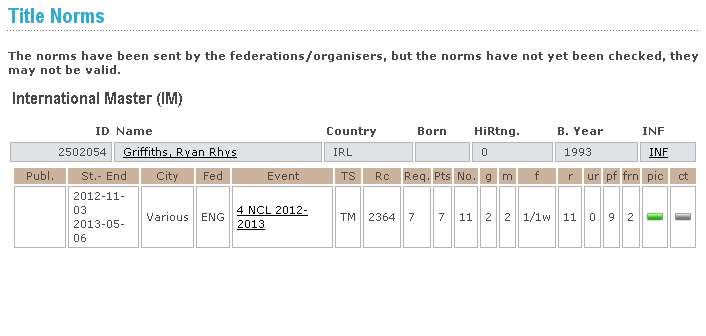
This reminds me of something that puzzled me some time back. Two years ago it was widely reported that Ryan-Rhys Griffths had recorded his second IM norm at the Czech Open 2013 in Pardubice. I recall seeing mentions of this by (in alphabetical order) Colm Daly, Mel Ó Cinnéide, and Rory Quinn.

But if you go to the relevant page on the FIDE website, only his first norm is recorded:

IM norms per FIDE website

Does anyone know why?

From his actual results, it seems clear enough that this should be a norm.

[Update, May 27, 2015: FIDE has now acknowledged the second norm.]

Posted in News | Leave a comment

Irish Junior (or Schools) Championships

The Irish Junior Championships are on this weekend in Blanchardstown. Best of luck to all participants!

Just in time for this event, David McAlister has put together a full list of all these events back to 1948, with just one exception (1996: can anyone please supply the missing information?).

Many familiar names are listed, including this year’s organiser John Delaney (joint champion in 1979), as well as yours truly (1979, 1981).

Some time back we had a great photo, supplied by Oliver Dunne, of the 1948 event, with the 1948 and 1949 winners Geoffrey Hand and Michael Fagan.

[Update, April 12, 2015: the photo may have been from the 1948 Leinster Schoolboys’ Championship.]

Posted in Tournaments | 2 Comments

Armstrong Cup 1901-02: Booterstown and Blackrock

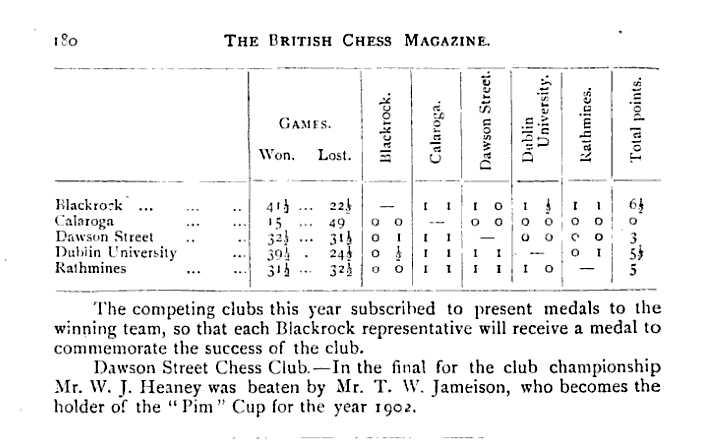
The 1901-02 Armstrong Cup was contested by five teams: Booterstown and Blackrock, Dublin University, Rathmines, Dawson Street, and Calaroga. The competition was set up as a double-round league over eight boards, with match points counting.

BCM 1902 p180 Armstrong crosstable

We have the crosstable above plus the full list of fixtures, and scorecards for 11 of the 20 matches. The season has been added to the Armstrong Cup page and full season results have been tabulated on a separate page.

The Booterstown and Blackrock club was in the middle of the most successful run in its existence: this win formed the middle of a three-in-a-row, and they also won in 1898-99. Board 1 was A. A. [Albert Augustus] MacDonogh M.A. (ca. 1866-1934), founder and long-time headmaster of the Avoca School in Blackrock, now merged into Newpark Comprehensive. He was followed by T. G. [Thomas George] Cranston (1877/78-1954), later twice Irish champion (1922 and 1931) and R. T. [Ralph Theodore] Varian (ca. 1865-1951), later Leinster champion (1928). At board 5 was “F. S. B.”, or Mrs. F. Sterling Berry, one of the strongest women players of the era.

The Calaroga club played its home matches at 25 Rutland Square North. I wasn’t familiar with that, and on looking it up found that it is now Parnell Square. It’s therefore interesting to note that board 2 of the Dawson Street team during this season was John Howard Parnell (1843-1923), brother of Charles Stuart, and an M.P. in his own right (from 1895 to 1900).

I’m not sure if the Calaroga club ever competed before or since: they’re not listed in David McAlister’s Armstrong Cup page. But is the Nicholas McCluskey who played at boards 2 and 3 in this season—with a plus score in the records available— the same as the N. McCluskey who played in the winning Sackville team in 1925-26?

[Update, April 16, 2015: Many thanks to David McAlister for providing two further scorecards, of matches 11 and 17 (Dawson Street v. Booterstown and Calaroga v. Dublin University respectively); with these we can also infer the final score in match 20 (Dublin University v. Dawson Street). Both pages have now been updated with the new information.]

Posted in Armstrong Cup, Tournaments | Leave a comment

Bunratty Classic 2015

The Bunratty Congresses have been around for many years now but they still post-date my own playing career by several years, so I have never played in any of them. Looking at the various reports this is a matter of some regret for me, as it looks to be a fantastic tournament.

Strangely the Tournaments pages here have not included any of the entire series up to now, but now this omission is corrected with a report on this year’s Bunratty Classic, which produced two norms, one of which was the first ever GM norm at an event held in Ireland. Though there were some complaints in various quarters about the number of short draws, there were many interesting games as well.

Posted in Bunratty, Tournaments | Leave a comment

Trouble in the Tait

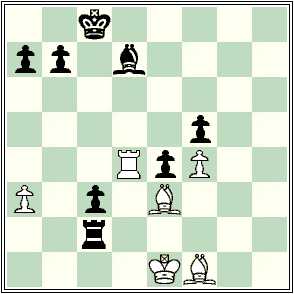
tnwr-23-1The latest issue of The New Winawer Report has (finally) been posted. This issue considers the Tait variation, which starts with the position at right, with Black to move.

The correspondence player (and now CC Senior International Master) Jonathan Tait discovered this around 1986 or 1987, and racked up a overwhelmingly positive score before publishing an article in Correspondence Chess in 1995. It’s rare that analysis from twenty years ago holds up so well: most of the essential points are present.

Later a major improvement was found for Black in Harding-Arounopoulos, World corr Ch 22, ½-final-05, 1997-99, and this classic game formed the foundation of the entire theory until as recently as 2010: see the discussion in Moskalenko’s The Wonderful Winawer (New in Chess 2010).

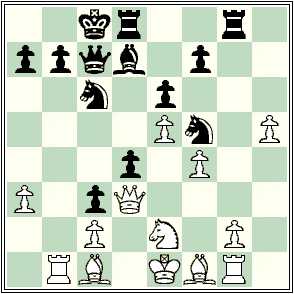
tnwr-23-2But theory turned again with a counter-improvement for White, after which the main line reaches the diagrammed position, with Black to play. The initial analysis given by Watson (ChessPublishing.com, May 2011) indicated that Black was lost. Strangely, though, several correspondence players have contested this verdict, and there are now nine practical examples in all. So far, though, Black has yet to record even a single draw.

Black needs new ideas. (For which see issue 24 …).

Posted in Articles | Leave a comment

Healy-Scallan, Armstrong Cup 2014-15

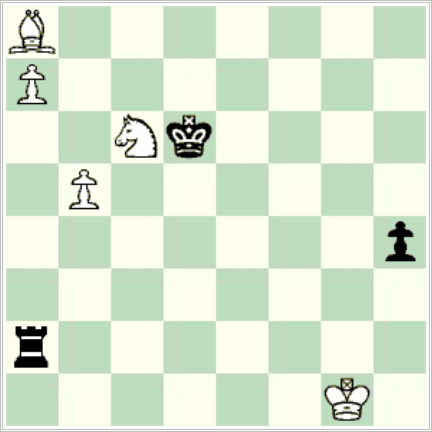
Some interesting games from this year’s league campaign featured recently on the St. Benildus C.C. web pages. Among these was a rare bishop + knight versus king ending, from the game Healy—Scallan, St. Benildus v. Rathmines, Armstrong Cup.

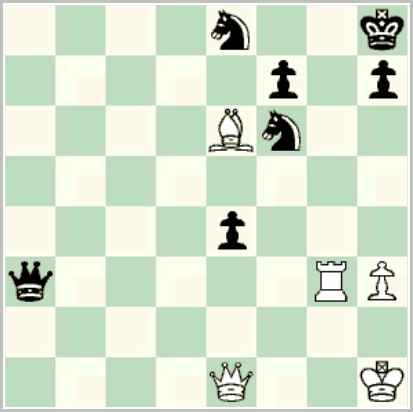
Healy - Scallan, Armstrong Cup 2014-15The critical position is shown in the diagram, with Black to play his 66th. Fiachra Scallan played 66. … Kc5?, apparently under the impression that bishop and knight v. king was a draw. Though John Healy’s notes don’t mention it, with 66. … Kc7! Black draws. White can only extract the bishop by giving up the a-pawn, e.g., 67. Nd4 Rxa7 68. Bc6, but the resulting B + N + P v. R ending (once the h-pawn drops) is easily drawn. (Coincidentally, we recently had another example of a B + N + P v. R ending here). Otherwise Black follows up with 67. … Kb6 and 68. … Kxb5 69. Bb7 Rxa7 70. Nxa7+ Kb6.

In the present game Black made it easy for White by heading quickly for the ‘right’ corner (from the B + N point of view). Tim Harding gives the useful practical advice to defenders of this ending that they should head for the ‘wrong’-coloured corner on the opponent’s side of the board, on the basis that many players have practiced the winning manoeuvre with the defending king on the ‘top’ side of the board, and sometimes find it difficult to translate into the reversed setup.

Posted in Games | Leave a comment

Who did Dake play?

In the comments to “The trials of Aibhistín de Búrca” Paul Brown raises the issue of which player played A. Dake at Warsaw (de Burca or Cranston). At IRLchess we have plumped for de Búrca.

De Búrca, in his 1960 article “International Team Tournament Warsaw 1935”, tantalisingly refers to both Dake and the Ireland -v- U.S.A. match; however the two separate passages do not provide an answer.

The victorious U.S.A. team were very even in strength, and consisted of Fine, the brilliant veteran Marshall, Kupchik, Dake and Horowitz. Arthur Dake, playing on fourth board, mowed down the cannon-fodder opposed to him mercilessly and had the best personal score of the tournament (86%).
….
The Irish team was regarded as a push-over by the Americans, who made no secret of their opinion by arriving twenty minutes after the clocks had been started. On three boards, this opinion was speedily justified. This was one of the matches in which I was given my “opportunity”, and played like a terrified rabbit fascinated into immobility by a dangerous snake.

When contemporary sources differ, it can be very difficult to find a definitive solution. However, I believe I’ve found something that goes to the heart of the matter.

White's queen is attacked, yet he forces a quick mate. How?

White’s queen is attacked, yet he forces a quick mate. How?

In the very first issue of B.H. Wood’s “Chess” magazine, dated 14th September 1935, on page 12 the diagrammed position is given as Exercise No.2. On page 40 of the same issue the following solution is given:

“By Q x Pch, K x Q; P x P double check and mate. Dake v. Cranston at Warsaw.

So far this is just one more contemporary source but in the 14th November issue (at page 83) there was this correction:

“Exercise No.2 in our September number accused Mr Cranston of courting sudden death at the hands of Dake at Warsaw. Actually it was de Burca, reserve for Ireland, who suffered this fate. Our apologies, Mr. Cranston!

All the same, we feel justified in being a little aggrieved ourselves when no less an authority than the Warsaw daily bulletin errs.”

Unfortunately no source is given for the information, but we might guess it was Cranston himself. However it does provide both a 1935 solution as to which Irish player Dake played and an explanation as to how the confusion arose; probably as definitive as it gets. It might be more difficult to determine with certainty whether the game ended with the queen sacrifice or the checkmate.

Tailpiece 30 August 2025

10 years ago, I believed that it was proved then to a high standard that de Búrca/Bourke played Dake but it turns out that there is further contemporary evidence supporting that conclusion.

W.R. O’Shea edited a weekly chess column in the (Cork) Evening Echo between 1933 to 1936. In his column for the 9th of November 1935 (on page 4 of the newspaper) the underneath item appeared.

The notes to the game are unattributed, and it is likely that these are O’Shea’s own annotations.

De Búrca was an occasional contributor to the Evening Post column, he was a student of University College Cork and knew O’Shea. It is highly unlikely that he would be unaware of the game appearing in the chess column of his local newspaper, and if there was a mistake as to Dake’s victim, that it was not raised with O’Shea and subsequently corrected. No such correction happened. It is even possible that Bourke had provided the game score to O’Shea.

We also note that the game-score ends with 18.Qxh7 and not 19.hxh6 mate, so this may tip the balance in terms of deciding the debate as to which move the game ended on.

Posted in Irish champions, Players | 2 Comments