Arbitrary and capricious—II

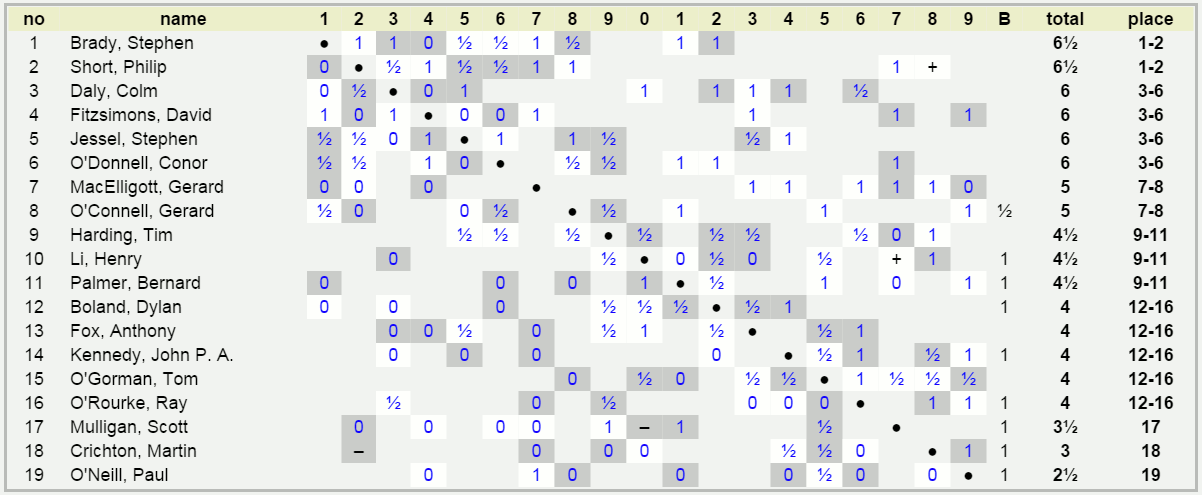
The last post asked how it could be that the tie-break system placed Philip Short ahead of Stephen Brady. The tie-break system was Median Buchholz followed by Buchholz, i.e., just sums of opponent scores (with median dropping the highest and lowest). Stephen Brady had higher opponent scores, so he should win, right?

Not right, as it turns out. (Although some points are still murky.)

(Recall that in addition to playing each other and 6 opponents in common, Brady played Bernard Palmer and Dylan Boland, 4½ and 4 respectively, while Short played Scott Mulligan, 3½, and had a walkover against Martin Crichton, 3.)

The FIDE Handbook, Annex 3, Section F(b) lists some adjustments that should be made for unplayed games. Since July 1, 2012, two adjustments apply:

For tie-break purposes all unplayed games in which players are indirectly involved (results by forfeit of opponents) are considered to have been drawn.

and

For tie-break purposes a player who has no opponent will be considered as having played against a virtual opponent who has the same number of points at the beginning of the round and who draws in all the following rounds. For the round itself the result by forfeit will be considered as a normal result.

This is murky in some ways but it’s clear enough how Chess-Results.com is implementing it.

Applying the first rule, we have the following adjustments:
(i) all byes count as ½, so the scores of Palmer, Boland, and Mulligan are all reduced by ½ (since they had full-point byes);
(ii) Scott Mulligan’s default against Henry Li in the last round counts as ½ instead of 0, so his score goes back up by ½; and
(iii) Philip Short’s walkover against Martin Crichton in round 1 counts as ½. N.B.! More on this later.

Applying the second rule, since Martin Crichton defaulted in round 1, he is replaced for purposes of Philip Short’s Buchholz calculation by a virtual opponent who had the same score as Philip Short at the beginning of the round (i.e., 0), lost that game, and then drew all remaining games, i.e., finishing on 4 points.

So after these adjustments, Stephen Brady played Palmer (4) and Boland (3½), while Short played Crichton (4) and Mulligan (3½). So now it’s clearer why Short did not lose. But why did he win?

The full set of scores of Short’s opponents, after adjustments and in descending order, was: 6½, 6, 6, 6, 6, 5, 5, 4, 3½.

The full set of scores of Brady’s opponents, after adjustments and in descending order, was: 6, 6, 6, 6, 6, 5, 5, 4, 3½.

So for Median Buchholz, discarding highest and lowest and adding the rest, both have 38. But for Buchholz, adding all scores, Short has 48 and Brady has 47½. (Which matches the official results shown on Chess-Results.com.)

But note the source of the difference: the (adjusted) opponent scores are identical except for the highest score. Philip Short is credited with an opponent score of 6½, since he played Stephen Brady. But Stpehen Brady is credited with an opponent score of 6, since he played Philip Short, whose adjusted score (counting the walkover against Crichton as a draw) is only 6.

Is this not odd, peculiar, and unsatisfactory? Opponent scores are only being used in the first place as a proxy for opponent strength. Two players have tied for first and we are trying to determine which should be judged stronger, since they finished on equal scores. It makes no sense for the tie-break system to judge these two players as of unequal strength.

It would make far more sense to disregard games where the two players played each other. (In which case the tie-break would have gone to result of individual game, which Brady won.) But then how would three-way ties be handled?

Posted in Puzzles | 3 Comments

Arbitrary and capricious

The close finish to this year’s Irish championship brought the possibility of a three-way tie for first place. When two players tie for first, the rule is (as it has been since the 1970s) that the players share the title. But if three or more players finish equal first, tie-breaks are applied to produce a single champion. (The tie-break methods appear to be Median Buchholz, followed by Buchholz, possibly followed by result of individual game.)

Three-way ties are rare (with only the 1996 example involving Richard O’Donovan, Colm Daly, and Tom Clarke), but this year it would only have required Stephen Jessel to win his last round game against Tim Harding, instead of drawing.

In that case Philip Short would have been the winner on tie-break and sole Irish champion. Similarly, with the actual results he was the winner on tie-break of the guaranteed Olympiad place.

But this is puzzling given the crosstable:

irlch2015crosstable

Stephen Brady and Philip Short had 6 opponents in common, and they also played each other. This leaves just 2 opponents each that were not in common: Brady played Bernard Palmer and Dylan Boland (both 4½/9 4½/9 and 4/9 respectively), while Short played Scott Mulligan (3½/9) and had a walkover against Martin Crichton (3/9). At first glance, Brady’s opponents did (very slightly) better than Short’s. So how on earth could it happen that Short won the tie-break?

This result seems correct: with these results, and with the current tie-break system, Philip Short is indeed the winner. Why? Answer in a few days.

The reasons include some that appear arbitrary and capricious. Of course this is not and can not be a criticism of Philip Short, who would have been badly treated if on these results the tie-break had gone the other way. But it does raise the question of whether the title of Irish champion should be awarded in this way in three (or more) way ties. The ideal solution would be a playoff at regular time controls; but even accepting that this is difficult to arrange, what exactly is wrong with allowing three players to share the title?

Posted in Puzzles | Leave a comment

Irish championship 2005

A report on the 2005 Irish championship has been added to the tournament pages here. Colm Daly won his third championship, after 1998 and 1999, by a full point. All games are available.

It’s interesting that fully half of the field that year (10 out of 20) competed again in this year’s championship.

The Irish championships page here is barer than it should be. It will be a priority over the next year to fill in details of as many other championships as possible.

Posted in Irish championships, Tournaments | Leave a comment

Glorney Cup 2015

Congratulations to the Irish Glorney Cup team, who won the Cup for the first time since 1963!

Full coverage is available at the tournament web site. By all accounts it was a very well organized tournament, with live boards for every game, including for the Gilbert, Stokes, and Robinson Cups, and first-class conditions, as evidenced by the series of photos taken by Daniel Lynch.

The 60 games played in the Glorney Cup have now been added to the archive here. Games from the other events will be added in a few days.

Update, July 23, 2015: the 36 games from the Gilbert Cup have now been added.

Update, July 25, 2015: the 72 games from the Robinson Cup have now been added. N.B.: for round 5 the game scores are missing. The tournament web site gives the round 6 games under the round 5 link, while the round 6 link leads to a blank template. (Further update, Sunday, July 26, 2015: the tournament web site now shows all games. The round 5 games have been added to the archive here.)

Update, July 27, 2015: The 72 games from the Stokes Cup have now been added.

Posted in Games, Glorney Cups, News | Leave a comment

Irish championship 2015

This year’s Irish championship, in progress as I write this, has a report available here, including all 35 games from the first four rounds. The report will be updated round-by-round.

Though the field is markedly smaller than last year’s, it includes three serious contenders who have never won: David Fitzsimons, Stephen Jessel, and Conor O’Donnell. There are also several very young players for whom this is the first Irish championship, generally acquitting themselves very well so far.

Update, July 8, 2015: Round 5 has been added. An eventful round! Stephen Brady took a pawn that turned out to be poisoned on the top board, bringing David Fitzsimons back into the lead. But only by ½ point ahead of a group of 5 (!) players. Conor O’Donnell will be disappointed at dropping a half point against Tim Harding when he was two pawns up at the first time control; 41 … Rd3!? Note: the report has added a column for player ages, which here means the age they will reach on this year’s birthday, whenever that is.

Update, July 10, 2015: Round 6 has been added. Another interesting round with decisive games at the top. David Fitzsimons’ king was caught in a queen & rook crossfire; he could earlier have entered a rook ending that seems drawn. On board 2 was yet another critical Irish championship game between Colm Daly and Stephen Brady (how many of these have there been down the years, and what is the overall record?); this time it all seemed to fall apart for Colm. Stephen Jessel won well on board 3. So Brady, Jessel, and Short lead, with Fitzsimons and O’Donnell a half point behind. What are the tie-break rules again? Note: the (long-standing) openings index bug has been fixed, and a video by Colm Daly (of round 4, boards 8 and 9) has been added.

Update, July 10, 2015: Round 7 results have been posted at chess-results.com. David Fitzsimons drops a second consecutive game and now is out of the running. Stephen Jessel and Philip Short share the lead on 5½, with Stephen Brady a half point behind. Will update the report when games are posted. Later: Round 7 games now added. David Fitzsimons will be bitterly disappointed at that game.

Update, July 11, 2015: Sensational results in round 8, with Colm Daly downing Stephen Jessel with Black. Philip Short drew with Black against Conor O’Donnell, and shares the lead with Stephen Brady, who beat Gerry MacElligott on board 3. So with a round to go it’s the veterans Brady and Short in the lead on 6/8, with Daly and Jessel a half point back. In the last round it’s Short-Daly, O’Connell-Brady, and Harding-Jessel. Games not available yet.

Update, July 13, 2015: When the dust had settled it was Stephen Brady and Philip Short who emerged joint winners in a hard-fought and close finish. As Martin Crichton points out below, many records were set. This is Stephen Brady’s 9th championship, equalling the record set by John J. O’Hanlon, whose championships spanned the period 1913 to 1940. Philip Short’s win comes 34 years after his first championship (in 1981, shared with David Dunne), surpassing the previous record of 27 years, shared by O’Hanlon and by James Alexander “Porterfield” Rynd (winner in 1865 and 1892). The report has now been updated with all games.

Posted in Irish championships, Tournaments | 1 Comment

Drogheda 2015

Drogheda 2015 was held over the weekend before last, May 30-June 1. The top section, which was won convincingly by Colm Daly–by far the highest-rated player–on 6/6, had two live boards in each round. I missed round 1 but the other 10 games have been added to the archive here.

Posted in Drogheda Congresses, Games | Leave a comment

Samuel Beckett, once removed

Oliver Dunne asks the exact question I had been wondering about myself: is it possible that any of Beckett’s games survive?

So far I have not found any. But I did find what may be the next best thing: a game between the two GHQ players Beckett played in the 1924-25 Armstrong Cup, Lieut. L. Mallin (whom Beckett beat in the first match) and Cmdt. L. Egan (whom Beckett lost to in the return match).

This game is from an Island Bridge Barracks v. GHQ second team match, played on February 22, 1924, so about a year before the Beckett games. It’s given in An t-Óglách, vol. 2, no. 5 (12 April 1924), p. 7.

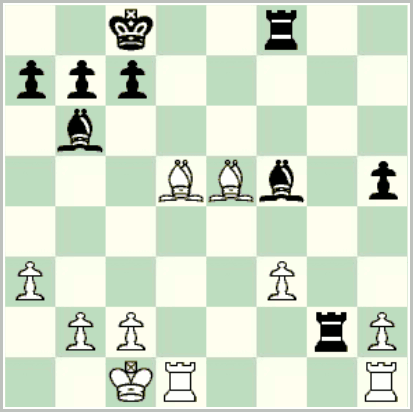
Mallin-Egan, Island Bridge-GHQ II match 1924The report says “criticism invited”. Well … while some of it is reasonable, there were passages that seem quite jarring today: the opening was odd, and in the diagrammed position White, to move, blundered with 25. Rd2??. After 25. … Be3 he could have resigned, but played on quite futilely for a while.

[Click to play through the full game.]

Of course Beckett beat the White player in this game (Mallin), and lost to Black (Egan). But the report goes on to say that Mallin beat Egan in two further games that evening. Make of that what you will!

Posted in Games, Players | 1 Comment

Samuel Beckett, contd.

In Samuel Beckett and the Armstrong Cup, I thought I had made an original discovery of Samuel Beckett’s career as a chess player, as chess players would understand the term, in the form of an Armstrong Cup scorecard from the 1925-26 season showing him as playing for Dublin University.

I should have known it wouldn’t be as easy as that. The article Harry Vandervlist, “Beckett, Duchamp and Chess: A Crossroads at Arcachon in the Summer of 1940“, Caliban: French Journal of English Studies 33 (2013) pp. 173-182, says that

“Beckett also took an active part in chess matches with the college 8, playing at number 7 for a couple of years”

citing James Knowlson, Damned to Fame: The Life of Samuel Beckett (New York: Simon & Schuster 1996) (quotation marks in the article). That book happens to be in my local library, so I’ve requested it and will take a look at what else he says, if anything.

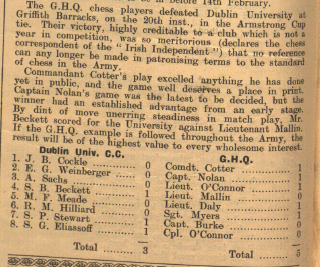
However I’ve found three new scorecards, all from the 1924-25 Armstrong season. Again from An t-Óglách (vol. 3, no. 3, January 31, 1925, p. 16), we have the first Dublin University–National Army G.H.Q. match of the season, played at Griffith Barracks on Tuesday, January 20, 1925:

sbbeckett-19250131

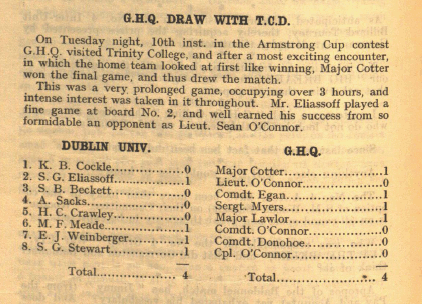
and from the same journal, vol. 3, no. 6 (March 14, 1925), p. 16, we have details of the return match, played at Trinity on Tuesday, March 10, 1925:

sbbeckett-19250314

In addition, the Irish Times, December 15, 1924 p. 4 had the scorecard of the Blackrock–Dublin University match played at the Carnegie Library, Blackrock the preceding Saturday:

Blackrock Dublin University     
A. A. MacDonogh 0 – 1 A. Spiro
R. T. Varian 1 – 0 S. G. Eliasoff
J. Gerrard 1 – 0 A. Sachs
C. Pearson 1 – 0 S. B. Weinberger
W. Crawford 1 – 0 E. J. Weinberger
P. J. Gillespie 1 – 0 M. F. Meade
E. Russell 1 – 0 K. B. Cockle
H. F. Penrose 0 – 1 S. B. Beckett
6 – 2

Clearly Beckett played on various different boards, including some well higher than 7. However Blackrock was a much stronger team than National Army G.H.Q., so Dublin University may have fielded a weaker team for the Army matches.

Posted in Armstrong Cup, Players, Tournaments | 2 Comments

Ballyfermot Open 1994, contd.

On Ray Woodhouse’s photo of the Ballyfermot Open 1994, we’re a little further along but matters are still not entirely clear.

David McAlister convincingly demonstrated that it was the 1994 event, the position on the top board identifying it as from Ryan—Baburin (see his comment on the last post). But the Irish Chess Journal report didn’t identify the round, and others I asked weren’t sure. If it’s from the last round, then Black on board 2 must be Russell P. White of England, who finished joint first.

There is some extra information pointing to it being the last round. Jonathan O’Connor kindly provided me with many of his games from the late 1970’s to mid-1990’s some time back, and all his games from this event are included. He played White in the even-numbered rounds. He’s playing Black in the photo, and it’s probably his last round game against Gerard O’Connell.

O Connell-O Connor, Ballyferrmot Open 1994In a King’s Indian, Jonathan’s attack failed to materialise and he was well lost by the time the diagrammed position arose (after 31. Nf5).

[Click to replay the full game.]

Jonathan’s other four games have also been added to the archive here: see the monthly index.

Does anyone have further information?

Posted in Games, Photos, Tournaments | Leave a comment

Ennis Congress 2015

Last weekend’s Ennis Congress featured live boards for the top two games in the Open and the top board in the Under 1400. The 18 games have now been added to the games archive here.

There were several interesting games, but the most interesting of all must be the Kalinins-Daly marathon in round 5, eventually won by Kalinins. It will be interesting to see Colm Daly’s analysis of this game. A curosry look indicates that Black had his chances throughout.

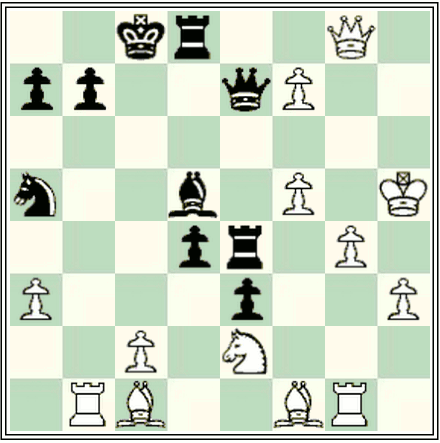
Kalinins-Daly, Ennis Open 2015 A critical moment was reached after White’s 51st move (Bb3xe6), resulting in the diagram at left.

Instead of 51. … Qe7 as played, what about 51. … Qxg3 52. Qxg3 fxe6, reaching a Q + P v. 2N + 3P ending? It’s not completely clear but it seems that Black should be able to draw comfortably.

[Click to replay the full game.]

[Update, May 22, 2015: on further reflection, I’ll have to withdraw the word “comfortably” above. I’m still not sure whether it’s a draw or not.]

Posted in Ennis Congresses, Games, Tournaments | Leave a comment