At the cutting edge of theory

At one time the Winawer made regular appearances at the highest levels, even in World Championship matches (Smyslov-Botvinnik, Tal-Botvinnik) but these days it’s a relatively rare occurrence. It’s therefore a delight to see two 2600+ grandmasters battle it out in a major tournament, and indeed in one of the wildest and most obscure lines of the Posioned Pawn variation. Hot off the presses (the game was played yesterday as I write) comes Perunović–Édouard, European Teams Championship, Reykjavik 2015.

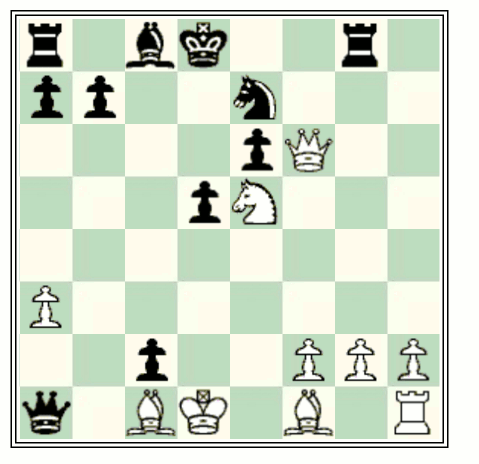
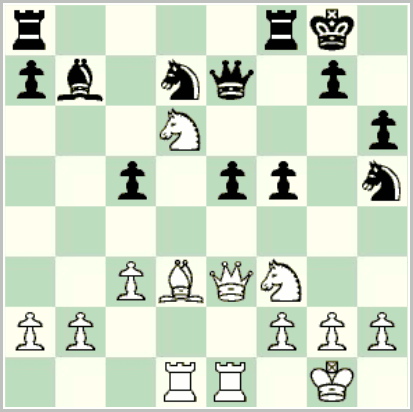
Perunovic-Edouard, European Teams Championship, Reykjavik 2015After 10. Kd1 Nd7!? Nbc6 11. Nf3 Nxe5 12. Bf4 Qxc3 13. Nxe5 Qxa1+ 14. Bc1 (see The New Winawer Report issues 7 and 10), Édouard tried 14. … d3?!, introduced in Bronstein–Uhlmann, United Nations Peace Tournament, Zagreb (April-May) 1965 (better 14. … Rf8). After 15. Qxf7+ Kd8 16. Qf6 dxc2+ the game reached the diagrammed position.

In issue 10, I argued that the less common 17. Kxc2! is best, leading to a clear advantage, though falling short of a forced win. But Perunović chose the older 17. Kd2. The continuation was 17. … Qd4+ 18. Bd3 Qc5! 19. Ke2 Bd7 20. Be3 d4? 21. Bxd4. All this is as in B. Stein-Beliavsky, Lloyds Bank Masters 1985 (later agreed drawn in a winning position for White): I think Black is already lost. The improvement 20. … Qxa3!?, which I think was suggested by Stein and Andrew Martin in the tournament book, seems to allow Black to survive.

Though I believe Black has objective equality after 17. Kd2?, in practice the position is very difficult to hold. You might try considering what happens after the (all tried in practice) alternatives in this sequence 17. … d4, 17. … Qb1, 19. Bb2, and 20. Bf4.

[Update, same day: the conclusions above were based on analysis I did around three years ago. Re-evaluating now, with a better engine of course (Houdini 4.0), it seems that 20. … d4 21. Bxd4 Qxa3 is also fine for Black (=, with a perpetual in the main line). White is better after 20. … Qd5, but it’s less than clear whether it’s a win.]

[Update, November 20, 2015: At ICC, this game features in GM Joel Benjamin’s Game of the Week video (about 35 minutes; subscription required; 5-minute preview available). Even if you are not especially interested in this line, Benjamin gives some fascinating variations. These include some new analysis of 20. … Qxa3 far out, leading to a position where ‘White is better but Black is still hanging around’. Highly recommended!]

[Update: November 21, 2015: If 20. … Qxa3, Benjamin gives 21. Ra1!, which causes Black some difficulties. So after thinking about it some more, I think the best course for Black is 20. … d4! (after all) 21. Bxd4 Qxa3!. One point is that the bishop no longer covers c1, so that 22. Ra1? is met by 22. … Qxa1 23. Bxa1 c1=Q, winning. Another is that compared to the alternative 21. … c1=Q? (from B. Stein-Beliavsky above), the black queen covers d6, preventing White’s Nf7+-d6xb7 manœuvre. White appears to stand worse in all lines except for 22. Nf7+ Ke8 (or 23. … Kc8 24. Qe5 c1=Q 25. Rxc1 Qxc1 26. Nd6+ with a perpetual) 23. Be5 Nf5 23. Bxf5 Bb5+ 24. Kd2 Qb4+ 25. Kc1 Qb1+ 26. Kd2 Qb4+=.]

Posted in Games | Leave a comment

Munster championship 2015–II

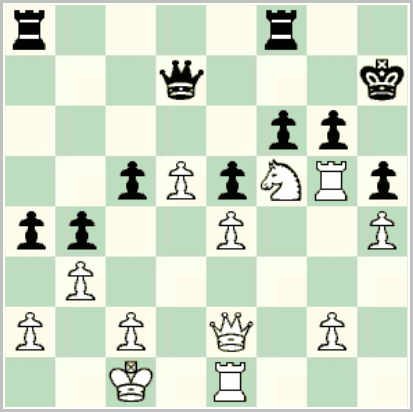
O'Connell-O'Brien, Munster championship 2015This year’s Munster championship provided a return to a separate event and live boards for the top two games, both welcome decisions. (See the recent post here.)

In an even more welcome development, the Munster Chess Union has now followed up by providing almost all of the remaining games, keyed in by Eric Salsac. These have now been added to the updated report on the Tournaments page here.

Here’s one interesting moment, from O’Connell-O’Brien in round 3, with White to play his 35th move. What’s your evaluation of 35. Rxh5+ gxh5 36. Qxh5+ Kg8 37. Re3 (as played in the game)?

Update, November 13, 2015: see my solution in the comments section.

[Click to replay the full game.]

Posted in Games, Munster championships, Tournaments | 1 Comment

Dinev-McMorrow, European Club Championship 2015

Both Irish teams found the going tough in this year’s recently-concluded European Club Championship in Skopje, with Gonzaga finishing 45th out of the 50 teams and Adare finishing last.

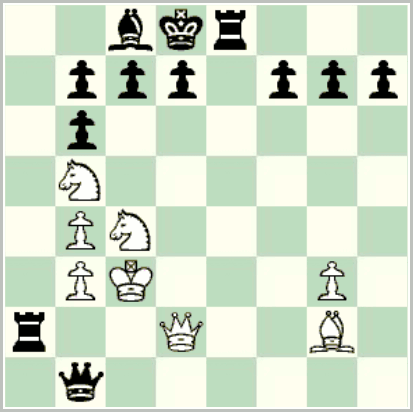
Dinev-McMorrow, European Club Championship 2015But it was not all grim. John McMorrow, fresh from his election as ICU Chair, recorded a spectacular win as Black against an FM in the first round. The final position, at right, tells its own story.

The deciding moment appears to have been 23. Rh1??. Surprisngly White was still very much in the game and engines even find him no worse after 23. Ne5! Rf8 24. a4.

[Click to play through the full game.]

[Update, November 6, 2015: all Irish games from the event have now been added to the collection here (91 games, including 7 by Kieran O’Driscoll (White Rose ENG) as well as all games by Adare and Gonzaga players).]

Posted in Games | Leave a comment

From Irish champion to polar adventurer

The format for the 1989 renewal of the Irish Championship provoked a bit of controversy at the time. The Irish Chess Union abandoned the usual formula of one-game a day over 9 rounds and compressed the Championship into 5 days. It was held at the Gresham Hotel, Dublin from Wednesday 12 to Sunday 16 July, with two games on the Wednesday and the Friday. Niall Carton from Newcastle, County Down finished with a score of 6.0 to win by a point from Philip Short, Tom Clarke and Gerry O’Connell.

Carton could, of course, only turn up and do his best whatever the format but he also proved himself under the traditional conditions when the won the 1993 Championship, also held in Dublin – from 10-18 July in the Teachers Club. This time he scored 7 points out of 9 with Colm Daly second on 6.5 and Joe Ryan third another half-point away. The 1989 controversy had not been forgotten. The report in the December 1993 Irish Chess Journal had the headline “Niall The Nine Round Hostage” and contained this passage in the text:

“This is Niall’s second title, his first being from the infamous “short” event of 1989 (it was played over seven rounds), but this victory confirms that he is a worthy nine round champion.”

The games from the 1993 Championship are not hard to find in the usual database sources, but the same does not apply to those from 1989. So here is a Carton victory from the earlier of his two successes.

Niall Carton – Joe Ryan
Irish Championship, Dublin 1989
Play through the game
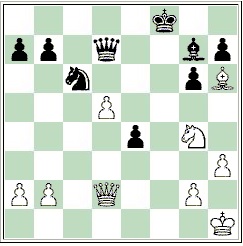
After 28. d5

After 28. d5

1.e4 Nf6 2.e5 Nd5 3.d4 d6 4.Nf3 g6 5.Bc4 Nb6 6.Bb3 Bg7 7.Ng5 e6 8.f4 dxe5 9.fxe5 c5 10.c3 cxd4 11.cxd4 0-0 12.0-0 Nc6 13.Be3 Nd5 14.Bxd5 exd5 15.Nc3 f6 16.exf6 Bxf6 17.Nf3 Re8 18.Qd2 Bg4 19.Rad1 Qd7 20.h3 Bf5 21.Kh1 Be4 22.Nh2 Bg7 23.Ng4 Rf8 24.Bh6 Rxf1+ 25.Rxf1 Rf8
Probably the losing move. 25…Bf5 should leave White with only a slight advantage.
26.Rxf8+ Kxf8 27.Nxe4 dxe4 28.d5 Ne7
If 28…Nd8 29.Qb4+ wins: e.g. 29…Kf7 (29…Qe7 30.Bxg7+ scoops at least a Bishop) 30.Ne5+ forking King and Queen and if Black captures the Knight with 30…Bxe5 it’s 31.Qf8 checkmate. Best appears to be 28…e3 29.Bxg7+ Qxg7 30.Qxe3 Nd8 but with still a winning advantage for White.
29.Bxg7+ Kxg7 30.Qd4+ Kf7
Or 30…Kf8 31.Qf6+ Ke8 32.Qh8+ Ng8 33.Nf6+
31.Ne5+ 1-0

Carton appears to have given up competitive chess about two years after his second Irish title. In 1997 he starting working for ING Bank in London in the Market Risk department and was responsible for the Central European region including Russia. He was transferred to Moscow in 2007 to run the financial markets desk for the bank there. It was during the Russian winters that Niall discovered cross-country skiing and the idea for skiing to the pole took hold of him.

Alexey Borichev, one of his Russian colleagues, accompanied Carton to the North Pole in April 2011, and they managed to raise $80,000 for the Tula orphanage, mostly from the financial brokers in Moscow. Carton managed to trek all the way despite suffering a nasty injury:

“I trained for four months, got fit, everything was good, but during the first day on the ice I fell, it was a bad fall, we thought I had cracked a rib. I skied on for another 7 days, and made it to the pole. Five days after I got back to Moscow, I went to see the doctor and he told me that I had three broken ribs and a partially collapsed lung. Stupid Irishman kept going!”

Not long afterwards Niall started to plan a trip to the South Pole and among a group of fourteen, including Borichov, set off in early 2013. This time money was being raised for a charity called The Greater Chernobyl Cause whose purpose is to provide hospices for terminally ill people in Russia, Ukraine and Belarus.

“The plan was to ski the last degree of latitude, which is a distance of roughly one hundred kms, a trip which should take about 8 days. We were to fly from Chile to the Union Glacier base camp. We planned to live in tents, and pull the sleds ourselves, after all, using dogs is sort of cheating. Then back to the base camp of Vinson Massif, the highest mountain in Antarctica at 4,892 metres, which we reckoned we could climb, which was quite ambitious as I for one have never climbed anything higher than Slieve Donard in Northern Ireland.”

The polar trek turned out harder than expected. The altitude and freezing temperatures led to constant headaches. The polar expedition needed to average 8 miles a day. While training in Russia, Carton was doing the that distance in 1 hours 45 minutes, without getting tired, but in Antarctica that same 8 miles took over 7 hours, leaving him absolutely exhausted. The last day was even more difficult, as Carton and rest of the team had to make detours around scientific experiments before reaching the South Pole and the Station there. Once again Carton did not escape unscathed:

“I woke up on my last day unable to see out of my right eye, I had very blurred vision. When we got back to the base camp, it was diagnosed as snow blindness. It took about five days to clear and it meant I couldn’t climb Vinson Massif.”

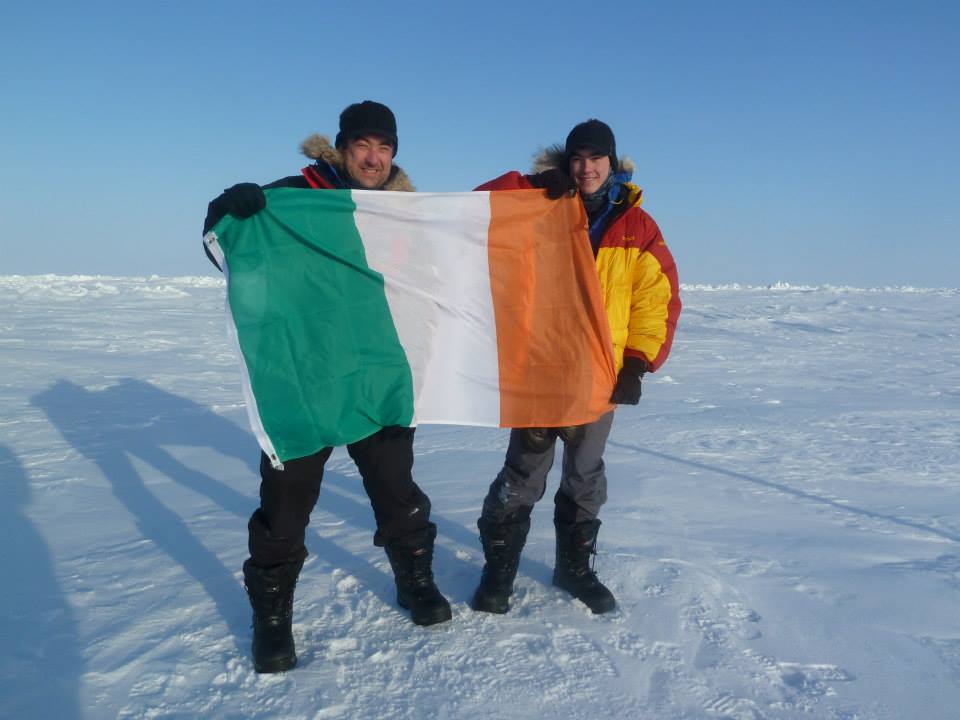
Not content with reaching both poles, Carton decided to undertake a further polar trip in April 2014 with his 15-year-old son James, who was hoping to become the youngest person to walk unaided to the North Pole, with Bernardos in Ireland being the charitable cause to benefit.

Unlike the solid, mainly flat terrain on the journey to the South Pole, the northern polar regions have shifting ice underfoot. The moving ice can work either for or against polar adventurers, bringing them closer to the Pole without them even moving, but the opposite can also occur. Unfortunately for Niall and James, the latter scenario played out for them. Having battled against bad weather, the Cartons battled against headwinds to make it to within five miles of the Pole on the penultimate day of their trek. They camped overnight but woke up the next morning to discover they had drifted 10 miles away and were faced with open water in trying to plot a route to the North Pole. Eventually James’s record attempt had to be abandoned and father and son were airlifted by helicopter to the North Pole for photographs.
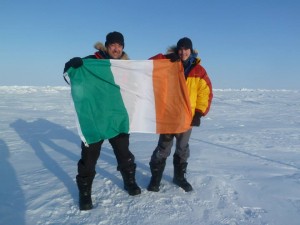
At the North Pole

At the North Pole

Sources for the polar expeditions commentary:
Meet our 2014 North Pole teams!
To the South Pole for charity
Newcastle boy bids to become youngest to walk to pole
Storms and drifting ice but James finally makes it to the North Pole
Photograph at the North Pole from the Facebook page of the Irish Embassy in Moscow
Posted in Irish champions | Leave a comment

Irish championship 1972

The Irish championship in 1972 marked the end of one era and the beginning of another. In part this was due to the Fischer boom: Fischer-Spassky began on July 11, in the middle of the event. For whatever reason, though the field was roughly typical for the era, the entire field combined won only one further Irish championship between them.

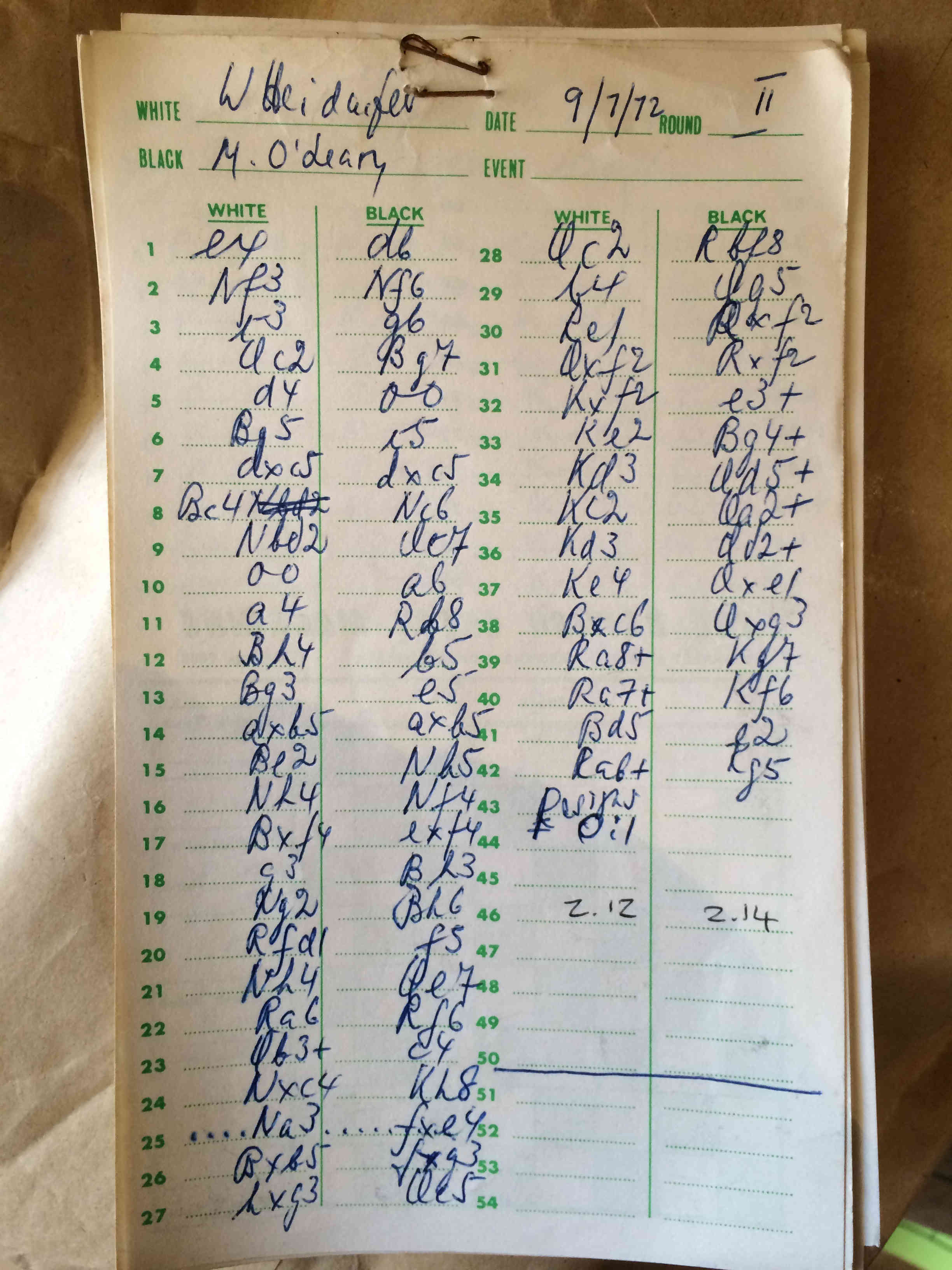
No games from the event appear in the ICU’s games archive or in any database. However, and very remarkably, none has been lost: John Gibson, who was controller for the event, has kept the full set of scoresheets. These have now been keyed in, and are available in a full tournament report here.

heidenfeld-oleary-1972-scoresheet

There were many interesting games, but possibly the game of the tournament was the round 2 encounter between the joint winners Wolfgang Heidenfeld and Matt O’Leary. Heidenfeld later won the playoff match and was sole champion, but O’Leary won their game in the championship itself.

Above: Heidenfeld’s scoresheet.

Many thanks to John Gibson for exemplary record-keeping. The report also draws from his notebooks for the 1971-72 Armstrong Cup for details of clubs and ratings.

Posted in Irish championships, Tournaments | Leave a comment

Munster championship 2015

The Munster championship has had various formats over the years, often taking the form of the highest Munster-based player in some other event, and in several years not being held at all. This year saw a welcome return to a stand-alone event, which took place in Ennis last weekend. The entrants included the current Irish (co-)champion Philip Short and for good measure the winner of this year’s Ulster championship as well, Rory Quinn (though he was ineligible for the title of Ulster champion). However in the event it was Paul Walsh who took clear first on 4½/5.

A report has been added to the Tournaments page here, and a new Munster championships page has been added.

Posted in Munster championships, Tournaments | Leave a comment

City of Dublin 2015

The City of Dublin Championships took place at the Gresham Hotel last weekend. Colm Daly finished first in the championship itself, for his 6th City of Dublin Championship. All games are available (inputted by the organiser, Herbert Scarry), and based on these a report has been uploaded to the tournament pages here.

Posted in City of Dublin championships, Tournaments | Leave a comment

Armstrong Cup 2015-16

O'Ccnnor-Fitzsimons, Armstrong Cup 2015The new Armstrong Cup season started on Monday. Over at Boards.ie there has been some speculation about the prospects, with the general opinion being that it will be hard to stop Gonzaga retaining the trophy.

In the opening match of the season, Elm Mount played host to Dublin and recorded a 6-2 win. We have the game from board 1, where Jonathan O’Connor recorded Dublin’s only win, versus David Fitzsimons. The diagram shows a critical point, where Jonathan has responded to 17. … f5? with 18. Ne4-d6.

Posted in Armstrong Cup, Tournaments | 1 Comment

Ulster championships 2015

Harris-Annesley, Ultser Ch 2015

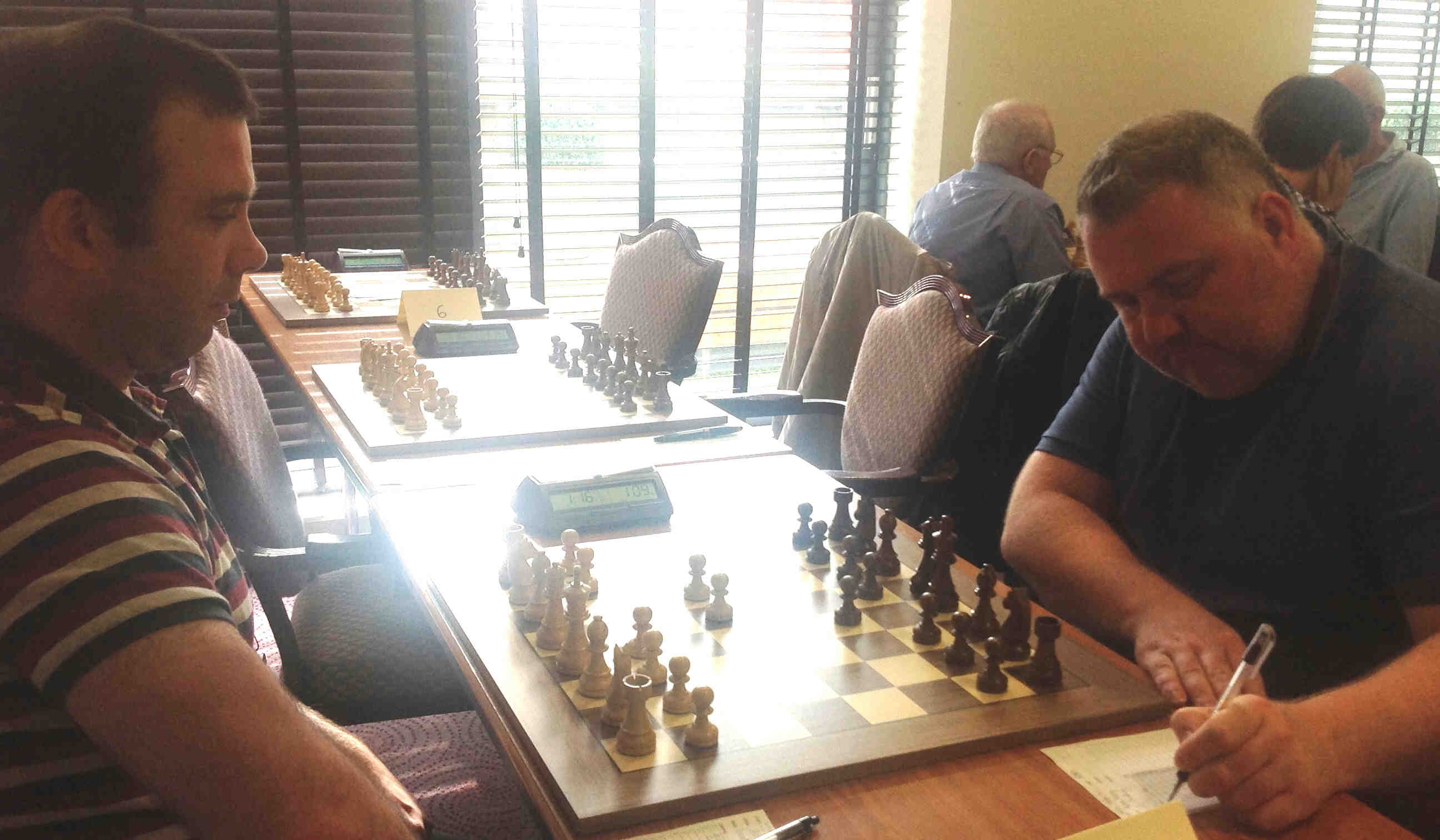
The Ulster Chess Union’s organisation of this year’s Ulster Championship included a major effort to upgrade the technology: not only live boards, but also a live webcam, added to the plush surroundings of the Europa Hotel in Belfast. By all accounts it seems to have been a very enjoyable tournament to play in, and a credit to the organisers.

Above: Ross Harris v. Gareth Annesley, round 2.

One of the innovations that intrigued me was that the Live Boards games are automatically saved on the ulsterchess.net site, instead of vanishing into the ether once the next round begins, as is usually the case. This seems to be down to Adrian Dornford-Smith, who it seems only needed about 10 lines of code to make this happen. I hope this catches on: it’s strange that so many other organisers go to all the trouble of arranging live boards and then allow the information to disappear.

In the event it was Rory Quinn who finished clear first on 5/6, though as he was not eligible for the title of Ulster champion, being neither Ulster-born nor -resident, the Ulster champion is Gabor Horvath, for the second consecutive year.

A report on the main event has been uploaded to the Tournament pages here. Many thanks to David McAlister for contributing many otherwise-unpublished photos and for providing background information on the event.

Posted in Tournaments, Ulster championships | Leave a comment

The Labyrinth: Enter at your own risk!

I’m still undecided on whether to continue The New Winawer Report for a third volume; I’ll probably make the final decision in January.

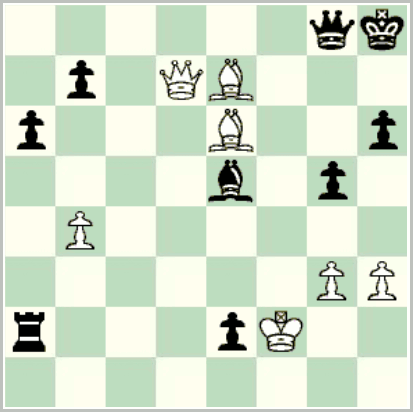
Ernst-Ottenklev, CellaVision (Rapid) 2015In the meantime, the latest issue of TWIC has an amazing game in one of the main lines of the Poisoned Pawn: Ernst–Ottenklev, CellaVision Cup (Rapid), Lund 2015. The diagram shows the position facing White for his 35th move. Clearly not all has gone according to plan, and even for a grandmaster the Winawer is as treacherous as ever.

He should have read Issue 21!

Posted in Articles | Leave a comment