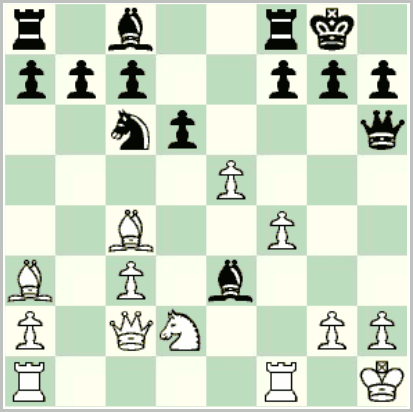
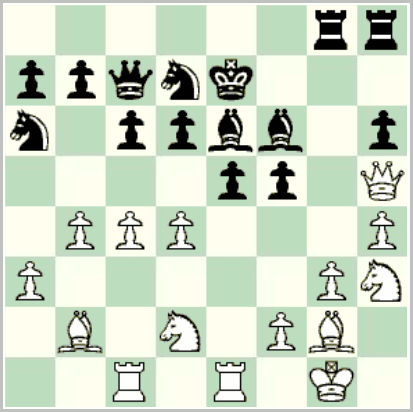
Black to play and win

Ryan-Rafiee, XV Foment Martinec 2013As the title says: Black to play and win.

(N.B. If you’d like to try it as an exercise, don’t read any further for now: the answer is given below.)

This is from a game of Joe Ryan’s (White), played on Saturday in an IM-norm tournament in Barcelona. There seem to be quite a few such events being organised in Barcelona these days and Joe is ideally placed for invitations, as a non-Spanish player with an FM title. The present event, XV Foment Martinec, is another 10-player, game-a-week all-play-all, with (I think) 6½/9 required for an IM norm in Joe’s case.

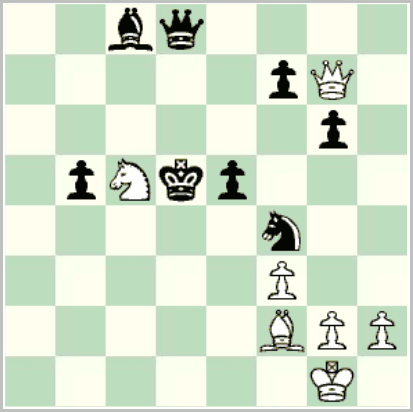
Going into this game he was on 2½/5, requiring wins in his last four games, quite a long shot. The game itself is an interesting one with many twists and turns, and is well worth playing over. It seems Joe built up a winning attack but misplayed it around the time control, and in the diagrammed position (reached shortly after the time control) was lost. Black has 43. … Kc4! 44. Qxe5 (there’s obviously nothing else) 44. … Qd1+ 45. Be1 Nd5! and the white knight has nowhere to go. Black missed the chance with 43. … Qg5? and after another error ended up losing. So the norm is still possible, though still a long shot. [Click to replay the full game.]

Posted in Games, Puzzles | Leave a comment

Zukertort-Soffe, blindfold simul 1879

Last week saw a welcome return of John Watson’s series of book reviews at The Week in Chess, after an extended break. And the very first book up for review is none other than Tim Harding’s Eminent Victorian Chess Players, mentioned here previously and listed on the Bibliography page.

And an excellent review it is too! This is particularly notable as in the past Watson hasn’t been a particular fan of chess history, but he liked this one: “surely this is one of the best and most accessible pieces of chess history ever written.”

Zukertort-Soffe, blindfold simul 1879One of the ten masters considered is Zukertort, whose visit to Ireland in 1879 was previously the subject of some of Tim’s research: see for example the Zukertort pages at ChessMail.com. He gave two major blindfold simuls. In the second, in Earlsfort Terrace ice skating rink on 7th March 1879, he reached the position at right against George Soffe, later Irish champion from 1889 to 1892 (based on his win in the 1889 championship), after Soffe’s 14. … Be3.

Zukertort went wrong with 15. g3?, and after 15. … Bh3 16. Rf3 Bxd2 17. Qxd2 Nxe5 was already lost. [Click to replay the full game.]

Easy enough to miss when you’re playing ten blindfold games simultaneously, of course. After the much better 15. exd6 Black’s better but White’s still very much in the game. Monck gave this as one improvement in his column in Our School Times, 10 May 1879, but his follow-up analysis leaves something to be desired: 15. … Bxf4 16. dxc7 Bxd2 17. Bxf8 Kxf8 18. Rxf7+ Ke8 19. Qe4+ and White wins. But what’s wrong with 16. … Qxh2 mate.? White must try 16. Rxf4 instead, when he’s doing relatively well, so Black is better advised to recapture with 15. … cxd6 instead.

Posted in Games, Simuls | Leave a comment

The New Winawer Report, issue 5

tNWR issue 5The fifth issue of The New Winawer Report has been posted: see the tnwr page. This issue continues with the much-maligned, but much-better-than-its-reputation, 13. Be3.

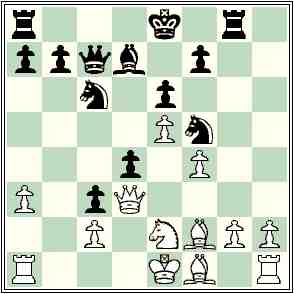
Black has a few viable options, but one of the main lines reaches the diagram at right, where White’s Be3-f2 has had the effect of inducing the committal … Nf5 and … d4. White may now proceed with either 15. h3 or 15. Rg1, planning in each case to follow up with g4. Although Black has an effective counter, this is overestimated by theory: Black has a narrow path to equality, but no more than that. Or so it seems to me: see the issue for full details.

Possibly the most important game featuring 13. Be3 was Spassky-Korchnoi, Candidates Final (2), 1977. In response Korchnoi sprung the surprise 13. … d4!?, a novelty, and won in great style. Much ink has been spilled on that, but I’ve never seen a persuasive answer to another question: what did Spassky have in mind, assuming Korchnoi continued with the usual 13. … Nf5 or 13. … 0-0-0, since 13. Be3 had had a dismal reputation for fifteen years or more by that point? I’ve seen the suggestions 13. … Nf5 14. Bf2 d4 (reaching the diagram above) 15. g4?! (Hartston in BCM, shortly after the match) or here 15. Ng3 0-0-0 16. Ne4 (a losing blunder!) in Archives, late ’80’s, but don’t find either very believable. Did Spassky ever say?

Anyway, the nest issue is tentatively planned to switch to the line 13. h3!?, with the plan of an immediate g4 (cutting out the Be3-f2 middleman). This was introduced by the late Robert Byrne in a famous game against Uhlmann in Monte Carlo 1968, and is a much more respectable try for White, especially as Uhlmann’s solution no longer seems to hold up theoretically.

Posted in Articles | Leave a comment

“Here’s one that wasn’t so good”: Alekhine-Barry, Dublin 1938

The Simuls page has a list of the illustrious visitors to Ireland down the years: these include Steinitz, Capablanca, Alekhine, Euwe, Smyslov, and Topalov, all world champions at one time or other. But only one of these was the reigning world champion during the visit. Alekhine gave three simuls in September 1938: in Dublin (Regent House, Trinity) on the 14th and 15h, and Belfast (Clarence Place) on the 17th.

The results were +31 =3 -1 and +28 =7 -0, respectively, in Dublin, and a clean +34 =0 -0 sweep in Belfast. Thus he lost only one game, versus Charles J. Barry (Sackville). Barry won the Leinster championship seven times, including the first three championships in 1912-14, as well as at least two Armstrong cups with Sackville (probably many more). He was never Irish champion: the closest he got was =2nd in 1940, ½ point behind O’Hanlon.

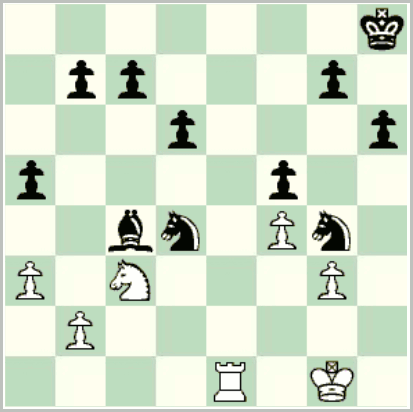
Alekhine-Barry, First simul, Dublin 1938It seems only two games from the entire visit survived (neither one in the ICU games archive, surprisingly), of which the only complete one is Barry’s win. Alekhine blundered in the opening (16. Bg8?) and it all went downhill from there. From the diagram the finish was 29. Re7 Ne6 30. Rf7? Nf6 31. Re7 Kg8 0-1.

[Click to replay the full game.]

There’s more to the story: at the end of the game, Barry asked Alekhine to sign his scoresheet, but Alekhine waved him away angrily and refused. Barry can’t have liked that, but what can you do? When “My Best Games of Chess 1924-1937” came out, Barry pasted the scoresheet onto the inside front cover and wrote across the top “Here’s one that wasn’t so good.” (Source: J.J. Walsh.)

Posted in Games, Simuls | Leave a comment

From Cork 2013

TWIC 963 had 23 games from the Cork Masters 2013, now all posted in the games archive.

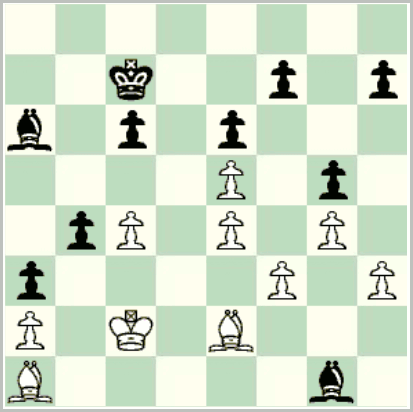
Doyle-Baburin, Cork Masters 2013In the second round, local player and newly minted Irish U-19 champion Hugh Doyle was up against Alexander Baburin, and reached the following position, as White, to play. He went wrong with 31. Kd3? Kb6 32. Bd4+? and lost quickly after 32. … Bxd4 33. Kxd4 c5+ 34. Kd3 b3! 0-1.

In retrospect he probably wished he had tried 31. Kb3!? from the diagrammed position, with a view to blocking the entire position and preventing Black from infiltrating. What is your evaluation of the resulting position?

Answer (or at least my answer) in a few days.

Posted in Games, Puzzles | 1 Comment

Alex Montwill

Alex MontwillJ.J. Walsh has sent the news that Alex Montwill, who has been mentioned here several times, died two weeks ago, on April 18th. He was 78.

As previously discussed here, he finished equal first in an Irish championship but was never Irish champion, losing out on tie-break in the 1962 championship in Derry (8-round Swiss, 16 players, finishing =1st-4thon 5½/8 with John B. Reid, Michael Littleton, and Brian Reilly; Reid and Littleton were declared joint Irish champions on tie-break). However he had the consolation of being (joint) Irish correspondence champion in 1963. He also played on two winning interprovincial Leinster teams in 1961 and 1964, on boards 11 and 5 respectively in the finals. He gave up chess relatively early and switched instead to bridge (as did so many other Irish players over the years), where he was apparently a very strong player.

He was most prominent (and apparently very well known) as a physicist, and was a Professor of Experimental Physics at UCD, where he worked in one capacity or another for over 40 years.

In a 43-minute interview from an Institute of Physics Ireland event in 2010, he gives many interesting details of his background. He was born in Riga, Latvia around 1935, and recalled the family hiding from invading Soviet troops during the war, moving around in Lithuania and Poland for a few years and ending in Germany. He moved to Ireland in 1947; apparently not just any refugee could do so at the time, and some connection to Ireland was required. In his case, one of his ancestors, an O’Rourke, was one of the Wild Geese, and a branch of the family, all O’Rourke’s, ended up over the centuries working for the Tsars.

A brief biographical summary has been added to the main players page. A more detailed page will be added at some point. The ICU games archive has just two of his games; does anyone know of any others?

Posted in News, Players | 1 Comment

The New Winawer Report, issue 4

The fourth issue of The New Winawer Report has been posted: see the tnwr page. This one continues with the main line of the poisoned pawn variation. A game from this year’s Gibraltar Masters, Janev-Quillan, featured 13. Be3. This was for a brief time one of the main recommended variations for White, but has been under a cloud for decades. But in Janev-Quillan, White got an excellent position from the opening, and duly won.

What went wrong for Black? Issue 4 considers the point, along with some of the theory of the 13. Be3 variation.

Posted in Articles | Leave a comment

Jonathan O’Connor awarded CC-IM title

Colm Daly’s galling near-miss of an IM norm last month happened just as I was leaving for a trip to Shanghai–as I left the house I thought he had it in the bag. Disappointing! But that is the way with norms: it seems there are a dozen near-misses for every actual success.

With the topic of norms in mind I remembered Jonathan O’Connor telling me about his near-misses in correspondence chess ten years ago. He earned two SIM norms (Senior International Master, roughly halfway between IM and GM), but fell short of that title, and two SIM norms didn’t automatically translate into an IM title either.

There’s a provision in the ICCF rules for national federations to make an exceptional application, so with time to kill at my meeting I idly tried to see if there was some way of constructing a case for Jonathan, for the IM title at least. The rules are that two norms are needed, covering at least 24 games. Jonathan’s norms were 7 / 10 in the Champions League Qualification Group 7 Board 1 (Category 5: SIM = 7, IM = 6½) and 9 / 11 in the 15th ICCF Correspondence Olympiad preliminaries Section 1 Board 5 (Category 4: SIM = 8, IM = 7½). So two norms, but only 21 games.

With the national exceptional application in mind, and seeing that Jonathan had scored well over the required minimum in each case, for the IM title in particular, I wondered what would happen if extra players were added into each event, without lowering the category, and Jonathan had just lost the extra games, but still leaving him with valid norms in the hypothetical expanded event. I found that 7 / 11 is enough for an IM norm for category 5, and 9 / 13 for category 4. So 24 games. Well, well, well!

But there was another pleasant surprise: when I searched on the ICCF site for how to go about making the case, and how previous applications for national exceptional applications had been formatted, I found that the 2011 ICCF Congress had codified this exact procedure into the regulations, because so many others had had exactly the same idea and there had never been an objection.

I submitted the writeup to Tim Harding, Ireland’s ICCF representative, who forwarded to the ICCF, and today the answer arrived from the ICCF Qualifications Commissioner: title approved, and indeed already recorded on the ICCF website, medal and certificate to be awarded at the ICCF Congress in Poland in July.
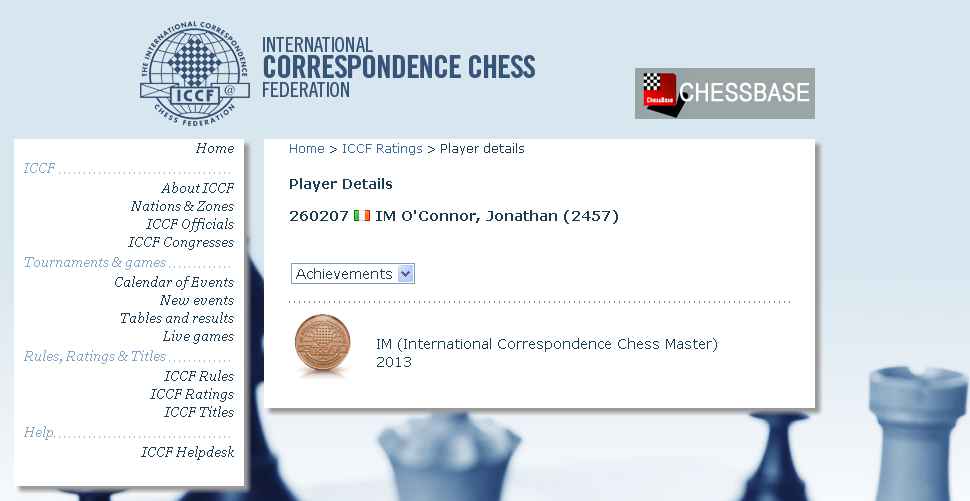
Jonathan O'Connor CC-IM

Congratulations to Jonathan! A richly deserved honour: he had a very high success rate for norms (2 norms out of the only 3 events he played) and would surely have gained the title long ago if he had had the time to spend on more tournaments.

My only regret is that we didn’t arrange to have the notification delivered on April 1, just to make it interesting. It only occurred to me afterwards.

Posted in News, Players | Leave a comment

An Armstrong puzzle

Dunne-Casey, Armstrong Cup 1999-2000Black to play: how do you evaluate the consequences of 19. … f4!?

This is from the game Oliver Dunne-Eoghan Casey, Elm Mount v. Gonzaga, Armstrong Cup 1999-2000. (Thanks to Oliver for supplying it.)

Posted in Armstrong Cup, Games, Puzzles | Leave a comment

12th Gonzaga Classic 2013: Masters

For some reason I’ve fallen behind in processing tournaments: probably this is because they’re more work than grabbing a game and adding it to the archive. Anyway this year’s Gonzaga Masters has now been added. Winner of the Masters, and Philip Hogarty Cup, for the fourth year in a row was David Fitzsimons. Well done to the organisers for making all games from the Masters available.

Posted in Gonzaga Classics, Tournaments | Leave a comment