A puzzle solved

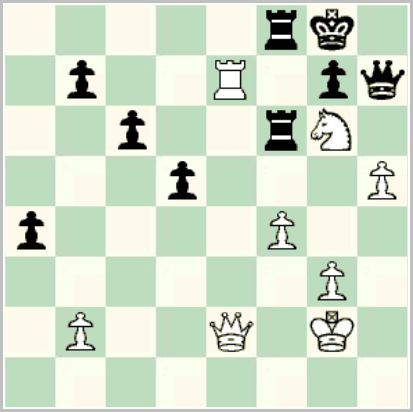
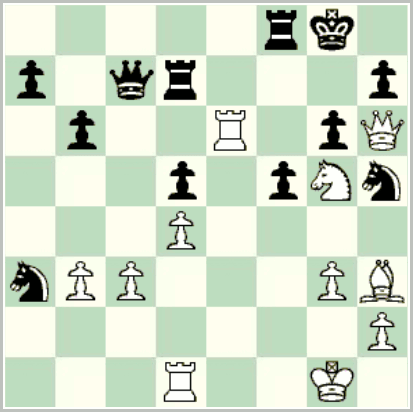
Three years ago, when a report on the Bunratty Masters 2006 was posted here, I asked how on earth White could have recovered from the diagrammed position, where Black has just played 31… Qh3 (How?, February 28, 2017).
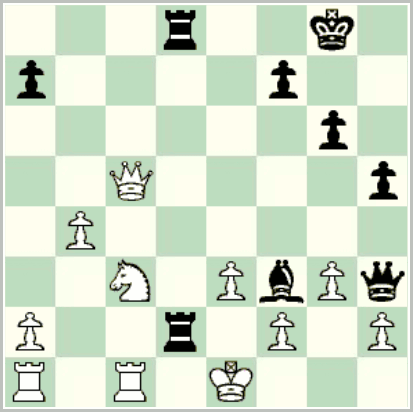
Van Voorthuijsen - Kane, Bunratty 2006

Van Voorthuijsen – Kane, Bunratty Masters 2006
32. ?

The ICU games archive gave “…” at the end, indicating that some moves were omitted, and the result was 1-0. Since Komodo 9.3 evaluates the position above at around -28, this must be close to an all time record for recovery from a lost position, and I wondered how it could have happened.

I was delighted to find on Wednesday that Peewee van Voorthuijsen had commented on the original post, with the continuation of the game, for which many thanks.
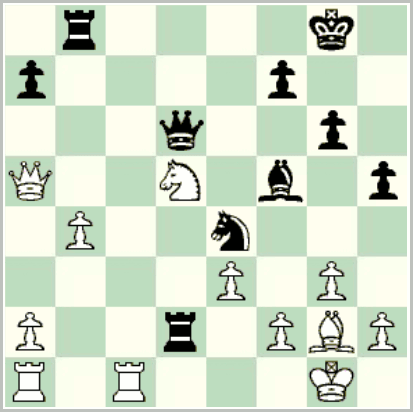
Van Voorthuijsen - Kane, Bunratty 2006, 27BThe time limit was a flat all moves in 90 minutes, and both players must have been short of time, Black catastrophically so. A few moves earlier, White had been better (see second diagram), and now with 27. Rd1 would have a clear advantage, e.g., 27… Qe5!? (27… Rxd1? 28. Rxd1 and White is winning) 28. Bxe4 Rxd1+ 29. Rxd1 Bxe4 30. Rd4 Bf3 31. Qc7 Qxc7 32. Nxc7 Rc8 33. Rc4 Bd5 34. Rc5 Bxa2, with a safe pawn plus. Instead, presumably with the clock playing a role, he went astray via 27. Bxe4? Bxe4 28. Nc3??. Here 28. Nf4!? is the move, with interesting play. After the move played, Black was winning, and after 28… Bf3 29. Qc5 Qe6 30. Kf1 Rbd8 31. Ke1 Qh3, the first diagrammed position was reached.

The simplest win was 32. Qb5 Qxh2 33. Qf1 Bg2, and this is where Komodo 9.3’s lopsided evaluation comes from. Once Black missed this via 32… Qg2?, the evaluation dropped to -7. After several missed wins, including a mate in 2, he seems to have lost on time.

[Click to replay the full game.]

All in all, it’s probably a good thing that the old no-increment days are no more. But there’s no doubt it led to some dramatic finishes.

A revised report has been uploaded.
Posted in Bunratty, Games, Tournaments | 1 Comment

S. Moran – O’Donnell, Irish Championship 2019

S. Moran - O'Donnell, Irish Championship 2019

S. Moran – O’Donnell, Irish Championship 2019
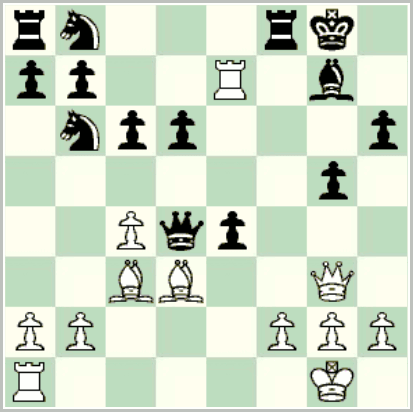
30. ?

Another game from the sixth round of the 2019 Irish championship, and another missed opportunity. Stephen Moran now played 30. Rxg6+? and the game soon ended in a draw.

He could have won via 30. Bxf5!!. Of course, it is immediately clear that 30… Rxf5? allows a mate in two. But other variations are not so obvious:
I. 30… Nf6 31. Bxg6! hxg6 32. Rf1 Qxc3 33. Qxg6+ Rg7 34. Qxf6! and wins;
II. 30… gxf5 31. Qxh5 Qxc3 32. Re8, e.g., 32… Nc2 33. Kh1 Qxb3 34. Ne6 and wins.

[Click to reply the full game.]

Posted in Games, Irish championships | Leave a comment

FIDE ratings, April 2020

The FIDE record ratings page, recording the all-time peak ratings of Irish players, has been updated to account for the April 2020 rating list.

I expected that there would be no change this month, given world events. But in fact two players reached new personal highest ratings:

Tarun Kanyamarala 2376 → 2384, 18th → 16th;
Killian Delaney 2302 → 2303, unchanged in 36th place.

Tarun Kanyamarala thus recorded a new personal record in at least the last seven lists. This month he moved past Colm Daly and Mark Orr, both with peak ratings of 2380.

Posted in Ratings | Leave a comment

O’Connell – G. Melaugh, Irish Championship 2019

O'Connell - G. Melaugh, Irish Championship 2019

O’Connell – G. Melaugh, Irish Championship 2019
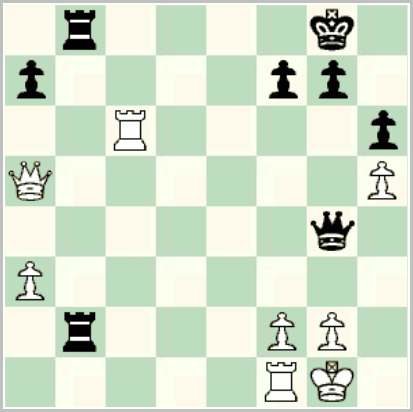
35. ?

In this round 6 game, Gerard O’Connell had fought back from a losing game to reach the diagrammed position. He now saw nothing better than 35. Nxf8, and the game soon ended in a draw.

He could have won via 35. f5!, when Black has no good defence to Re8 followed by Qe6+ / Qe7 and a quick mate:
(I) 35… Rxf5 36. Qe6+ R5f7 37. Re8, or more neatly 37. Qxf7+, etc.
(II) 35… Qh6 36. Re8 Qg5 37. Qe6+ Kh7 38. Rxf8 Rxf8 39. Nxf8+ Kg8 40. Qe8 and wins.

[Click to replay the full game.]

Posted in Games, Irish championships | Leave a comment

Irish Championship 2019

A report on the Irish Championship 2019 has been added to the Tournaments sections here.

The championship has been going from strength to strength, with each of the last three years bringing a stronger field. This year had in addition an outcome that was in suspense until the last few minutes, when Conor E. Murphy turned around a losing position against Conor O’Donnell to finish clear first with 7½/9, a point ahead of defending champion Alex Lopez and Sam Collins.

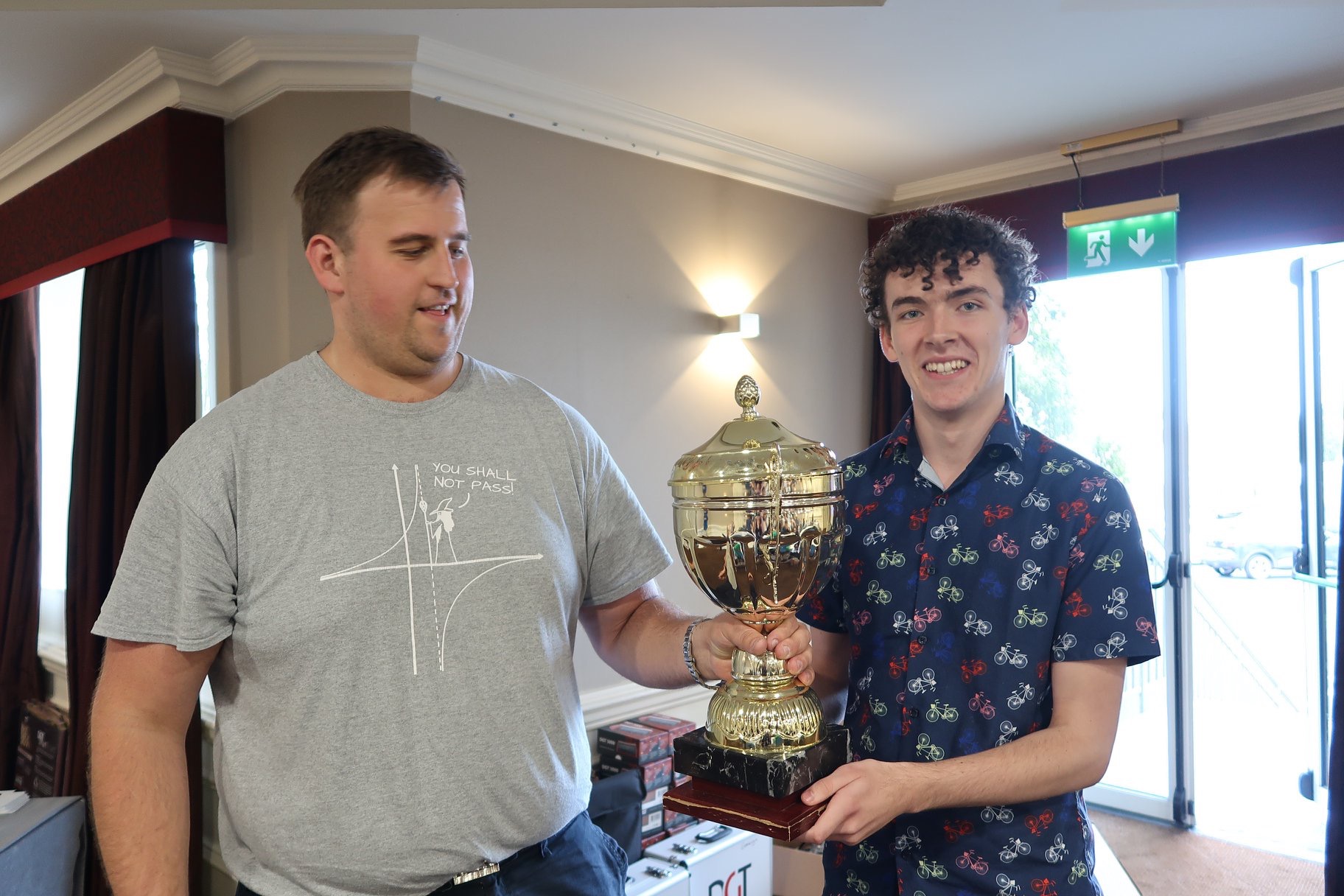
The ICU web site has a photo of the prizegiving (credit: Fiona Steil-Antoni):

Irish Championship 2019 prizegiving

Trivia question: what’s that trophy? (See report for answer.)

There were many interesting games, which the next few posts will explore.

Posted in Irish championships, Tournaments | Leave a comment

Windmill

Some considerable time ago, we had an example of a double seesaw/windmill here, in a game between Oliver Dunne and Pat Fitzsimons.

The theme arises again, and once again in a game of Oliver Dunne’s. This time he’s on the receiving end, in a game against Seán Cummins, from the Heidenfeld a couple of weeks ago.

The diagram shows a critical position, after White’s 19. Bd2-c3.

Cummins - Dunne, Heindenfeld 2019-20

Cummins – Dunne, Heidenfeld Trophy 2019-20
19… ?

After 19… Be5! 20. Bxd4 Bxg3 the windmill arose, but this time White saw no way of converting it to a win, and after 21. Rg7+ Kh8 22. Rf7+ Kg8 23. Rg7+ Kh8 24 Rf7+ Kg8, the players agreed a draw, on Black’s offer.

Can White do better? White’s best seems to be to recapture with 21. fxg3, when 21… exd3 White uses the windmill to capture the pawns on g5, b7, and a7 and the knight on b6. Though White is then just a single pawn up, engines think it’s clearly winning. Instead 21… Rf7 is a better try, when after 22. Rxe4 the windmill is avoided and material is level, but engines still think White has a decisive advantage.

[Click to replay the full game.]

Many thanks to Oliver for sending the game.

Posted in Games | 1 Comment

Bunratty Masters 2020

A report on the Bunratty Masters 2020 has been added to the Tournaments pages here. Nigel Short won for the third time in the past five years; it’s strange to think he had never won before then.

The organisers did an outstanding job in making virtually all games available within days of the event, and 149 out of the 151 games are available, with a long list of Interesting games.

Here is a neat finish from the last round. White has just played 27. Qc3-a5? (instead of something like 27. Rc5=). Black to play and win:

Brady - Fitzsimons, Bunratty Masters 2020

Brady – Fitzsimons, Bunratty Masters 2020
27… ?

[Click for solution and to replay the full game.]

Posted in Bunratty, Tournaments | Leave a comment

Inscription

My local club, the Mechanics’ Institute in San Francisco, has an excellent chess library, with about 2,000 books, along with complete runs of the British Chess Magazine, Informator, New in Chess, and others.

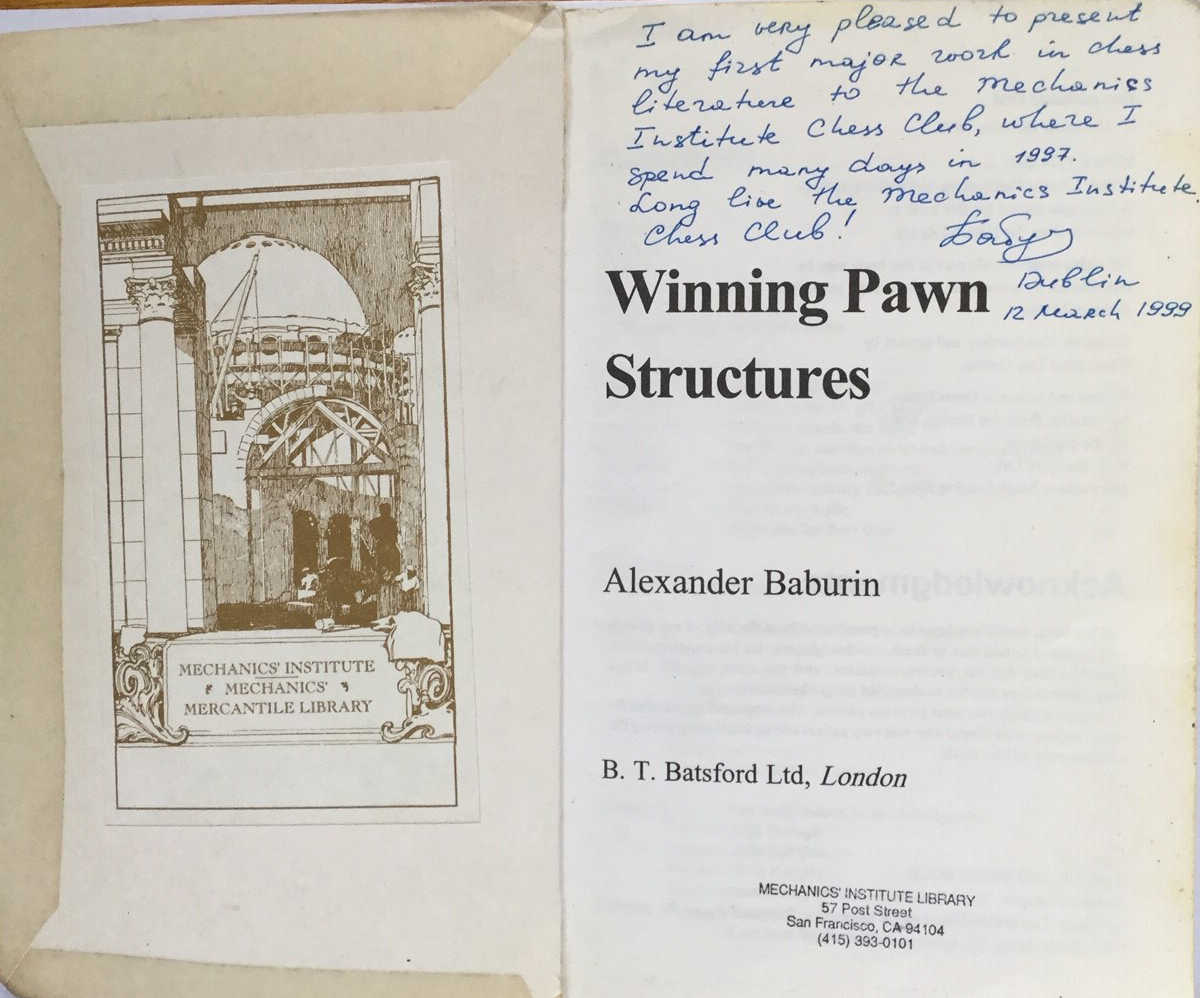
I have meant for some time to read Alexander Baburin’s acclaimed book Winning Pawn Structures (Batsford, 1998), long recognized as a classic but out of print for years. I was pleased to find that the Mechanics’ Institute had a copy, but was surprised and delighted to find that it comes from the author himself, as attested by the inscription:

Baburin, Winning Pawn Structures

Posted in Books | 1 Comment

FIDE ratings, March 2020

The FIDE record ratings page, recording the all-time peak ratings of Irish players, has been updated to account for the March 2020 rating list.

Three players reached new personal highest ratings:

Tarun Kanyamarala 2349 → 2376, =21st → 18th;
Henry Li 2310 → 2315, 33rd → =30th-33rd;
Killian Delaney 2287 → 2302, 43rd → 36th.

That’s at least six consecutive lists in which Tarun Kanyamarala has achieved a new personal best rating.

Posted in Ratings | Leave a comment

Two knights versus a pawn

The celebrated ending of two knights versus a pawn is the hardest of the ‘basic’ endings, and was exhaustively analyzed long before the tablebase era. Interesting though it is, its importance is mostly theoretical, as the ending is very rare in practice. (It’s sometimes given as an example of what the practical player should not study.)

But “very rare” and “never” are two different things, and the ending cropped up yesterday in the Bunratty Challengers.

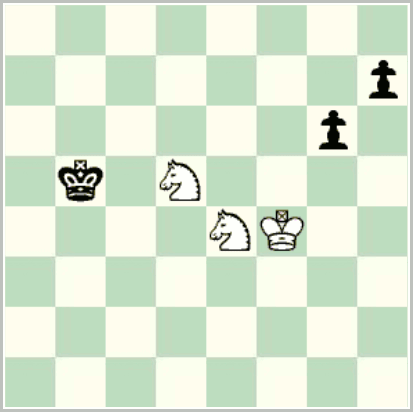
White - Mirza, Bunratty Challengers 2020

White – Mirza, Bunratty Challengers 2020
48. … ?

The diagrammed position shows the game at the critical point, a couple of moves before the ending in question appeared. The basic idea is well known: White needs to keep one black pawn on the board to avoid stalemate, and will usually need to blockade it behind the ‘Troitsky line’ e4-f5-g6-h4. Even then, the required winning procedure often runs foul of the 50-move rule.

The usual tablebases (e.g., Nalimov) show that from the diagrammed position Black loses with best play in 97 moves, but this does not account for the 50-move rule.

But the Syzygy tablebases give the information we need. From the diagram, Black has four moves that hold the draw via the 50-move rule: 48… Kc4, 48… Kc6, 48… g5+, and 48… h6. Instead, Diana Mirza played 48… h5?. The ending is so obscure that the ‘?’ is harsh, but this changes the valuation. White could now win via 49. Ng5! (only move), blockading the g-pawn behind the Troitsky line. It’s still a close-run thing: after, say, 49… h4 50. Ne3 h3 51. Kg3 Kc5 52. Kxh3, White mates in 49 moves with best play, with the next pawn move resetting the counter in 44 moves.

As it was, White erred with 49. Kg5?, when it’s a draw even without the 50-move rule. Using = to mean drawn with best play without the 50-move rule, and [=] to mean drawn only because of the rule, the play continued 49… Kc4? [=] (49… h4!, only move, =) 50. Ndf6? (50. Ne3+ [=]; 50. Nf4 [=]) 50… h4=. After 51. Kxh4 White continued, optimistically enough, for another 32 moves.

[Click to replay the full game.]

This is not the first Irish game to reach this ending: Keogh – Bjørgvik, World Senior 65+ Championship 2018 is the only other game in the ICU archive that did so. At all relevant stages that game was won for the two knights if not for the 50-move rule, but drawn once the rule is taken into account.

Posted in Bunratty, Games, Tournaments | 1 Comment