From the Irish championship 2018

The Irish championship ran from August 4-12 in Dublin. Congratulations are due to the organisers for an outstanding event, which must rank as the strongest ever. The turnout of 36 players has only rarely been exceeded (fifth on the all-time list, I think), including 8 former champions and 12 titled players.

The in-form Alex Lopez won in a canter, finishing with 8/9, 1½ points ahead of the field. He was never in any trouble throughout the event, and for good measure he followed up with 9/9 in the blitz. He has now played in three Irish championships (2010, 2017, and 2018) and has been champion or joint champion in all of them.

In addition David Murray recorded his first IM norm. That’s the second consecutive year in which the Irish championship has produced a norm, and another testament to the work of the organisers. (And to David Murray, of course.)

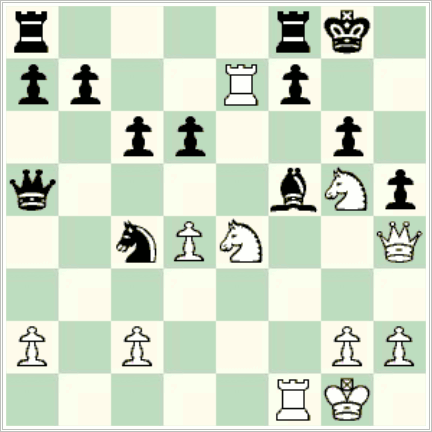
It will take some time to compile a full report. In the meantime, here is one fragment. In round 8, the only Ulster player Stephen Rush (White) grabbed a pawn against Eamon Keogh, and was faced with the following position at move 23:
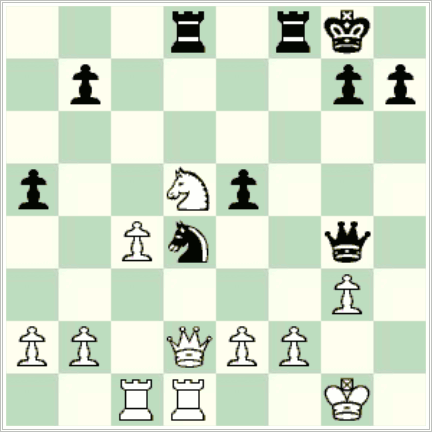
Rush - Keogh, Irish Championship 2018

Rush – Keogh, Irish championship 2018
White to play

Play continued 23. Re1? Rd6 24. Kg2 Qe4+ 25. f3 Rxf3! 26. exf3 Qxf3+ 27. Kg1 Qxg3+ 28. Qg2 Nf3+ 29. Kf1 Nh2+ and the players agreed a draw, due to the perpetual.

Actually, 24… Qe4+? threw away a win. After 24… Rh6! White is defenceless, since the presumably-intended 25. Rh1 loses to the same theme after 25… Qe4+.

So from the diagram White needs to cover the square e4, as well as e2. He thus had to play 23. Nc3!, when he is still in the game: engines then give White a small edge.
Posted in Irish championships, Tournaments | Leave a comment

Hans-Joachim Hecht simuls, 1974

Oisín McGuinness’s recent comment on the Simuls page here talks of a simul the West German grandmaster Hans-Joachim Hecht gave at Collegians C.C. (Kiely’s of Donnybrook) on April 17, 1974.

A report of the event appeared in the Irish Times (April 19, 1974 p. 4). There were 39 players, and Hecht recorded 28 wins, 7 draws, and 4 losses, to Ray Byrne, Tony Dennehy, David Dunne, and Wolfgang Eulitz. This has now been added to the Simuls page, along with the simul he gave in Wexford the following day (+22 =0 -0).

Actually, Seán Terry (of Oxford City C.C. and DisinformatorTM) sent me information about the Collegians simul some considerable time back [January 18, 2012, now that I look at the date of his email], including his game.

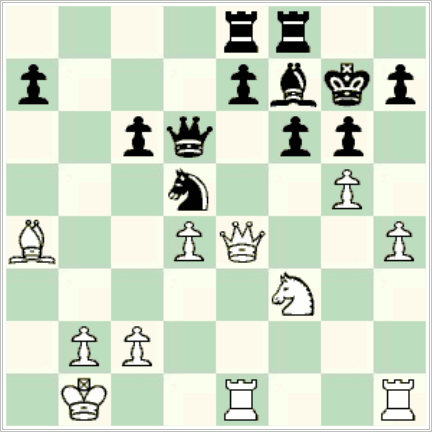
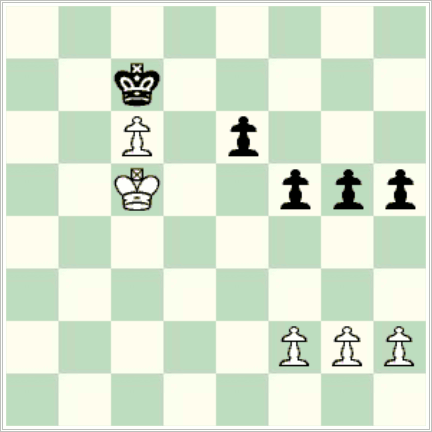
The game reached the following position, with White (Hecht, of course) to move. How would you evaluate this position and what would you play as White? This is not at all trivial and is well worth your time.

Hecht - Terry, simul 1974

Hans-Joachim Hecht – Seán Terry
Simul, Dublin 1974
White to play

Answer, plus full game, in a couple of days.

[Updated July 22, 2018, with corrected name of fourth player to win.]

[July 23, 2018: see comment for solution. Click for full playable game.]

Posted in Simuls | 2 Comments

8th Blind Olympiad, Hungary 1988, contd.

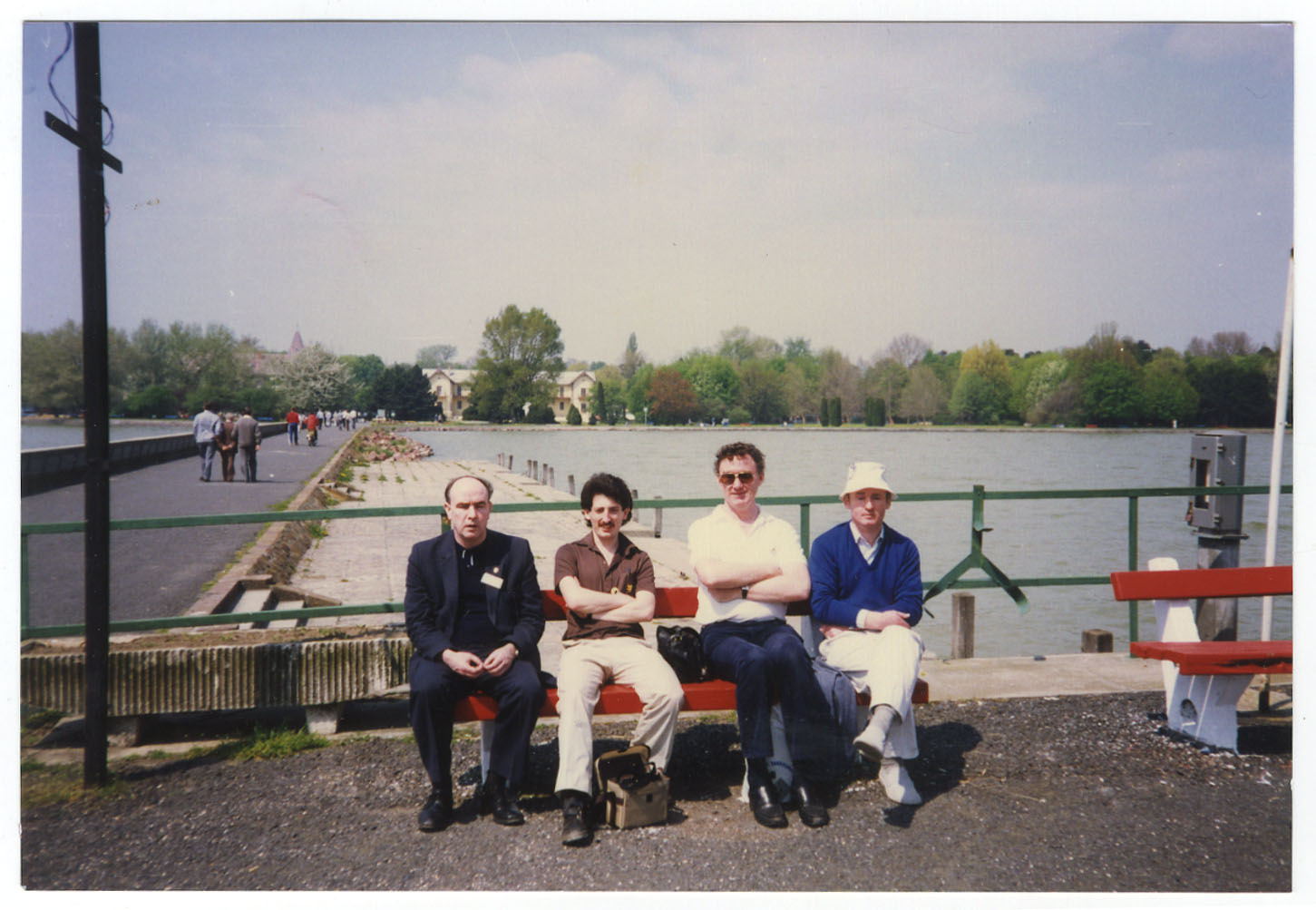
Following on to the last post, here is another photo from the 8th Blind Olympiad, again kindly provided by Philip Doyle.

8th Blind Olympiad, Hungary 1988: Irish squad at Lake Balaton

Michael Keating, Gerard MacElligott, Ernie McElroy, Philip Doyle
Lake Balaton, April 1988
Posted in BCAI | Leave a comment

8th Blind Olympiad, Hungary 1988

The 8th Blind Olympiad was held in Zalaegerszeg, Hungary, April 17-30, 1988. In all 23 teams competed, and Ireland finished in the middle, fifth out of eight teams in the second of the three final groups.

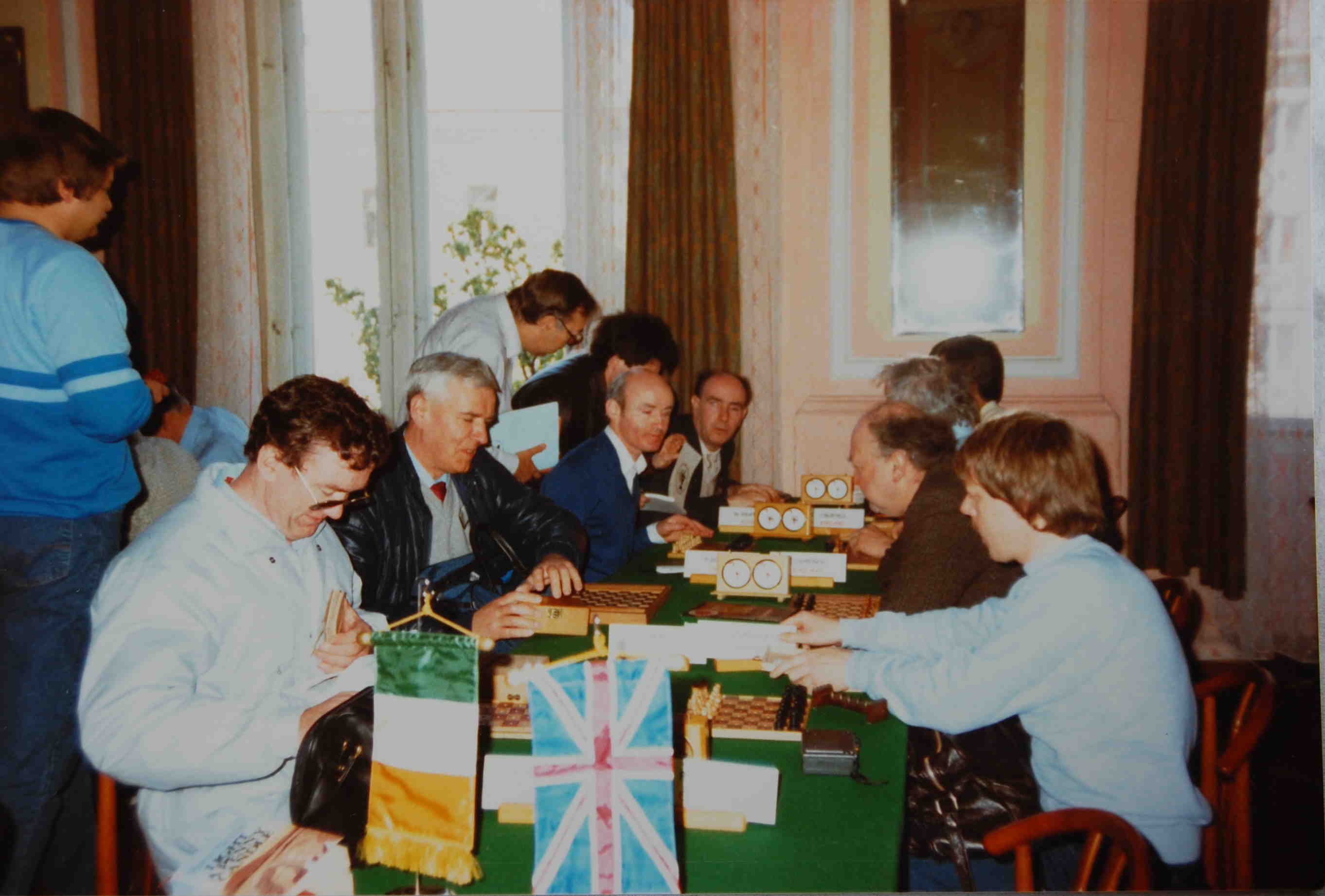
Philip Doyle, author and compiler of the B.C.A.I. History pages, has kindly provided several photos of Irish teams down the years, that have not appeared anywhere else. Here is one from this event, at the start of Ireland’s match against Great Britain.

Ireland v Great Britain, 8th Blind Olympiad, Hungary 1988

Ireland v. Great Britain, 8th Blind Olympiad, Hungary 1988
Ireland, L.-R.: Ernie McElroy, Seán Loftus, Philip Doyle, Michael Keating.

[Click for full resolution version (1.5 MB).]

Ireland’s captain and guide was Gerard MacElligott, who is partially hidden here, between Philip Doyle and Michael Keating.

No games from the event appear in the ICU games archive at the time of writing, but they’re all available at the always excellent OlimpBase site. All Irish games have now been added to the collection here.

Posted in BCAI | Leave a comment

New analysis: a missed win

Round 6 of the 1975 Irish championship paired Oisín McGuinness and Alan Ludgate, each on 3½/5 and just half a point off the lead. The following position was reached after White’s 24. Nce4.

McGuinness-Ludgate, Irish championship 1975
McGuinness – Ludgate, Irish Championship 1975
Black to play

Play continued 24… Nd2 25. Nxd2 Qxd2 26. Rxf5? (but White is much worse after 26. Rfe1 also) 26… gxf5 27. Qxh5 Qxd4+ and White’s attack had petered out.

But Tony Doyle has now contributed new analysis, showing that actually White is winning in the diagrammed position. After 24… Nd2, 25. Nf6+ Kg7 26. Nxh5+ gxh5 27. Nxf7! is a win in all lines, e.g., 27… Ne4 28. Qxh5 Qd2 29. Nh6+ Kf6 30. Ng8+! and mate in two moves.

‘Nor does Black have a draw by first playing 24… Bxe4 25. Nxe4 Nd2. White wins with 26. Qe1 Nc4 27. Qg3!, with the threat of Rfxf7: if then 27… Kg7 28. Qh4 (threatening Qf6+, followed by Ng5 and Ne6). In short, Black is completely lost in the position at move 24.’

[Click to play through the full game.]

So there was a win; but it was quite missable, to say the least. It’s therefore worth pointing out that the opportunity and analysis above were all found by Tony without any engine analysis. (Though engines confirm it all.) ‘I could have saved myself a couple of hours by initially entering the position at move 24 into Komodo, but where’s the fun in that? It was this kind of analysis that I used to love when playing CC.’ Yes, indeed.

Posted in Games, Irish championships, Tournaments | 1 Comment

Irish championship 1975

A report on the Irish championship 1975 has been added to the tournament archive pages here. In a field of 30 players, Eamon Keogh and Alan Ludgate tied for first and shared the title; this was the first time either of them was Irish champion.

This was until recently one of the most mysterious Irish championships: final totals were available, but very few round results were known. Possibly due to the large field, press reports gave only a sample of the leading results. Fortunately Alan Ludgate kept excellent records, which he has very kindly provided, with all of his games and almost all round results.

Opening choices reflected the era: Keene & Botterill’s The Modern Defence from the Batsford series was enormously influential: of the 11 games we have available, 1… g6 appeared in six.

The Indian player Sai Prakash, a student at T.C.D., started well, with 2/2 and later 3/4, but lost his last four games. After round 6 (out of 8), the teenagers Paul Delaney and Paul Wallace were tied for first. Both lost in round 7, to Keogh and Ludgate respectively. These shared the lead heading into the final round, where both had Black.

In the final round Keogh drew quickly with the defending champion Tony Doyle. Alan Ludgate was therefore assured of clear first if he won against Paul Delaney. The Irish Times reported that “Ludgate gained a winning position against Delaney and appeared certain to win the title outright, but he mishandled the attack in time pressure and allowed the alert Delaney to escape with a draw”. This is where it is very helpful to have the game score—previously not available—as this description is inaccurate in several respects.

The diagram shows what was perhaps the most critical moment. Ludgate, as Black, is to play. How would you continue? There are several continuations that seem promising, but all except one lead to no advantage.

Delaney - Ludgate, Irish championship 1975
P. Delaney – Ludgate, Irish Championship 1975
Black to play

[Click to reply the full game.]

Posted in Irish championships, Tournaments | 2 Comments

Weymouth 1968: Postscript

British Pathé has a newsreel of Weymouth 1968, lasting 1 minute, 6 seconds. Unfortunately there’s no sound, but the video is interesting nevertheless.

There is also one additional game, Keane – Rantalainen, round 9 (Ireland – Finland), not in the OlimpBase collection, from the Evening Herald of May 8, 1968. Not a classic, unfortunately: Rantalainen erred in the opening and Michael Keane recorded Ireland’s quickest win of the event.

Posted in BCAI | Leave a comment

3rd Blind Chess Olympiad: Weymouth 1968

The 3rd Blind Chess Olympiad was held in Weymouth, England, from March 29 to April 11, 1968. Twenty teams competed, with the Soviet Union finishing first, followed by Yugoslavia and Romania.

The Irish team of Seán Loftus, Willie Breen, Ernie McElroy, and Michael Keane had an outstanding result, finishing in tenth place, ahead of both Great Britain and the United States, the only time this has ever happened in any chess Olympiad. “It is not often in chess—or in other sports—that teams from Ireland find teams from England and the U.S.A. behind them at the finish” (Jim Corby, Evening Herald, May 8, 1968 p. 7). Indeed!

The OlimpBase report on the event has the final table and 14 of Ireland’s 44 games. (See also the games archive here.)

Philip Doyle has compiled a detailed account of Ireland’s long and distinguished history in events for blind and visually impaired players, and has kindly provided permission for the pages to be hosted on this website. A new page has been added, and a separate collected games page will be integrated here in the near future.

Posted in BCAI | Tagged | Leave a comment

Where and when?

As far as I am aware, there is only one Olympiad in which Ireland finished ahead of Great Britain / England.

Where and when?

Answer in a few days.

Posted in Puzzles | Leave a comment

Armstrong Cup 1892-93: Kingstown

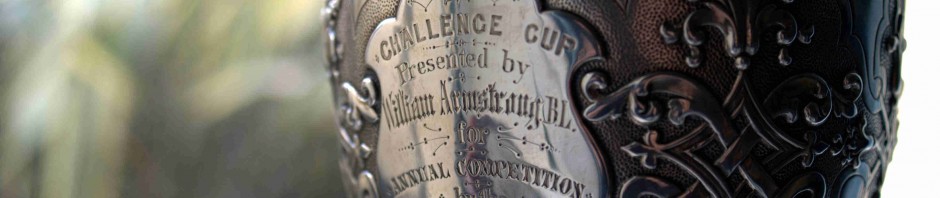
Congratulations to Gonzaga on winning the Armstrong Cup for the fourth consecutive season! For the first time in a while there was a close finish, with the result well in doubt heading into the final day.

The last post discussed the void season 1891-92. Moving on to the following season, 1892-93, i.e., 125 years ago, five teams entered: Booterstown & Blackrock, Dublin, Dublin University, Kingstown, and Rathmines. Teams were to play home and away, matches were over six boards, and only overall match results counted. (In case of a tie, there would have been a playoff match.)

Clontarf, the team disqualified in 1891-92, did not take part, though they were still an active club. Dublin C.C. played at least two matches, but were only able to fill 4 boards for one of them and 2 boards for the other; they may have withdrawn from the competition.

Schedules were much more haphazard 125 years ago than today: match dates were agreed at the beginning of the season but could clump in different ways for different teams. The season came down to a struggle between Kingstown and Dublin University, but the two matches between them occurred two weeks apart at the end of the season. Dublin University lost one match to other teams (to Booterstown & Blackrock, assuming Dublin indeed dropped out). Kingstown had drawn against Rathmines.

The first match between Kingstown and Dublin University was played on Wednesday, March 15, 1893, at T.C.D., and resulted in a convincing 4½-1½ victory for Dublin University, who swept the top three boards. The decisive return match was held two weeks later, on Saturday, March 25, 1893, in Kingstown, with the following outcome:

Kingstown Dublin University
P. Dunscombe ½ – ½ W. E. Thrift
W. Cooke 1 – 0 A. E. R. Joynt
R. J. Dale 1 – 0 A. L. Joynt
A. Dawson 1 – 0 A. Traill
T. C. Morris 0 – 1 Dr. McHugh
J. M. Goldsmith 1 – 0 Mr. Cosgrave
4½ – 1½

So Kingstown won the match, “thus securing this much-coveted trophy” (Irish Times, March 27, 1893 p. 3), for the first and only time in their history. (Even if Dún Laoghaire is viewed as a successor.) The winning team was Parker Dunscombe, Wheeler Cooke, R. J. Dale, Adrian Dawson, T. C. (Thomas) Morris, and John Mills Goldsmith. These same six players played in all six matches against Dublin University, Booterstown & Blackrock, and Rathmines (it’s unclear if they played Dublin that season).

A summary of the season, with scores of all available matches, has been added to the Armstrong Cup page here.

Posted in Armstrong Cup, Tournaments | Leave a comment