Cox centenary: Challenge match with O’Hanlon

In our earlier Thomas Cox centenary article Play-off for the Dublin CC Championship 1936, I chronicled how J.J. O’Hanlon had suffered a surprise defeat to Cox. O’Hanlon was the reigning Irish champion and he perhaps felt the need to restore his position as Ireland’s best player because shortly after the end of play-off match he issued what the Irish Independent described as “a friendly challenge for a return match (best of seven games)”.

Only 10 days after the play-off match ended,  the challenge match commenced in the Dublin CC clubrooms at 20 Lincoln Place. The Irish Press for Friday 5th June 1936 reported that Game 1 had been played the previous evening and had resulted in a O’Hanlon win after 48 moves. The moves of this game do not appear to have been reported in the contemporary press, but the moves of the other 6 games of the match all appeared in the Irish Independent. Those game-scores are not to be found in the ICU database or indeed any of the major databases, so we present them all here.
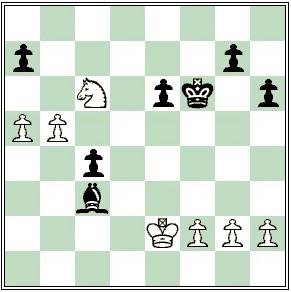
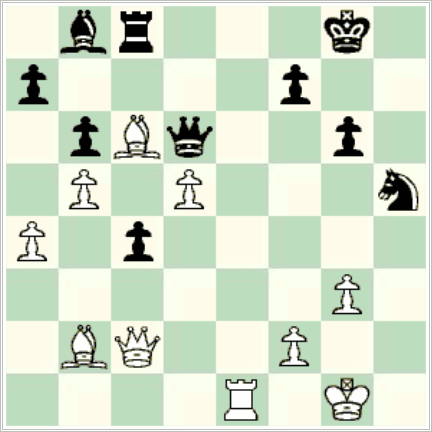
Game 2 final position

Thomas Cox – John J. O’Hanlon
Challenge Match, Dublin

Game 2, Monday 8th June 1936

1.d4 e6 2.c4 d5 3.Nf3 Nf6 4.Nc3 Nbd7 5.Bg5 c6 6.e3 Qa5 7.Nd2 Bb4 8.Qc2 0–0 9.Be2 Re8 10.0–0
Improving on 10.Nb3, played in Galvin-O’Hanlon/IRL-ch (prelim), Dublin 1935, 0–1. 10…e5 11.dxe5 Rxe5 12.Bf4 Re8 13.Nb3 Qd8 14.cxd5 cxd5 15.Nb5 Ne5 16.Qc7 Nc6 17.Qxd8 Rxd8 18.a3 Bf8 19.Rfd1 Be6 20.Nc7 Rac8 21.Nxe6 fxe6 22.Rac1 Kf7 23.Rc2 Nd7 24.Rdc1 Nb6 25.Bb5 Bd6 26.Bxc6 Bxf4 27.Bxb7 Rxc2 28.Rxc2
The game was adjourned here and the Irish Independent reported on the 9th June that “Mr. O’Hanlon is a Pawn down, but may, by his usual excellent play, succeed in drawing.” In fact, Cox very efficiently secured the win when play resumed on the 11th June.
28…Be5
(sealed move). 29.Ba6 Rd7 30.Nd4 Rc7 31.Rxc7+ Bxc7 32.Nc6 Na4 33.b4 Bb6 34.Kf1 Kf6 35.Bd3 h6 36.Bc2 Nb2 37.a4 Nc4 38.a5 Bxe3 39.Bd3 Bd2 40.Bxc4 dxc4 41.Ke2 Bc3 42.b5 (diagram) 1–0 [Click to play through the game]
Score after 2 games: Cox 1, O’Hanlon 1.
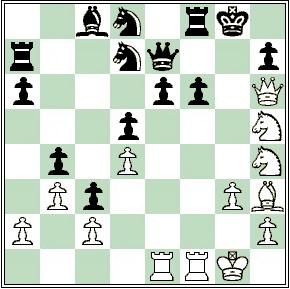
Game 3 after Black's 25th move

John J. O’Hanlon – Thomas Cox
Challenge Match, Dublin

Game 3, Monday 15th June 1936

1.e4 e6 2.d4 d5 3.Nc3 Nf6 4.Bg5 Be7 5.e5 Nfd7 6.Bxe7 Qxe7 7.f4 a6 8.Qd2 c5 9.Nf3 Nc6 10.g3 b5 11.Bg2 Bb7 12.0–0 0–0 13.Rad1 Nb6 14.b3 c4 15.f5 b4 16.f6 gxf6 17.exf6 Qxf6 18.Ne2 c3 19.Qe3 Qd8?
“Bad. 19…Qe7 is correct.”(Irish Independent, 16th June)
20.Qh6 f6 21.Bh3 Bc8 22.Nf4 Qe7 23.Rde1 Nd8 24.Nh5 Ra7 25.Nh4 Nd7 (diagram)
O’Hanlon now uncorks an eye-catching finish.
26.Rxe6! Nxe6 27.Bxe6+ Rf7 28.Qg7# 1–0 [Click to play through the game]
Score after 3 games: Cox 1 – O’Hanlon 2.
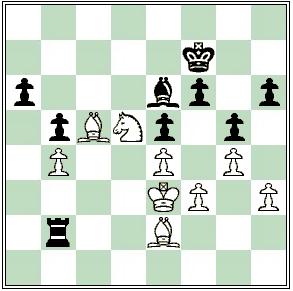
Game 4 final position

Thomas Cox – John J. O’Hanlon
Challenge Match, Dublin
Game 4, Thursday 18th June 1936

1.d4 e6 2.Nf3 Nf6 3.c4 d5 4.Nc3 Nbd7 5.Bg5 Be7 6.e3 0–0 7.Rc1 c6 8.Qc2 h6 9.Bf4 a6 10.a3 dxc4 11.Bxc4 b5 12.Be2 Bb7 13.0–0 c5 14.dxc5 Nxc5 15.Rfd1 Qb6 16.b4 Ncd7 17.Rd4 Rac8 18.Qd1 Rfd8 19.Ne5
Leading to a large scale liquidation.
19…Nxe5 20.Bxe5 Rxd4 21.Bxd4 Qd6 22.Bxf6 Qxd1+ 23.Nxd1 Rxc1 24.Bxe7 Bd5 25.Kf1 Ra1 26.Bc5 Rxa3 27.f3 e5 28.e4 Be6 29.Ne3 Ra1+ 30.Kf2 Ra2 31.Nd5 f6 32.Ke3 Kf7 33.g4 g5 34.h3 Ra1 35.Kf2 Ra2 36.Ke3 Rb2
(diagram)
White here sealed his move. The following morning the Irish Independent reported that the adjourned position was very drawish and the players obviously agreed because the game was agreed drawn that evening without further play. ½–½ [Click to play through the game]
Score after 4 games: Cox 1½ – O’Hanlon 2½.

With no further play in game 4 after the adjournment, the players then embarked on game 5.
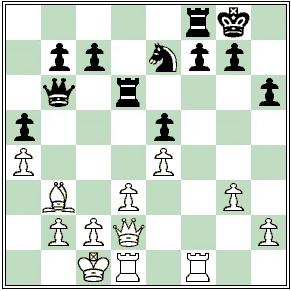
Game 5 position at adjournment

John J. O’Hanlon – Thomas Cox
Challenge Match, Dublin

Game 5, Friday 19th June 1936

1.e4 e5 2.Bc4 Nf6 3.d3 Bc5 4.Nc3 Nc6 5.f4 d6 6.Nf3 Be6 7.Nd5 0–0 8.fxe5 dxe5 9.Bg5 Bxd5 10.Bxd5 h6 11.Bxf6 Qxf6 12.Rf1 Ne7 13.Bb3 Ng6 14.Qd2 Qb6 15.g3 a5 16.a4 Rad8 17.Qe2 Bb4+ 18.Nd2 Rd6 19.0–0–0 Bxd2+ 20.Qxd2 Ne7 (diagram)
21.Qc3 Sealed move. There was now a little break in proceedings before the game resumed on 29th June. The players very quickly agreed a draw.
Nc6 22.Rde1 Rd7 ½–½ [Click to play through the game]
Score after 5 games: Cox 2 – O’Hanlon 3.
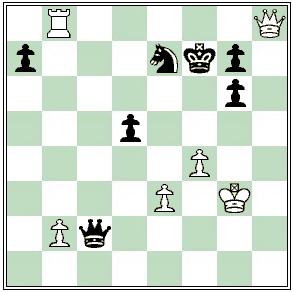
Game 6 after White's 41st move

Thomas Cox – John J. O’Hanlon 
Challenge Match, Dublin

Game 6, Monday 29th June 1936

1.d4 d5 2.Nf3 Nf6 3.c4 c6 4.Nc3 dxc4 5.a4 Bf5 6.e3 e6 7.Bxc4 Bb4 8.0–0 0–0 9.Qb3 Qb6 10.Nh4 Bg4 11.h3 Bh5 12.g4 Bg6 13.Nxg6 hxg6 14.Qc2 Nbd7 15.Bd2 Rac8 16.a5 Qc7 17.a6 b6 18.Qb3 Be7 19.Rac1 Nb8 20.Be2 Qd7 21.g5 Nd5 22.Nxd5 exd5 23.Bg4 Qd8 24.Bxc8 Qxc8 25.f4 Qxh3 26.Rf2 Re8 27.Qd1 c5 28.Rh2 Qe6 29.Kf2
The game was adjourned here and play resumed on 2nd July. The Irish Independent had reported that at adjournment Black was in a difficult position and then in a subsequent report awarded the sealed move a question mark.
29. ..Nc6? 30.Qh1 f5 31.gxf6 Bxf6 32.Rh8+ Kf7 33.Rxe8 Kxe8 34.dxc5 bxc5 35.Rxc5
Cox looks to have victory in his grasp, but his next few moves are not the most precise and he allows O’Hanlon a chance to draw the game.
35…Ne7 36.Bc3 Qxa6 37.Bxf6 Qxf6 38.Rb5 Qc6 39.Rb8+ Kf7 40.Qh8 Qc2+ 41.Kg3
(diagram) 41…Nf5+
Obvious but Black needed to hold back this move because the Knight is needed to defend his own King. Instead he needed to attack the White e3-pawn with his Queen (e.g. 41…Qe2) which would also threaten mate starting, only now, with Nf5+. If White prevents the Knight check with e.g. Rb7, Black  seems to have a perpetual check with his Queen here.
42.Kh3 Qf2 43.Qe8+ Kf6 44.Qe5+ Kf7 45.Qxd5+ Kf6 46.Rf8+ Ke7 47.Rf7+ Ke8 48.Qd7# 1–0 [Click to play through the game]
Score after 6 games: Cox 3 – O’Hanlon 3.
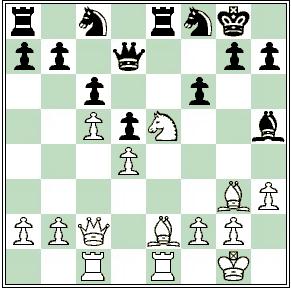
Game 7 after White's 21st move

John J. O’Hanlon – Thomas Cox
Challenge Match, Dublin

Game 7, Thursday 9th July 1936

1.e4 Nf6 2.e5 Nd5 3.c4 Nb6 4.d4 d6 5.exd6 exd6 6.Nf3 Be7 7.Be2 0–0 8.0–0 Re8 9.Nc3 N8d7 10.Bf4 Nf8 11.Qc2 Bg4 12.Rac1 Bf6 13.Rfd1 c6 14.c5 Nc8 15.Ne4 d5 16.Nxf6+ Qxf6 17.Be5 Qe7 18.h3 Bh5 19.Re1 f6 20.Bg3 Qd7?? 21.Ne5!(diagram)
The double question marks and the exclamation point are from the Irish Independent. O’Hanlon wins a pawn and with the position not providing any obvious counterplay, Cox will have to sit and suffer, hoping his opponent’s technique will let him down.
21…Bg6 22.Nxd7 Bxc2 23.Nxf6+ gxf6 24.Rxc2 Ne7 25.Bh5 Nfg6 26.Rce2 Kf7 27.Bh4 Ng8 28.g4 Rxe2 29.Rxe2 Re8 30.Rxe8 Kxe8 31.f4 Kf8 32.Bg3 Kg7 33.Kf2 N8e7 34.f5 Nf8 35.Be8 h6 36.Ke3 Nh7 37.h4 Kf8 38.Bd7 Kf7 39.Bb8?
Here is an inaccuracy from O’Hanlon.
39…Nf8 40.Be6+ Nxe6
The game was adjourned here and resumed on 13th July.
41.fxe6+(Sealed move)41…Kxe6 42.Bxa7 f5 43.g5 hxg5
So soon after the adjournment, Cox must surely have looked in home analysis at the alternative 43…h5 with the idea of capturing White’s h-pawn. If White tries to save it with 44.Bb8 Ng6 45.Bg3, then 45…f4+ 46.Bxf4 Nxh4 and it will be not be easy for White to make progress.
44.hxg5 f4+ 45.Kxf4 Nf5 46.Bb8 Nxd4 47.g6 Ne2+ 48.Kg5 Nd4 49.Kh6 Nf5+ 50.Kh7 d4 51.Bf4 Kd5 52.g7 Nxg7 53.Kxg7 Kxc5 54.Kf6 Kc4 55.Ke5 Kd3 56.a3 c5 57.Kd5 Kc2 58.Kxc5 Kxb2 59.a4 Kb3 60.a5 Kc3 61.Kb6 1–0 [Click through the game]
Final result: Cox 3 – O’Hanlon 4.
Posted in Irish champions, Players | Leave a comment

Joe Ryan misses IM norm by ½ point

I haven’t seen any mention of this on the ICU site, but if I’m reading the requirements correctly Joe Ryan missed an IM norm by the narrowest of margins last month. The event was the 4th Sant Martí IM tournament in Barcelona, a game-a-week ten-player all-play-all, where Joe finished 2nd-3rd on 6/9. If I’m right, the IM norm was 6½/9.

His games have all been added to the archive.

In fact the norm possibility disappeared relatively early: he won his last three games and scored 3½ out of the last 4, so in one sense there was never a point where the norm was likely. A possible missed opportunity (in hindsight) was the fourth-round game:

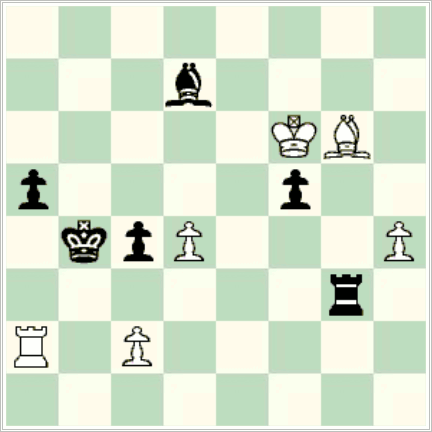
Aranda - Ryan, Sant Marti IM 2012Jose Aranda Gonzalez-Joe Ryan
4th Sant Martí IM 2012 (4)

Engines think White is only slightly better, if at all. The rest is reported without commentary: see if you can figure out where Black could have improved.

54. … f4 55. h5 f3 56. h6 Kc3 57. h7 f2 58. Ra3+ Kxd4 59. h8=Q f1=Q+ 60. Ke7+ Kc5 61. Qe5+

1-0

[Click to replay the full game.]

Posted in Players | Leave a comment

‘Fighting like Kilkenny cats’

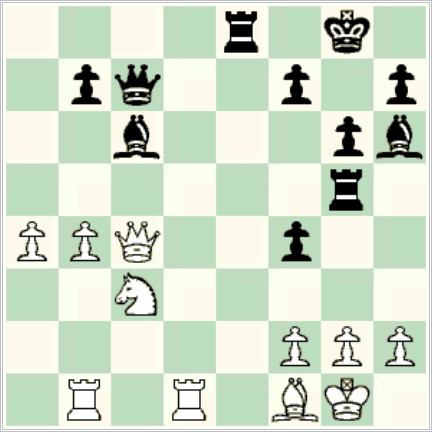
Collins - Jones, Kilkenny 2012An Irish game had the distinction of featuring as one of the ChessBase puzzles this week, with fanciful title to match: the reader had to determine the consequences of 27. … Bxg2 in the diagrammed position. See Oliver Reeh’s article for the specific question and the solution. (The ChessBase solution is a dead link as of January 25, 2019. See the full game instead.)

Earlier in the week there was another Irish appearance on the broader chess stage, when Pete Morriss’ questions were featured in Geurt Gijssen’s column at ChessCafe.com: How should an arbiter dress?. The article title is prompted by one of Pete’s questions, apparently prompted by an incident at a recent international tournament he participated in. (The solution, of course, is to reprimand the complainers and dock them two minutes for wasting everyone’s time.)

Posted in Puzzles | Leave a comment

Rook v. Three Pawns (part II)

Continuing the discussion of this ending from part I:

I thought this ending must be extremely rare in practice. But to my surprise Mason-Paulsen turns out to be only the first of many examples in Irish chess, i.e., where the game was played in Ireland or at least one of the players was Irish. Here is a list of all the examples I know of, excluding cases where this balance appeared only for an instant as part of an exchange: 15 more games from the ICU online games archive, 4 more from Tim Harding’s database of correspondence games UltraCorr3, and 1 from OlimpBase.

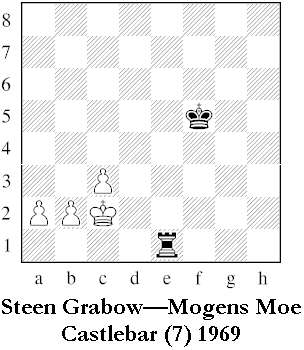
Grabow-Moe, Castlebar 1969

There were five Danish players in Castlebar 1969, and here two of them met in the last round. White’s pawns are nowhere near far enough advanced to cause difficulty, and Black manages a routine win:

54. a4 Ke4 55. b4 Kd5 56. Kb3 Rb1+ 57. Kc2 Rh1 58. Kb3 Rh3 59. a5 Kc6 0-1. [Replay.]

Centred dots

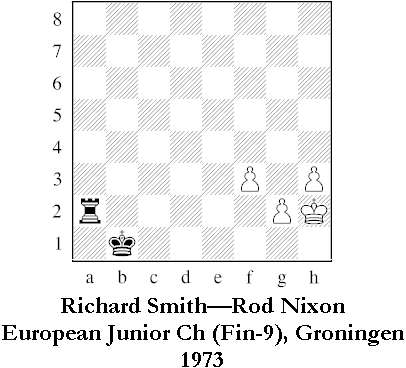
Smith-Nixon, Groningen 1973

Rod Nixon played in Leinster in the early 1970’s, and played on the 1972 Glorney Cup team. He left for London around 1980 and is now playing in Oxford: he’s one of the players pictured on the cover of the latest DisinformatorTM (Oxford C.C. magazine). The European Junior when he played consisted of a preliminary stage followed by a final. He had lost to Richard Smith (Wales?) in the preliminary rounds, and here was pressing for revenge when they met again in the finals. The position is finely balanced: the pawns are still far back but the Black king is far away. It’s a draw with best play; win with the Black king at c2 instead. As it happens, both players go wrong but the errors cancel themselves out.

59. h4 Kc2 60. Kg3? (60. g4=) 60. … Ra8? (60. … Kd3/Kc3/Kb3 wins: the White king blocks the g-pawn and by keeping his rook on the 7th rank Black would force White to use several tempi to disentangle) 61. Kf4 Rh8 62. Kg5 Rg8+ 63. Kf6 Rh8 64. Kg5 Kd3 65. h5 Kd4 66. h6 Ke5 67. Kg6 Rg8+ 68. Kf7 Rxg2 69. h7 Rh2 70. Kg7 Rxh7+ 71. Kxh7 Kf4 ½-½. [Replay.]

Centred dots

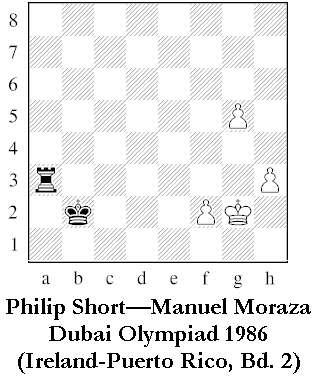
Short-Moraza, Dubai Olympiad 1986

From Smith-Nixon above, you would guess that a draw is the correct result here, and you’d be right. Unfortunately Short goes astray:

57. h4 Kc3 58. Kh3?

Now the Black king gets to e5; 58. h5/f4/Kf3/Kg3=.

58. … Kd4+ 59. Kg4 Ke5 60. f4+ Ke6 61. f5+ Ke5 62. f6 Ke6

White has managed to arrange the pawns protecting each other on the 4th, 5th and 6th ranks but is still lost according to the tablebases. The problem is that in aiding the advance of the pawns, White’s king has had to push too far forward. With the rook cutting off a retreat the king runs out of squares and is forced to allow the rook onto the h-file. Draw if the White king were at g2 here. The corresponding position with pawns at f4, g5, h6, White king at g4, Black king at g6 and rook at a3 is also lost for White, regardless of whose turn it is to move.

63. Kf4 Rh3 64. Kg4 Rh1 65. Kg3 Kf7 66. Kg4 Kg6 67. Kg3 Kh5 68. Kf3 Rh3+ 69. Kf4 Rxh4+ 70. Kf5 Rh1 71. Ke6 Kg6 72. Ke7 Re1+ 0-1. [Replay.]

Centred dots

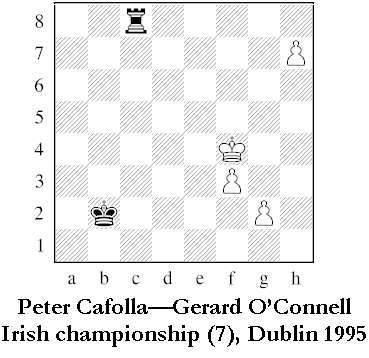
Cafolla-O'Connell, Irish Ch 1995

Here the ending disappears almost as soon as it appears, since the h7 pawn is lost. But it would be a draw even with White to move, since Kg5 is met by … Rc5+ and the king has no shelter from the checks.

67. … Rh8 68. g4 Rxh7 69. g5 Kc3 70. g6 Rh1 71. Kf5 Kd4 72. f4 Kd5 73. Kf6 Ke4 74. f5 Rf1 75. g7 Rg1 76. Kf7 Kxf5 77. g8=Q Rxg8 ½-½. [Replay.]

Centred dots

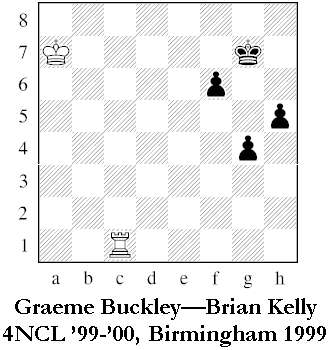
Buckley-Kelly, 4NCL '99-'00

Here the White king is again far afield, but now the Black pawns are dangerously advanced, especially as it’s Black to move, so here it’s White who is struggling to draw. With best play he just manages it. (Win if any of the Black pieces is advanced one square.)

60. … h4 61. Rh1! (only move) h3 62. Kb6! (only move) Kg6 63. Kc5 Kg5 64. Kd4 f5 65. Ke3 f4+ 66. Ke4 f3! (now Black needs to be careful; this is the only move to draw) 67. Ke3 Kh5! (another only move) 68. Rxh3+ ½-½. [Replay.]

Centred dots

To be continued …

Posted in Articles | Leave a comment

Rook v. Three Pawns (part I)

The following is very slightly adapted from an article I submitted to the ICJ some time back. Unfortunately the ICJ seems to have fallen dormant, with the last issue having appeared a year ago this month. I’m still hoping we’ll see it return sometime soon, but as it’s unclear when, I think it’s a good time to post this here.

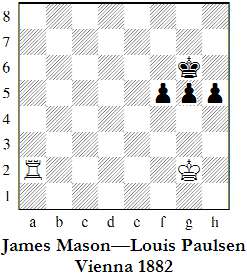
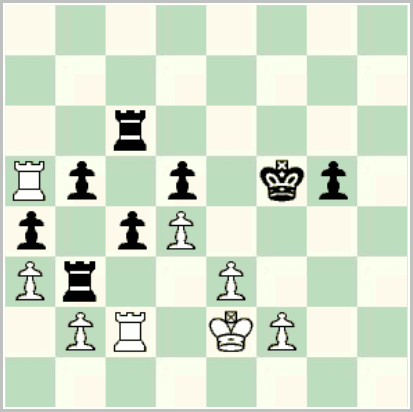
The game Mason-Paulsen, Vienna 1882, (see the ICU online archive of Irish games, http://www.icu.ie/games) reached the following picturesque and very unusual position, where White has just played 52. Rxa2:

Mason-Paulsn, Vienna 1882

What is the verdict with best play? Mason had no doubt it was a win, in his annotations to this game in his The Principles of Chess in Theory and Practice (London, 1902), pp. 272-76:

52. … g4 53. Ra8

If it were merely a question of stopping pawns with king, 53. Kg1 would be the move.

53. … h4 54. Rg8+ Kh5 55. Kf2 f4 56. Rf8 Kg5 57. Kg2 f3+ 58. Kf2 Kg6 59. Rh8 Kg5 60. Rh7

A coup de repos, better than 60. Ke3, which would give some chance of a draw. The White king gets in among the pawns, and it is all over.

60. … h3 61. Kg3 Kf5 62. Re7 Kg5 63. Rf7 Kg6 64. Rf4 Kh5 65. Rxg4 f2 66. Rf4 h2 67. Kxh2 1-0.

This ending, rook v. three united passed pawns, is of course very rare in practice.’

Mason identified Paulsen’s losing move as occurring a few moves earlier.

But these days such endings are within the range of tablebases, so we can check the exact status with perfect accuracy. Using the online Nalimov tablebases (http://k4it.de/index.php?topic=egtb&lang=en) several missed chances are revealed:

52. … g4?

One of only two losing moves: 52. … f4? is also bad but everything else draws. So the diagrammed position is drawn.

53. Ra8 h4 54. Rg8+?

54. Rf8! wins, the only move that does so.

54. … Kh5?

54. … Kf7! (only move) draws. Black is now lost and White gives no more chances to escape.

55. Kf2 f4 56. Rf8 Kg5 57. Kg2 f3+

Zugwang forces Black to break up the pawn front. 57. … h3+ 58. Kh2 and Black has to play … f3 or lose a pawn immediately.

58. Kf2 Kg6 59. Rh8 Kg5 60. Rh7

Mason didn’t like it but 60. Ke3 is also fine, and in fact it wins one move earlier than Rh7.

60. … h3 61. Kg3 Kf5 62. Re7 Kg5 63. Rf7 Kg6 64. Rf4 Kh5 65. Rxg4 f2 66. Rf4 h2 67. Kxh2 1-0.

Centred dots

Speelman, noting that there is considerable theory on this ending, gives an extended discussion in Batsford Chess Endings (Speelman, Tisdall, Wade; Batsford 1993), pp. 219-224. Summarising, the first key position is shown below:

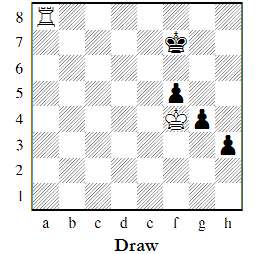
Speelman first drawn position

The key to the evaluation of the ending is the well-known fact that two connected pawns on the 6th rank can’t be stopped by a lone rook. In the position above, White can force the capture of the f-pawn by either king or rook. But a capture by the king can only be forced in a way that allows Black to reply … g3 winning (or perhaps forcing White to take a draw by perpetual), e.g. 1. Kxf5 g3 or 1. Ra3 Kf6 2. Rb3 Kg6 3. Rb6+ Kf7 4. Kxf5 g3 and draws, since White must take the perpetual. On the other hand a capture with the rook can only be forced with the White king on f4, when … h2 wins, e.g. 1. Rh8 Kg7! (only move) 2. Rh5 Kg6! (only move) 3. Rxf5? h2 or 3. Rg5+ Kh6 4. Rxf5? h2 and wins, or on e5, when … g3 wins. With the rook on a5-e5 and the White king on f4, Black shuffles his king between g6 and h6. So (regardless of who moves next) this position is drawn.

It’s not all plain sailing for Black, as there are some winning positions White can aim for.

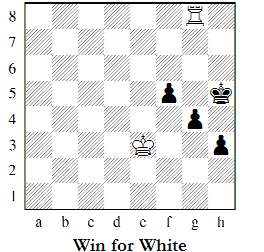
Speelman second drawn position

Here the rook restrains an immediate … g3, but more importantly the Black king is cut off on the h-file. This prevents … h2 because of the skewer and also sets up mate threats, e.g., 1. … Kh4 2. Kf4 Kh5 3. Kxf5 and wins.

Note that this was exactly Paulsen’s final error: instead of 54. … Kh5?, allowing White to reach the model winning position, he should have played 54. … Kf7 followed by … h3(+), reaching the model drawn position.

After 1. … Kh6 above, it’s still a win for White but not a straightforward one. 2. Kf4? Kh7 draws, and it was thought there was nothing better until Kopaev (1958) found the winning approach: 2. Ke2!. After 2. … Kh7 3. Rg5 Kh6 4. Rxf5, the king is much better placed on e2 than f4, and White can stop the pawns. After 2. … Kh5 the main line runs 3. Kf2 f4 4. Rh8+ Kg5 5. Kg1! Kf5 6. Kh2 Ke4 7. Rh7 Kf3 8. Rg7 Ke2 9. Rxg4 f3 10. Re4+ Kf1 11. Kg3! f2 12. Rf4 and wins. So (regardless of whose turn it is to move) this is a win for White.

Centred dots

The International Chess Tournament Vienna 1882 was up to then the strongest tournament ever held: an 18-player double-round robin event including all, or almost all depending on opinion, of the world’s top ten. It ended in a tie for first between Steinitz and Winawer, after two playoff games failed to split the deadlock. James Mason, in one of the best results of his career, finished clear third on 23/34, ahead of Zukertort, Blackburne, Paulsen, Chigorin, Weiss, and Bird.

There’s an excellent account of the event in ChessBase Magazine 103 (2005), available online (http://www.chessbase.com/newsdetail.asp?newsid=2117).

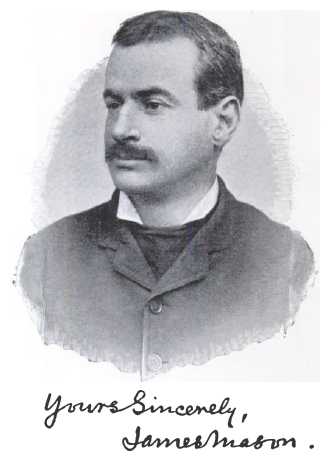
Mason’s origins are shrouded in mystery: his name was changed when he was a child and he never spoke publicly of his real name or place of birth. He was born in Ireland, it seems, though even that is not beyond dispute. Beyond that, although there are some very elaborate theories, nothing is known for certain.

His book, cited above, is now out of copyright and available on Google Books, so let’s take advantage by showing a picture from it:

James Mason

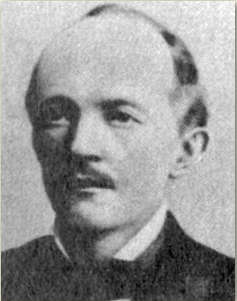
And while we’re at it, here’s a picture of Louis Paulsen, from the article at ChessBase.com mentioned above:

Louis Paulsen

Centred dots

To be continued

Posted in Articles | Leave a comment

Monthly updates, October and November

Another update on the items over the past couple of months that weren’t the subject of separate posts:

“Search games”: The search function for games in the IRLchess games archive has been rewritten. It’s now much faster–almost instantaneous, I think–instead of the previous wait of 30 seconds or so. See https://www.irlchess.com/cgi-bin/searchforgames.pl?query=brady or https://www.irlchess.com/cgi-bin/searchforgames.pl?query=daly for examples of how the new search works.

These two searches illustrate a point about the search as currently set up: if you’re looking for games by Stephen Brady, then searching for “Brady” matches games by any Brady: currently four games of Cormac Brady’s are included. But if you search for “Stephen Brady”, then (unfortunately) the search results will omit many of the games you’re looking for, as there are many games of “Brady,S” (no space) in the archive. That’s less than ideal, but the explanation is that TWIC gives names that way, and games extracted from older TWICs (before TWIC started adding FIDE IDs) show up like that. There are some improvements planned that address this issue, but in the meantime, I recommend trying a broader search.

Games archive: Games continue to be added to the archive. Apart from the ones from the World Youth Championship in Maribor and the World Senior Championship in Greece, the extra games that were not (yet) the subject of separate posts were:

I say “not yet” as there’s a post in preparation about one of these.

ECO classification: Here’s a topic that puzzles me slightly. I’ve added ECO classifications to all the games in the archives. Based on my own experience, this is one of the first items I look at when a new collection of games becomes available. (And you can search for any ECO code: e.g., typing B97 into the Search Games feature gives the Sicilian Najdorf Poisoned Pawn games.) The part that puzzles me is that ECO classification is not consistent across different sources. This would be understandable if the codes are typed in by players or tournament inputters, but even automated sources vary. For example, my favourite opening the French Winawer Poisoned Pawn 1.e4 e6 2.d4 d5 3.Nc3 Bb4 4.e5 c5 5.a3 Bxc3+ 6.bxc3 Ne7 7.Qg4 Qc7 used to be classified as C18 (by ECO, for example, and by Korchnoi’s monograph “C18-19” on the Winawer). Nowadays it’s often classified as C19: for example, this is the classification that TWIC uses. What’s the point of changing it? That simply makes finding games more difficult than it has to be, as you have to search for the openings you’re interested in under multiple codes. In any case, henceforth the policy here will be to convert all games to the default for the pgn-extract utility: I think this is the same classification that TWIC uses, and if TWIC isn’t the standard, what is?

Posted in Administrative | Leave a comment

World Youth Championships, Maribor, Slovakia

A group of seven Irish players participated in the World Youth Championships in Maribor earlier this month. A full trip report is available over on the ICU site. The organisers did a great job in transcribing 8,000+ game scores and making them available promptly on the web site, and the Irish games have now been added to the archive here: 74 games, and 2 results with moves missing.

Posted in Games | Leave a comment

Irish Women’s Championship

The 2012 Kilkenny Congress also played host this year to the Irish Women’s Championship. The Championship was open to non-Irish qualified players and Czech WFM Martina Mareckova won the event, with the championship title going to runner-up WCM Karina Kruk.

Gerry Graham’s excellent report on the Congress states that this was the first separate women’s championship since 1982. Short memories, since there was a championship only two years ago as part of the Dun Laoghaire Chess Festival. Perhaps the reason for this apparent forgetfulness is that the ICU’s own list of Ladies’ champions does not include the 2010 winner, April Cronin.

There are probably some further errors or omissions in the ICU list. For instance, my own researches indicate that the first championship was held in 1953 and that the championships attributed to Hilda Chater in 1951 and 1952 are phantoms. I hope to return to the history of the women’s championship in future posts.

Posted in Tournaments | Leave a comment

World Senior Championship

The 22nd World Senior Championships are currently in progress in Kamena Vourla, Greece. Ireland is represented by Pete Morriss of Galway, who is having an excellent tournament so far. He’s currently on 5/8, with a tournament performance of 2236, about 250 points higher than his current rating. He’s also on 1½/3 against titled players, including an FM scalp. All the games are available on the excellent tournament web site, and Pete’s games so far are available in the archive here.

Here’s an elegant finish from his round 6 game, against Boris Blaushtain (Israel), rated 2092.

Morriss - Blaushtain, World Senior Championship 2012Pete Morriss—Boris Blaushtain
22nd World Senior Ch, Kamena Vourla (6)
18 November 2012

28. Re6! fxe6

After 28. … Qf8 29. Rxg6+ fxg6 30. Qxg6+ Ng7 31. Bxg7 Qxg7 32. Qe6+ White emerges two pawns up.

29. Qxg6+ Kf8 30. dxe6 Qd1+ 31. Kg2 Ke7 32. Ba3+ Kd8 33. Qe8+
1-0.

Posted in Games | 1 Comment

A missed opportunity: Arkell-Allen, Blackpool 2012

From the first round of this year’s Blackpool Open in March, here’s a near-miss by Keith Allen, playing Black against GM Keith Arkell.

Arkell-Allen, Blackpool Open 2012White has been over-pressing to squeeze something out of a level position, and has now fallen into trouble. It seems from what follows that both players were probably short of time.

55. … g4?

It’s not immediately obvious why this is bad. Instead 55. … Rh6! is much simpler. Black wins easily, since the rook comes around to b1.

56. Ra8 c3!

Black is still better, but it’s more complicated than it needs to be after White’s next.

57. Re8!

A shock: after 57. … cxb2?? 58. Rxc6 the black king is caught in a mating net, since the escape square g4 has been closed off by Black’s 55th. Allen finds the best continuation.

55. … g3!

Opening up g4 again. Black still has much the better of it.

58. bxc3 gxf2?

Now Black’s advantage slips away. Better 58. … g2! 59. Rc1 Rxa3 with excellent winning chances.

59. Kf1!

Much stronger than 59. Kxf2 Rcxc3. White plans to capture on f2 with the rook instead, after which the black king is once again exposed.

59. … Rcxc3?! 60. Rxf2+ Kg4??

A tragedy. 60. … Kg6 is essential, after which White has nothing better than a perpetual.

61. Rg8+ Kh3 62. Rf7 Rb1+ 63. Ke2

and Black is mated.

1-0

[Click to replay the full game.]

Posted in Games | Leave a comment