The FIDE ratings page has been updated to account for the December 2019 list.
Tarun Kanyamarala and Killian Delaney reached new personal record high ratings, and Shane Melaugh crossed 2200 for the first time.
The Ulster Championship 2019 was held in the Europa Hotel over the August Bank Holiday weekend. The event was dominated by Daniil Zelenchuk, who started with five straight wins and had wrapped up clear first with a round to spare, for his first Ulster championship.
Going by ratings, this was a major surprise, as he was rated 9th out of 13 at the start of the event, over 400 points behind the top seed.
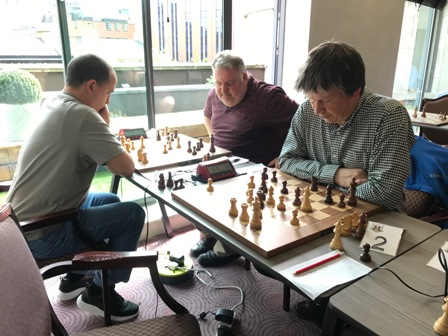
The event marked the return to the fray of many times former champion Keith Allen, who hadn’t played in this event since 1990. The photo below shows him in action in round 1 in his game against the eventual winner.
A full report has been added to the tournament pages here.
The Irish Women’s Championship took place in Buswells Hotel over the weekend. Ioana Miller won for the third consecutive year, winning all her games, also for the third consecutive year. And for the second consecutive year there were no draws among the 30 games played.
So much for the similarities; there were also significant differences. In particular this event was much stronger than last year’s, with the champion only barely the top seed over Trisha Kanyamarala. The critical game between these two saw the champion win with Black (game unfortunately not available).
17 of the 30 games are available, plus one fragment. These have been compiled into a report in the tournament section here.
The Irish Championship for 1977, held in Cork, attracted a field of 34 players. It was a very young field, in which 15 players were playing in their first championship, including future winners Philip Short, John Delaney, Eugene Curtin, and Paul Delaney, as well as Keith Allen, Tom Clarke, and Tim Harding.
The defending champion Bernard Kernan was not there—in fact he never played in any subsequent Irish championship either—and the path was open for a new winner. After four rounds Colm Barry and Eugene Curtin, both of whom played in the Glorney Cup later that month, were in the lead, having dropped only a half point against each other. By round 6, Alan Ludgate, co-champion in 1975, had taken a lead which he never subsequently relinquished, finishing with three draws for an undefeated 6½/9 and his second shared title.
The sensation of the event, though, was the performance of Ray Devenney, who beat Barry, Curtin, Paul Delaney, and Eamon Keogh to finish with 6½/9 and become joint champion. Devenney suffered his only setback in round 6 when, on 4/5, he lost to John Gibson in a game in which he stood much better. He bounced back in the next round with a critical win against Eamon Keogh.
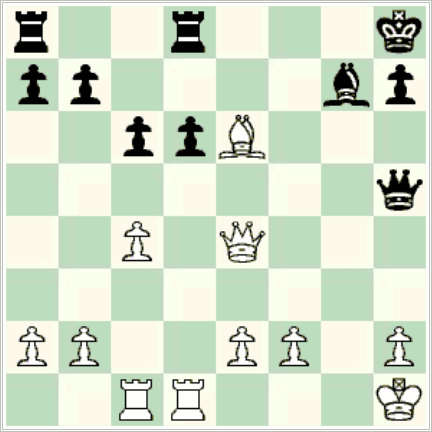
In this game it was Keogh who stood better earlier, before blundering a pawn. In the diagrammed position, it is still all to play for: after 26… Rf8 27. f4 Bh6 28. e3 Rae8 Black would have full compensation. Instead play continued 26… Re8 27. Qg4 Qe5? (27… Qh6!=) 28. Bf5 Qxe2? (28… Re7, with advantage to White) 29. Qh3 h6 30. Rxd6 Rad8 31. Rxh6+! with a decisive attack.
[Click to replay the full game.]
A full report on the championship has been added to the tournament pages here.
The third annual St. Andrew’s Charity Classic was held the weekend before last in Booterstown, Co. Dublin. The event attracted 130 players across 3 sections.
The Masters ended in a tie for first between Tarun Kanyamarala and Conor O’Donnell. A report (with all 42 games, via live boards) has been added to the Tournaments pages here.
A new page has been added here on FIDE title norms achieved by Irish players (and by non-Irish players in events played in Ireland). The page also lists progress of Irish players towards titles.
Many thanks to John McMorrow, who pointed out several errors and omissions in an earlier draft of this page, as well as suggesting the idea for having such a page.
The City of Dublin Championships were held in Coláiste Éanna over the weekend, attracting 123 players over four sections.
In the Masters, Conor O’Donnell became champion for the first time, with 4½/5. Of the 32 games played, 29 were available on live boards, and they have been compiled into a report on the tournament pages here.
Sir Horace Plunkett kept detailed diaries over decades; they have been transcribed and are available online at the National Library of Ireland website. His diary for 1919 provides some background on Capablanca’s visit, and his stay at Plunkett’s house. The full entries for all the days on which Capablanca is mentioned are given below.
4 Dec, Thu
J R Capablanca the Chess Master (probably the world Champion though he has yet to meet Emmanuel [sic (Emanuel)] Lasker who is the titular champion – he would beat all others) arrived. The young Cuban, he is only 31, was interesting in his political views. He knows the outlines of the Irish Question & like the rest of the world blames England bitterly for not settling it. He played 40 in the Mansion House. He by an oversight lost his Queen & the game to one player (not a good one) won 27 and drew 12. I was among the drawers but they were all adjudicated. I had a draw only with the best play.
5 Dec, Fri
Had Capablanca on my hands but got through some work. Ld. ffrench turned up & I had him out for a walk & talk in the afternoon. We agreed that the Dominion idea is making way, but – well England is England & Ireland is Ireland. Played again in the simultaneous exhibition. This time I drew & the draw was distinctly in my favor.
6 Dec, Sat
Capablanca went to Killarney for weekend. Monteagle & Gerald Heard a relative of Mary Perceval (nee Massey). G.H. is a possible private secretary and I am getting him for a few days’ visit – I go next Thursday to London en route for U.S.A. – to see whether we might suit each other.
8 Dec, Mon
Got Heard to help me with some literary work & decided to take him on as private secretary.
Capablanca came back from Killarney & I got to like him.
Capablanca scored +27 =12 -1 and +37 =2 -1 in his two Dublin simuls, on December 4 and December 5, 1919, respectively. Shortly afterwards, he recorded his impressions of Irish chess, in a letter to the Irish Statesman:
‘Señor Capablanca on Irish Chess
To the Editor:
Sir – Your readers may perhaps be interested to know what I thought of the play during my visit to the Dublin chess clubs. I found much stronger opposition than I had any reason to anticipate. Some of my opponents’ play was very good – particularly once they obtained an advantage which would indicate facility for carrying on an attack, an excellent – and I am told – Irish quality. I have no doubt that some of my opponents would, with the proper kind of practice and a little study, become very strong players, and I hope most earnestly that they will persevere in their playing, as, taken as a whole, the qualities exhibited by my adversaries were of a high order. If I may be allowed to boost a little of my own work, I would advise those who think that they could learn something from my play to obtain a copy of my recent book, My Chess Career, published by Bell and Sons, London, where they will find notes and advice that may be valuable to them.
Dublin, 10 December 1919 J.R. Capablanca.’
Source: Irish Statesman, December 13, 1919, p. 611, via Chess Notes 3723, 25 April 2005 (Harrie H. Grondijs).