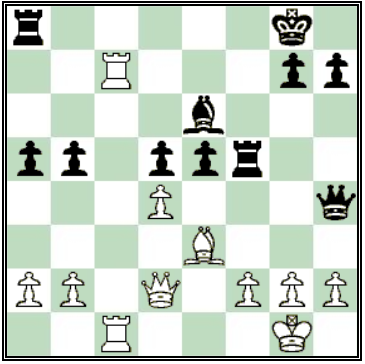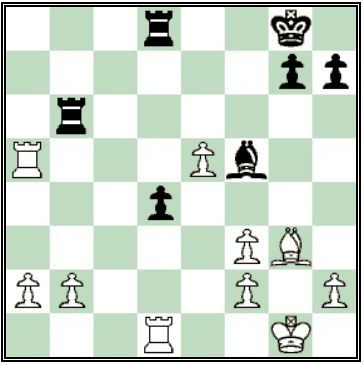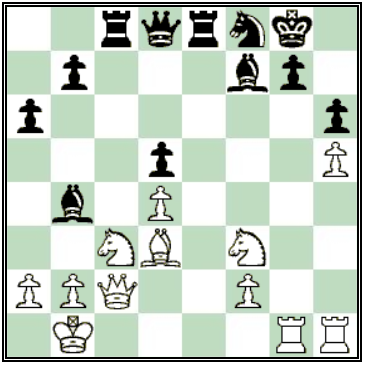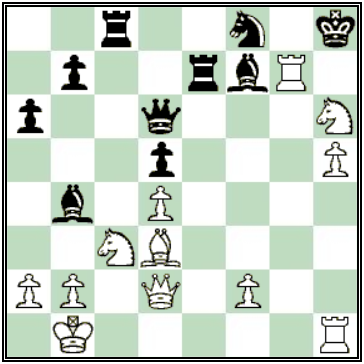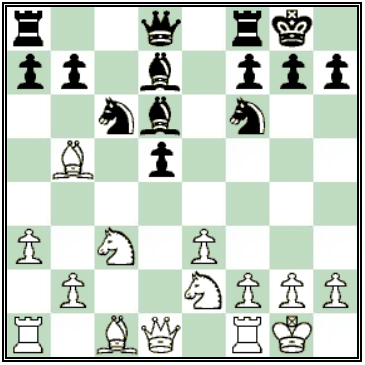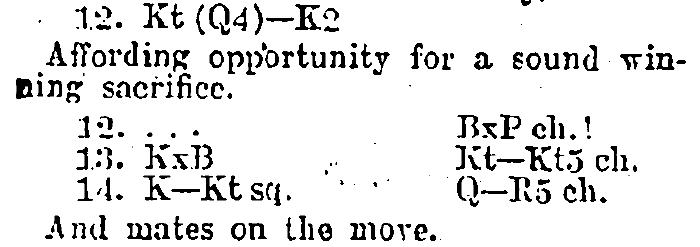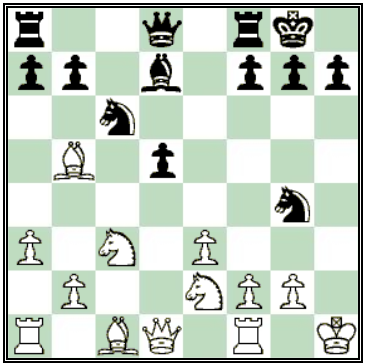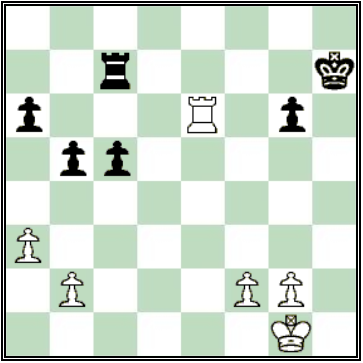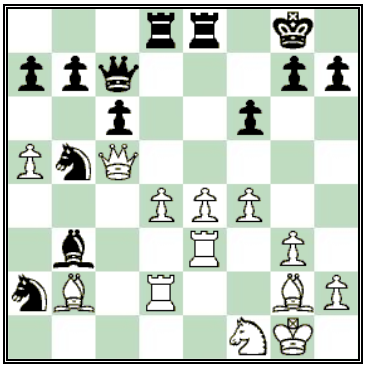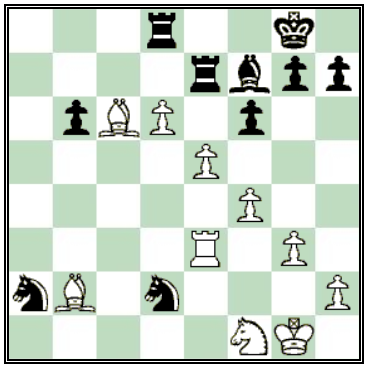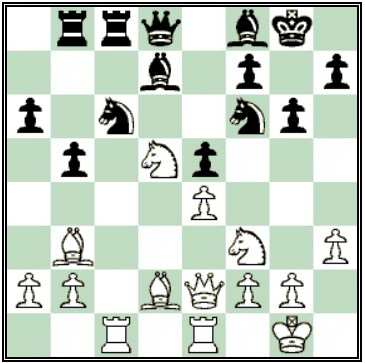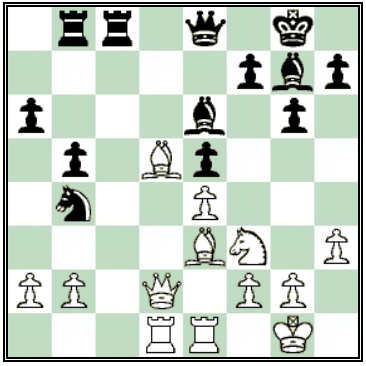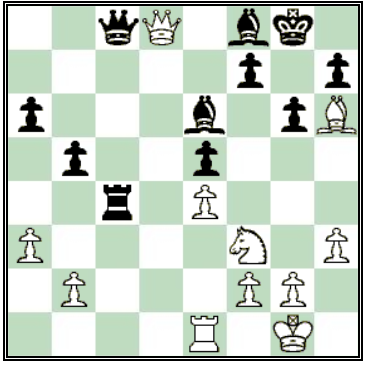
Two small miracles

Philidor Cup, Hyères 1928

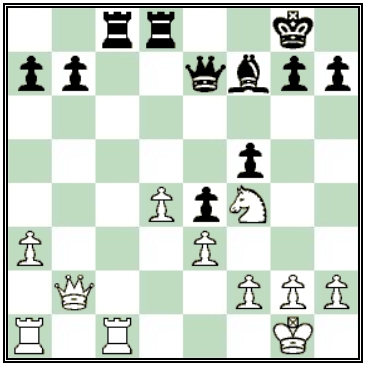
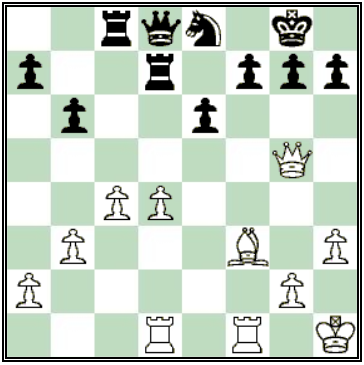
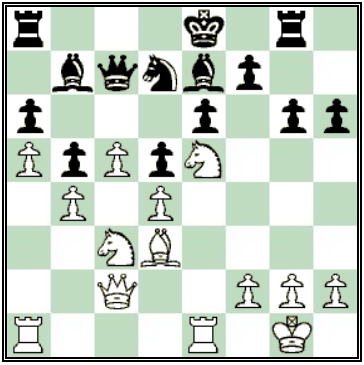
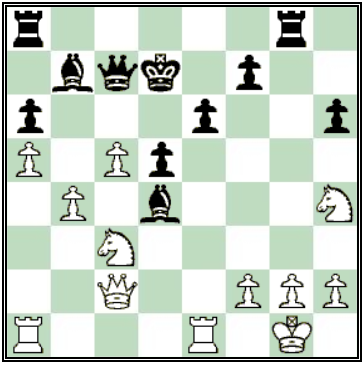
A total of 45 games were played in the tournament but unfortunately we have so far succeeded in finding only one brilliant game from the 2nd round, when M. Duchamp crushed the last player E.H. Smith. It is unlikely that any more games can be found in a French magazine or daily but perhaps a game is preserved in private archives of a local club or a local player. Since there were two British players, some of the games might also be found in a British chess column. [There is a footnote here: “J. Keeble in the 1920s was in charge of the problem section of the chess column in the Hastings and St. Leonards Observer, some games by J.J. O’Hanlon could be in a Irish chess column.”]. The discovery of another game from this tournament would be tantamount to a small miracle.
[Vlastimil Fiala: The Chess Biography of Marcel Duchamp (1887-1968) Volume 2: On the Road to the Chess Mastery (1926-1930), page 125.]

Turning first to the Hastings and St. Leonards Observer chess column, Keeble reported on the Hyères tournament in three successive editions on the 28th January, 4th and 11th February 1928. Two Scottish newspapers – the Falkirk Herald, and the Linlithgowshire Gazette – also carried his reports [in largely similar language] in their chess columns.

The column in the Hastings and St Leonards Observer for Saturday 28th January 1928 provided a preview of the event.

The Hyères tournament, the chief event of which is for the “Philidor” Cup, is rather a failure this year [the report in the Gazette adds: “as far as entries are concerned”], but it promises to be a pleasant affair. Only 15 entries were received, and of these only seven are of first-class strength. To make up the Cup tournament the committee have promoted three others, including Mr. John Keeble. The tournament is therefore being run with a premier section of ten players and a minor with five. The latter will play a double-round. The players in the chief event are Nicholas [de] Terestchenko, (Russia), Halberstadt (Russia), Duchamp, de Pampelonne and Jules Patey (France), O’Hanlon (Ireland), Col. Stuart-Prince, A. J. Maas, Dr Smith, and J. Keeble (England).

Competitors in the minor are Mr. Paull, J. Baines-Lewis (Harrogate), Lahallé, Garcia and Glogg (France).

The Observer’s column for Saturday 4th February carried a progress report on the event.

One of the players, Jules Patey, who entered for the Hyères tourney, has not turned up, so the cup contest is being played with nine competitors only. The scores at the end of the first week were:- Marcel Duchamp 4.5; V. Halberstadt 4.0; J.J. O’Hanlon 4.0, N. [de] Terestchenko 3.5; A.J. Maas 3.0: J. Keeble 2.0; Col. Stuart-Prince 1.5; R de Pampelonne 0.5;  Dr. E.H. Smith 0.0. Duchamp has played one more game than the others.

On Saturday 11th February, the Observer completed its coverage.

The Hyères Chess Congress ended in a triple tie between M. Duchamp (Paris), V. Halberstadt (Russia), and J. J. O’Hanlon (Ireland), who scored 6 points out of a possible 8. They divided the prize money, taking 916 francs each, but as no opportunity occurred for playing off the ties for the cup, it will remain at Hyères till next year. Mr. A. J. Maas, now of Hyeres but formerly of London took 4th prize (300 francs) scoring 5.5, and Nicholas de Terestchenko [with 4.5 points] the fifth (160 francs). The remaining scores were J. Keeble, 3.5; Col. Stuart-Prince, R. de Pampelonne 2; and Dr E. H. Smith 0. The latter retired after the fifth round so that Maas, [de] Terestchenko and Pampelonne scored a game by default.

The minor tourney was played as a double round with five players only. This also resulted in a tie with, J. Baines-Lewis (Harrogate) and Lieut. de Vassien Lahallé 5.5. each. They divided the first and second prizes of 500 and 350 francs. A third prize, 150 francs, was won by M. Garcia.

The Observer also reported on a problem solving event at the Congress, but the two Scottish newspapers gave more detail. Here is the identical report from the Herald (Wednesday 8th February) and Gazette (Friday 10th February).

The fifth prize-winner in the Premier event, Nicholas de Terestchenko, is a problem composer of great merit. A charming and sympathetic man. It is quite a privilege to meet him. He has composed about 200 chess problems, and made a couple specially in honour of the Hyères Chess Congress (one in two moves and the other in three). These were set in a special solving competition Thursday morning [2nd February]. The first prize in this (75 francs) was won by John Keeble, who fully solved both quite accurately in 20 minutes.

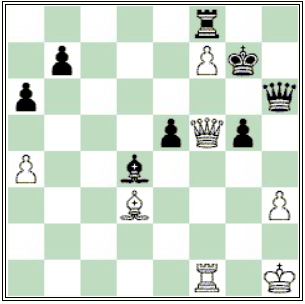
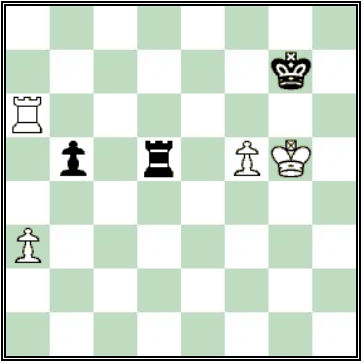
The two mover appeared in both the Observer and the Gazette.
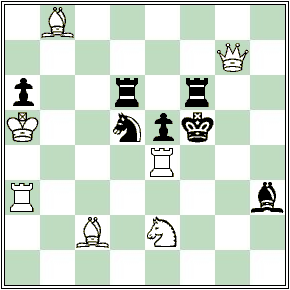
Nicholas de Terestchenko – Mate in two moves

[Click here for Solution]

Returning to the competition for the premier tournament, J.J. O’Hanlon’s local newspaper, the weekly Portadown Times, provided brief reports on his progress in three consecutive editions, with the final one revealing a controversial finale.

[Friday 27th January] At the International Chess Tourney at Hyères, Riviera, France, Mr. J.J. O’Hanlon, Portadown, beat E.H. Smith, Canada in the first round.

[Friday 3rd February] At the International Chess Tourney at Hyères, Riviera, France, Mr. J.J. O’Hanlon, Portadown, drew with V. Halberstadt, Russia, in the 4th round, and beat J. Keeble in the 5th round.

In the 6th round he beat A.J. Maas, Holland.

Leading scores are :-
O’Hanlon, Ireland 5.0
Halberstadt, Russia 5.0
[De] Terestchenko 4.5
Duchamp 4.5

[Friday 10th February] The Hyères International Chess Tournament has resulted in a tie – J.J. O’Hanlon (Ireland), V. Halberstadt (Russia) and M. Duchamp (France) making an equal score.

These players will jointly hold the Philidor Challenge Cup and Championship of The Riviera for 1928.

At the start of the last round O’Hanlon was leading by one point, but after a few moves he accidentally touched a piece and was compelled to resign, and thus allowed two players to draw level with him.

A brief report on the tournament in the Belfast News-Letter chess column on 9th February provides an extra detail about the last round incident, revealing O’Hanlon’s opponent and thereby increasing the controversy level.

In the final round O’Hanlon lost to Duchamp through accidentally touching a pawn, which his opponent insisted upon his moving.

Hyères 23 January-3 February 1928
Final Crosstable

[Source: La Stratégie, 1928, page 39 via Jeremy Gaige: Chess Tournament Crosstables, Volume IV (1921-1930) page 802, amended to reflect the three games defaulted by Smith]

                         D  V  O  M  T  K  S  P  S  Pts
1=3. M. Duchamp          x  ½  1  0  ½  1  1  1  1   6
1=3. V. Halberstadt      ½  x  ½  1  ½  1  ½  1  1   6 
1=3. J.J. O'Hanlon       0  ½  x  1  1  1  ½  1  1   6
4.   A.J. Maas           1  0  0  x  1  ½  1  1  +   5½
5.   N. de Terestchenko  ½  ½  0  0  x  ½  1  1  +   4½
6.   J. Keeble           0  0  0  ½  ½  x  1  ½  1   3½
7.   C. Stuart-Prince    0  ½  ½  0  0  0  x  ½  1   2½
8.   R. de Pampelonne    0  0  0  0  0  ½  ½  x  +   2
9.   E.H. Smith          0  0  0  -  -  0  0  -  x   0

We started with Vlastimil Fiala’s faint hopes for finding more games from the event. Now, to conclude, we can present our two small miracles, courtesy of O’Hanlon and the Belfast News-Letter.

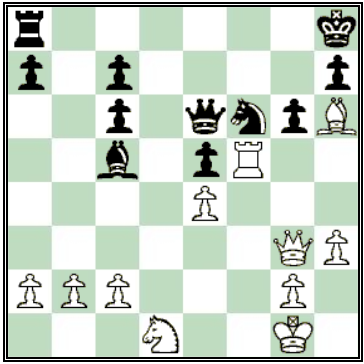
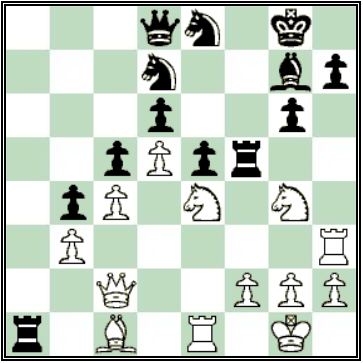
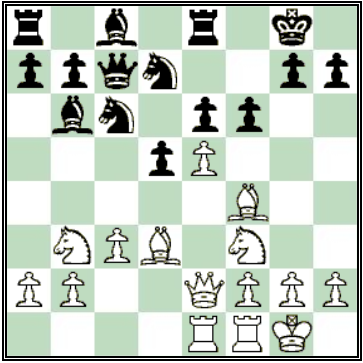
Vitaly Halberstadt – John J. O’Hanlon
Philidor Cup, Hyères 1928 (Round 4)
[Source: Belfast News-Letter, 1 March 1928, page 13; annotations by O’Hanlon]

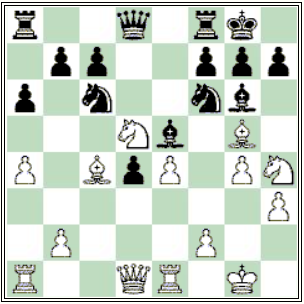
1.d4 d5 2.Nf3 Nf6 3.c4 e6 4.Bg5 Nbd7 5.e3 Be7 6.Nc3 0-0 7.Rc1 a6
Played by Janowski many years ago, and at that time it was thought that 8.c5 or cxd5 gave white the advantage. The Swiss player, W. Henneberger analysed the defence and proved that in reality 8.c5 was a bad move and he won a fine game from Alekhine in playing against the latter move. After this game, Alekhine was so impressed with the possibilities of this defence that he adopted it in a number of games in his match with Capablanca.
8.cxd5
In the earlier games of the Capablanca – Alekhine match Capablanca played 8.a3 without gaining any advantage, but he afterwards played the text move, which is, undoubtedly, the only move which gives any prospect of advantage.
8…exd5 9.Bd3 c6
This move is necessary, and at first sight it would seem that White has a very great advantage owing to Black’s weakness on the b6 and c5 squares, but in actual play it is very difficult, if not impossible, to exploit this weakness.
10.0-0
It would probably have been better for white to have played 10.Qc2 as now Black forces the exchange of Bishops and equalises the game at once.
10…Nh5 11.Bxe7 Qxe7 12.Ne5
Threatening to win a pawn by 13.Bxh7.
12…Nhf6 13.f4 Re8
A routine move whereas 13…Nxe5 14.fxe5 Ne8 followed by f6 would have given Black practically a winning advantage.
14.Qe1 Nf8
Black gains nothing by 14…Nxe5 15.fxe5 Nd7 16.Rf3 f6 17.Qh4
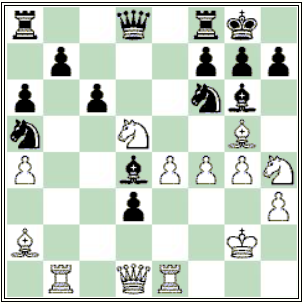
15.h3 N6d7 16.Rf3 f6 17.Nxd7 Bxd7 18.Kh2 Rad8 19.Qf2 Be6 20.a3 Bf7 21.Na4 Qc7 22.Nc5 Ne6 23.Qc2 h6
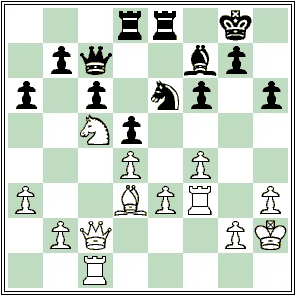
24.Nxe6
After this move, White offered a draw which, after some hesitation, Black accepted. If 24.b4 then 24…Ng5 25.Rg3 h5 26.fxg5 (If 26.h4 Rxe3 27.Rxe3 (if 27.hxg5 Qxf4 wins) 27…Qxf4+ 28.Rg3 Qxh4+ 29.Rh3 Nxh3 30.gxh3 Re8 winning) 26…h4 winning the Rook.

[Click here to replay the game]

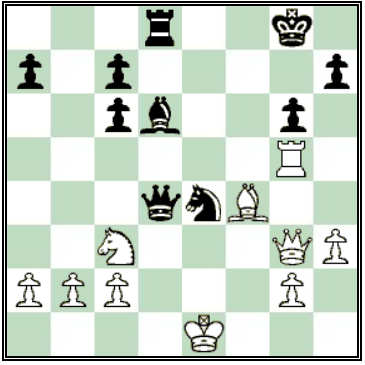
Arthur J. Maas – John J. O’Hanlon
Philidor Cup, Hyères 1928 (Round 6)
[Source: Belfast News-Letter, 23 February 1928, page 5; annotations by O’Hanlon]

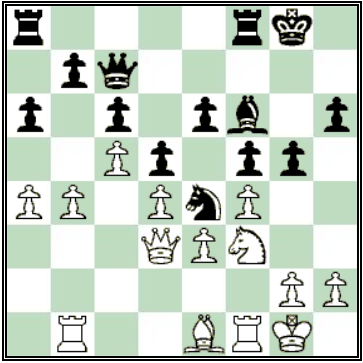
1.d4 d5 2.Nf3 Nf6 3.c4 e6 4.Nc3 Nbd7 5.Bg5 c6 6.e3 Qa5 7.Bxf6 Nxf6 8.Bd3 Bb4 9.Qb3 Nd7
White’s last three moves are recommended by Tartakower as giving an advantage to White but he now continues …9…0-0 10.Ne5 .The move in the game is distinctly better, and seems to give Black the advantage as he remains with the two Bishops.
10.0-0 0-0 11.Ne2 dxc4 12.Qxc4
No doubt better than 12.Bxc4 as it saves a move
12…Bd6 13.Ng3 e5
Black hesitated between this move and 13…c5 but finally selected the text move to remain with three pawns to two on the Queen’s side.
14.Qc2
If 14.Nf5 Bc7 [RR The way to equality is in fact 14…Nb6 15.Qc2 Bxf5 16.Bxf5 g6 17.dxe5 Bxe5 18.Nxe5 Qxe5] 15.Ne7+ Kh8 16.Nxc8 Raxc8 White has only exchanged his active Knight for an inactive Bishop, and is faced with the advance of Black’s Queen’s side pawns. [RR O’Hanlon misses the move 17.Ng5 threatening the pawns on f7 and h7, when best is 17…Qd5 but after 18.Qxd5 cxd5 19.Bf5 Rcd8 20.Nxh7 Rfe8 21.Ng5 Re7 22.Nf3 White has a considerable advantage.]
14…g6 15.Ne4 Be7 16.dxe5 Nxe5 17.Nxe5 Qxe5 18.f4
A weak move, but White was trying to get up an attack on the King’s side before Black could advance on the Queen’s side.
18…Qa5 19.a3 Bf5 20.Nf2 Bxd3 21.Nxd3 Qb6 22.Kh1 Rad8 23.e4 Rd4 24.Rae1 Rfd8 25.Rf3
If 25.Ne5 Black would have replied 25…Bf6 (and not 25…Rd2 because of the reply 26.Qc4).
25…Qb5 26.Ree3 c5 27.b3 c4
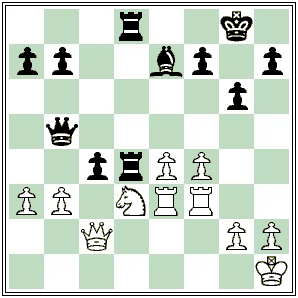
28.bxc4 Rxc4 29.Qe2
If 29.Qb2 Rxd3 winning a piece.
29…Bc5 30.Ne1
If White plays 30.Nb2 then 30…Qxb2 wins.
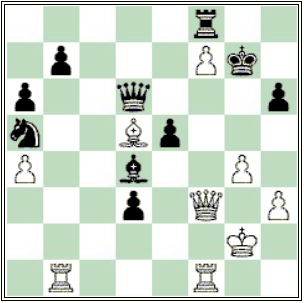
30…Bxe3 31.Rxe3 Qc5 32.h3 Rc3 33.Rxc3 Qxc3 34.Nf3 Qc1+ 0-1

[Click here to replay the game]

On the 2nd March 1928 the Portadown Times reported that O’Hanlon “had just received intimation that he had been awarded the special prize for the best game in the tourney” and it seems quite likely that it was for this game against Maas.
Posted in Analysis, Games, Players, Tournaments | Leave a comment

Ulster championships 2025

The Ulster championships 2025 were held in Lisburn C.C. over the August Bank Holiday weekend, August 23-25.

Apparently there was a last-minute change of venue after the usual Queen’s University location fell through, and this caused entries to be limited. Overall, though, numbers were healthy, with 24 contesting the Ulster championship proper (‘Senior’) and 20 contesting the Ulster Intermediate, for players rated under 1700.

Reports on both events (Ulster championship 2025 and Ulster Intermediate Championship 2025) have been uploaded to the Tournament pages here.

In the top section, Oisín O’Cuilleanáin was top seed, and he ended first with 6/6. In round 2, Ethan Cole reached an instructive drawn ending against him, but lost.

The rules for eligibility for the title of Ulster champion were not stated explicitly this year, or at least I was not able to find them, but the rules from last year were that the player had to have lived for at least 12 months in one of the 9 counties of Ulster. At any rate, O’Cuilleanáin wasn’t eligible, and the title of Ulster champion came down to a tight finish between Daniil Zelenchuk, Modestas Razbadauskas, Stephen Scannell, Conor Spackman, and Mandar Tahmankar, who were separated by just half a point heading into the final round, with Zelenchuk ahead and the rest tied. (I am not certain that all of these were eligible; in particular, Zelenchuk doesn’t seem to have played recently in Ulster.)

In the final round, Spackman lost to O’Cuilleanáin on top board, and Tahmankar beat Zelenchuk, while Scannell beat Razbadauskas as Black. This left Tahmankar and Scannell tied on 4½/6. After tie-break (Buchholz), Mandar Tahmankar became Ulster champion for 2025.

The game between the champion and the tournament winner had an interesting conclusion.

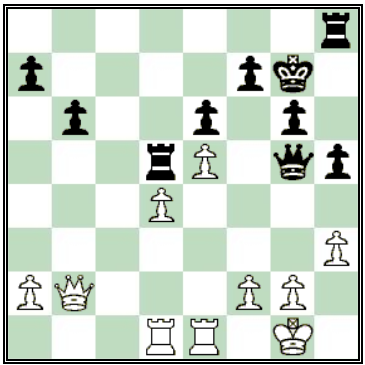
Tahmankar - O'Cuilleanain, Ulster championship 2025

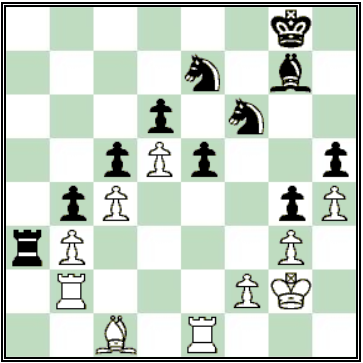
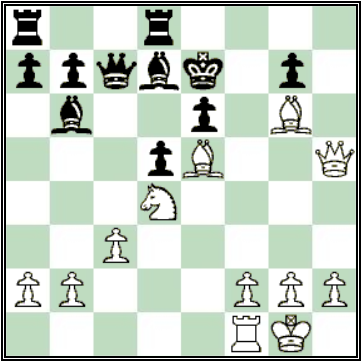
Tahmankar – O’Cuilleanáin, Ulster championship 2025 (4)
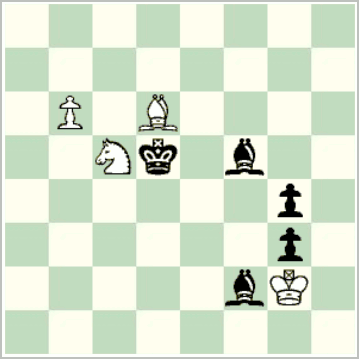
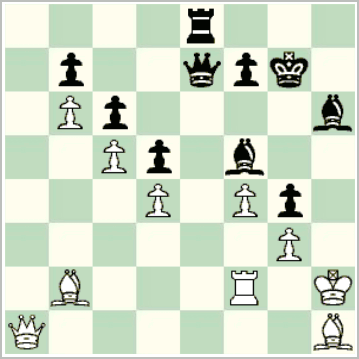
Position after 37. b6

Black’s pieces all stand markedly better than their counterparts, so it is not surprising that Black stands much better. If White had played 37. Qc1 instead, though, the game would still have been in the balance. From the diagrammed position, engines find that Black is winning after 37… Bxf4!!; the reader is invited to work out the variations. O’Cuilleanáin instead played the also-winning, and from a human point of view much safer, 37… Qe3. After 38. Qf1 (there is nothing better) came 38… Bxf4!. Now 39. Rxf4 leads to a quick mate, while after the game’s 39. gxf4 g3+ 40. Kg1 Bd3, Black will emerge a clear rook up. White resigned.
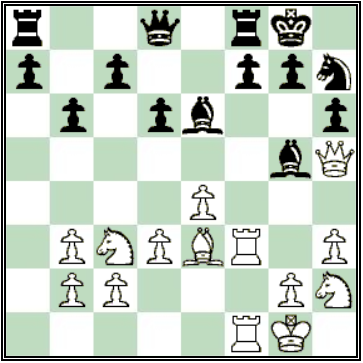
Tahmankar’s other dropped half point came against Razbadauskas in round 4, in a topsy-turvy game in which he went from much better to completely lost, to lost with some play left, to a draw.

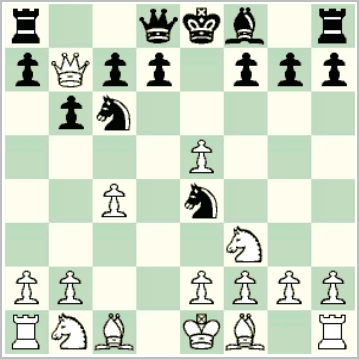
In the Intermediate, Peter Dolan also finished with 6/6. He is SCO-registered, but reports were silent on whether he was eligible for the title of Ulster Intermediate Champion. His last-round game against Andrew Campbell produced early fireworks, reaching the diagrammed position at move 6:

Dolan - Campbell, Ulster Intermediate Championship 2025

Dolan – Campbell, Ulster Intermediate 2025 (6)
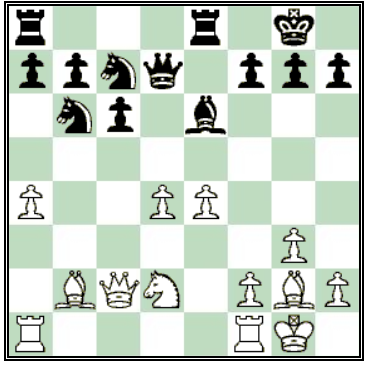
Position after 6… Nc6

How should White continue? The solution is left as an exercise.

In the game, he did not find the best continuation, and reached a lost position, but later recovered to a roughly equal ending, and after a blunder by Black, even won.

[Click to replay the full game.]

Posted in Tournaments, Ulster championships | Leave a comment

De Búrca or Cranston again, and other Warsaw reverberations

“At the time I was 22 years old and easily the youngest member of the Irish team. Cranston, Creevey and O’Hanlon were already veterans of the chess-board; so that Ireland’s team had the doubtful distinction of being the oldest, in average age, which competed in Warsaw.”
(“International Team Tournament, Warsaw 1935” by Austin Bourke in “Chess in Ireland”, January 1960, pages 12-14)

Who played Board 4 against Poland?

In Who did Dake play? (to which today I have added a tailpiece) I addressed the uncertainty of whether T.G. Cranston or Austin Bourke (de Búrca) had played on Board 4 for Ireland in the Round 6 match against the U.S.A.

It turns out that this may not be the only misidentification involving those two players in some of the published material about the Warsaw Olympiad.

To start off our quest for the truth, here is Bourke’s take on how the Olympiad worked out for Ireland.

HOW IRELAND FARED
“It soon became obvious that the Irish team was rather outclassed – and there wasn’t even the consolation of young players gaining valuable experience. Indeed I watched the first third of the tournament from the sideline, for at least with the Irish team, the term “reserve player” was taken literally. Reilly and O’Hanlon played in all nineteen rounds. I was eventually brought on to the team on five occasions when the opposition was so strong that defeat was inevitable in any case; surely a baptism of fire for the young intruder. But when poor Cranston was laid low with digestive troubles, I got three further games against less stern opponents, and even won a game, rather luckily, against Salo of Finland. Reilly won in the same match, so Ireland drew with Finland as a single bright spot amongst eighteen defeats.”

24 years had elapsed for Bourke since playing at Warsaw until writing his article for Chess in Ireland. His recollections may have become a little hazy in that time. However, by doing a simple calculation, the article suggests that he played 8 games in total.

However, our own database lists all the games played by the Irish team at Warsaw (plus the Cork-born Hugh Alexander who played for the British team) and only gives (at least until now) seven games for de Búrca, as seen below. That total number and opponents (including Dake) concurs with the same in major databases such as Chessbase and Olimpbase. 

Golombek, Harry	   de Búrca, Austin  1-0 (4.4)  1935.08.18
Dake, Arthur       de Búrca, Austin  1-0 (6.4)  1935.08.20
de Búrca, Austin   Réthy, Pál        0-1 (7.4)  1935.08.21
Danielsson, Gösta  de Búrca, Austin  1-0 (8.4)  1935.08.21
Raizman, Maurice   de Búrca, Austin  1-0 (11.4) 1935.08.24
de Búrca, Austin   Salo, Toivo       1-0 (18.4) 1935.08.30
Luckis, Markas     de Búrca, Austin  1-0 (19.4) 1935.08.31

The first thing I should point out is that not all the game scores from Warsaw 1935 have entered the public domain. This applies to the game below, from the Ireland -v- Poland match which is the focus of our attention for misidentification.

Friedmann, Henryk  Cranston, T. G.   1-0 (15.4)	1935.08.27

The alternative spelling Friedman is used in many sources, and which from this point I shall use in preference.

The alleged Friedman-Cranston game is one of 17 games currently listed for Cranston in the IRLchess database and in others, e.g. Chessbase). It also appears in A.J. Gillam’s Warsaw Olympiad 1935 (Nottingham, 2020) as game 592 at page 271 (though, of course, it is only a stub).

There is, however, contrary evidence elsewhere that de Búrca in fact played 8 games and Cranston only 16 and that the correct listing for the Board 4 game in the Poland-Ireland match is Friedman-de Búrca.

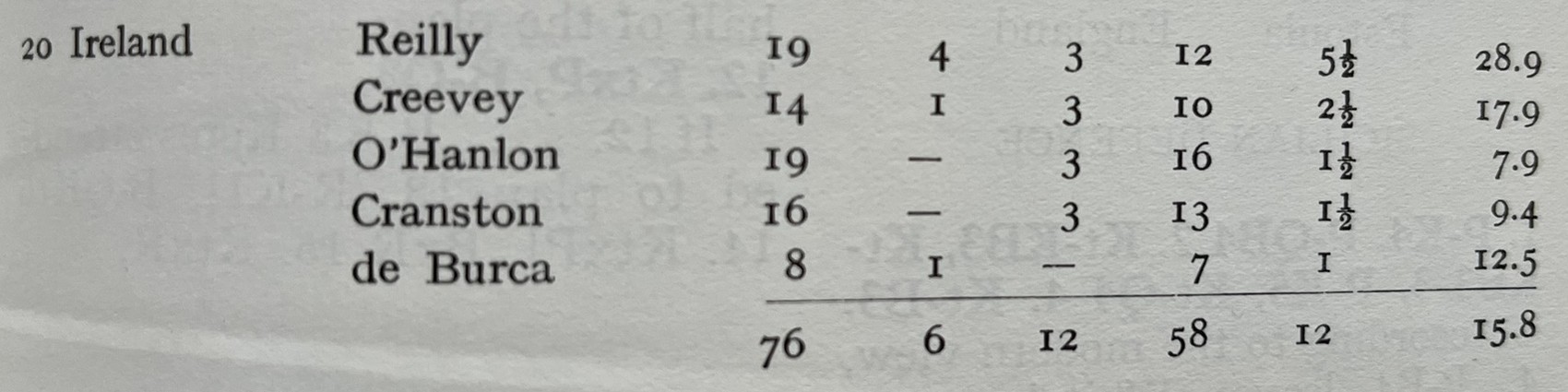
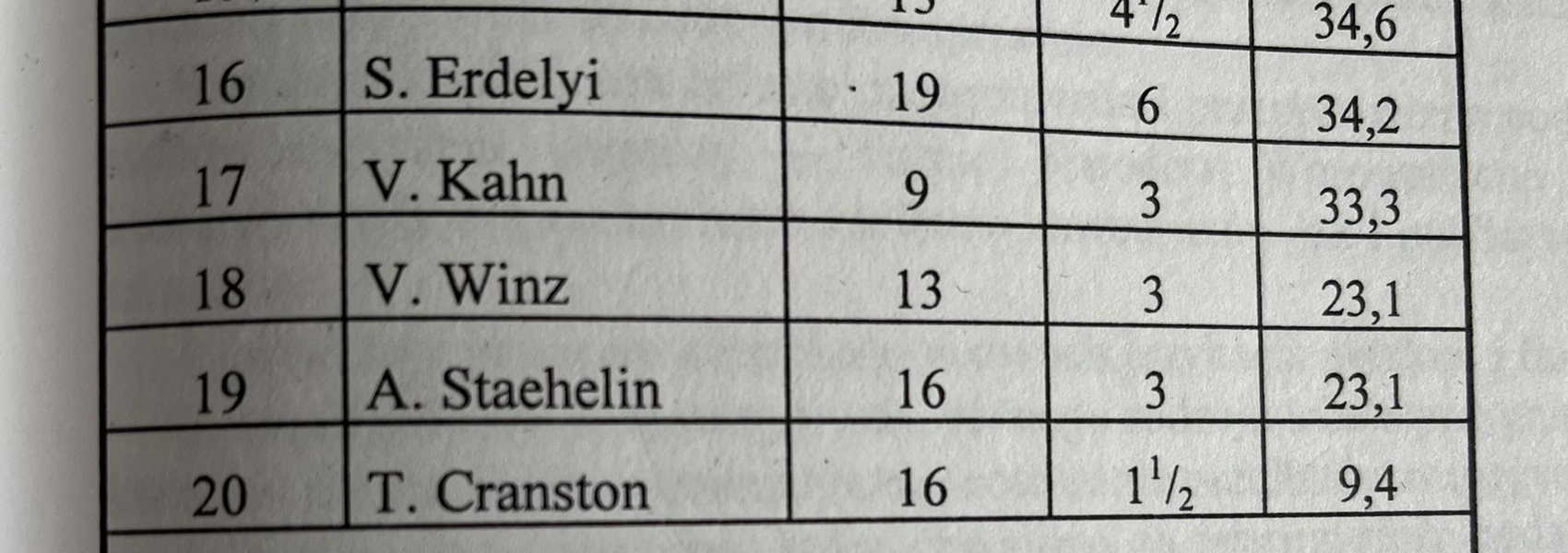
In Chess Olympiads by Árpád Földeák (Corvina Press, Second enlarged edition, 1968) there are extensive statistical tables and at page 113 (see Table 1) the overall scores for the Irish team members at Warsaw 1935 are given: Cranston 16 games, de Búrca 8.

Table 1

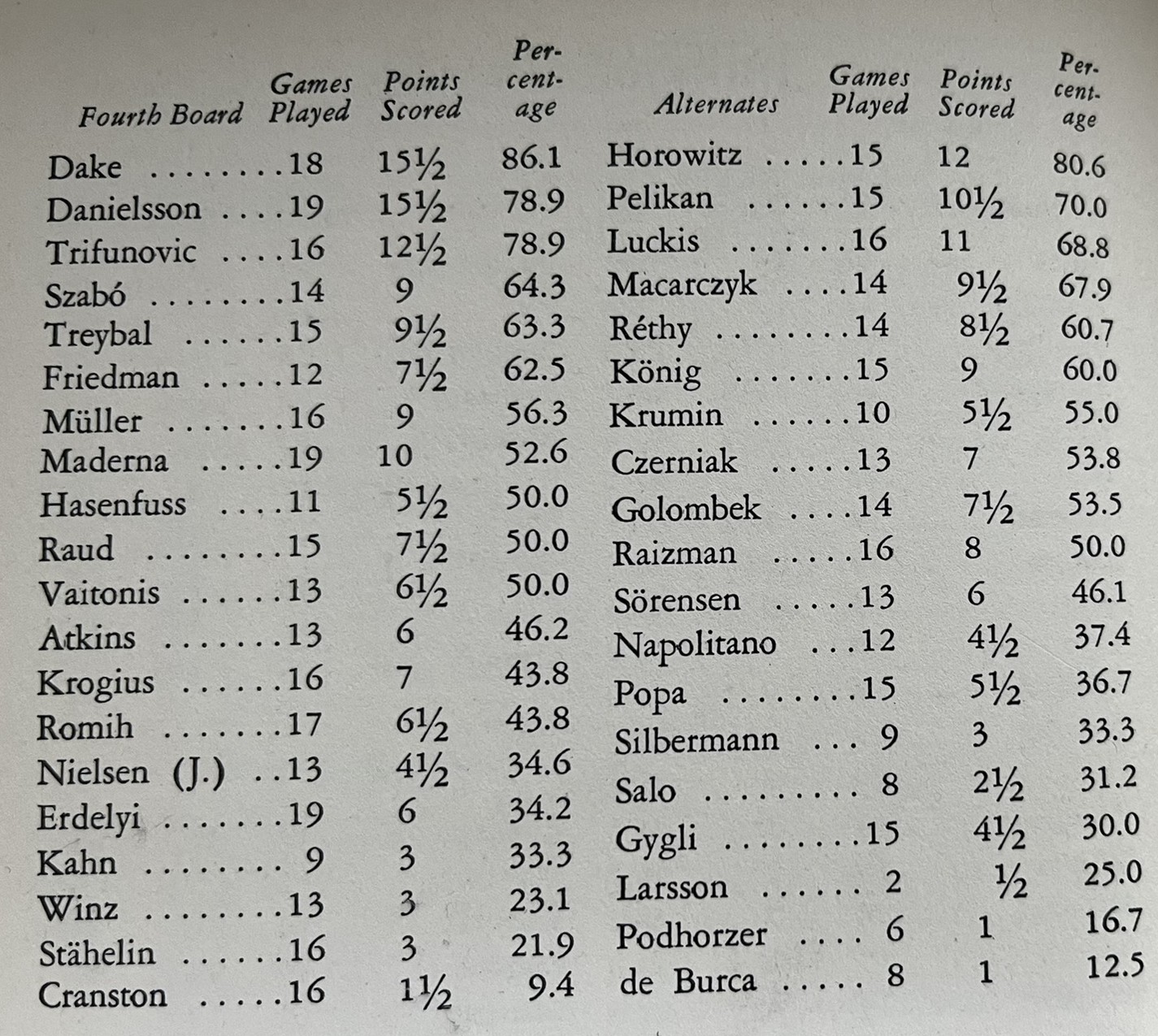
Warsaw 1935 International Team Tournament by Fred Reinfeld and Harold M. Phillips (Black Knight Press, 1936) also provided the individual scores of every player. At page xii (see Table 2) the scores for the Fourth Board players and the Alternates (or Reserves) are again: Cranston 16 games, de Búrca 8.

Table 2

VI Wszechświatowa Olimpiada Szachowa, Warszawa 1935 by Mirosława Litmanowicz (Warsaw, 1996) provides a contradictory picture of the game totals for Cranston and de Búrca.

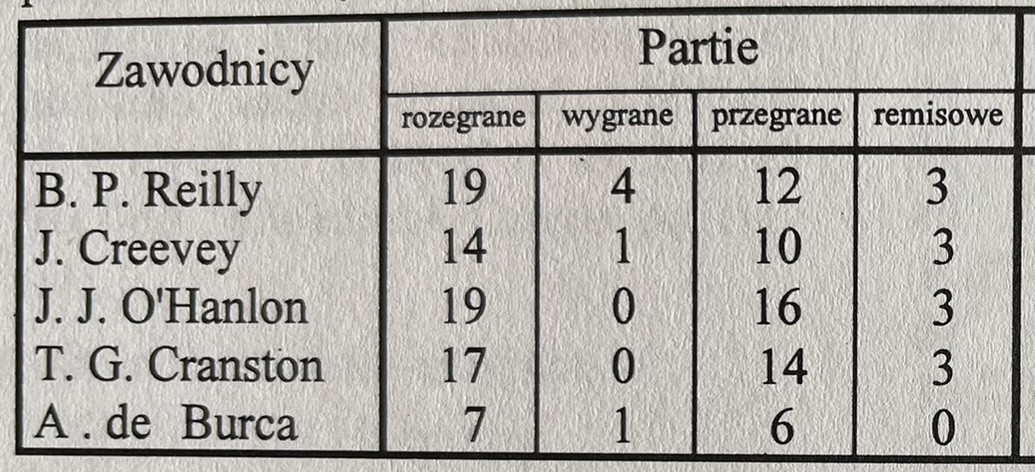
In that book, each competing country was allocated a separate chapter outlining its performance. In the chapter for Ireland, at page 314 (see Table 3) the individual scores for each player are given: Cranston 17 games, de Búrca 7.

Table 3

For the avoidance of doubt, immediately below is the translation from Polish to English of the words given in Table 3.

zawodnicy partie rozegrane wygrane przegrane remisowe
players   games  played    won     lost      drawn

At pages 55-66 there are a number of statistical tables given by Litmanowicz.

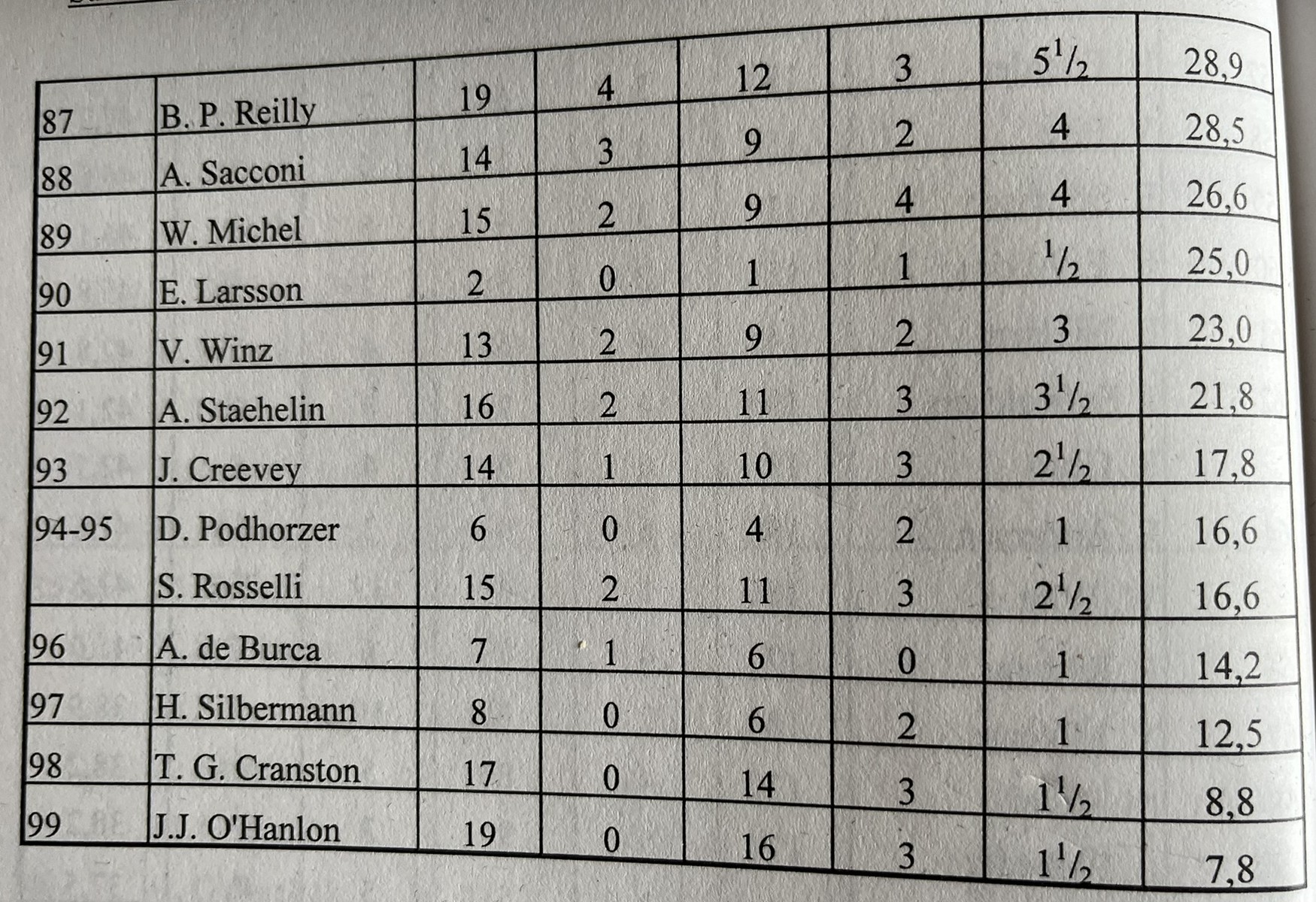
In “Tabela 5. Indywidualne wyniki zawodników” (Individual results of players) all 99 players are listed in descending order of percentage score. At page 62 we find the lower reaches of that Tabela/Table (see our Table 4) where unfortunately we find all the Irish players: Cranston 17 games, de Búrca 7 again.

Table 4

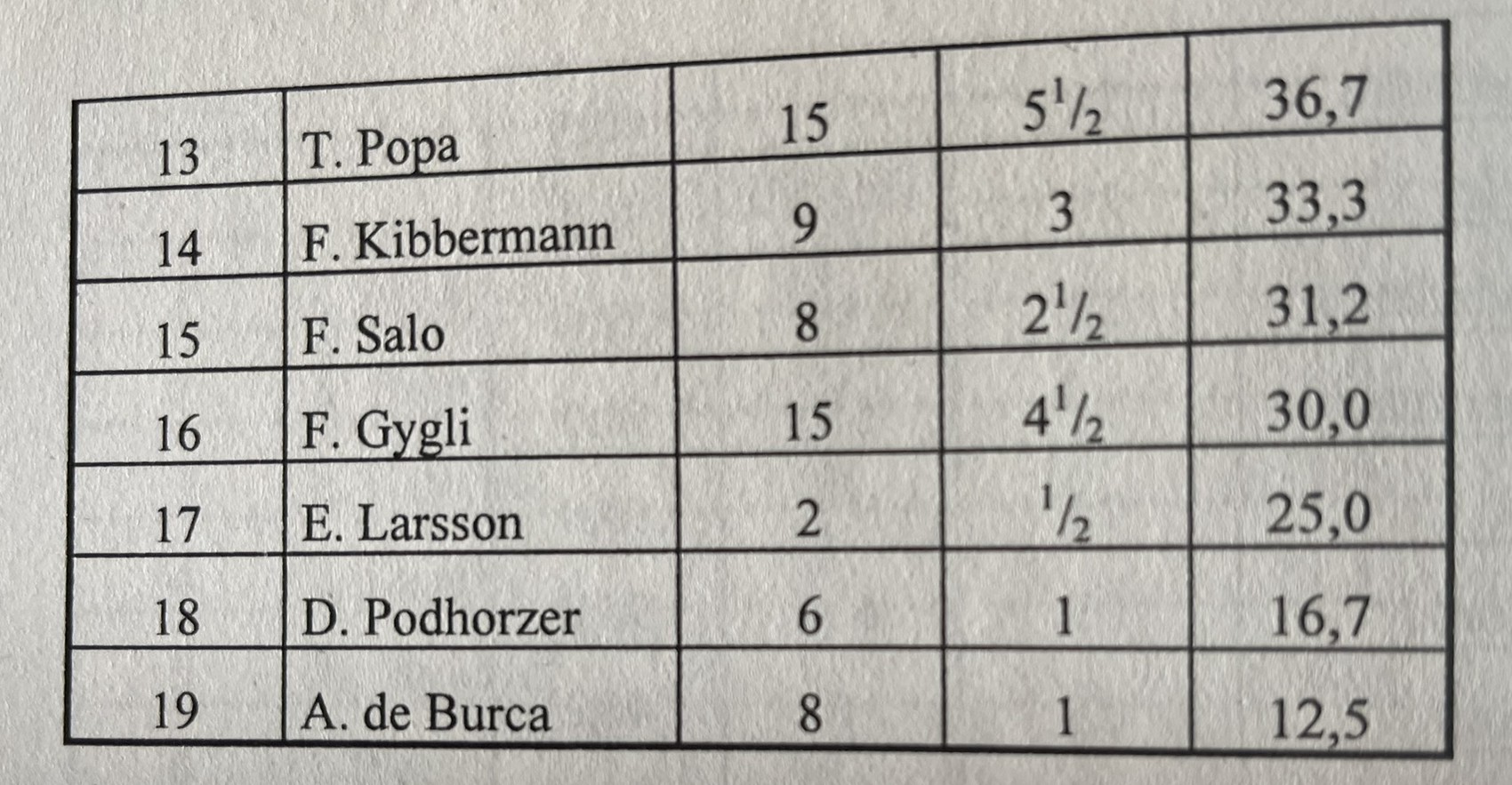
However it is a different story when we come to Litmanowicz’s “Tabela 6. Indywidualne wyniki zawodników wedlug szachownic” (Individual player results by board). First an excerpt from page 65 (see our Table 5) from the Board 4 results: Cranston only 16 games.

Table 5

Now, on page 66 (see our Table 6) we find the tail-end of the Reserves’ totals: De Búrca goes up to 8.

Table 6

However, there is another piece of relevant information in Litmanowicz and I would suggest that it provides a compelling argument in favour of the Cranston 16 games, de Búrca 8 games version of events. It helps particularly with proving there is a second game from the event (the first being the game against Dake) where there has been a misidentification between Cranston and de Búrca.

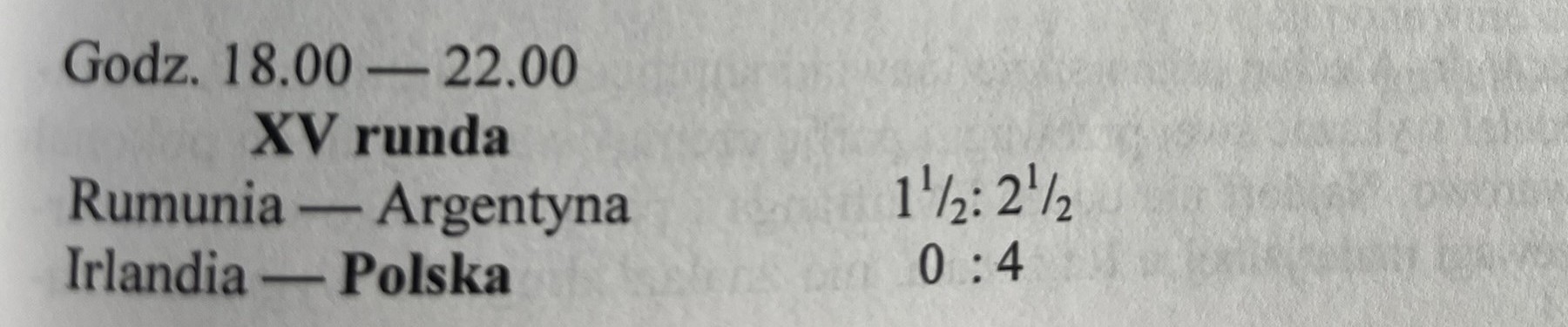
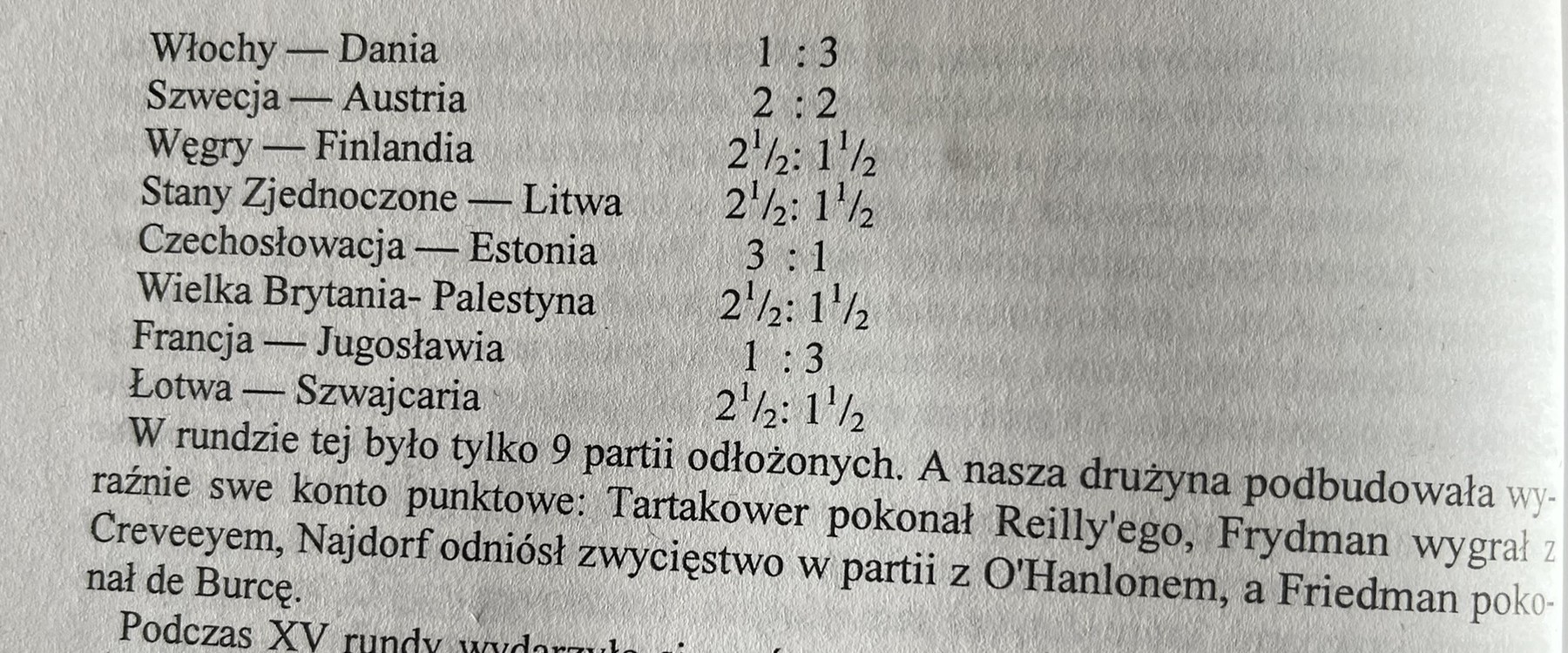
From pages 16-51 there is a chapter entitled Przebieg rozgrywek (Course of the games).  A large part of the chapter is given over to a round-by-round report of the tournament and usually the individual results of the Polish team are given for each round. At pages 41-42 can be found the report on Round 15 including reference to the individual results in the Ireland-Poland match (see extract immediately below).

The final part of this excerpt translates into English as:

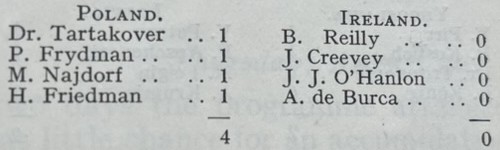
Tartakower defeated Reilly, Frydman defeated Creevey, Najdorf won the game against O’Hanlon, and Friedman defeated de Búrca.

So here, we have the evidence – from a Polish author, who had access to many Polish contemporary sources – that Friedman’s opponent was not Cranston, but instead de Búrca.

Of course, there might still be a nagging doubt over the discrepancies in the Litmanowicz statistical tables. However there is one final piece of evidence, that I consider wins the day for my hypothesis and it is moreover from a contemporary source.

The British Chess Magazine in its October 1935 edition contained a lengthy report on the Warsaw Team tournament, and which included the detailed results of  every one of the matches played. Here, from page 445, is the result of the Poland-Ireland match.

Quod erat demonstrandum.

Bourke-Salo

This game, played in the Ireland-Finland match and mentioned in Bourke’s Chess in Ireland article on Warsaw 1935, does not seem to have found its way into the databases nor any of the major books on the event.

The game-score is to be found in the chess column of Bourke’s local newspaper, the (Cork) Evening Echo. Unfortunately the legibility of the source’s digital column is not optimal though fortunately good enough to read the game score, but the appended notes on the game (probably by the editor W.R. O’Shea, and possibly based on comments by Bourke) are indecipherable. However, it is possible to see in the game-score the bracketed letters (from a to i) used to identify each note – and they are after moves black 2, black 3, white 14, black 15, white 18, white 21, white 24, black 24 and white 30. This does provide a rough guide to various significant points in the game

It is a complex game and worth studying in depth. I used Stockfish 14 to assist my understanding and the annotations are intended to provide no more than a few signposts on a journey through the game. Hopefully the computer engine has helped me avoid any egregious errors.

Aibhistín de Búrca – Tapio Salo
Olympiad Warsaw (Round 18, Board 4), 30 August 1935
[Source: Evening Echo, Saturday 15 February 1936, page 6]

1.d4 d5 2.c4 dxc4 3.Nf3 a6 4.a4 Nf6 5.e3 Bg4 6.Bxc4 e6 7.0-0 Nc6 8.Nc3 Bd6 9.Re1 0-0 10.h3 Bf5 11.g4 Bg6 12.e4 e5 13.Bg5 exd4 14.Nd5 Be5 15.Nh4

15…Na5
15…h6 was a plausible alternative and after 16.Nxg6 fxg6 17.Bxf6 Bxf6 if White goes material hunting with 18.Nxc7+ Kh7 19.Nxa8 then Black could counter-attack with 19…Bh4 20.Rf1 Ne5 21.Bd5 when both 21…Nf3+ and 21…Rf3 look promising.
16.Ba2 d3 17.f4 Bxb2 18.Rb1
Here White could have offered the exchange by playing 18.f5 or or 18.e5 when, in both cases, capturing the Rook would give White a strong attack. 18.Nxg6 is probably not as strong as the two pawn moves, if Black’s declined the exchange sacrifice, but accepting with 18…Bxa1 would have been catastrophic for Black after 19.Nde7+.
18…Bd4+ 19.Kg2 c6

20.e5
Here the alternative pawn push 20.f5 might have been better. White can win a piece with 20…cxd5 21.fxg6 hxg6 22.e5 but he would not necessarily be better, e.g. 22…Bxe5 23.Rxe5 when now Black can try 23…Nc4 24.Re1 d2!? 25.Bxd2 Ne4 26.Bxc4 Qxh4. White would now be forced to play 27.Rxe4 and after 27…dxe4 28.Rxb7 Stockfish 14 assesses this as 0.00.
20…cxd5 21.f5 h6
Better here would be 21…Bxe5 22.Rxe5 Nc4 23.Re1 h6! with advantage for Black.
22.Bxf6 gxf6 23.fxg6 fxe5 24.gxf7+
The alternative was 24.Nf5 fxg6 25.Nxd4 exd4 26.Qxd3. The pawns at d4, d5 and g6 are all targets and Re6 is a threat. Best for Black might be the counter-attacking 26…Qf6; e.g. 27.Bxd5+ Kh8 and if 28.Re6 Qf2+
24…Kh8
Black had to sacrifice the exchange, viz. 24…Rxf7 and if 25.Nf5 then 25…Rxf5 26.gxf5 Qg5+ with good counter-attacking chances.
25.Ng6+ Kg7 26.Nxf8 Qxf8 27.Bxd5 Qc5 28.Qf3 Rf8 29.Rf1 Qd6

30.Be4?
Letting Black back into the game. Instead 30.g5 immediately and if 30…hxg5 31.h4 gxh4 32.Kh1 and the threat of Rfg1 is decisive.
If (instead of 30…hxg5) Black plays 30…h5 now 31.Be4 works; if still 31…Nc4 32.Qxh5 the only way to prevent mate in two is 32…Ne3+ 33.Kh1 Nf5 and after 34.Rxf5 White is a Rook up – plus Stockfish asserts it is at most mate in 9. In this line if (instead of 31…Nc4) 31…Rh8 is played then 32.Qf5 and …f8(Q) followed by mate is inevitable.
30…Nc4 31.g5 Ne3+ 32.Kh1 Nxf1 33.Rxf1 hxg5 34.Qf5 Qh6 35.Bxd3

35…a5
Black must play 35…e4 to allow his Bishop to help out the defence. After 36.Bxe4 best is probably 36…b5 when 37.a5 may well be better than capturing the pawn. White could probably keep the pressure on, hoping Black cracks.
36.Rf3
36.Be4 stopping …e4 would be stronger. One idea available would be pushing h4 – for instance (although not forced) after 36…b6 37.Rf3 Bb2 38.Kg2 Bd4 39.h4! gxh4 (39…Qxh4 40.Qf6#) 40.Qg4+ Kh8 41.Kh3 and mate in ten according to Stockfish. However the move actually played turned out well. White’s relentless pressing finally paid off as Black now self-destructed.
36…Qh5?? 37.Qf6# 1-0

[Click here to replay the game]

A tongue-in cheek assertion

Austin Bourke provided an article for the Evening Echo chess column which appeared in the 16th April 1936 edition of the newspaper. He used the events of Warsaw 1935 and particularly his win against Salo to produce an over-elaborate claim to star status.

“AM I WORLD CHAMPION?”
by AUSTIN BOURKE

Capablanca set a stiff standard for succeeding world champions when, for a period of some three or four years, he played continuously in tournaments, and never lost even a single game. So that today, when in some obscure tournament, a Master, stale with too many simultaneous displays, slips up to some unknown amateur, the chess correspondents shake their heads and say:” Is X as good as he used to be?” However, even Homer nods (I have lost games myself!), and if every victor in every chess game is a better player than every vanquished, then I am World Champion! Why, on Warsaw form alone — I beat Salo (Finland), who beat Popa, of Rumania. Popa beat Golombek (England), who beat Horowitz (U.S.A.), who, in turn, beat Trifunovic, of Yugoslavia. Trifunovic beat our own O’Hanlon, who drew with Stolz, of Sweden. Stolz beat Marshall (U.S.A.), who beat Grunfeld (Austria). And Grunfeld drew with Alekhine, Flohr, Tartakover, Vidmar, Book, Winter, Stahlberg, etc. [all] of which goes to prove I could give Alekhine pawn and move. It may not be to far out, at that!

Epilogue

The final paragraph of Bourke’s Chess in Ireland article brought together his chess and work careers, and acknowledged the immense events that had occurred between two visits to Warsaw.

“The building in which the Team Tournament was held had immediately previously housed a meeting of the International Meteorological Organisation, a body then unknown to me. Last year, after a lapse of twenty-three years, I returned to Warsaw , and was elected President of Commission for Agricultural Meteorology of the World Meteorological Organisation! I looked for the old Military Club in which the chess tournament had been held, but it had vanished in the destruction and rebuilding of Warsaw. So much had changed; only the indomitable spirit of Poland, which has survived so much and continues to endure, remained unchanged.”

Posted in Analysis, Games, Players, Tournaments | Leave a comment

Sonja Graf – Part 4: A Bewitching Visit to Cork

The Evening Echo for Saturday 9th February 1935 gave Sonja Graf the big build-up, with some impressive evidence to back it up.

TO VISIT CORK.

FRAULEIN SONJA GRAF.

Up to recently, Fraulein Wally Henschel (Hamburg) was the sole, and none too successful representative of German women’s chess to partake in important tournaments (Hamburg, 1930, Prague, 1931). Early in 1933 Fraulein Henschel was displaced from the women’s championship of Hamburg by Fraulein Ehlers (Hamburg), but Frau Ehlers, too, was destined to enjoy her title for only a short time, for suddenly a new star rose in the German women’s chess world. From Munich, by way of Holland, where she had swept all before her in simultaneous displays, came the small and very slender Fraulein Sonja Graf to beat Frau Ehlers by such a convincing margin (five wins and one draw to no wins) that, coupled with her previous successes against established Hamburg Masters, it removed any remaining doubt as to who was the greatest living German woman chessplayer. The German Masters, Paul Kruger and Alfred Brinkmann, among others, have acclaimed her us such.

Fraulein Sonja Graf’s style, which shows her as a pupil of the Tarrasch school, is, in contrast to the general play of women chessplayers, bright, aggressive and full of combinations, whilst she specialises in Queen sacrifices. She shows the imagination and temperament that are the legacy of her Russian descent. Her play is sometimes a little wild and unbalanced, but her ability is beyond question. In the International Women’s Tournament (June, 1932, at Vienna) she won first prize. In the winter of 1933-34 she took part in the Master Tourney of the Munich Chess Club, an unprecedented happening for a German woman, and emerged with a very creditable score just behind the prizewinners. Brian Harley thinks she is the second greatest woman chess player in the world, and recollects a match between herself and Miss Menchik in which she managed to snatch a win from the lady champion of the world. On next Wednesday evening, February 13th, at the Pavilion Café, Cork, from 7 p.m. to 10.30 p.m., Fraulein Sonja Graf, the German chess wizard, will face the leading chess lights of Cork, when she will play 16 boards simultaneously. An event of outstanding importance, this spectacular exhibition of brainwork by a lady chess player, eminently qualified to undertake the task, has aroused widespread interest, and speculation is already rife as to the results.

On the day of the Simultaneous Exhibition, the Evening Echo had a further preview of the event, including high praise for Sonja from the soon-to-become World Chess Champion.

Fraulein Sonja Graf, the 21-year-old woman champion of Germany, who is presently touring Ireland, arrives in Cork to-day to conduct a simultaneous display at the Pavilion Café this (Wednesday) evening, commencing at 7 p.m., when she will face 16 of the best chess-players in Cork. In view of her fine record and great success at Dublin recently, great interest is attached to her performance this evening. Chess-players interested in the display are invited to be present. Dr. Max Euwe, the Dutch champion and candidate for world championship honours against Dr. Alekhine, in a match to be played soon at The Hague, says she is better than Miss Menchik, woman champion of the world.

The day after the simultaneous exhibition, the Evening Echo was still rolling out the superlatives.

A REAL MASTER

Last evening, at the Cork Chess Club, Pavilion Café, Fraulein Sonja Graf, the woman champion of Germany, on the invitation of the club, gave a simultaneous display of chess against sixteen of the best players in the city. This young lady – she is only 21 years of age—came with a big reputation. Not alone is she lady champion of her native land, but she had the honour of winning a game against the lady champion of the world, Miss Menchik, recently in London.

Her reputation had preceded her to Cork. Last week in Dublin, where she is at present spending a holiday, she gave four simultaneous displays. She played sixteen boards on each occasion and only suffered eight defeats —two losses on each of the four nights.

Her opponents last night included Mr. R Archer, many times champion of Cork, and Austin Bourke, present champion of Munster. The results entirely favoured [the] Fraulein as out of the sixteen boards she only lost two games, winning six and drawing eight. This convincing display speaks for itself, and Fraulein Sonja Graf certainly deserves to be congratulated on the manner in which she played. A remarkable feature of the display was the speed at which she moved. She averaged fifteen moves at each board in the first hour, or fifteen seconds per move. She played bright, forceful chess, and proved herself a real master when defending with Black. She returns to Dublin this afternoon and leaves Ireland on Saturday next. It may be of interest to mention that [the] Fraulein played continuously for over four hours.

The Saturday edition of the Evening Echo provided an extensive review of the events of Wednesday night.

THE WEEK’S GREAT EVENT.

FRL. SONJA GRAF’S VISIT.

Fraulein Sonja Graf has come and gone, and her coming caused a great sensation in Cork, as evidenced by the great concourse of visitors that thronged the Pavilion Café on Wednesday evening, when she faced sixteen of the strongest chess players in Cork. After the Secretary of the Cork Chess Club had introduced the lady champion of Germany, play commenced at 7.20 p.m., when she had White on the first eight boards and Black on the remaining eight. Moving with extraordinary quickness she replied to her opponents’ moves with a rapidity that amazed everybody, and when the first hour had struck she had made a complete circuit of the tables fifteen times, and in two hours had made twenty-five moves against each player. As the evening progressed, the spectators increased in numbers and here and there knots of people congregated near a player with an interesting position. Fraulein Sonja Graf was now moving more slowly. Play had passed the initial stage, and intricate, situations had arisen that called for greater thought as the result of her having sprung various traps here and there. A bait of Pawn was offered at some boards, whilst at others she was planning difficult combinations in an effort to puzzle her opponents and involve them in making a hasty foolish move. At 8.45 p.m., there was a break of fifteen minutes for a rest. When play was resumed at 9 p.m. it was obvious that some results would soon be forthcoming and at 9.30 p.m. the Secretary announced the first win of the night in favour of the German which was greeted with applause. Numerous draws followed. Sonja suffered her first loss at the eighth board, where the best game of the evening was played. Here she met the hero of the evening — not with a smile but with the King’s Gambit, the most daring opening on record, which was declined by her prudent adversary. The game, from an early stage had attracted a gallery that were admirers of the able manner in which Black was handling his defence. Eventually a crisis was precipitated, and a series of most brilliant counter-checks followed, and on the 28th move Fraulein Sonja Graf resigned, and Mr. O’Donovan received a warm handshake from the most dangerous opponent he has over crossed swords with in chess, which was followed by numerous handshakes and applause all round. Mr. O’Donovan’s was the outstanding win of the night. He is a popular member of the C.Y.M.S. Chess Club, where his name has figured prominently this season.

In passing, there are two other players who are warmly deserving of recognition for their draws; these are Mr. J. Good and Mr. R. Jagoe, two most popular Cork chess players. The final results were — Six wins, eight draws and two losses for Fraulein Sonja Graf. She maintained her reputation, and proved herself to be a chess-player of the finest type, and all those with whom she came in contact while in Cork on Wednesday night were unanimous in acclaiming her as a worthy representative of the Fatherland, and that her play was of the highest order of merit, and of the standard of a master; whilst the display itself will always be remembered as an exhibition of coolness, skill and courage, and an endurance test that no one present would care to undertake. Mr, J. J. O’Hanlon, ex-champion of Ireland, was also present, and acted a co-adjudicator.

Result- 

         PLAYING BLACK

1.  R. Archer               1
2.  B. St. J. Galvin        ½
3.  W.J. L. O'Connell M.E.  ½
4.  W.G. Whittaker          ½
5.  Austin Bourke           ½
6.  M. Madden               0
7.  C. O'Leary              ½
8.  Chris O'Donovan         1

         PLAYING WHITE

9.  D. Tuohy                0
10. Dr. G. T. Pyne          0
11. Dr. A. Whelton          ½
12. R. Jagoe                ½
13. Joe Gilroy              0
14. Miss V. Lynch           0
15. John Good               ½
16. B. Flahive              0

Normally the player giving a simultaneous display takes the White pieces on all boards, so it was a generous gesture by Sonja Graf to gift them to the bottom eight Boards – particularly as the top eight were as strong a group of Cork-based players as could be put out to face the German champion.

On Saturday 23rd February the Evening Echo published four game scores from the top eight group.

Sonja Graf – Chris O’Donovan
Simultaneous Exhibition, Cork, 13th February 1935

1.e4 e5 2.f4 d6 3.Nf3 Nc6 4.Bb5 Nf6 5.0-0 Bg4 6.d3 Be7 7.f5 0-0 8.Bxc6 bxc6 9.h3 Bxf3 10.Qxf3 d5 11.Nc3 dxe4 12.dxe4 Kh8 13.Be3 g6 14.Rad1 Qc8 15.Bh6 Rd8 16.fxg6 fxg6 17.Qg3 Qe6 18.Rf5
Precipitating the crisis.
18…Rxd1+ 19.Nxd1 Bc5+

20.Kf1?
20.Kh2 was the correct move when 20…Nxe4 21.Rxe5 Nxg3 22.Rxe6 Nf1+ 23.Kh1 Ng3+ 24.Kh2 Nf1+ is perpetual check. If (instead of 20…Nxe4) if Black plays 20…Bd6 21.Rf1 Nxe4 22.Qh4 Nc5 the position is roughly even.
20…Rd8?
Missing 20…Qc4+ 21.Ke1 (or 21.Qd3 Qxd3+ 22.cxd3 gxf5) 21…Qxe4+ winning.
21.Rxe5?
Unfortunately for Graf, this forces O’Donovan to find the move he missed previously. Instead White has a difficult to see resource found by Stockfish 14: 21.Nf2 Bxf2 22.Rxf2 and after 22…Nxe4 White has 23.Qd3!! and if now 23…Rxd3 24.Rf8+ Qg8 25.cxd3 Nd6 26.g4 the most likely result is a draw.
21…Qc4+ 22.Ke1 Qd4
This is good enough to secure the win but Stockfish 14 prefers 22…Qxc2 23.Nc3 (23.Qf3 Rxd1+ 24.Qxd1 Qf2#) 23…Bd4 as an easier road to victory.]
23.Nc3 Bd6 24.Bf4 Kg8 25.Rg5 Nxe4

26.Rxg6+
A last desperate attempt, hoping for 26…hxg6 27.Qxg6 when White can still hope to keep the complications alive.
26…Kh8! 27.Rxd6
Losing immediately, but there does not seem to be any move here that would have prevented Black from taking the win.
27…Qg1+ 0-1

[Click here to replay the game]

The other  three games given in the Echo were cagey affairs with the Cork players seemingly content to steer the games to a draw.

Sonja Graf – Cornelius O’Leary
Simultaneous Exhibition, Cork, 13th February 1935

1.d4 e6 2.c4 d5 3.Nf3 Nf6 4.Bg5 Be7 5.e3 Nbd7 6.Nc3 c6 7.Bd3 dxc4 8.Bxc4 Nd5 9.Bxe7 Qxe7 10.e4 Nxc3 11.bxc3 Nf6 12.Qc2 c5 13.0-0 b6 14.Rab1 cxd4 15.cxd4 0-0 16.Rfe1 Qc7 17.Qb3 g6 18.Rbc1 Qf4 19.Bd3 Bb7 20.Qb1 Rad8 21.Bc2 h5 22.Rcd1 Kg7 23.h3 Rh8 24.Ne5 Nd7 25.Nxd7 Rxd7 26.Qb2 Qf6 27.e5 Qg5 28.Be4 Bd5 29.Bxd5 Rxd5 ½-½

[Click here to replay the game]

Sonja Graf –  William J.L. O’Connell
Simultaneous Exhibition, Cork, 13th February 1935

1.d4 Nf6 2.c4 e6 3.Nf3 d5 4.Bg5 Nbd7 5.Nc3 Bb4 6.e3 c5 7.a3 Bxc3+ 8.bxc3 Qc7 9.Bxf6 Nxf6 10.cxd5 exd5 11.Bd3 0-0 12.Qd2 Ne4 13.Bxe4 dxe4 14.Ng1 cxd4 15.cxd4 Be6 16.Ne2 Rfd8 17.0-0 Rac8 18.Rfc1 Qe7 19.Qb2 f5 20.Nf4 Bf7 ½-½

[Click here to replay the game]

Sonja Graf – Barry St. John Galvin
Simultaneous Exhibition, Cork, 13th February 1935

1.d4 Nf6 2.c4 e6 3.Nf3 b6 4.Bg5 Be7 5.Nc3 Bb7 6.e3 Ne4 7.Bxe7 Qxe7 8.Nxe4 Bxe4 9.Qb3 d6 10.Be2 Nd7 11.Nd2 d5 12.Nxe4 dxe4 13.f3 Nf6 14.Rd1 0-0 15.fxe4 Nxe4 16.0-0 Rad8 17.Bf3 Nf6 18.Kh1 c5 19.Qa3 Qc7 20.Qc3 cxd4 21.exd4 Rc8 22.b3 Rfd8 23.Qe3 Rd7 24.Qg5 Qd8 25.h3 Ne8 ½-½

[Click here to replay the game]

The Evening Echo for Saturday 2 March had one final tale to tell.

ARCHER V. SONJA GRAF.

The following-game, played in the recent simultaneous display … shows the champion in characteristic fighting mood. A close study of the game reveals a well pressed attack by the German that is repelled by Mr. Archer in an able manner. Indeed, if he erred at all it was on the side of extreme caution, but then he probably did not care to underestimate his famous opponent; but she did, and this was the rock on which she perished. Now and again, Sonja made some tempting sacrifices in the hope of luring her opponent into an unsuspecting trap, but prudence, tempered with sound judgment, prevailed, and age and experience proved more than a compensating match for youth and genius.

Sonja Graf – Richard Archer
Simultaneous Exhibition, Cork, 13th February 1935

1.d4 Nf6 2.Nf3 d5 3.c4 c6 4.Nc3 e6 5.Bf4 Nbd7 6.e3 g6 7.Bg5 Be7 8.Bd3 Nb6 9.c5 Nbd7 10.0-0 b6 11.b4 a6 12.a4 Bb7 13.Re1 b5 14.a5 h6 15.Bxf6 Nxf6 16.Qc2 Rg8 17.e4 Qc7 18.Ne5 Nd7 19.exd5 cxd5

20.Nxg6
There are two much better sacrifices here. Stockfish 14 evaluates both 20.Nxb5 and 20. Bxb5 as leading to a decisive advantage. [There was also the sensible option 20.c6 Nxe5 (20…Bxc6? 21.Nxd5!) 21.cxb7 Nf3+ 22.gxf3 Qxb7 winning a piece.]
20…Bf6
[20…fxg6 21.Bxg6+ Kd8 22.Bf7 Rg5 23.Bxe6 with three pawns for the piece and Stockfish 14 assesses this as winning for White.]
21.Bxb5 Bxd4
[If 21…axb5 22.Nxb5 and the threat of Nd6 is very strong here. Stockfish suggests 21…Rxg6 as giving the best defensive chances, but it will require good survival instincts after 22.Rxe6+]
22.Bxd7+
Handing the advantage to Black. White should have played 22.c6 which Stockfish assesses as winning.
22…Kxd7 23.Nh4

23…Qf4! 24.Rad1
24.g3 does not work as Black can still play 24…Qxh4 because the g-pawn is pinned.
24.Nf3 also fails to 24…Qxf3 because of the pin – and then due to the immediate checkmate threat, the c3-Knight will also be lost.]
24…Qxh4 25.Ne4 Qg4 26.g3 Qg7 27.Nd6 Bc6 28.Qe2 Bc3 29.Rf1 Bxb4 30.Nc4 Bb5 0-1

[Click here to replay the game]

I decided to leave aside the final paragraph from the Evening Echo’s 16th February report, because now as a valediction, it cannot be improved upon.

Fraulein Sonja Graf has gone from us, and we hope her visit will do much to foster chess in Cork. We will follow her future in international chess with interest, as it is the career she has mapped out for herself, and she carries with her the good wishes of the many friends she made in Cork during her short stay.

Posted in Games, Players, Simuls | Leave a comment

Sonja Graf – Part 3 Overlapping Matches

MATCH AGAINST  JOHN J. O’HANLON

John James O’Hanlon, as the saying goes, needs no introduction, but the Irish Chess Union website does have this fine tribute from J.J. Walsh.

The Irish Independent reported on Day 1 of the match in its Thursday 7th February 1935 edition.

In the first game of her 5-game match with J.J. O’Hanlon, at the Dublin C.C. yesterday Fraulein Sonja Graf was forced to resign after 41 moves in an extremely interesting battle. O’Hanlon played his favourite opening, the Ruy Lopez, Sonja adopting the Morphy defence.

There was an adjournment at the 21st move in the second game, in which Sonja (white) played the Queen’s Gambit, and Black declining. She played Flohr’s attack and castled on the Queen’s side, which is rather unusual. Neither has the advantage.

John J. O’Hanlon – Sonja Graf
Match (Game 1) Dublin, 6th February 1935
[Source: Ireland’s Saturday Night, Saturday 9th March 1935, page 4B]

1.e4 e5 2.Nf3 Nc6 3.Bb5 a6 4.Ba4 Nf6 5.0-0 Nxe4 6.d4 b5 7.Bb3 d5 8.dxe5 Be6 9.c3 Be7 10.Nbd2 0-0 11.Qe2
As Fraulein Graf is thoroughly acquainted with all the ramifications of this form of defence to the Lopez, Mr. O’Hanlon played 11.Qe2 instead of 11.Re1 in order to avoid the Breslau variation.
11…Nc5 12.Nd4 Nxb3 13.N2xb3 Nxd4 14.cxd4 Qd7 15.Be3 a5
This move is weak. 15…f6 at once would be better.
16.Rac1 f6! 17.Nc5 Bxc5 18.Rxc5 fxe5 19.Rfc1 Qe7 20.Rxc7 Qh4 21.Qd2 Rf5

22.dxe5 Rh5
If 22…Rxe5 23.Rxg7+ Kxg7 24.Bd4 etc. [ RR If 24…Qf6 (or 24…Kf6 ) 25.f4]
23.Bf4 Rf8 24.Bg3 Qe4 25.Qc2 Qg4 26.Qc6 d4 27.Qxb5 Qe4 28.R7c5 Rh6 29.Rd1 Qg4 30.Qd3 Rd8 31.Rxa5 Bf5 32.Qf3 Qxf3 33.gxf3 Rb6

34.e6 Bh3 35.Rh5
Black was probably on the look out for perpetual check. But if 35.Bc7 Rxe6 36.Bxd8 Rg6+ 37.Rg5 was available. The game was lost no matter how Black played.
35…Rxe6
[RR The text gives the ambiguous “35…RxP” so 35…Rxb2 could have been played, but seems less likely given the moves played thereafter.
36.Rxh3 Re2 37.Bf4 d3 38.Bd2 Rf8 39.f4 g5 40.Rxd3 gxf4 41.Bc3 1-0

[Click here to replay the game]

Sonja Graf – John J. O’Hanlon
Match (Game 2) Dublin, 6th & 7th February 1935
[Source: Sports Mail and Dublin Weekly Mail, Saturday 9th February 1935, page 3]

1.d4 d5 2.c4 e6 3.Nf3 Nf6 4.Nc3 Nbd7 5.Bg5 c6 6.cxd5 exd5 7.e3 Be7 8.Bd3 0-0 9.Qc2 Re8 10.0-0-0 Nf8 11.h4 Be6 12.Rdg1 Rc8 13.Bxf6 Bxf6 14.g4 a6 15.Kb1 c5 16.g5 Be7 17.h5 cxd4 18.exd4 Bb4 19.g6 h6 20.gxf7+ Bxf7

This is probably where the game was adjourned on Day 1 of the match with White’s 21st move sealed, but it is possible that this procedure happened after either player’s 21st move. In any event, considering the Irish Independent’s assessment of the position at adjournment, the game concluded very quickly the next day with a sacrificial flourish from Graf.
21.Qd2 Qf6 22.Ne5 Re7 23.Ng4 Qd6 24.Nxh6+ Kh8 25.Rxg7 1-0

[Click here to replay the game]

Unfortunately, no game scores of the final three games in the match have been discovered in contemporary sources. However we can give some sense of how those games unfolded from the general overview of them in the local press.

John J. O’Hanlon – Sonja Graf
Match (Game 3) Dublin, 7th & 8th February 1935

The Irish Independent report on Friday 8th February sets out the abrupt finish of Game 2 and the commencement of Game 3.

The second game in the series of five between Sonja Graf and J.J. O’Hanlon was won in brilliant style, at the Dublin C.C. yesterday by the German lady, O’Hanlon resigning at move 25. The third game – a Queen’s Gambit Declined – in which Sonja adopted Tarrasch’s Defence – was then entered on, and play was adjourned till today at 10.30am.

The conclusion of game 3 saw Sonja Graf go ahead for the first time in the match, as  reported in the Independent’s Saturday edition.

On the resumption of play in the third game of their match at the Dublin C.C. yesterday, Sonja Graf (black),  forced Mr. J.J. O’Hanlon to resign. Playing in truly great style, she obtained a slight advantage —the win of a pawn — and pushed it home In a masterly-played ending.

Sonja Graf – John J. O’Hanlon
Match (Game 4) Dublin, 9th and 11th February 1935

This game took place either side of Sunday with play finishing up early enough on the Monday for the Evening Herald to report on the whole game that day

MR. O’HANLON WINS THE FOURTH CAME.

The fourth game in the match between Sonja Graf and Mr O’Hanlon commenced on Saturday forenoon at the Dublin C.C. The game, a Queen’s Gambit (declined), which was later adjourned, was resumed this morning. After a long and stiff contest, Mr. O’Hanlon succeeded in winning a pawn, which enabled him eventually to force a win and equalize the scores at two games each. At certain stages the Fraulein had a certain draw, but sportingly took chances in the hope of forcing a win.

The Sunday Independent on the 10th February had reported in greater detail on the Saturday play – and this report also appeared verbatim in its sister paper on the 12th.

The game in the Sonja Graf — J. J. O’Hanlon match was started at the Dublin C.C. on Saturday. Sonja (white) opened with the Queen’s Gambit, which was, as usual, declined. The opening was carried out on orthodox lines with the advantage going neither way. When the time for adjournment came the material and position were equal, but if it comes to an end-game with the major pieces off Mr. O’Hanlon will probably stand tbc better chance, as he has two bishops against bishop and knight.

Following immediately below that report in the weekday Independent, was a report on the Monday play of Game 4.

Fraulein Sonja Graf, the German lady champion, lost the 4th game of her match with J.J. O’Hanlon yesterday morning. It should have been a draw, but both players made errors near the end, being pressed for time, and Mr. O’Hanlon jumped at his chance when Sonja had missed a beautiful win.

John J. O’Hanlon – Sonja Graf
Match (Game 5) Dublin, 11th & 15 February 1935

The Irish Independent report on the Monday play also carried news of the start of Game 5 and some news on Graf’s schedule for the rest of the week.

The fifth, and last, game in this match was started in the evening. O’Hanlon (white) won a pawn in the middle game as a result of correct positional play in the opening – a Ruy Lopez – to which Sonja replied with the old variation of the Berlin Defence.

At the adjournment both parties had their Rooks and one Bishop left; but Mr. O’Hanlon has five pawns to four. However, the position appears to be a draw on its merits. The score at present stands 2 games all, the result of the match depending upon the final issue of the game in progress.

….

Fraulein Graf will pay a visit to Cork tomorrow [Wednesday] returning to Dublin on Thursday. On Thursday and Friday she will play at the Dublin C.C.

REST DAY

The Irish Independent reported on Wednesday 13th February 1935 that there had been a pause on Sonja’s chess activities.

Fraulein Sonja Graf took a well-earned rest yesterday. She was wise to do so, as continuous play during the last nine days must have been a great strain on her. Tomorrow she goes to Cork to fulfil an engagement with the clubs there.

Sonja will resume the deciding came in her match with J.J. O’Hanlon on Friday, and also hopes to have enough time to play a three-game match with that very strong Dublin C.C. player, A.P. Watkinson, before leaving for England next Saturday.

MATCH -v- A. PANTON WATKINSON

Arthur Panton Watkinson was born in England, but he is recorded as resident in Dublin in both the 1901 and 1911 Census, and continued to live in Ireland thereafter. In the 1901 Census Form, where his age seems to have been incorrectly given as 29, he appears as a  boarder in the household of a Mr and Mrs Farrell of 262 Kenilworth Square, Rathmines.

On the 12th March 1902 he married Katie Hollingsworth (the Marriage Certificate names him as Arthur Watkinson) and the 1911 Census finds them living at 1 Healthfield Road, Terenure. They have a two year-old daughter Eve, who later became a distinguished actress. The Census Form details for A.P.W. include him being aged 35 and that his occupation is “Decorating and Building Contractor.”

Although his almost universal use of “A. Panton Watkinson” tends to give the impression of a double-barrelled surname,  the Census forms make it clear that Panton is a forename, He died on the 12th April 1960 aged 81.

Sonja Graf – A. Panton Watkinson
Match (Game 1) Dublin, ? February 1935

No contemporary reporting has been found as to when the first game in the Graf -v- Watkinson match was played. Originally, it may have been intended to start the Watkinson match only after play in the O’Hanlon one had been completed, but with the fifth, and final, game against O’Hanlon adjourned to Friday and Graf leaving for England on the Saturday, scheduling the Watkinson match now was looking a little tricky.

Two possibilities seem the most likely for the date of Game 1. First, despite having taken Tuesday 13th February off, Graf may nonetheless have decided to pay a visit in the evening to the Dublin Chess Club. Watkinson was a member of the club – Sonja may have found him there and that then led to an impromptu start to the match. The second possibility is that game one was arranged for the morning of Wednesday 13th February before Sonja set off for her visit to Cork.

The one important piece of information we can confirm from the reports on the rest of the match is that Graf won that first game.

The Irish Press for Friday 15th February reported on Sonja’s return from Cork and her usual frenetic schedule.

DUBLIN CHESS

IMMEDIATELY on arriving from Cork last evening Fraulein Sonja Graf, the German lady champion, proceeded to the Dublin Chess Club to start the second game in the series of three with Mr. A. Panton Watkinson [of Dublin C.C.].

This concluded with the 15th move when Mr. Watkinson (playing white) resigned to give the visitor her second victory and the match. In the third game an adjournment was called on the 25th move.

Arthur Panton Watkinson – Sonja Graf 
Match (Game 2) Dublin, 14th February 1935

“This bright specimen of Fraulein Graf’s style has come along. Mr Watkinson, although he has not been figuring in matches of latter years, is still looked upon as one of the Dublin Chess Club’s strongest players. The game was one of three played by him in a match with Sonja.” (Evening Herald, 2nd March 1935, page 8)

1.d4 d5 2.c4 e6 3.Nf3 c5 4.cxd5 exd5 5.Nc3 Nc6 6.e3 Nf6 7.Bb5 Be7 8.dxc5 Bxc5 9.Nd4 Bd7 10.a3 0-0 11.0-0 Bd6 12.Nde2

12…Bxh2+ 13.Kxh2 Ng4+ 14.Kh1
Here the source confusingly gives “14. K-Kt sq Q-R5 ch. And mates on the move.” So did White play 14. Kh1 or 14.Kg1?

If White had played 14.Kg1 then there would be no immediate mate after 14…Qh4 because of 15.Re1 but after 15…Qh2+ 16.Kf1 Qh1+ 17.Ng1 Nh2+ 18.Ke2 Bg4+ Black would have an overwhelming attack.

Looking at the other two responses to 13…Ng4+:
1. If White goes 14.Kh3, Black wins the opposition Queen after 14…Nxf2+ (or 14…Nxe3+ which also allows for the possibility of a quick checkmate, if White chooses 15.Kg3, with Qg5+ 16.Kf3 (or 16.Kh2 Qxg2 ) .
2, However 14.Kg3 gives White a chance of surviving. After 14…Qg5 (threatening 15…Ne3+ and Qxg2 mate) 15.f4 Qg6 16.Bd3 f5 17.Kf3 although Black has a strong attack, there is no clear win immediately in sight.]

Now going back to the position after 14,Kh1.


14…Qh4+ 0-1
and, of course, it is checkmate “on the move” after 15. Kg1 Qh2.

[Click here to replay the game]

Sonja Graf – A. Panton Watkinson
Match (Game 3) Dublin Chess Club, 14th and 15th February 1935

As appears above in the Irish Press report, this game was commenced on the 14th February and then had to be adjourned to the following day at Dublin CC, where it would join in with the already scheduled adjournment session of the final game in the O’Hanlon match.

ADJOURNMENT SESSION DOUBLE-HEADER

Play in the adjournment session ended sufficiently early on Friday 15th February 1935 that the Evening Herald was able to report the conclusion of both the O’Hanlon and Watkinson matches on the day.

FRAULEIN SONJA GRAF.

The young German champion, who returns to London to-morrow, completed a heavy programme this morning at the Dublin Club. In the challenge 5 game match with Mr. O’Hanlon, with the score standing at two games each, the final game, which was adjourned on [Monday], was resumed at 10.30 and finally ended in a draw, the match accordingly resulting in a tie at 2½ points each

Immediately on the conclusion of this match Sonja Graf faced Mr. A. Panton Watkinson, who had challenged her to a 3 game match. Already having won the first two games, the Fraulein continued the third game, which was adjourned from the previous evening, and which she eventually won.

Mr. Watkinson , who has not played any serious chess for some time, very sportingly issued this challenge, although with little hopes of success. He experienced hard luck in the third game in missing a winning line.

The following day’s report in the Irish Independent provided some further detail and in particular its reporter’s assessment of how close Sonja had come to losing both games.

Against [O’Hanlon], she obtained a draw … at the 40th move, after Mr. O’Hanlon had lost a winning chance a move earlier.

Fraulein Graf won against Mr. Watkinson, as he resigned at the 32nd move, after he had missed a certain win half-a-dozen moves earlier.

The Irish Press had a different take on the the conclusion of the two matches and provided a very positive evaluation of the German champion’s visit to Ireland.

A SUCCESSFUL TOUR

FRAULEIN SONJA FRAF, the German lady champion, after a most successful tour of various Irish chess-playing centres, has departed for London.

Yesterday she entered upon the final stage of the fifth and last game of the match with Mr. J.J. O’Hanlon. The result of this was a draw, to leave the main issue all square at 2½ each.

The lady also found time to complete the last game of the three in her match with A. Panton Watkinson. With two wins to her credit, she proceeded by playing great chess to complete the treble.

                1  2  3  4  5  TOTAL
SONJA GRAF      0  1  1  0  ½    2½
J.J. O'HANLON   1  0  0  1  ½    2½


                1  2  3  TOTAL
SONJA GRAF      1  1  1    3
A.P. WATKINSON  0  0  0    0
Posted in Games, Players | Leave a comment

Sonja Graf – Part 2: Simultaneity, Dancing and Blitzing

Fraulein Sonja Graf, the German Woman Chess Champion, photographed in Dublin yesterday (Irish Independent, 5th February 1935, page 9)

The Evening Herald in its 2nd February 1935 edition reported on Sonja Graf’s imminent arrival and gave a brief preview of her likely engagements.

The German lady chess champion, Fraulein Sonja Graf, who will arrive in Dublin this (Saturday) evening, and will be the guest of Mr. and Mrs. James J. Doyle during her stay in the city, has kindly agreed to give several seances of simultaneous play as well as other demonstrations of chess skill.

In total, four simultaneous exhibitions were staged in Dublin on the following Monday, Thursday, Friday and Saturday. There was also time for casual games with members of the Dublin Chess Club during the week, and to finish the week off with a flourish Sonja visited the Regal Dance Rooms.

Monday 4th February Simultaneous Exhibition, Dublin Chess Club

The Evening Herald in its Tuesday 5th February edition reported:

On Monday evening, before a large attendance, Fraulein Sonja Graf demonstrated her ability at the Dublin Chess Club, 20 Leinster Place, when she, single-handed, defeated a strong side of sixteen male members, winning 7 games against 3 lost, and drawing the remaining 6.

Professor Thrift, President, extended on behalf of the club a hearty welcome, and wished her every success in her undertaking.

The Fraulein, in returning thanks, said she was delighted to visit Dublin. The task before her was a difficult one, but she would do her best.

After three hours’ play all games had concluded, which clearly indicates the speedy play of the young German champion.

There was also coverage in the same day’s Irish Independent.

Fraulein Sonja Graf, the German lady champion, delighted a “full house” when she gave a simultaneous display against 16 of the strongest Dublin C.C. players at 20 Lincoln Place last night.

Prof. Thrift, F.T.C.D., president of the club, in an opening speech welcomed the visitor, who suitably replied.

Her speed in playing was very little behind that of Herr Lilienthal when he was here a month ago.

The first win of the night was recorded by G. D. Millett, who won Sonja’s Queen in the opening with a pin by one of his Bishops, and as he was giving nothing away in the afterplay. Sonja resigned, very sportingly, about the 25th move.

The last game to be decided was W. Hassell’s, which was a draw by mutual agreement when the time for adjudication came. Two other players. Rev. L. E. Deens and O. A. Quigley, also succeeded in winning against the champion.

1.  P. J. Laracy           ½
2.  Rev. L. E. Deens       1
3.  O. A. Quigley          1
4.  H. N. Bowesman         0
5.  J. Barry-Brown         0
6.  S. A. French           ½
7.  W. Hassell             ½
8.  H. A. Hartford         0
9.  J. C. Mahony           0
10. H. T. Twomey           ½
11. Major J. P. M. Cotter  ½
12. E. K. Dixon            0
13. J. J. Ryan             0
14. T. Freeney             0
15. G. D. Millett          1
16. R. T. Varian           ½

There was not any exhibition play on Tuesday the 5th but the Irish Independent on the following day reported on a more casual evening spent at Dublin CC.

The German lady champion, Fraulein Sonja Graf, was again at the Dublin Chess Club last evening and gave a delightful exhibition of accurate and, at the same time, brilliant play in numerous games, some of which were played as Blitz (immediate move and counter-move) against, amongst, others:— J. J. Doyle, A. P. Watkinson, Major Cotter, J. T. Gerrard. and T. Cox. She lost only one game — a “Blitz” against A. P. Watkinson.

The German Champion was to get the chance for revenge for her only loss because a 3-game match was arranged against A. Panton Watkinson, to be played at the Dublin club. The Independent also had news of an another match to start that very day, and a southward journey to meet the chess players of Cork.

Today, at 10.30 a.m. Sonja will commence a 5-game match against J. J. O’Hanlon, many times Irish champion and runner-up to this year’s champion, Mr. J. Creevey, at the Dublin C.C. She will also be at the club this evening for play.

Fr. Sonja Graf will pay a visit to Cork next week.

We will document the O’Hanlon and Watkinson matches, and the Cork visit in Parts 3 and 4 respectively of our series on Graf.

Thursday 7th February Simultaneous Exhibition, Dublin Chess Club

The Evening Herald reported on the second simultaneous to played at the Dublin Chess Club in its Friday edition. This time it was not the Dublin CC members who were the opposition, as the club had invited players from other clubs, and even one unattached player, to challenge Sonja.

In the contest at the Dublin Club, 20 Lincoln Place, between the German woman champion and a composite team of players selected from the various Dublin clubs. Mrs. Markey (unattached) was last to finish, and was congratulated by Mr. James J. Doyle on her fine achievement.

In returning the score of 12 wins against 2 losses and 2 draws, Fraulein Graf was also heartily congratulated. The team facing her in this contest was as follows:—

1.  Major Griffith   (Rathmines)     ½
2.  J. J. Mortimer   (Dublin Univ.)  0
3.  J. Casey         (Rathmines)     0
4.  P. Kelly         (North City)    0
5.  C. P. Glorney    (Rathmines)     0
6,  B. Maher         (North City)    0
7,  C. McFionnlaoich (Colmcille)     0
8,  J. J. Hoey       (Colmcille)     0
9,  E. J. Butler     (Dublin Univ.)  0
10. R. J. Cuddy      (North City)    0
11. N. Caird         (Rathmines)     0
12. G. O'Nolan       (Blackrock)     1
13. H. H. Bolton     (Rathmines)     1
14. M. O'Nolan       (Blackrock)     0
15. Mrs. Markey      (unattached)    0
16. W. Reeves        (Rathmines)     ½

The Herald also carried news of Graf’s next two seances.

To-night, at 7.30, Sackville intend putting forward a team, which will include Mrs. Markey and all their strongest talent, in the hope of holding their own. The clubrooms are at 30 Harcourt Street, and visitors are cordially invited.

To-morrow, at the Town Club, Blackrock, Fraulein Sonja Graf will give her final simultaneous display as far as Dublin is concerned when she will try conclusions against the Blackrock Club.

Friday 8th February Simultaneous Exhibition, Dublin Chess Club

The Sports Mail and Irish Weekly Mail for Saturday 9th February reported on another challenge successfully completed.

Fraulein Sonja Graf’s Victory

The powerful side of 17 players that the Sackville Club put forward at their comfortable quarters, 30 Harcourt Street, was, without doubt, the hardest test put before the young German champion, and at the conclusion of her display, with 8 wins to her credit against 2 losses and the remaining 7 games drawn, Fraulein Graf well merited the compliments paid to her by Mr. H.N. Bowesman, president, in a great performance. The team and their score was as follows:-

1.  P. J. Laracy        ½
2.  C. J. Barry         1
3.  G. Kerlin           ½
4.  F. Wilcox           ½
5.  J. T. Gerrard       ½
6.  Mrs. Markey         0
7.  C. Mac Fionnlaoich  0
8.  J. S. Plaisted      0
9.  Russell Clarke      ½
10. C. Murray           0
11. W. Murray           0
12. M. J. Mullins       0
13. G. R. Haynes        0
14. T. G. Cranston      ½
15. G. H. Jacobs        ½
16. H. N. Bowesman      1
17. Miss Lonergan       0

Saturday 9th February Simultaneous Exhibition, Blackrock Chess Club

The final Dublin simultaneous gave another club a chance to face Sonja.

On Saturday evening at the Town Hall, Blackrock, the German champion completed a busy week’s programme, when single handed she defeated a strong side of 14 players, which was captained by Mr. R. T. Varian , president of the Blackrock Club. Losing only one game to Mr Russell, drawing four, and winning 9 games, the Fraulein well deserved the congratulations she received at the conclusion of play. The following are details:—

1.  R. T. Varian    0
2.  M. O'Nolan      ½
3.  P. Wahlrab      ½
4.  T. Cox          ½
5.  E. Russell      1
6.  J. Kenny        0
7.  G. O'Nolan      0
8.  B. O'Nolan      0
9.  Miss Armstrong  ½
10. J. G. Clare     0
11. S. Douglas      0
12. R. Dockrell     0
13. L. O'Higgins    0
14. F. Condron      0

Already in the course of five days, Sonja Graf had provided four Simultaneous Displays and also played four match games against J.J. O’Hanlon, the most recent of which had been earlier that day.

All the walking required by the simul-giver cannot have tired her feet out that much (or perhaps it was good training) because after that evening’s chess, Sonja went out on the town for a spot of dancing with some friends. Even this was reported upon – indeed she seems to have been the centre of attention there too.

Irish Press, 11/02/1935, page 12

Posted in Players, Simuls | 4 Comments

Sonja Graf – Part 1: Foundation

“Many highly-coloured stories have been written about Sonja Graf, but the majority of these have been found to be without foundation.”
Anne Sunnucks, The Encyclopaedia of Chess, 2nd Edition, 1976, Robert Hale, London.

This is the first of four posts that document Sonja Graf’s 1935 whirlwind fortnight in Ireland. The information contained therein is mainly based on the contemporary reports of her stay, but the perfect truth is elusive because those reports sometimes differ.

The first mention of Sonja Graf’s visit to Ireland was on page 11 of the Irish Independent for Tuesday 29th January 1935 in its Sports Gossip of the Day column.

CHESS players in Dublin are promised another treat in the visit of Fraulein Sonja Graf, the 21-years-old lady champion of Germany, whose fine play against some of the best Continental and English players in the Major “A” was a feature of the recent Hastings Congress. At the invitation of the Dublin Club, she is coming to give a series of exhibitions at the Club’s rooms, 20 Lincoln Place. After Hastings, Sonja was invited to give exhibitions at Eastbourne, Watford, Worcester, Malvern, and London. Her record of success in simultaneous displays is little short of wonderful. Her rate of play in simultaneous exhibitions, like that of Herr Lilienthal, who played recently in Dublin, is rapid. Fraulein Sonja is at present in London as the guest of Miss Vera Menchik, the world’s lady champion, whose opinion of Sonja’s play is extremely high. Those who play against her when she comes to Dublin are in for an unpleasant surprise should they under-rate her strength on account of her sex and youth. Particulars of her programme, which begins on Monday next, will appear shortly.

Her imminent arrival was noted on page 4 of the Irish Press for Saturday 2nd February.

The youthful German woman Chess champion, Fraulein Sonja Graf, will arrive in Dublin this evening and will, during her stay in the city, give several exhibitions of simultaneous play, as well as other demonstrations of chess skill.

The following three exhibitions of simultaneous play have been arranged:

Monday at 7 p.m., at the Dublin Club, 20 Lincoln Place, against a side selected from the members. Thursday, at the same hour and place, against a side composed of players from the other Clubs. Friday, at 7.30 p.m., at the Sackville Club, 30 Harcourt Street, against a side selected from the members of this Club.

On other evenings during the week Fraulein Graf will give demonstrations of consultation play, etc., at the Dublin Chess Club.

It turned that her engagements were much more extensive than those foreshadowed.

Full itinerary:

Saturday 2nd February
Arrival in Dublin

Monday 4th February
Simultaneous Exhibition, Dublin Chess Club, 7.00 pm with members of the club
Graf played 16 games: won 7 lost 3 drew 6

Tuesday 5th February 
Casual games at Dublin Chess Club with members of the club

Wednesday 6th February 
Match -v- O’Hanlon, Dublin Chess Club, 10.30 am, Games 1 and 2
G1. O’Hanlon 1-0 Graf 41 moves, Ruy Lopez Morphy Defence (Open)
G2. Graf -v- O’Hanlon adjourned after 21 moves, Queen’s Gambit Declined, Flohr’s Attack

Thursday 7th February
Match -v- O’Hanlon, Dublin Chess Club,  Game 2 adjournment session and Game 3
G2. Graf 1-0 O’Hanlon 25 moves (Match score Graf 1.0-1.0 O’Hanlon)
G3. O’Hanlon -v- Graf (adjourned) Queen’s Gambit, Tarrasch Defence

Simultaneous Exhibition, Dublin Chess Club, 7.00pm with composite team of members from various other Dublin clubs
Graf played 16 games: won 12 lost 2 drew 2

Friday 8th February
Match -v- O’Hanlon, Dublin Chess Club,  10.30am,  Game 3 adjournment session
G3. O’Hanlon 0-1 Graf (Match score Graf 2.0-1.0 O’Hanlon)

Simultaneous Exhibition, Sackville Chess Club, 7.30 pm with members of the club
Graf played 17 games: won 8 lost 2 drew 7

Saturday 9th February
Match -v- O’Hanlon, Dublin Chess Club,  Game 4
G4. Graf -v- O’Hanlon (adjourned) Queen’s Gambit Declined

Simultaneous Exhibition, Blackrock Town Hall, 7.00 pm with members of the Blackrock Chess Club
Graf played 14 games: won 9 lost 1 drew 4

Monday 11th February 
Match -v- O’Hanlon, Dublin Chess Club,  Game 4 adjournment session (morning)  and Game 5 (evening)
G4. Graf 0-1 O’Hanlon (Match score Graf 2.0-2.0 O’Hanlon)
G5. O’Hanlon -v- Graf (adjourned) Ruy Lopez

Tuesday 12 February
Graf took a rest day

Wednesday 13th February 
Simultaneous Exhibition, Cork Chess Club Pavilion Café, Cork, 7.00 pm with players of the city (play commenced at 7.20pm)
Graf played 16 games: won 6 lost 2 drew 8

Thursday 14th February
Match -v- A. Panton Watkinson, Dublin Chess Club, Games 2 and 3
[The date on which Game 1 was played has not been conclusively identified but it was probably played on either 12th or 13th February; the game was won by Graf]
G2. Watkinson 0-1 Graf 14 moves, Queen’s Gambit, Tarrasch Defence
G3. Graf v Watkinson (adjourned)

Friday 15th February
Match -v- O’Hanlon, Dublin Chess Club,  10.30 am, Game 5 adjournment session
G5. O’Hanlon ½-½ Graf, 40 moves (Match final score Graf 2.5-2.5 O’Hanlon)

Match -v- A. Panton Watkinson, Dublin Chess Club, immediately following the end of the O’Hanlon Match, Game 3 adjournment session
G3. Graf 1-0 Watkinson, 32 moves (Match final score Graf 3.0-0.0 Watkinson)

Saturday 16th February
Departure from Dublin

Posted in Players | Leave a comment

Koltanowski Simuls and Match -v- O’Hanlon 1937

On the 21st January 1937, after playing in the famous Hastings Christmas Congress and then an international tournament in Birmingham, George Koltanowski embarked on a lengthy exhibition tour of Britain and Ireland, but when he arrived in Dublin, it seemed that some serious match-play chess might also be on the menu. On Saturday 6th March 1937 the Irish Independent reported:

Monsieur Georges Koltanowski, the famous Belgian Chess Master, is due to arrive in Dublin on Monday next for a week’s engagement. He has been booked by the Dublin C.C. up to Wednesday. It is hoped to arrange a 3-game match against the Irish champion, Mr. J.J. O’Hanlon.

On Monday (8.0 p.m.) he will lecture at 20 Lincoln Place, and on Tuesday he will give a simultaneous display against 30 boards at 7 p.m. at Regent House, T.C.D., and on Wednesday play blindfold against a selected team of ten players, also at T.C.D., 7 p.m.

The hoped-for match against O’Hanlon did come to fruition, starting on the Monday.

The moves for the first two Match games were given in the Irish Independent in the following day’s editions. The final few moves of each game were frustratingly omitted apparently because the win was clear, but fortunately the full game scores have been located in the Evening News, a London newspaper.

George Koltanowski – John James O’Hanlon
Match, Dublin (Round 1) 8th March 1937
[Annotations from the Irish Independent, 9th March 1937, page 17]

1.d4 d5 2.c4 e6 3.Nc3 Nf6 4.Bg5 Nbd7 5.e3 c6 6.a3 Be7 7.Qc2 0-0 8.Rd1 Re8 9.Nf3 a6 10.Bd3 dxc4 11.Bxc4 Nd5 12.Bxe7 Qxe7 13.0-0 Nxc3 14.Qxc3 c5 15.d5 exd5 16.Rxd5 b5 17.Rg5 g6 18.Bd5 Ra7 19.Bc6 Rc7 20.Bxd7 Bxd7 21.h4 Bf5 22.e4 Qxe4 23.Re1 Qa8 24.Rxe8+ Qxe8 25.Qf6 Bc8 26.Re5 Be6 27.h5 Qf8 28.Ng5 Qe7 29.Nxh7 Kxh7 30.hxg6+ fxg6 31.Qxe6 Qxe6 32.Rxe6

32…c4
“This is an unfortunate blunder. 32…a5 draws for Black.”
33.Rxa6 c3 34.bxc3 Rxc3 35.g3 Kh6 36.Kg2 Rb3 37.f4 Kg7 38.Kh3 Rc3 39.Kh4 Rd3 40.g4 Rd4 41.Kg5 Rd5+ 42.f5 gxf5 43.gxf5
“and wins easily.”

[This is where the game score ended in the Irish Independent and the following moves are taken from the 24th March 1937 Evening News chess column.]
43…Rc5 44.Ra7+ Kf8 45.Kg6 Rc3 46.Ra8+ Ke7 47.f6+ Ke6 48.Re8+ Kd7 49.f7 Rg3+ 50.Kh5 1-0

[Click here to replay the game]

John James O’Hanlon – George Koltanowski
Match, Dublin (Round 2) 9th March 1937
[Annotations from the Irish Independent, 10th March 1937, page 14]

1.e4 e5 2.Nf3 Nc6 3.Bb5 a6 4.Ba4 d6 5.c3 Bd7 6.0-0 Nf6 7.Re1 Be7 8.d4 0-0 9.d5 Nb8 10.Bc2 Ne8 11.c4 c5 12.Nc3 b5 13.Qe2 Nc7 14.b3 b4 15.Nd1 f5 16.exf5 Bxf5 17.Bxf5 Rxf5 18.Ne3 Rf7 19.Bb2 a5?
“A positional error. 19…g6 now while White’s Bishop is on b2 is correct and would save two moves, giving Black time to being his Knights over to the kingside.”
20.Rad1 Bf6 21.Nd2 g6
“It is too late now. White has a fine attacking position.”
22.Ne4 Bg7 23.Ng4 Ne8 24.Bc1 Rf5 25.Rd3 Nd7 26.Rh3 a4 27.Qc2?
“This is bad and quite unnecessary. 27.Nh6+ forcing 27…Bxh6 would have given White a smashing advantage. White’s play hereabouts poor.”
27…axb3 28.axb3 Ra1

29.Rhe3??
“This, of course, is a blunder. It loses his two Knights for the Rook and enables Koltanowski to win easily.”
29…h5 30.Ng3 Rg5 31.h3 hxg4 32.h4 Rh5 33.Nxh5 gxh5 34.Qg6 Nef6 35.R3e2 Qe8 36.Qf5 Qf7 37.Qc2 Nf8 38.g3 Qg6 39.Qb2 Qb1 40.Kg2 Ng6 41.Qxb1 Rxb1 42.Rb2 Ra1 43.Bd2 Ra3 44.Bc1 Ne7
“and White resigned in a few moves.”

[Again the Irish Independent had left the game before the final whistle but the 30th March chess column in Evening News provided the denouement.]
45.Rb1 Ra2 46.Rb2 Ra1 47.Bd2 Ra3 48.Bc1 Nf5 49.Rb1 Ra2 50.Rb2 Ra1 51.Bd2 Ra3 52.Be3 Ne4 53.Kf1 Nc3 54.Kg2 Nxe3+ 55.fxe3 e4 56.Kf1 Be5 0-1

[Click here to replay the game]

The first two games have not appeared in print elsewhere after their appearances in the Irish Independent and Evening News – though considering Koltanowski’s prodigious journalistic activities, one cannot be definitive about this. They seem to be absent from all modern databases (at least until now).

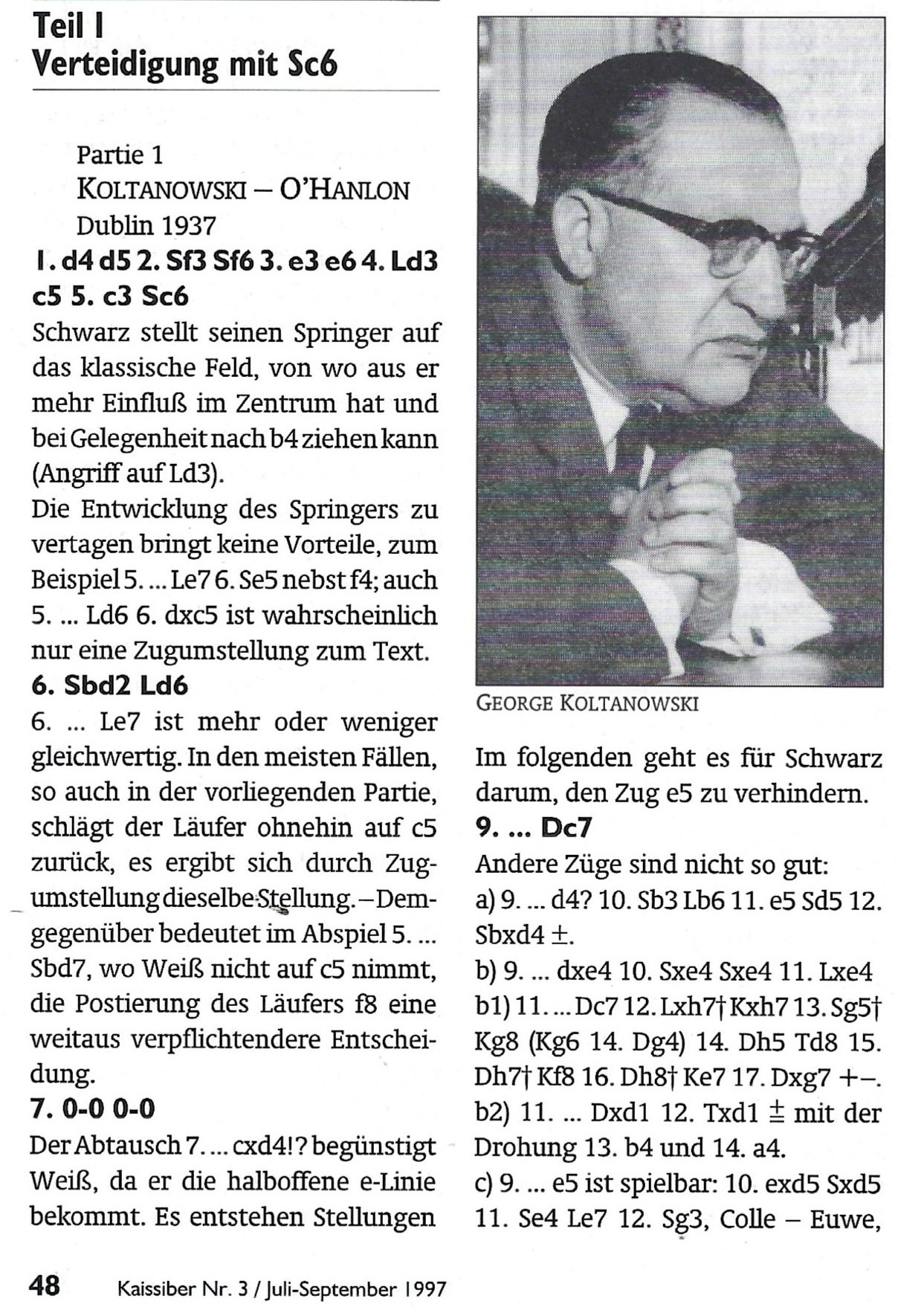
The third game, which only the Irish Independent published contemporaneously, has however appeared in various places since, probably due to its importance to the theory of the Colle System and its attractive finish.

It is game 813 in Irving Chernev’s The 1000 Best Short Games of Chess, first published in 1955. Nowadays, it can be found in online databases (e.g. from the major internet presence lichess to the boutique historical archive Belgian Chess History) and it should also be possible to find videos presenting the game on the web.

It has been extensively analysed by Dr. Stefan Ottow in his article Meister des Läuferopfers Edgard Colle und sein System for Kassibier magazine – excerpt below.

George Koltanowski – John James O’Hanlon
Match, Dublin (Round 3) 11th March 1937
[Annotations from the Irish Independent, 11th March 1937, page 16]

1.d4 d5 2.Nf3 Nf6 3.e3 c5
“This is quite playable, but foreign to O’Hanlon’s style. 3…Bf5 as recommended by many experts gives Black a freer game.”
[There are two points we should mention here:
1. We are following the game score as it appears in the Irish Independent, but Ottow’s Kassibier article – as seen in the image above – instead goes 3…e6 4.Bd3 c5 5. c3. This is also the move order given in Chernev’s book.
2. Previously in the very well-known game Colle – O’Hanlon, Nice 1930, (also extensively analysed by Ottow in his Kassibier article) after 1.d4 d5 2.Nf3 Nf6 3.e3 O’Hanlon had already played 3…c5. The game continued 4.c3 e6 5.Bd3 Bd6 6.Nbd2 Nbd7 7.0-0 0-0 8.Re1 Re8 9.e4 dxe4 10.Nxe4 Nxe4 11.Bxe4 cxd4 12.Bxh7+ Kxh7 13.Ng5+ Kg6 14.h4 Rh8 15.Rxe6+ Nf6 16.h5+ Kh6 17.Rxd6 Qa5 18.Nxf7+ Kh7 19.Ng5+ Kg8 20.Qb3+ 1-0.]
4.c3 e6 5.Bd3 Nc6 6.Nbd2 Bd6 7.0-0 0-0 8.dxc5 Bxc5 9.e4 Qc7 10.Qe2 Re8 11.e5 Nd7 12.Nb3 Bb6 13.Bf4 f6?
“Black’s game is cramped, but 13…f5 here is much better.”
14.Rae1

14…Ndxe5?
“This gives Koltanowski a chance to start a winning combination at once. 14… f5 even now would leave him with some, if poor, fighting chances.”
[Again this is the Irish Independent move order, but Ottow and Chernev both give the other Knight capturing first on e5: 14…Ncxe5 15. Nxe5 Nxe5. ]
15.Nxe5 Nxe5 16.Bxh7+
[Ottow here comments, “Der arme John J. O’Hanlon wird ein weiteres Mal mit diesem Läuferopfer konfrontieret, nach dem er 1930 spektakulär gegen Colle verloren hatte.” (Poor John J. O’Hanlon is confronted with this bishop sacrifice once again, after losing spectacularly to Colle in 1930.)]
Kf8 17.Bg6 Rd8 18.Qh5 Ke7 19.Nd4 Bd7 20.Rxe5 fxe5 21.Bxe5 1-0

“Resigns. As, if he moves his Queen anywhere, White mates in three thus:- 22, Qh4+ Kf8 23,Qh8+ Ke7 24.Qxg7 mate.”

[Click here to replay the game]

Turning now to the staple diet of Koltanowski’s tour, on the 10th March the Irish Independent provided this report on the 30 board simultaneous exhibition:

Belgian Master’s Fine Display
Loses Only One Match in Mass Challenge

Mons. Koltanowski gave a wonderful display of fast, and at the same time, accurate chess, when at Regent House, T.C.D., last night he took on 30 players simultaneously. After a little less than four hours’ play he had finished all the games – a remarkable feat in a display of this kind, leaving no work for the adjudicators!

W. Reeves (Rathmines) was the only to win against him – the master sportingly resigning when he lost a piece through an oversight.

George Koltanowski – W. Reeves
30 board Simultaneous, Dublin, 9th March 1937

1.e4 e5 2.Nf3 Nc6 3.Bc4 h6 4.0-0 Nf6 5.d3 Be7 6.Nc3 0-0 7.h3 d6 8.Be3 Be6 9.Bb3 Qc8 10.Nh2 Nd4 11.f4 Nxb3 12.axb3 exf4 13.Bxf4 Nh7 14.Be3 b6 15.Qh5 Bf6 16.Rf3 Qd8 17.Raf1 Bg5

18.Bd4?? g6 19.Rxf7 Bxf7 20.Qg4 c5 21.Bf2 Nf6 22.Qe2 Nd7 0-1

[Click here to replay the game]

Mons. Koltanowski conceded a courtesy draw to little Jackie Vard (aged 9), who played remarkably well. The following eight also drew: G. O’Nolan, M.J. O’Sullivan, and O.A. Quigley (Blackrock), H.A. Hartford and Major Griffith (Rathmines), W. Hassell (Dublin), G.H. Jacobs (Sackville) and F. Cotter (Colmcille).

The following 20 lost: J. Casey (Rathmines), T.A. Vard (Dublin), R. Clarke (Sackville), J. McNeill (Colmcille), J.J. Doyle (Dublin), C. MacFhionnlaoich (Colmcille), R.T. Varian (Blackrock), S.A, French, H. McIlwaine, J.A. Bonner, Major Cotter and J.T. Gerrard (Dublin), Mrs. M. Dwyer (Sackville), H.T. Twomey (Dublin), Isaac Baker (Jewish), G. Kerlin (Sackville), A. Mac Guill, F. Mac Guill and M.A. Rudaigh (Ard Chroabh), and B. O’Sullivan (Rathmines).

The next evening’s entertainment was the blindfold simultaneous exhibition and the 11th March report in the Independent again praised the skill of Koltanowski, though he was disappointed at the need for adjudications.

Playing Chess Blindfolded
Belgian Master’s Fine Display

Monsieur Georges Koltanowski, the famous Belgian master, gave a marvellous display of simultaneous blindfold against ten of the strongest Dublin players at Regent House, T.C.D., last night.

Mons. Koltanowski won four and drew the other six games, but he stated that he would much preferred to have actually finished all the games as he hates adjudications! The reason for his inability to actually finish was the brevity of the time allowed for the display in comparison to the strength of the opposing team.

The board numbers (though the players do not seem to have been placed in order of playing strength) and results were as follows:

1.  W. Pattison     (Rathmines) lost
2.  T. Cox          (Dublin)    drew
3.  C. Fhionnlaoich (Colmcille) drew
4.  T.A. Vard       (Dublin)    lost (adjudicated)
5.  H.T. Twomey     (Dublin)    drew (adjudicated)
6.  B. Spain        (Jewish)    lost (adjudicated)
7.  H.N. Bowesman   (Sackville) drew (adjudicated)
8.  J.T. Gerrard    (Dublin)    drew (adjudicated)
9.  R.T. Varian     (Blackrock) lost (adjudicated)
10. J.J. Doyle      (Dublin)    drew (adjudicated)

George Koltanowski – Thomas Cox
10 board Blindfold Simultaneous, Dublin, 10th March 1937

1.d4 Nf6 2.Nf3 d5 3.e3 Bf5 4.c4 c6 5.Qb3 Qb6 6.c5 Qc7 7.Ne5 e6 8.Bd3 Nbd7 9.f4 Bxd3 10.Qxd3 Ne4 11.Nxd7 Qxd7 12.Nd2 f5 13.Nf3 Be7 14.Bd2 Bf6 15.b4 0-0 16.0-0 h6 17.Rab1 g5 18.a4 a6 19.Be1 Qc7 Draw agreed

[Click here to replay the game]

Appended 23 August 2025

The Irish Times report of 11 March on the Simultaneous Exhibition went into more detail about Koltanowski’s annoyance that so many games had to be adjudicated.

At one time there seemed a doubt as to whether a game could be continued to a conclusion, Mr. Koltanowski called: “What time do you chuck us out here?”

The games were taking place in the Regent House, Trinity College, and Professor W.E. Thrift T.D., Vice-Provost, answered: “We are supposed to leave at 11 o’clock.” (It was then 10.40 p.m.)

“Very well. Carry on, ” said Koltanowski. “I am not afraid. I will make no mistake.”

WINS AND DRAWS

Shortly before 11 o’clock the Belgian master won his first game, beating W. Pattinson (Rathmines). Previously he had drawn with T. Cox (Dublin) and C. Mac Fhionnlaoich (Colmcille).

At 11 o’clock seven games were unfinished, and it was decided that Mr. Koltanowski, with Mr. J.J. O’Hanlon and Mr. J.J. Doyle, should adjudicate upon those games, the Belgian master, still “blindfolded,” explaining what moves he could have made to win. In one case, the game with Mr. J.T. Gerrard (Dublin). Mr. Koltanowski could not agree that he had not won, and the judges could not agree that he had, so this game was continued until 11.20 p.m.. when it was agreed that the game should be left as a draw.

“We should have started earlier, or had an adjournment,” said Mr. Koltanowski. “I am working for certain advantages, and now I am unable to win the games owing to there being no time..”

Mr. Koltanowski won the games with T.A. Vard (Dublin), B. Spain (Jewish) and R.T. Varian (Dublin), and drew those with H.T. Twomey (Dublin), J.J. Doyle (Dublin) and H.N. Bowesman (Sackville).

Posted in Analysis, Players | 1 Comment

Irish Championship 2025

The Irish Championship started on Saturday in Ennis, and has today reached the two thirds stage. A preliminary report has been added to the Tournament pages here.

Initially entries were slow to arrive, and it seemed the event might follow the pattern of many championships held outside Dublin in the past, with a small field. I even saw a suggestion on line that in future all championships might have to be held in Dublin. I disagree; rotating the event is vital to give everyone a chance of competing at least once in a while, and is a necessary part of having a representative national championship. In any case, the point is moot as a mammoth field of 37 signed up in the end.

After six rounds, there is a 7-way tie for first on 4½ between (in descending order of FIDE rating) top seed Conor O’Donnell, Oleg Gubanov, Kavin Venkatesan, Shane Melaugh, Jason Liu, Peter Carroll, and six times champion Colm Daly, the only former champion in the event. Of these, Oleg Gubanov is ineligible for the title of Irish champion (as I read the rules). Lukian Hushpit and Oisín O’Cuilleanáin are half a point behind this group.

It’s close enough at the top that an eventual multi-way tie is quite possible. In that case, the title will be decided under the rules introduced in 2018 (cf. Terms and Conditions, fourth heading down).

All games are available live at Livechesscloud and Lichess, and commentary by Diana Mirza and Jonathan O’Connor is available at the former’s Twitch channel.

I will update the report as I am able, but due to some time commitments over the weekend, this might not happen on a round by round basis.

Update, August 8, 2025: the report has been updated with the round 7 games and the round 8 draw. It was a round of high drama, with many interesting games, and generally more fighting chess than seemed to be the case in earlier rounds. On the top three boards, involving six of the seven joint leaders, Oleg Gubanov won convincingly against Conor O’Donnell, Kavin Venkatesan beat Peter Carroll, and Shane Melaugh beat Jason Liu. On board 4, the remaining joint leader Colm Daly, as Black, was thoroughly outplaying Lukian Hushpit, and following it on line I was expecting a resignation any move.

Hushpit - Daly, Irish Championship 2025

Hushpit – Daly, Irish Championship 2025 (7)
70… ?

Black takes the bishop and White resigns, I assumed. But no; Colm, with 55 seconds on the clock, played the incomprehensible 70… Bxc5??, drawing after 71. Bxc5 Kxc5 72. b7 Be4+, since the remaining Black pawns will be lost. Chess blindness, I suppose, and these sessions are very long, but still, that’s an ending for the ages.

So Gubanov, Venkatesan, and Shane Melaugh share the joint lead with 5½, with Daly half a point behind, and a group of seven players another half a point behind on 4½. Tomorrow, Venkatesan has White against Gubanov, and Shane Melaugh has Black against O’Donnell, and Daly has White against Andrey Ivanov.

Update, August 9, 2025: the report has been updated with the round 8 games and the round 9 draw. On the top board, Kavin Venkatesan and Oleg Gubanov drew relatively quickly, while on board two, Conor O’Donnell defeated Shane Melaugh with an overwhelming attack. On board three, Colm Daly somewhow managed to turn an almost dead drawn queen ending into a win, against Andrey Ivanov.

Daly, Gubanov, and Venkatesan lead on 6/8, and are not paired against each other in the last round. Patryk Brozynski, Peter Carroll, Shane Melaugh, and Conor O’Donnell follow half a point behind. Apart from the ineligible Gubanov, any of these players could conceivably win the title tomorrow.

Update, August 12, 2025: the report has been updated with the final round games. Wow, what an ending! Conor O’Donnell won early on, putting pressure on Kavin Venkatesan and Colm Daly, who each needed a win with Black to avoid a tie-break. Kavin was under pressure and was never better, though he didn’t seem to be in any real trouble ever. On board 3, Patryk Brozynski seemed to be better out of the opening against Colm, but matters swung sharply, and Colm seemed to be clearly winning; for example, 26… h4 seems decisive. Easy to say while watching, of course. Colm’s advantage persisted but gradually seemed to peter out, and finally he erred and even lost.

This left Kavin, Patryk, and Conor tied with the ineligible Oleg Gubanov on 6½/9, for only the second four-way tie in the history of the Irish championship, and the first three-way tie of eligible players since 1996. After a series of blitz, rapid, and more blitz games, Kavin Venkatesan emerged victorious, for his first Irish championship.

Several people have wondered if he is the youngest champion ever. I am not certain of his exact date of birth, but based on an unconfirmed date, I think he is the third youngest, after Brian Kelly, who won in 1995 aged 16 years, 228 days, and John Moles, who won in 1966, aged 16 years, 297 days.

Though the report is complete, no games are currently annotated, and details of the playoffs have not yet been added. I will continue to add to it over the next few weeks.

Update, August 17, 2025: the report has been updated to add the playoff games (see the Pairings & results page), along with several other modifications. The report also includes a pgn file of the playoff games.

Posted in Irish championships, Tournaments | 1 Comment

O’Hanlon at Cambridge 1932

Throughout his career, J.J. O’Hanlon would send a selection of his game scores to the editors of Irish chess columns, frequently with his own annotations appended.

Here we present the result of one such offering, as described by T.P. Donnegan of the Evening Herald, and spread out over two successive issues of his column therein.

Mr. O’ Hanlon has been good enough to favour us with a couple of his games (together with his own annotations) played at the Cambridge Easter Tournament. One of them is of much importance; it breaks fresh ground in the [Nimzo-Indian Defence] and is likely to become a new headline in this variation.

John James O’Hanlon – William James Fry
Cambridge Major A Cambridge (Round 2), 28th March 1932
[Annotations by O’Hanlon; notes in italics are based on analysis by Stockfish 14]

1.d4 Nf6 2.c4 e6 3.Nc3 Bb4 4.g3
This move was suggested to me by Dr. Euwe, the Dutch champion, who thought it might prove to be the best way of meeting the Niemzowitsch defence. The object is to try and hold the centre, and White plays consistently for this purpose throughout the game. I am not aware if the move had been previously tried in tournament play.
4…d5 5.Bg2 0-0
If 5…dxc4 6.Qa4+ wins a piece; and if Black captures the pawn at the 6th or 7th move, then White plays Ne5 recovering the Pawn.
6.Nf3 c6 7.0-0 Nbd7 8.Qb3 Bxc3 9.bxc3 Re8 10.Nd2 dxc4 11.Qxc4
White could have prevented 11…e5 by 11.Nxc4; if 11…e5  12.Nd6 Re6 13.Ba3 threatening to win the exchange by 14.Bh3. But instead of 11…e5 Black could have played 11…c5 and it was to prevent this move that White played 11. Qxc4.
11…e5 12.e4 Nb6 13.Qd3 exd4 14.cxd4 Nfd7 15.Qc2 Nf8 16.Bb2 Ne6 17.Nf3 Nc7 18.a4 Be6 19.Nd2 Qd7

20.Rfe1
In order to be able to play 21.Bh1 if Black offered the exchange [of bishops], but it would have been better to have first played 20.a5 driving back the Knight and prevented the development of Black’s a8-Rook. The neglect to play 20.a5 allows Black to get up an attack.
20…Rad8 21.f4 f6 22.Rac1 Na6 23.a5 Nc8 24.Red1 Nb4 25.Qb1 Ba2 26.Qa1 Qf7 27.Nf1 Bb3 28.Rd2 Nd6 29.Qa3 Na2 30.Re1 Nb5 31.Qc5 Qc7 32.Re3

32…b6
Best! If 32…Bf7 33.d5! Qxa5 (if 33…cxd5 34.Qxc7 Nxc7 35.exd5 and the passed pawn would win) 34.Ra3 wins a piece.
[However Stockfish provides a way out here with 34…Qb4 when, to avoid a worse game White must play 35.Qxb4 and then the Knight escapes after the recapture 35…Nxb4.]
33.axb6 axb6 34.Qh5 Bf7 35.Qf3 Nd6 36.e5
The ending is very interesting, and it will be found that White wins in every variation.
36…Nc4 37.Qxc6 Qxc6 38.Bxc6 Re7 39.d5 Nxd2 40.d6

40…Rxd6
White expected 40…Nxf1 41.dxe7 Rd1 when the problem-like move 42.Ra3 wins.
[However Stockfish suggests instead 40…Re6! 41.Nxd2 Rdxd6 42.exd6 Rxe3 and a probable draw with best play.]
41.exd6 Rxe3 42.Nxe3 Nb4 43.Bb5 Be6 44.Bc3 1-0
[Source: Evening Herald, 30th April 1932, page 13]

The other game … is one with the blind player, Rupert Cross, who, Mr. O’Hanlon says, possesses great chess talent. He plays entirely by touch on a special board for the blind.

John James O’Hanlon – Rupert Cross
Cambridge Major A Cambridge (Round 4), 30th March 1932

[Annotations by O’Hanlon; notes in italics are based on analysis by Stockfish 14]

1.e4 e5 2.Nf3 Nc6 3.Bb5 a6 4.Ba4 Nf6 5.0-0 Be7 6.Re1 b5 7.Bb3 d6 8.c3 0-0 9.h3
Often played at this point, but 9.d4 at once is probably better.
9…Na5 10.Bc2 c5 11.d4 Qc7 12.Nbd2 Bd7 13.Nf1 Rfc8 14.Ne3
Black threatened to win a pawn, but as deployment if the Knight at g3 is desirable it might have been better to play 14.Bd3 or 14.d5
14…Bf8 15.Bd2 g6 16.Qe2 cxd4 17.cxd4 Nc6 18.dxe5 dxe5 19.Bb3 Rab8
If now or at the next move Black plays 19…Nxe4 then 20.Nd5 wins.
20.Rac1 Qd8 21.Nd5

21…Nxd5 22.Bxd5
White, who was paying more attention to the blind player’s clock than his own, was getting short of time and completely overlooked that he could probably have won by 22.exd5 Nd4 23.Nxd4 exd4 24.Bf4 followed by 25.Be5. After this let-off Black plays accurately to a draw.
22…Bg7 23.Bg5 Qe8 24.Be3 Be6 25.Rcd1 Nb4 26.Qd2

26…Bxd5 27.Qxb4
[A mistake; the correct capture would be 27.exd5.]
27…Be6
[Missing 27…Bf8 and the attack on the White Queen would allow Black to win the e4 pawn next move.]
28.a3 Rc4 29.Qa5 Qc6
[A serious mistake; with this move, Stockfish’s assessment goes from the game being equal, to White having a decisive advantage.]
30.Rd8+ Rxd8 31.Qxd8+ Bf8 32.Bh6 Qc8

33.Qxc8
[Forcing off all the major pieces with 33.Rd1 Qxd8 (or 33…Rd4 34.Rxd4 exd4 35.Qxf8+ Qxf8 36.Bxf8 Kxf8 37.Nxd4) 34.Rxd8 Rc8 35.Rxc8 Bxc8 36.Bxf8 Kxf8 37.Nxe5 leads to a clearly winning ending, whereas in the game continuation Black’s active Rook provides compensation for the lost e5-pawn.]
33…Rxc8 34.Bxf8 Kxf8 35.Nxe5 Rc2 36.Nd3 Bc4 37.Nb4 Rxb2 38.Nxa6 Ra2 39.Re3 ½-½
[Source: Evening Herald, 7th May 1932, page 13]

Until now, both games do not appear to have found their way into the modern databases. Click the links for the playable games of O’Hanlon -v- Fry and O’Hanlon -v- Cross.

Cambridge Major Open A: Final Crosstable

                    G K C D O F M R Pts 
1=2. H. Golombek    x 1 = = 1 1 = 1 5.5 
1=2. G. Koltanowski 0 x 1 = 1 1 1 1 5.5 
3.   A.R.N. Cross   = 0 x = = 1 1 1 4.5 
4=5. L.C.G. Dewing  = = = x = 0 = 1 3.5 
4=5. J.J. O'Hanlon  0 0 = = x 1 = 1 3.5 
6.   W.J. Fry       0 0 0 1 0 x 1 = 2.5 
7=8. A.J. Mackenzie = 0 0 = = 0 x 0 1.5 
7=8. P. Reid        0 0 0 0 0 = 1 x 1.5
Posted in Analysis, Games, Players, Tournaments | Leave a comment