Armstrong Cup 1932-33

Four teams contested the Armstrong Cup in 1932-33: Sackville (holders), Dublin, Blackrock, and Colmcille. Matches were over eight boards, each team played each of the others home and away, and only overall match results counted.

Sackville and Dublin had dominated the event for decades, since Booterstown and Blackrock won in 1902-03. Colmcille were playing in the Armstrong Cup for the first time; they had won the Ennis Shield for the previous two years.

The event started with one of the most stunning shocks ever seen in the event, when Sackville lost their opening match 7-1 to Blackrock, with their sole point coming from a walkover. The match was played on November 29, 1932, at Sackville’s club rooms at 30 Harcourt Street.

Sackville Blackrock
T. P. Kane 0 – 1 J. J. O’Hanlon
C. J. Barry 0 – 1 A. A. MacDonogh
T. A. V. Haynes 0 – 1 R. T. Varian
H. N. Bowesman 0 – 1 M. J. O’Sullivan
F. Mahoney 0 – 1 M. V. O’Nolan
G. H. Jacobs 0 – 1 O. A. Quigley
G. R. Haynes 0 – 1 E. Russell
F. J. Wilcox + / – H. M. Dockrell
1 – 7

Dublin beat Colmcille 5½ – 2½.

In the second round matches, both played on December 12, 1932, Sackville beat Colmcille 6 – 2, but Blackrock and Dublin drew 4 – 4. On board 1, the reigning Irish champion T. G. Cranston, for Dublin, drew with John O’Hanlon; the two were playing a match for the Irish championship for 1932 at the time.

The Irish Times reported (December 16)

“This season will be memorable in Dublin chess for the breakdown of the supremacy of two clubs, Dublin and Sackville, which had persisted for over a quarter of a century. In their first Armstrong Cup match Blackrock gave a crushing defeat to Sackville, and now, in their second match, they have drawn with Dublin.”

Blackrock thus held the joint lead with Dublin heading into 1933. However, they suffered a major setback by losing their next match 5 – 3 to Colmcille.

Dublin recorded hard-fought wins against Sackville and Blackrock, as well as a more comfortable win against Colmcille, to reach 4½ match points out of 5. Blackrock had beaten Sackville in the return match, so none of the other teams could catch Dublin. Sackville recorded a consolation 5 – 3 win against Dublin in their return match.

The final table, with the result of the second Blackrock – Colmcille match unknown, was:

D S B C mp
Dublin . 10 ½1 11
Sackville 01 . 00 11 3
Blackrock ½0 11 . 0– *
Colmcille 00 00 1– . 1*

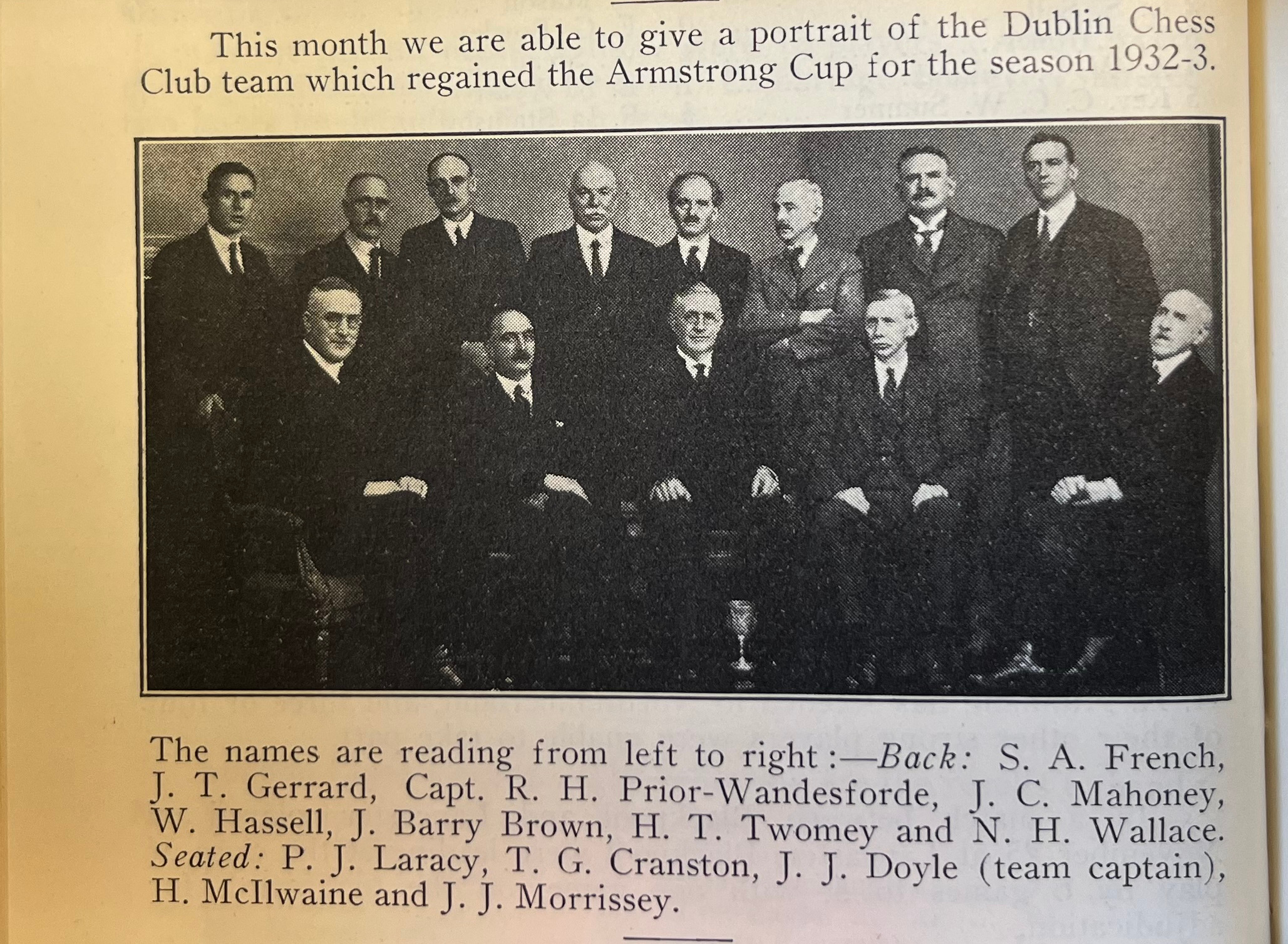
So Dublin won the Cup, for the 11th time. The team was T. G. [Thomas George] Cranston (+2 =3 −1), J. J. [James] Doyle (+4 =0 −2), Norman H.[ay] Wallace (+2 =2 −1, 1 unknown), P. J. [Patrick Joseph] Laracy (+4 =1 −1), J. T. [John Thomas] Gerrard (+4 =1 −1), William Hassell (+1 =0 −0), J. J. Morrissey (+2 =0 −0), J.[ohn] Barry Brown (+1 =1 −1); S. A. French (+1 =0 −1), J. C. Mahoney (+1 =0 −2); H.[ugh] T. Twomey (+2 =1 −0, 1 unknown); Hugh M. McIlwaine (+0 =0 −1); Capt. R. H. [Richard Henry] Prior-Wandesforde (+1 =0 −1).

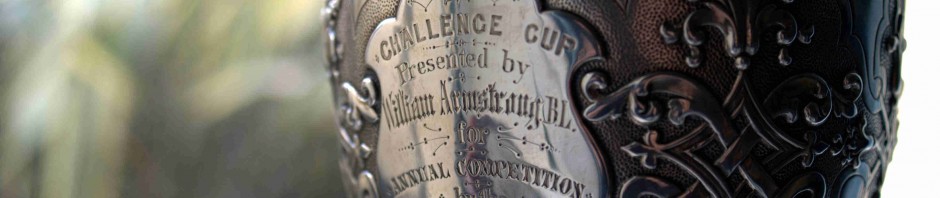
A photo of the winning team appeared in the January 1934 issue of BCM:

I had added details of the season to the Armstrong Cup page several years ago, but did not add a cover post at the time, I think because I set it aside until I could copy the photo.

Posted in Armstrong Cup, Tournaments | Leave a comment

European School Championships 2024

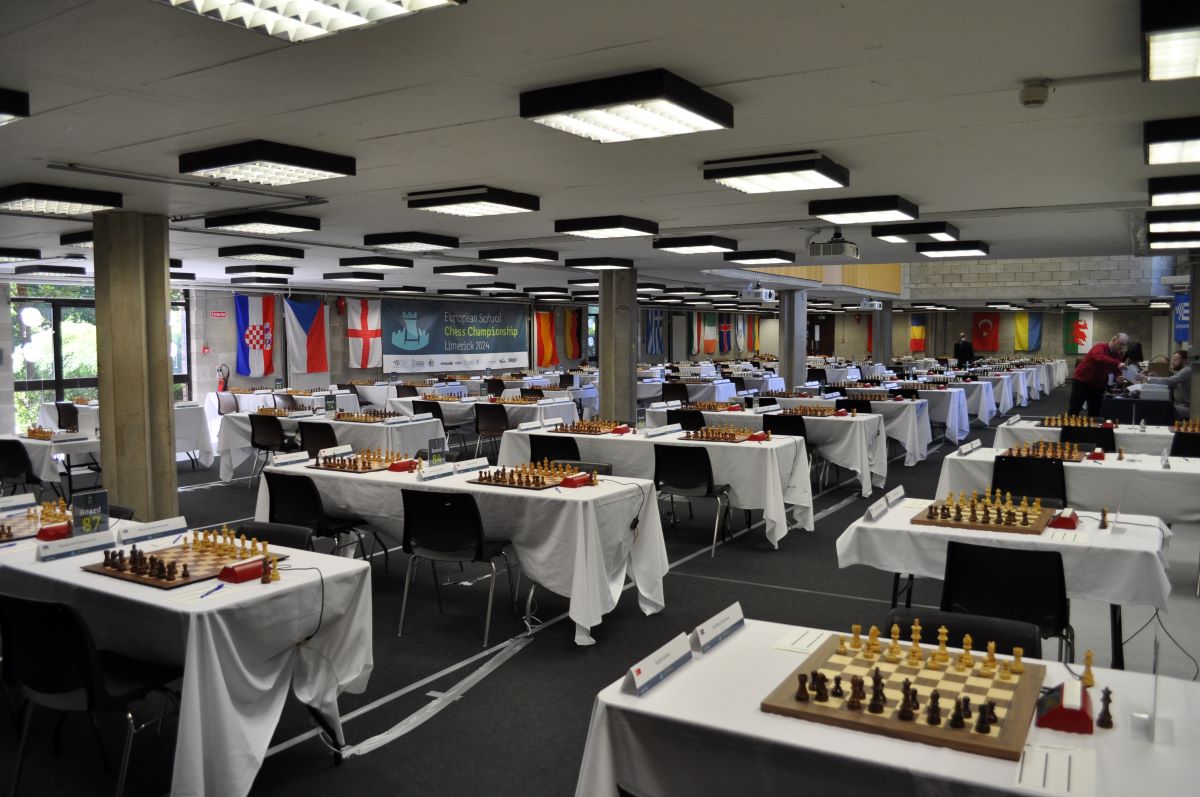
Last year Ireland hosted the European School Championships at the University of Limerick (May 31-June 7). This was a major undertaking, comprising 12 tournaments (U17, U15, U13, U11, U9, and U7 in both Open and Girls categories), with 191 players and 799 games.

Playing hall, European School championships 2024

Playing hall

Players from 17 countries participated, with visitors from Bulgaria, Croatia, Czech Republic, England, Germany, Greece, Hungary, Iceland, Israel, Lithuania, Poland, Romania, Spain, Turkey, Ukraine, and Wales.

Turkey sent a strong delegation and by far the largest contingent, and duly dominated in all events, winning all twelve championships. Even the five players who finished equal first but lost on tie-break were from Turkey.

Full reports have been added for all events in the Tournament pages here:

European School Open U17 Championship 2024; 1st Adar Tarhan (TUR)
European School Girls U17 Championship 2024 1st-2nd Ecrin Efsa Büyük (TUR) (1st on tie-break), Hatice Aslı Muştu (TUR)
European School Open U15 Championship 2024; 1st Egehan Yıldız (TUR)
European School Girls U15 Championship 2024; 1st Pelin Seyhan (TUR)
European School Open U13 Championship 2024; 1st Ali Alper Çelik (TUR)
European School Girls U13 Championship 2024; 1st-2nd Zümral Yazıcı (TUR) (1st on tie-break), Çağla Yudum Şahin (TUR)
European School Open U11 Championship 2024; 1st-2nd Uzdemir Ali Poyraz (TUR) (1st on tie-break), Ege Öz (TUR)
European School Girls U11 Championship 2024; 1st Zeynap Sönmez (TUR)
European School Open U9 Championship 2024; 1st-2nd Ata Peray (TUR) (1st on tie-break), Efe Aynaoğlu (TUR)
European School Girls U9 Championship 2024; 1st Eslem Tolan (TUR)
European School Open U7 Championship 2024; 1st-2nd Ömer Taha Dede (TUR)
European School Girls U7 Championship 2024; 1st-2nd Miray Akıncı (TUR) (1st on tie-break), Kumsal İşlek (TUR)

The organisers produced reports for the first five rounds: rounds 1, 2, 3, and 4-5. However, I made no attempt to integrate the commentary or to select interesting games for each event.

A nearly hour-long video of the awards ceremony by the Turkish delegation is available on YouTube. Also available is an interview of Chief Organiser Desmond Beatty by Jonathan O’Connor, discussing how the event came about.

The most comprehensive review I found was the post Schulschach-Europameisterschaft 2024 in Irland, Gottfried-Keller-Gymnasium web site, (in German), which includes 33 photos, including the one above of the playing hall, and concludes (via Google Translate)

“The Irish organizers and hosts also showed their best side. All delegations agreed at the end that they had never experienced such a well-organized and executed tournament of this magnitude.”

Games may be downloaded from each of the tournament reports, but a combined collection of all 797 available games can be downloaded here.

Posted in Tournaments | Leave a comment

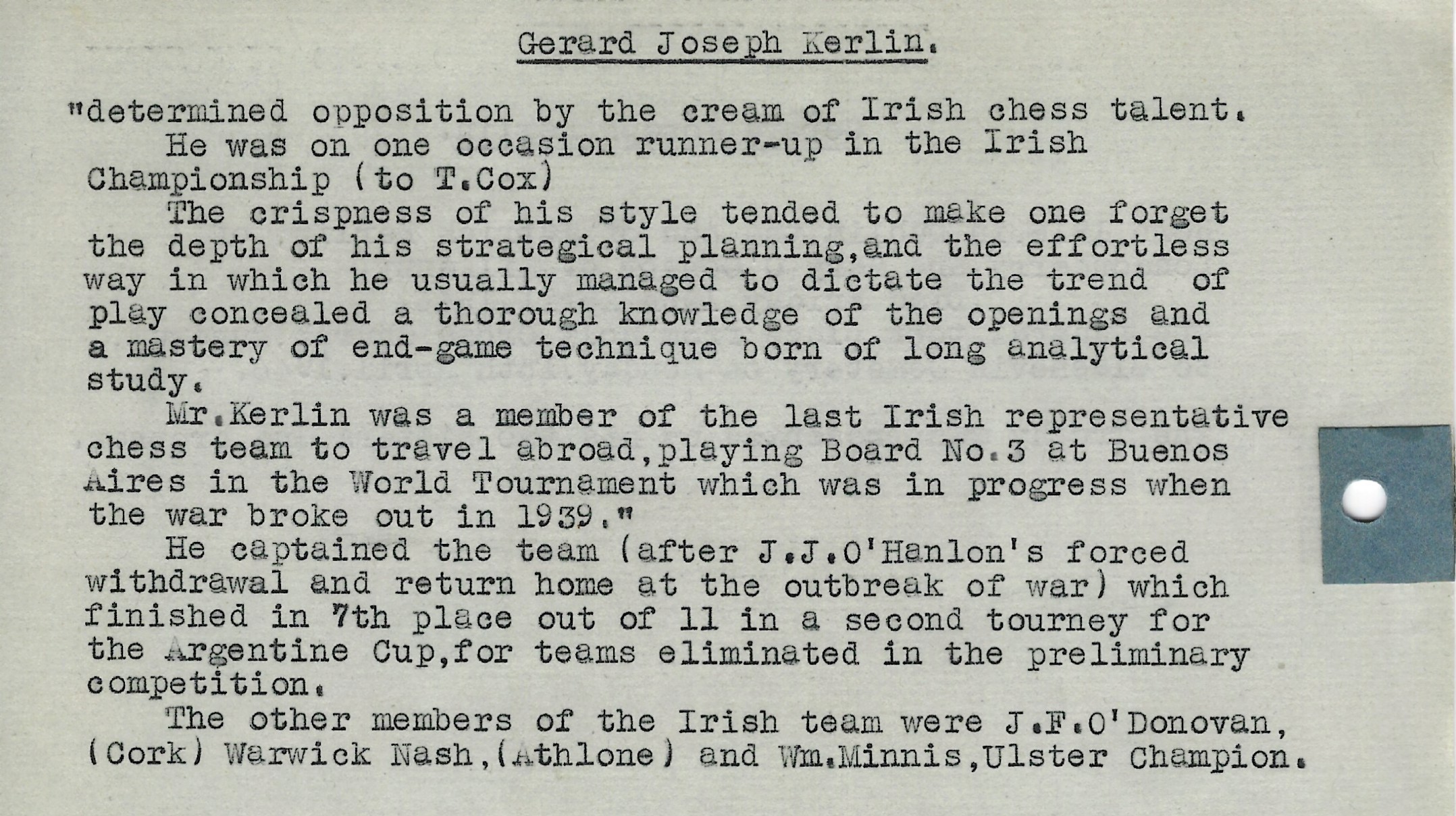
Gerard Kerlin, and the 1942 Champions’ Chess Tourney

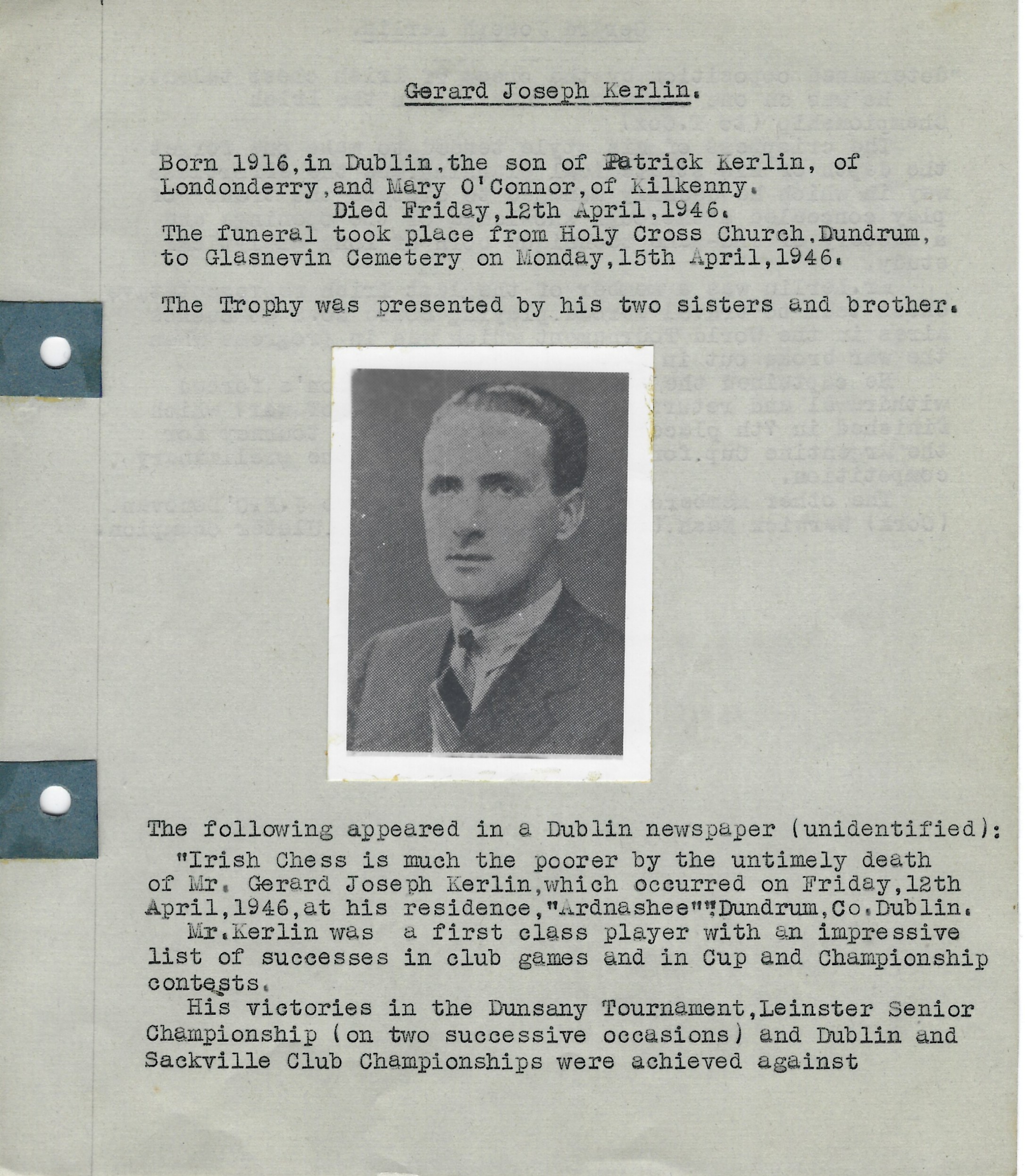
On the 25th of August 1969 Albert Long, Honorary Secretary of the Ulster Chess Union, wrote to Brenda Kerlin about her brother Gerard.

In the letter, by way of introduction, he indicated that he had been given her address by Paul Cassidy, the Honorary Secretary of the Irish Secondary Schools’ Chess Council, and the letter proceeded as follows:

An Ulster boy (D.C. Wilson of Methodist College, Belfast) is the present holder of the “Gerard Kerlin Memorial Trophy” a silver Cup which was presented in 1948 and which has since been successively competed for and won by 10 Dublin, one Cork and 11 Belfast boys.

I am keeping a record of Chess Events and include, if possible a photo of the remembered one, a description of the various Trophies, with information about the circumstances of their donation.

I am writing now to ask you if you could let me have a photograph of Gerard Kerlin, taken about 1948 or thereabouts, so that I can have it copied.

I will return it carefully to you.

I would like also some biographical details if you could supply them, such as – Parents’ names, place of birth of Gerard Kerlin, date, school, and if dead, date and place of burial.

On the 13th of October 1969, Miss Kerlin replied providing a number of biographical details and enclosing four newspaper cuttings and a photograph. Albert Long was as good as his word, because on the 2nd of December Miss Kerlin wrote again thanking him for returning the cuttings and a photographic negative and providing some further information that Mr. Long must have requested. One important point she confirmed was that her brother’s first name was Gerard and not Gerald, the latter spelling having been given in at least one of the cuttings.

Here is the entry for Gerard Kerlin in Albert Long’s Archive:
I have also not been able to identify the source of the newspaper cutting referred to in the Kerlin profile but there was also an obituary in the Irish Press, which contains some further biographical information, but it has an incorrect rendering of his first name. [Irish Press, 15 April 1946, page 11]
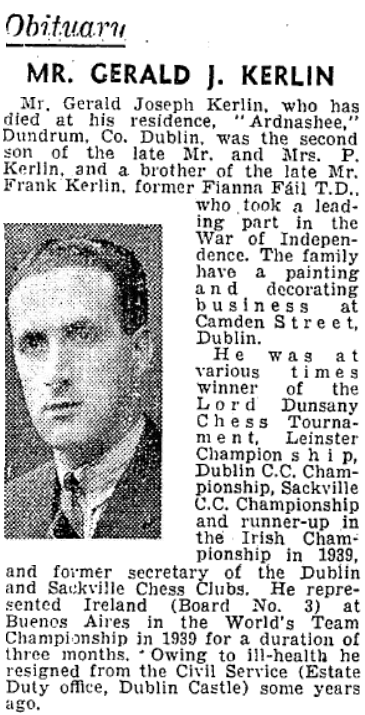
The chess column in the Evening Herald (edited by T.P. Donnegan) periodically included photo-biographies of the players who competed in the newspaper’s correspondence tournaments. Kerlin was profiled in the column for the 11 of September 1937. Perhaps this was one of the cuttings that his sister Brenda sent to Albert Long. The text follows below:

Mr Gerard J. Kerlin learnt Chess from his brother, the late Frank Kerlin, T.D. and became a member of the “Evening Herald” circle. So rapid has been his progress latterly that this year saw him well in the running for the Irish Championship. Has a decided bias towards Gambit play, in the intricacies of which he seems to revel.

A couple of years ago he joined the “Sackville,” which, although loaded with years of Chess honours, and notwithstanding its comfortable quarters in the Civil Service Club, Harcourt Street, was then in rather low water, due to losses in the course of nature of some of its leading players. G.J.K. was at once made Hon. Secretary, with the happy result that, through his energy, a rejuvenation of this celebrated old club has been effected.

The short-lived magazine Irish Chess presented extensive coverage of the 1937 Irish Championship (mentioned above by Donnegan) and here is one of Kerlin’s wins from the event with his own annotations.

G.J. Kerlin (White) – J.D. Peebles (Black)
Irish Championship, Dublin (Round 1), 24 May 1937
[Source: Irish Chess, July 1937, page 12]

1.d4 d5 2.c4 e6 3.Nc3 Nf6 4.Bg5 Nbd7 5.cxd5
Simplifying. Releases the tension in the centre and declares for wing attacks.
5…exd5 6.e3 Be7 7.Bd3 0-0 8.Qc2 c6 9.Nf3 Re8 10.0-0-0 Ne4?
This is premature and loses a pawn. Probably best is 10…Nf8 followed by b5, etc.
11.Bxe4 Bxg5? 12.Bxh7+ Kh8? 13.Bd3 Bh6 14.g4 Qf6 15.Be2 Nf8 16.Rdg1 Ne6 17.h4!
It is practically impossible to find a defence for Black.
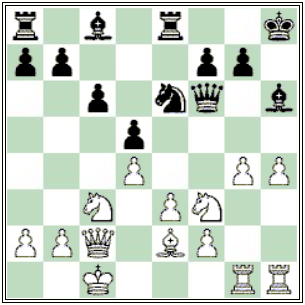
17…g5 18.hxg5 Nxg5 19.Nxg5 Qxg5 20.f4! Qf6?
But this loses a move. 20…Qg7 at once was better.
21.g5 Qg7 22.Rxh6+ Kg8 23.Rgh1 Rxe3 24.Qh7+ Kf8 25.Qh8+
With White a piece up this is probably the simplest.
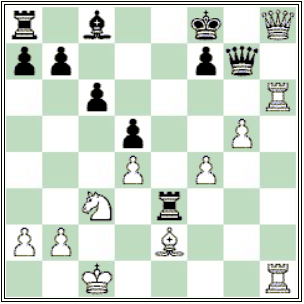

25…Qxh8 26.Rxh8+ Ke7 27.Kd2
27.Bg4 at once, winning the exchange, is stronger.
27…Rg3 28.Rg8 Rg2 29.Rhh8 Kd7 30.Rf8 c5 31.Rxf7+ Kc6
31…Ke6 would hold out a trifle longer. 32.Rc7 and if 32…cxd4  33.Rh6+ followed by mate. Therefore 32…Kd6 33.Rcxc8 and Black is two pieces down.
32.Rh6+ 1-0

[Click here to replay the game]

In the obituaries quoted above, mention is made of Kerlin’s victory in the Dunsany Tournament, which I wrote about 10 years ago (doesn’t time fly?) and there is a strong argument to be made that this was his best career tournament performance. But there is a rival candidate – a forgotten tournament, it seems, even at the time of Kerlin’s death four years later.

Champions’ Chess Tourney 1942

The name of this tournament had a number of variations. The alliterative Champion’s Chess Competition was also widely used. However both these versions were more descriptions of the event than titles, and in its “Sports Records of the Year” (on page 4 of its 30 December 1942 edition) the Irish Independent used the version O’Hanlon Premier Tourney.

On page 4 of the Irish Press for Saturday the 3rd of October 1942 was this announcement:

A CHAMPIONS’ TOURNEY

A novel tournament will commence next Monday at the Dublin [Chess] Club and will be continued Mondays and Thursdays throughout this month and next for prizes presented by Mr. O’Hanlon.

The entries are the following champions or former title holders – J.J. O’Hanlon (Irish), C. Barry (Leinster), T. Cranston and B. O’Sullivan (ex-Irish), G. Kerlin, J. Gerrard and R. Varian (ex-Leinster) and A. Bourke (Munster).

To this preview, we can that the format of the tournament would be a double-round all-play-all.

The Champion’s Tourney had a stronger cast that the 1940 Irish Championship, which was missing the 1939 Champion Barney O’Sullivan and two-time winner T.G. Cranston. It was also arguably slightly stronger than the previous year’s Dunsany Tourney (won by Kerlin) which did not have O’Sullivan in the field. The double-round format could also be said to be a better gauge of the absolute strength of the participants.

The press reported that Ralph Varian had “resigned from the tournament” prior to Round 4. His first round game against Bourke had been postponed and then he had sustained losses to Barry and O’Hanlon. Instead of his results being cancelled, players received a walkover point for the originally scheduled games against Varian. Of course, it made no practical difference.

The standings at the end of the first half of the tournament were:
Gerard Kerlin 5.0; Austin Bourke and Barney O’Sullivan 4.5; T.G. Cranston 3.5; J.J. O’Hanlon 3.0; J.T. Gerrard 2.5; C.J. Barry 2.0.

At this stage, there were three games that had been adjourned or postponed and not completed. Two of those three were Barry’s games against Cranston and O’Hanlon. I have been unable to identify the third game with a sufficient degree of certainty but am convinced that it did not involve Kerlin or Bourke.

Only one game-score appears to have survived from the tournament. It appeared in Donnegan’s chess column, but he did not name the loser, perhaps to save his blushes.

However, in a report on the Round 10 proceedings (in the Irish Press for November 13 at page 4) there is this description of a game that closely matches the game-score given by Donnegan:

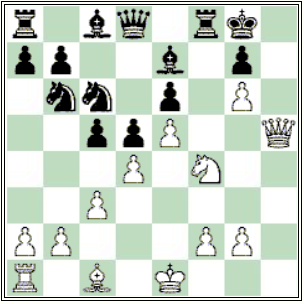
The game between Kerlin and Gerrard was a French Defence. Kerlin, on the 12th move, made a brilliant sacrifice of three pieces to mate his opponent on the 16th move.

G. Kerlin (White) – J.T. Gerrard (Black)
Champion’s Tourney, Dublin (Round 10) 12 November 1942
[Notes by Donnegan in the Evening Herald: 9 January 1943, page 2]

In the O’Hanlon Tourney at the Dublin Chess Club one of G. Kerlin’s wins was against a French defence which followed “M.C.O. col 43 until 7…Be7?
1.e4 e6 2.d4 d5 3.Nd2 Nf6 4.e5 Nfd7 5.Bd3 c5 6.c3 Nc6 7.Ne2 Be7 8.Nf3 0-0 9.h4 f6 10.Nf4 Nb6
Here White made a treble sacrifice.
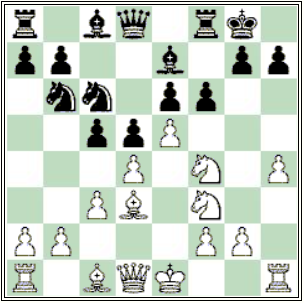

11.Bxh7+ Kxh7 12.Ng5+ fxg5 13.hxg5+ Kg8 14.Rh8+ Kxh8 15.Qh5+ Kg8 16.g6 1-0
[Click here to replay the game]

The fourteenth and last round of the tournament was held on Monday the 30th of November, and the Irish Press reported the following day (at page 4 of the newspaper) on the final outcome, with another twist on the name of the event:

Kerlin Wins Chess Champions’ Trophy

Gerry Kerlin, holder of the Dunsany Trophy – a substitute Irish Championship held last year – and the ex-Leinster champion, became the first winner of the Champions’ Chess competition by defeating B. O’Sullivan in the final round at the Dublin Club, Lincoln Place, last night.

In a Queen’s Gambit Accepted opening, Kerlin by clever play won a pawn on the 30th move. O’Sullivan failed to recover and was forced to resign on the 38th move.

Final Crosstable

                    GK AB JO BO TC CB JG RV Total

1.   G. Kerlin      xx 1= 11 01 00 11 11 ++  10.5
2.   A. Bourke      0= xx 1= 11 =1 1= 01 ++  10.0
3=4. J.J. O’Hanlon  00 0= xx =1 1= 10 11 1+   8.5
3=4. B. O’Sullivan  10 00 =0 xx 11 01 11 ++   8.5
5.   T.G. Cranston  11 =0 0= 00 xx 1= 10 ++   7.5
6.   C.J. Barry     00 0= 01 10 0= xx == 1+   6.0
7.   J.T. Gerrard   00 10 00 00 01 == xx ++   5.0
8.   R. Varian      -- -- 0- -- -- 0- -- xx   0.0
 

Posted in Players, Tournaments | Leave a comment

1940 Irish Championship, Dublin

Following on from our recent post O’Hanlon at the 1940 Irish Championship, we have now compiled, in our usual format, a full report on that Championship.

Originally a ten-player tournament was planned, but at the last moment the Ulster players A.L. Davies and J.D. Peebles had to withdraw due to travel difficulties, leaving a field of eight.

In the absence of the title-holder Barney O’Sullivan, the favourites were reckoned in the press previews to be previous eight-time winner J.J. O’Hanlon and two much younger players – the 1940 Leinster Champion Gerard Kerlin (finishing ahead of five of his rivals for the 1940 Irish title), and the former Munster title-holder Austin Bourke. However Bourke had been stationed at Foynes Airport in County Limerick since joining the newly-founded Irish Meteorological Service in late-1938 and might be handicapped by a lack of strong practice there compared to his student days at University College Cork.

Charles J. Barry was in the veteran category alongside O’Hanlon, having faced off with him in the Preliminary Match in the first Irish Chess Union-organised Championship in 1913. Barry had qualified for that event as the Leinster Champion – he won five Leinster titles between 1912 and 1934 and was to win two more, in 1942 (ahead of Bourke and Kerlin) and 1945. To him however, fell probably the most embarrassing blunder of the tournament.

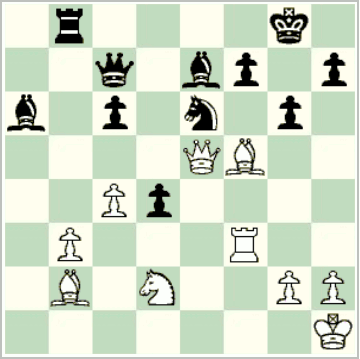
Warwick Nash (White) -v- Charles J. Barry (Black)
Irish Championship, Dublin (Round 4) 16 July 1940

Position after Black’s 22nd move

23. Qc7 Nc5? 24. Qxa5 1-0

[Click here to replay the entire game] and [here for the full report]

Posted in Uncategorized | Leave a comment

North City, Ennis Shield champions 1936-37, contd.

In response to the recent post on North City and the Ennis Shield 1936-37, Philip Doyle has written to provide more information on two of the players, much more in the case of one of them.

“W. Breen” in the photo is the distinguished blind player Willie Breen, 1917-2001, who represented Ireland in the Blind Olympiads of 1964, 1968, 1972, and 1976.

The article Braille Chess: the Irish story, written and compiled by Philip Doyle, and hosted on the B.C.A.I. tab here, gives much more detail of his life and career, incorporating much information from Willie himself. Here are some excerpts; there is much more in the full article:

“By the mid ‘thirties both Joe Barret and Willie Breen were members of the North City Chess Club which was based at 14 Mountjoy Square, in Dublin. With the outbreak of war however, this Club was forced to disband due to the departure of many of its members who went to work in Britain or Northern Ireland.

With the ending of hostilities the Club was reformed at a new address. It was renamed the Kevin Barry Chess Club and it frequently had blind players as members until its demise in 1992.”

”Willie Breen was born in Dublin on March the 10th 1917. He was one of a family of twelve, eight girls and four boys. Willie was only three years of age when he contracted Trachoma, a very serious eye complaint. Much of the next six or seven years was spent in the Eye and Ear Hospital in Dublin, in an effort to save some of his rapidly failing vision, but alas, to little or no avail.”

”In 1952 Willie had a very serious car accident in which he was extremely lucky to survive. Having made a complete recovery, he married two years later, but bringing a lull in his over-the-board Chess until 1960 when the O’Hanlon Chess Club for the Blind was founded. Willie applied himself with renewed enthusiasm, playing Board 1 for the Club, where he acquitted himself with remarkable distinction. Willie also represented Ireland in four Chess Olympiads for the Blind.”

“J. Barrett” is the partially sighted Joe Barrett, who, as noted above, also later joined Kevin Barry C.C., but about whom not much more information is available

Many thanks to Philip for the information.

Posted in BCAI, Players | Leave a comment

O’Hanlon at the 1940 Irish Championship

We have previously mentioned on a number of occasions John Saunders’ outstanding Britbase website. During some recent research, John came across an important annotated Irish Championship game and kindly sent it to me, while also pointing out that elsewhere a photograph existed of the players during the game.

Both the game and the photograph appear further below, but before and after, there will be some context with particular attention to J.J. O’Hanlon’s journey to his ninth and final Irish title.

The 1940 Irish Championship was held in July at the Dublin Chess Club, 20 Lincoln Place. The tournament had a tight schedule:
Monday 15th: Rounds 1 and 2
Tuesday 16th: Rounds 3 and 4
Wednesday 17th: Adjourned games and Round 5
Thursday 18th: Rounds 6 and 7
Friday 19th: The remaining Adjournments

Originally Rounds 8 and 9 would have been on the Friday, but the two Ulster nominees, A.L. Davies and J.D. Peebles, were unable to travel, probably due to wartime restrictions and so only 7 Rounds were needed.

The daily sessions were from 9.30am to 1.30pm and 6.30pm to 10.30pm. Rate of play was 40 moves in the first two hours and thereafter 20 moves for each subsequent hour.

In Round 1 the Leinster champion Gerard Kerlin was a piece down to O’Hanlon after about 10 moves in a Queens Gambit Declined but recovered well by the end of the session and the game appears to have been agreed drawn without resumption.

In Round 3 O’Hanlon’s opponent Charles J. Barry was 45 minutes late and did well to to bring the game safely to an adjournment and an eventual draw.

Now, our featured game:

John J. O’Hanlon (White) – Austin Bourke (Black)
Round 4, Tuesday 16th July
Source: CHESS, September 1940, Volume 5 page 268
Annotations by O’Hanlon (JJOH) and the publisher/editor of CHESS, B.H. Wood (BHW)

J.J. O’Hanlon’s best game in the Irish Championship, according to himself. (BHW)
1. d4 d5 2. c4 dxc4 3. Nf3 a6
A Swedish variation which was tried a few times by Alekhine. In my opinion, the usual method of accepting the gambit is much superior. (JJOH)
4. e3 Bg4 5. Bxc4 e6
If 5… Nf6? 6. Bxf7+ Kxf7 7. Ne5+ and wins. Or even 6 Ne5 threatening mate. (BHW)
6. Qb3 b5
Black’s original idea was to reply to 6 Qb3 by 6… Nc6. If 7. Qxb7 7… Na5 wins a piece. But White can play 7. d5 and if 7… Na5 8. Qa4+ b5 9. Bxb5+ axb5 10. Qxg4 with a fine position (JJOH)
The best for Black is 6… Bxf3 (BHW)
7. Be2 Nd7 8. a4 b4 9. O-O Ngf6 10. Rd1 Be7 11. Nbd2 O-O 12. Nc4 Qc8
Black absolutely fails to see the strategical necessity of the position, which is to play 12… c5. Unless he gets in this move at once, challenging White’s centre, he is in grave danger of succumbing to pressure along the c-file. (BHW)


13. Bd2 a5 14. Rac1 Qb7 15. Be1 Bd6
Black is embarrassed to find a good move, but this gives White the opportunity to take possession of the c-file with advantage. (JJOH)
16. Qc2 Bf5
The only good defence was} 16… Rfc8. (JJOH)
17. Nxd6 cxd6 18. Qc7 Qb6 19. Rc6 Qxc7 20. Rxc7 Rfc8 21. Rdc1 Nb6 22. Bb5 Nfd5
Black has fought back well to neutralise the open file but is left with a fatal weakness – his queen’s side pawns are immobilised by the white bishop. (BHW)
23. Rxc8+ Rxc8 24. Rxc8+ Nxc8 25. Nd2 Nc7 26. Nc4
There is no defence against this, which wins pawn and game. (BHW)
26… Nxb5 27. axb5 Be4 28. f3 d5 29. Nxa5 Bd3 30. Bxb4 Bxb5 31. Bc5
Putting the black knight to sleep. (BHW)

Irish Independent 17/07/1940 page 10

31…f6 32. Kf2 Kf7 33. Ke1 Ke8 34. Kd2 Kd7 35. Kc3 g5 36. Kb4 Ba6 37. Ka4 Nd6 38. Bxd6
Eliminating the bishops on oppositely coloured squares. (BHW)
38… Kxd6 39. b4 Bc8 40. b5
Even stronger is 40. Kb5, preventing the black king getting to b6. (BHW)
40… Kc7 41. Nb3 Kb6 42. Nc5 1-0
42…Bd7 is prevented and the passed pawn, after 43 Kb4 and 44 Na4+, will resume an irresistible advance. (BHW)


[Click to replay the game]

Returning to the progress of the Championship – on Wednesday the contemporary reports suggest that the best performance of Round 5 was Sam French’s draw with O’Hanlon.

After a number of adjourned games were played off on the Wednesday evening, the standings after 5 Rounds were:
John O’Hanlon 4.0; John Casey 3.0; Gerard Kerlin 2.5; Austin Bourke 2.5: Taylor Vard 2.0; Charles Barry 2.0; Sam French 1.5; Warwick Nash 1.5.
At this point Vard and Nash had still not completed their Round 1 game.

Between them, the sixth and seventh Rounds produced only three completed games out of the eight played. The standings at the close of play on Thursday night (and awaiting the final adjournment sessions) were:
John O’Hanlon 4.0/5; Austin Bourke 4.0/7; John Casey 3.0/7; Gerard Kerlin 3.0/6; Charles Barry 3.0/6; Taylor Vard 2.0/4; Sam French 1.5/5; Warwick Nash 1.5/4.
Although Nash was sharing last place in the standings after close of play on Thursday he could still win the tournament – he had two adjourned games in his favour (against Vard and French) which he won on resumption in the Friday morning session. Vard had also entered the Friday action still in the running for first place but his loss to Nash and a further defeat by Barry ended his hopes.

Nash’s other adjourned game was his Round 7 encounter with O’Hanlon. Thereby hangs a tale. On the sea passage to the Buenos Aires Olympiad the previous year, the vastly experienced O’Hanlon had coached the team, including playing over the Grunfeld Defence several times with Nash. In their final round game, Nash put his learnings to the test! After 1. d4 Nf6 2. c4 g6 3. Nc3 d5 O’Hanlon responded with 4.Bf4 aiming to capture the Black c-pawn [For a later example of this variation in Nash’s praxis, see Mulcahy -v- Nash, Irish Championship 1953]. Nash was able to hold the game reasonably easily but it was eventually only enough for a draw, which was sufficient for O’Hanlon to secure the Championship.

However, O’Hanlon was not quite finished yet. After securing the title he still had to finish off his Round 6 adjourned game against Taylor Vard. The encounter had been an exciting struggle with admittedly its share of inaccuracies, with Vard making an excellent recovery after a bad mistake on his 30th move – and he had good winning chances when the time came for adjournment. O’Hanlon was unable to save the game on the Friday evening, and for this victory Vard was awarded a prize put up by former Irish champion, James Creevey, for the best game by a non-prize winner.

Final Crosstable

               O  B  N  K  B  C  V  F  Total
J.J. O'HANLON  X  1  =  =  1  1  0  =   4.5
A. BOURKE      0  X  =  =  1  1  =  =   4.0
W. NASH        =  =  X  0  1  0  1  1   4.0
G. KERLIN      =  =  1  X  0  0  1  1   4.0
C.J. BARRY     0  0  0  1  X  1  1  1   4.0
J. CASEY       0  0  1  1  0  X  =  =   3.0
T.A. VARD      1  =  0  0  0  =  X  1   3.0
S.A. FRENCH    =  =  0  0  0  =  0  X   1.5  


Posted in Uncategorized | 1 Comment

Irish championship players

The lists of Irish championship players have been updated to reflect the 2024 championship, and to add some details.

The full list is available in alphabetical order and in descending order of number of championships played.

The 2024 championship set an all-time record for number of players, at 53. This was made possible by a huge crop of new players, with nineteen players making their débuts, taking the total to 599 players in all. Of these, 51 have been Irish champion.

(The number of new players, though huge, did not set a record: 20 players played for the first time in the 1966 championship in Belfast.)

First names have been added for several more players:

F. Ballance (1968): Frank Ballance, a student at Belvedere College, who also played in the 1968 Glorney Cup. (Belvedere College Annual 1968, p. 94.)

L. S. Breen (1953, 1954, 1957) is named as Liam Breen in Ficheall, no. 5, May 1956, p. 1. I later found a photo of him in play, against Joe Keenan, on the ICU web site. This was one of the spectacular set of photos collected by Joe Keenan in the 1950’s and unearthed in 2012. At the latter link, J. J. Walsh suggested that the photo might be from the Irish championship 1953.

M. Casey (1956, 1966): Michael Casey, of Kevin Barry C.C. (Irish Independent, November 15, 1965, p. 16.)

V. D. Farris (1952): Victor Desmond Farris. “Qualifying for admission to the degree of Doctor of Philosophy (Faculty of Science) at Queen’s University, is Mr. Victor Desmond Farris, 124 Woodvale Road, Belfast”, Belfast Telegraph, October 1, 1954, p. 8. Cf. The Universities Chess Annual (British Universities Chess Association), third issue, 1952-53, p. 20: secretary for Belfast, V. D. Farris, 124 Woodvale Road, Belfast.

R. McCaughey (1966): Robert McCaughey (Ireland’s Saturday Night, December 18, 1971 p. 10).

A. C. Leyn (1954): Antoine Camille (Tony) Leyn (1930-2014). Born in Co. Carlow, he attended Blackrock College and U.C.C., later moving for post-graduate studies to Liverpool, and later to the U. S., where he taught physics in Duquesne University in Pittsburgh. All this is from a very informative obituary first published in the Pittsburgh Tribune Review on March 27, 2014. Only the chess connection was omitted, but this is amply confirmed by newspaper reports. He played on at least one Copeman Cup-winning team with U.C.C.

[Update, same day: the lists have been revised to correct glitches for Des de Loughry, and also to add one new first name:

D. D. Bryant (1970): David Bryant (Belfast Telegraph, July 15, 1970 p. 2 (photo, head in hands, in play at Irish Championship 1970)).]

Posted in Irish championships, Players | Leave a comment

North City, Ennis Shield champions 1936-37

North City, Ennis Shield 1936-37

North City
Ennis Shield champions 1936-37

North City C.C., in only their second season, won the Ennis Shield, then the second division of the Leinster Leagues, in what seems to have been a surprise. The outstanding photo above shows the club celebrations. (See full size version.)

The team in rough board order was Cecil Murray, W. Breen, D. O’Rourke, B. O’Rourke, M. Maher, D. Malone, W. Sherringham, J. Barrett, and B. McMahon.

(Note that the handwritten caption is incorrect in giving the season as 1935-36.)

The photo belongs to Alan Murray, son of Cecil Murray, by far the youngest on the team, who played board 1 and is holding the shield. Alan sent it to John Delaney, who forwarded it to me. I am embarrassed to say that John’s email to me was on April 29, 2015, and it was not until my computer produced it on the anniversary in a “Your memories on this day” that I recalled it. Many thanks to Alan and John.

Cecil St. Eloi Murray (1917-2000) was later a founding member of Kevin Barry C.C., where he played on a later Ennis Shield-winning team in 1953-54. He was CIE champion in 1976, and competed in Irish correspondence championships, winning several sections. He played in one Irish championship, the 1938 event in Belfast, a 10-player all-play-all where he finished with 4/9.

He was the brother of Victor Murray, long-time member and former President of Elm Mount C.C., who died last August, aged 100.

Posted in Photos | Leave a comment

Another king hunt

The last round of the Leinster leagues took place on Sunday. Congratulations to Knights of Éanna / Rathmines for an emphatic win in the Armstrong Cup, their first as a merged club. The Armstrong Cup page here has been updated.

Malahide had an excellent year and finished second; I’m not immediately sure if they have ever finished so high. Going into the last day, they had quite a reasonable chance of getting into a playoff with Knights of Éanna / Rathmines, because the margin between the teams was affected by many walkovers. My calculations indicated that if Malahide needed to score 1½ points more on the last day to force a playoff.

In the event, Knights of Éanna / Rathmines had a comfortable 5½ – 2½ win against the relegated St. Benildus B, while Malahide were beaten by defending champions Dublin by the same margin.

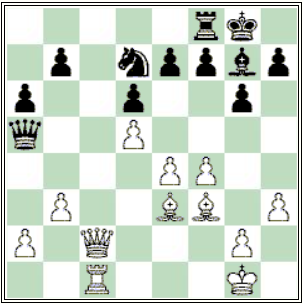
Board 3 in the Dublin – Malahide match featured a spectacular queen sacrifice and king hunt, one of the best I have seen in quite some time, which Jonathan O’Connor posted on X on Tuesday.

Corte Real Neto - Brozynski, Armstrong Cup 2024-25

Corte Real Neto – Brozynski, Armstrong Cup 2024-25
Dublin – Malahide (3)
White to play

In the diagrammed position, Cyro Corte Real Neto, for Dublin, played the thunderbolt Qxe6!!??. Patryk Brozynski did not see a mate and captured the queen quickly. I’ll leave this as an exercise: how should play continue?

[Click to replay the game.]

Jonathan also posted his own game from the same match, on board 1 versus Shane Melaugh, on X, and he analysed it thoroughly with Mark Quinn on Mark’s Twitch channel earlier this week: see video. The game was entertaining, and the video was very instructive and worthwhile.

[Click to replay O’Connor – Melaugh.]

Posted in Games | Leave a comment

Gerard McDonnell 1960-2023

I was very sorry to learn of the passing of Gerard McDonnell, in Manhattan, New York, on June 3, 2023, after a long illness.

Gerard McDonnell

He was born in Castlebar, Co. Mayo, on October 30, 1960, the eldest of a family of ten. He was Connacht champion three times, in 1978, 1982, and 1983. He played on the Irish Glorney Cup team in 1979, in Carmarthen, Wales (where I was a team-mate).

He emigrated to the US in 1986, and competed with success in several strong tournaments in New Jersey and New York. He earned the title of US National Master.

He returned to Ireland to play in the 1991 Irish Championship in Limerick, where his younger brothers Joe and Niall also played. He finished equal second, a point behind Stephen Brady. In retrospect, he could have gone further in this event: he blundered from a much better position against Philip Short in the first round and from an equal ending against Brady in round 6.

He reached his peak FIDE rating of 2295 in the January 1992 list (history).

As recounted here previously, I had long been aware that Gerard McDonnell was a strong player in New Jersey, but was unsure whether it was the same person. I had finally established that he was, two years ago, it turns out just around the time of his passing. I was on holiday in Manhattan last week, and this jogged my memory to look him up. Unfortunately, I found obituaries.

The photo above is adapted from the article Death of Castlebar man in New York is widely mourned from the Connaught Telegraph, June 10, 2023, and several more obituaries with more detail are given on the Players: References page here.

Gerard McDONNELL, b. Castlebar, Co. Mayo, 30 October 1960, d. Manhattan, New York USA, 3 June 2023.

Posted in Connacht champions, Photos, Players | 1 Comment